
SaaS vs. Hosted vs. Self-Hosted Affiliate Software: What to Choose?
Tracknow experts explain the differences between the three types of affiliate software and which type suits the needs of specific projects and tasks.

Choosing affiliate software is not only a feature comparison. It is also a decision about who will operate the infrastructure, protect conversion and payout data, deploy updates, investigate tracking failures, restore backups, and keep the platform available during high-volume campaigns.
The market is usually described through three labels: SaaS, hosted, and self-hosted. Those labels sound straightforward, but vendors do not always use them consistently. “Hosted” may mean ordinary vendor-managed SaaS, a dedicated single-tenant environment, a private-cloud deployment, or software installed in the customer’s cloud but maintained by the vendor. Two products described with the same word may create very different responsibilities.
This guide explains the practical differences, shows how to calculate total cost of ownership, identifies the security and operational questions that matter, and reviews current product examples. The goal is not to declare one architecture universally superior. It is to help you choose a model your business can operate reliably.
Short answer: managed SaaS is the sensible default for most businesses because the provider operates the application and infrastructure. Dedicated hosted environments are worth considering when isolation, custom integrations, data location, or performance guarantees justify the additional cost. Self-hosted software is appropriate only when control is a real requirement and the company has the engineering, security, database, monitoring, and incident-response resources to own it
What SaaS, Hosted, and Self-Hosted Actually Mean
SaaS Affiliate Software
With Software as a Service, the vendor runs the affiliate application and the underlying production environment. Customers access the platform through a browser or API and normally pay a recurring subscription, usage-based fee, or negotiated contract.
The provider is typically responsible for application updates, database maintenance, infrastructure monitoring, backups, availability, vulnerability remediation, and core platform security. The customer is still responsible for account permissions, integration credentials, commission rules, affiliate approval, privacy configuration, conversion validation, and payout decisions.
Many SaaS products are multi-tenant: customers use the same application platform while their accounts and data are logically separated. Multi-tenancy can provide efficient updates and scaling; it does not automatically mean weak security. The meaningful questions are how tenant isolation is implemented, which controls are audited, how data is encrypted, what the backup and recovery commitments are, and which subprocessors can access data.
Best fit: businesses that want to launch quickly, avoid infrastructure ownership, receive continuous updates, and scale without building an internal affiliate-software operations team.
Dedicated Hosted Affiliate Software
Dedicated hosted software is usually vendor-managed but gives one customer a more isolated environment, database, infrastructure allocation, or deployment configuration. It may run in the vendor’s cloud account, a dedicated private environment, or—in some contracts—the customer’s cloud account while the vendor manages the application.
This model can provide stronger workload isolation, custom networking, dedicated resources, more control over release timing, specific data-residency arrangements, and deeper database or CRM integration. It also tends to involve higher setup costs, a longer implementation, custom commercial terms, and more complex responsibility boundaries.
Best fit: high-volume affiliate programs, regulated industries, multi-brand operations, enterprises with private networking requirements, or companies that need a tailored integration and can justify the additional cost.
Important: “hosted” is not a technical guarantee. Ask whether the application, database, queue, file storage, and encryption keys are shared or dedicated; who controls the cloud account; who applies updates; and what happens when the contract ends.
Self-Hosted Affiliate Software
Self-hosted affiliate software is installed in infrastructure controlled by the customer. That may be an on-premises server, a virtual private server, Kubernetes, or a cloud account owned by the business. The customer normally controls the application files, database, network, backups, logs, and deployment schedule.
This model offers the greatest infrastructure control, but it also transfers operational risk. The business must install and upgrade the application, maintain the database, monitor queues and scheduled jobs, patch the operating system and dependencies, secure public endpoints, manage encryption and secrets, test backups, plan disaster recovery, investigate slow tracking, and maintain capacity during traffic spikes.
Owning the server does not necessarily mean owning the source code or having unlimited modification rights. A self-hosted commercial product can still require a license key, restrict redistribution, limit updates, or depend on the vendor for security fixes. Review the license and support terms separately from the hosting model.
Best fit: organizations with a genuine control, data, networking, or customization requirement and an experienced team that already operates production applications around the clock.
SaaS vs Hosted vs Self-Hosted: Side-by-Side Comparison
| Decision area | Managed SaaS | Dedicated hosted | Self-hosted |
|---|---|---|---|
| Application operation | Vendor | Usually vendor; contract-dependent | Customer |
| Infrastructure | Vendor-managed shared or logically isolated platform | Dedicated or more isolated resources | Customer-controlled cloud or servers |
| Updates and security patches | Vendor deploys continuously or on a managed schedule | Vendor, sometimes with customer-approved maintenance windows | Customer plans, tests, and deploys |
| Initial deployment | Usually fastest | Moderate to long | Moderate to long, depending on infrastructure |
| Customization | Configuration, APIs, webhooks, and supported extensions | Configuration plus contract-specific integrations or infrastructure | Potentially extensive, but limited by license and available source/API access |
| Scaling | Provider-managed within plan and usage limits | Planned jointly with reserved or dedicated capacity | Customer must design, test, and fund scaling |
| Backups and disaster recovery | Vendor operates; customer verifies commitments | Defined in contract and architecture | Customer owns backup, off-site storage, and restore testing |
| Data access | Dashboard, export, API, or contracted access | Often deeper access, depending on contract | Direct database and infrastructure access |
| Internal technical workload | Low to moderate | Moderate | High and continuous |
| Cost pattern | Recurring subscription or usage fees | Higher recurring and implementation costs | License plus infrastructure, labor, security, upgrades, and incident costs |
| Best for | Most small, midsize, and enterprise programs | Regulated, high-volume, or heavily customized operations | Technically mature organizations with a documented control requirement |
The Responsibility Matrix Buyers Often Miss
Affiliate tracking is a financial system. It determines which partner receives credit and how much money is owed. Before selecting a deployment model, assign ownership for every critical task.
| Task | Managed SaaS | Self-hosted | What the customer must verify |
|---|---|---|---|
| Tracking availability | Vendor monitors core service | Customer monitors every component | Health checks, alerting, escalation, and incident communication |
| Conversion accuracy | Shared: vendor provides tools; customer validates integration | Customer | Deduplication, currency, refunds, status updates, and reconciliation |
| Infrastructure security | Vendor | Customer | Patch cadence, network controls, encryption, vulnerability handling |
| User and API permissions | Customer configures within vendor controls | Customer | 2FA, least privilege, key rotation, audit logs, offboarding |
| Backups | Vendor, subject to contractual scope | Customer | Frequency, retention, location, encryption, and restoration testing |
| Commission rules | Customer | Customer | Eligible value, attribution priority, validation period, reversals |
| Affiliate payouts | Customer approves; platform may automate execution | Customer | Approval controls, tax data, thresholds, payment failures, audit trail |
How to Choose the Right Deployment Model
Choose Managed SaaS When
- You want to launch in days or weeks rather than build an infrastructure project.
- Your technical team should focus on the revenue integration, not application maintenance.
- You need vendor-managed upgrades, monitoring, backups, and capacity.
- Your requirements can be met through configuration, APIs, webhooks, postbacks, plugins, or supported custom development.
- You prefer predictable recurring costs and a clear support escalation path.
Choose Dedicated Hosted When
- You need stronger workload or database isolation.
- A regulator, enterprise policy, or customer contract requires a specific hosting region or network design.
- Your traffic volume requires reserved capacity or special performance commitments.
- You need a deep CRM, billing, trading, gaming, or data-warehouse integration that will be operated by the vendor.
- You want vendor operations but need more infrastructure control than standard SaaS provides.
Choose Self-Hosted When
- A documented legal, security, data, or networking requirement prevents managed deployment.
- You have engineers who already operate databases, queues, cron jobs, web applications, monitoring, backups, and disaster recovery.
- You can provide after-hours incident response when tracking or payout data is affected.
- You accept responsibility for upgrades, capacity, dependencies, security fixes, and integration compatibility.
- The additional control is worth more than the ongoing engineering and risk cost.
Do Not Choose Self-Hosted Only to Avoid a Subscription
A license fee is only one part of cost. A self-hosted platform can become more expensive after adding cloud resources, database administration, monitoring, logging, backups, security tools, development, upgrade testing, on-call coverage, and lost revenue from incidents. “No monthly software fee” does not mean “no recurring cost.”
How to Calculate the Real Cost
Compare deployment models over at least three years. Use the same traffic assumptions, integration scope, availability target, data-retention period, and internal labor rate.
Three-year TCO = license and usage fees + implementation + infrastructure + integrations + maintenance + security and compliance + monitoring + backups and disaster recovery + internal labor + expected incident cost + migration and exit cost
The expected incident component can be estimated as:
Expected annual incident cost = probability of a material incident × estimated financial impact
The impact should include lost orders, untracked conversions, affiliate disputes, manual reconstruction, engineering time, duplicate payouts, delayed campaigns, and reputational damage. It should not be limited to server repair.
For an operating comparison, calculate:
Platform cost per approved conversion = total platform and operating cost ÷ approved conversions
A higher-priced managed platform may be economically better if it reduces manual reconciliation, affiliate support, fraud loss, infrastructure work, or missed conversions. A cheaper product can be costly if critical reports require spreadsheets and developer intervention every month.
Security, Privacy, and Business Continuity Checklist
Ask every vendor—or your own infrastructure team—the same questions:
- Where are production data, backups, logs, and encryption keys stored?
- Is the application multi-tenant, single-tenant, dedicated, or customer-cloud hosted?
- Which components are shared, and how is customer data isolated?
- Is data encrypted in transit and at rest?
- Are 2FA, role-based permissions, audit logs, IP restrictions, and API-key rotation supported?
- How quickly are critical vulnerabilities patched?
- Who monitors tracking endpoints, queues, postbacks, databases, and scheduled jobs?
- What are the service commitments and exclusions?
- What are the recovery time objective (RTO) and recovery point objective (RPO)?
- How often are backups restored in a test environment?
- How are failed webhooks and postbacks retried?
- Can affiliates, conversions, commissions, payments, and audit data be exported?
- What happens to the data after termination, and how long is retrieval available?
RTO is the target time to restore service after an outage. RPO is the maximum acceptable period of data loss. “We take backups” is incomplete without retention, restore testing, RTO, and RPO.
Best Managed SaaS Affiliate Software
The following ranking focuses on managed deployment, operational support, tracking capability, business fit, and scalability. It does not assume that every platform serves the same market.
| Rank and platform | Deployment | Best suited to | Main consideration |
|---|---|---|---|
| 1. Tracknow | Managed SaaS; tailored dedicated infrastructure available for advanced requirements | Ecommerce, SaaS, affiliate networks, finance, prop trading, iGaming, and influencer programs | Map the plan and integration scope to the number of offers, brands, managers, and tracking volume |
| 2. Impact | Managed enterprise partnership platform | Large brands managing several partner types and complex workflows | Implementation and commercial complexity may exceed the needs of smaller programs |
| 3. Everflow | Managed cloud platform | Performance marketing, partner programs, and network-style operations | Evaluate pricing, usage limits, reporting workflow, and required implementation support |
| 4. PartnerStack | Managed SaaS and partner ecosystem | B2B SaaS affiliate, referral, and reseller programs | Marketplace and ecosystem value should be evaluated separately from tracking requirements |
| 5. Refersion | Managed SaaS | Ecommerce affiliate and ambassador programs | Confirm plan limits, integration coverage, reporting depth, and total volume cost |
| 6. Tapfiliate | Managed SaaS | Small and midsize ecommerce or SaaS programs needing a modern interface | Some business models and integrations require technical implementation |
1. Tracknow — Best Overall Managed Affiliate Software
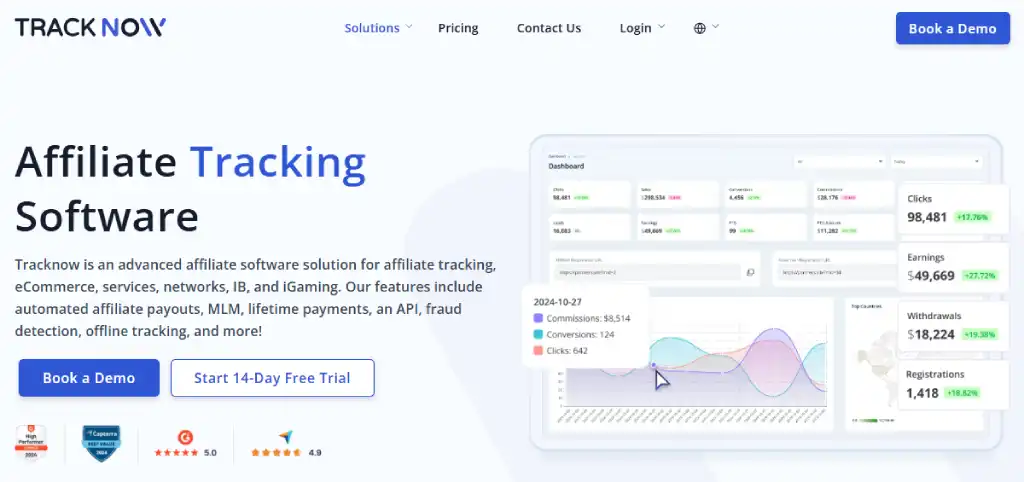
Tracknow ranks first because it combines managed cloud operation with the tracking, commission, integration, reporting, security, and affiliate-management capabilities needed across several business models. It supports ecommerce programs, B2B and SaaS partnerships, affiliate networks, finance and broker operations, prop trading, iGaming, and influencer programs.
The managed approach means customers do not need to install the core application, operate its production database, deploy platform upgrades, or maintain tracking infrastructure. At the same time, integrations can use plugins, pixels, postbacks, APIs, webhooks, promo codes, product data, and tailored development. Advanced plans can support dedicated infrastructure and deeper CRM or database integration when a standard SaaS setup is not sufficient.
Why it stands out:
- Real-time tracking and detailed click, conversion, affiliate, campaign, and payout reporting.
- Multiple commission models, tiers, categories, recurring or lifetime attribution, and sub-affiliate structures.
- Promo-code, deep-link, short-link, QR, smart-link, S2S, API, and webhook options.
- Fraud controls, roles and permissions, 2FA, audit logs, and GDPR-related privacy controls.
- Affiliate portal, communications, creatives, payment workflows, and mass-payment options.
- Setup and migration support, reducing the risk that a technically “connected” integration produces incorrect commission data.
Best for: businesses that want one managed platform capable of starting with a conventional affiliate program and expanding into more advanced campaigns, partner hierarchies, network operations, or industry-specific integrations.
Consider before choosing: define the number of offers, brands, team members, tracking requests, currencies, commission models, payment methods, and required integrations before selecting a plan. The 14-day trial should be used to test real conversion, refund, deduplication, and reconciliation scenarios rather than only the interface.
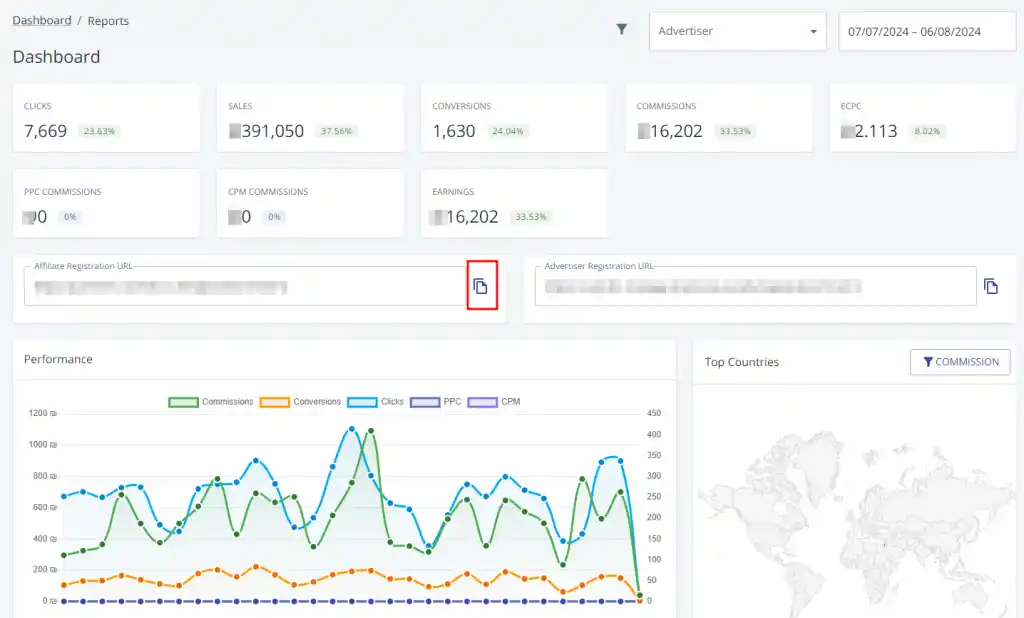
2. Impact

Impact is commonly considered by larger brands that want to manage affiliates, creators, strategic partners, and other relationship types within an enterprise partnership environment. Its appeal is broader partner lifecycle management, automation, discovery, contracting, tracking, and reporting.
Best for: established organizations with multiple partner types, formal procurement, internal program teams, and a budget for enterprise implementation.
Trade-offs: a broad enterprise platform can introduce more configuration, onboarding, and commercial complexity than a focused affiliate program needs. Buyers should separate must-have affiliate functions from broader partnership functionality and evaluate the total operating model.
3. Everflow
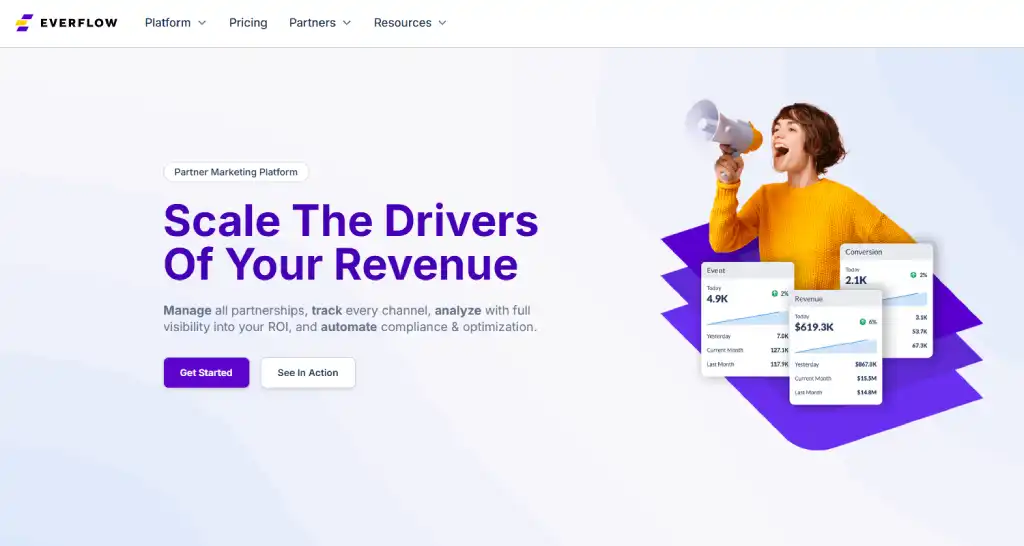
Everflow is a managed cloud platform used for partner marketing, performance tracking, and network-style workflows. The important correction to the previous draft is that it should not be presented as a conventional self-hosted package merely because it supports advanced integrations, custom domains, or enterprise controls.
Best for: performance teams, affiliate networks, agencies, and brands that require detailed event tracking and operational workflows.
Trade-offs: assess total usage cost, implementation responsibility, reporting workflow, support scope, and data-export needs. Advanced capability is useful only when the team can configure and operate it efficiently.
4. PartnerStack

PartnerStack is oriented toward B2B SaaS partner ecosystems and can support affiliate, referral, and reseller relationships. Its marketplace and partner-network positioning may help companies that need partner recruitment in addition to software for program operations.
Best for: B2B SaaS companies building several partner motions around subscription revenue.
Trade-offs: determine whether marketplace access, reseller workflows, and ecosystem functions create measurable value for the business. A company needing straightforward affiliate tracking may not benefit from every layer of a broader partner platform.
5. Refersion
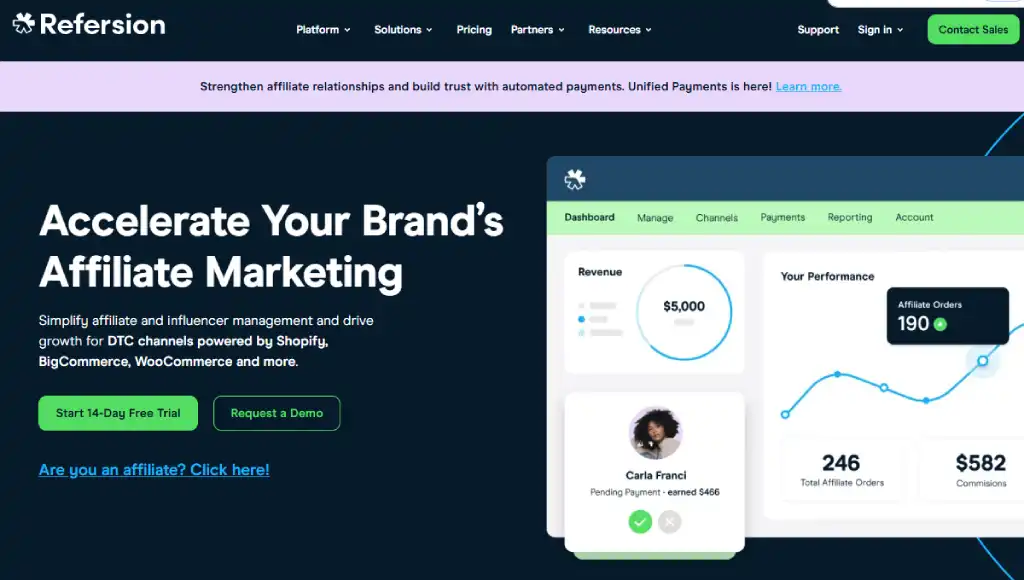
Refersion is a managed affiliate and ambassador platform with a strong ecommerce orientation. It can be relevant to brands that want partner onboarding, referral links, conversion tracking, offers, and commission management tied to an online store.
Best for: ecommerce companies whose requirements fit supported store and payment integrations.
Trade-offs: test the exact refund, coupon, recurring-order, multi-currency, product-level, and payout workflows. Plan limits and transaction volume can materially affect total cost, so compare the expected operating year rather than the starting price.
6. Tapfiliate

Tapfiliate is a managed affiliate platform aimed at brands that want an approachable interface, configurable commission structures, affiliate assets, reporting, and API-based integration options. It can suit conventional ecommerce and SaaS programs when the supported integration path matches the customer journey.
Best for: small and midsize programs that want managed software and can complete any required technical integration.
Trade-offs: verify fraud controls, data depth, renewal handling, payment workflow, and the limitations of the specific integration. A short setup is not the same as complete lifecycle tracking.
Other Managed Platforms You May Encounter
The affiliate-software market also includes general-purpose and industry-specific platforms. These products should not be compared by hosting label alone; evaluate business fit, tracking architecture, integration ownership, commission logic, support, limits, and migration terms.
| Platform | Common evaluation context | What to verify |
|---|---|---|
| Trackdesk | Affiliate program management for ecommerce and SaaS | Plan limits, integrations, payments, and reporting depth |
| Affilka | iGaming-oriented affiliate operations | NGR logic, CPA qualification, carryover, brands, and player reporting |
| Track360 | Specialized performance and affiliate operations | Integration ownership, reporting model, support, and customization |
| Affise | Performance marketing and affiliate networks | Usage pricing, event limits, fraud tools, and advertiser workflows |
| Cellxpert | Finance, trading, and iGaming partner programs | CRM integration, commission models, reconciliation, and implementation scope |
| TUNE | Partner marketing and network operations | Pricing structure, customization, integrations, and team workload |
| Trackbox | Broker, finance, and specialized affiliate operations | CRM data flow, attribution, hierarchical commissions, and support |
| Rewardful | SaaS affiliate and referral programs | Billing integration, recurring commissions, partner workflow, and scaling limits |
| Scaleo | Advertisers and affiliate networks | Usage allowances, fraud prevention, reporting, and network tools |
| CAKE | Performance marketing and lead-generation operations | Implementation, tracking volume, reporting, integrations, and total cost |
Best Self-Hosted and Flexible-Deployment Affiliate Software
There are fewer actively maintained general-purpose self-hosted affiliate products than managed SaaS platforms. The shortlist below distinguishes a genuinely downloadable application from a WordPress plugin and from a product that can support both hosted and customer-operated installations.
1. iDevAffiliate — Best General-Purpose Self-Hosted Option
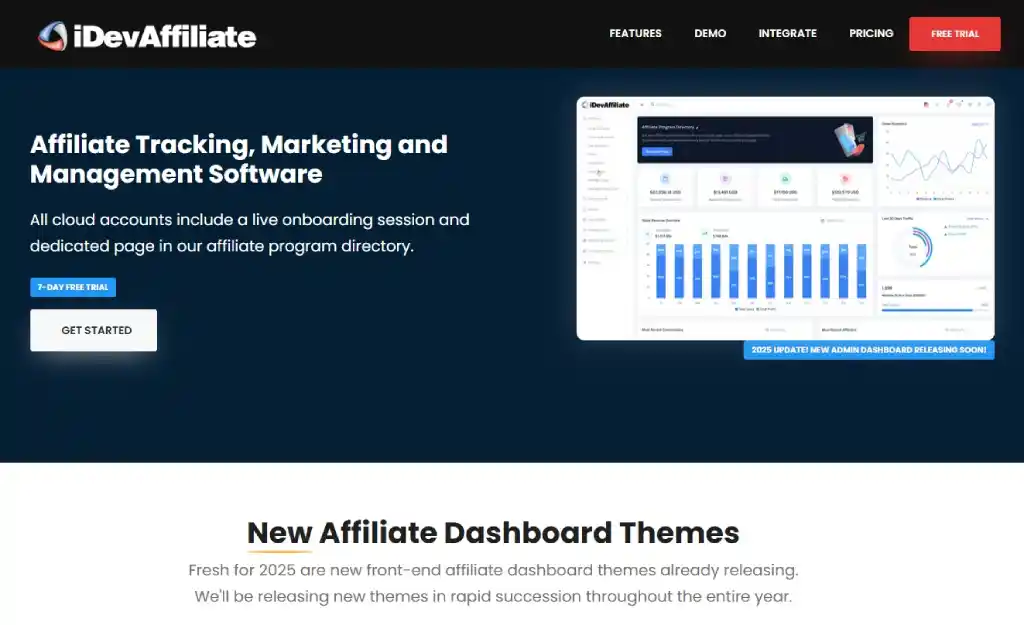
iDevAffiliate remains a genuine downloadable affiliate application. Its self-hosted edition uses PHP with MySQL or MariaDB and is installed in the customer’s hosting account. The customer hosts the files and database and is responsible for installation and upgrades, although paid installation and upgrade services may be available.
Best for: businesses that specifically require a general-purpose self-hosted affiliate application and already operate compatible web infrastructure.
Strengths:
- Customer-controlled application files and database.
- Conventional PHP/MySQL deployment familiar to many web teams.
- Commission, coupon, recurring, multi-tier, API, webhook, and integration capabilities.
- A licensing model that can reduce recurring application fees, although upgrades and operations still cost money.
Trade-offs: the customer owns infrastructure security, database health, upgrades, monitoring, backups, capacity, mail delivery, and restore testing. A one-time license should be evaluated together with optional upgrade access, installation services, and internal labor.
2. Post Affiliate Pro — Best When Both Hosted and Self-Hosted Deployment Matter
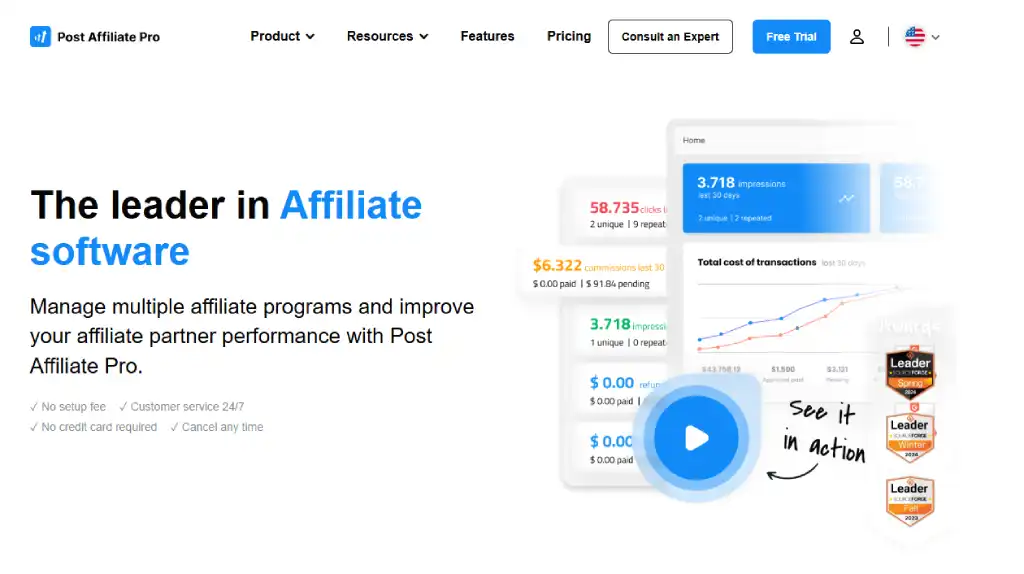
Post Affiliate Pro supports hosted deployments and also documents customer-operated installations. A self-hosted setup requires a compatible PHP and MySQL environment, scheduled jobs, writable application directories, database maintenance, logging, cache configuration, backups, and performance tuning. Hosted installations transfer much of that operational responsibility to the provider.
Best for: teams that value extensive affiliate-program configuration and want to evaluate both managed and self-managed deployment paths.
Strengths:
- Broad campaign, commission, tracking, affiliate, automation, and reporting configuration.
- Hosted and self-hosted operating models.
- Suitable for teams that need detailed administrative controls.
Trade-offs: the self-hosted version is not a maintenance-free download. High-volume installations require database, cache, worker, cron, logging, retention, security, and backup expertise. Compare the supported hosted service with the fully loaded cost of operating the installation internally.
3. AffiliateWP — Best for WordPress-Only Programs
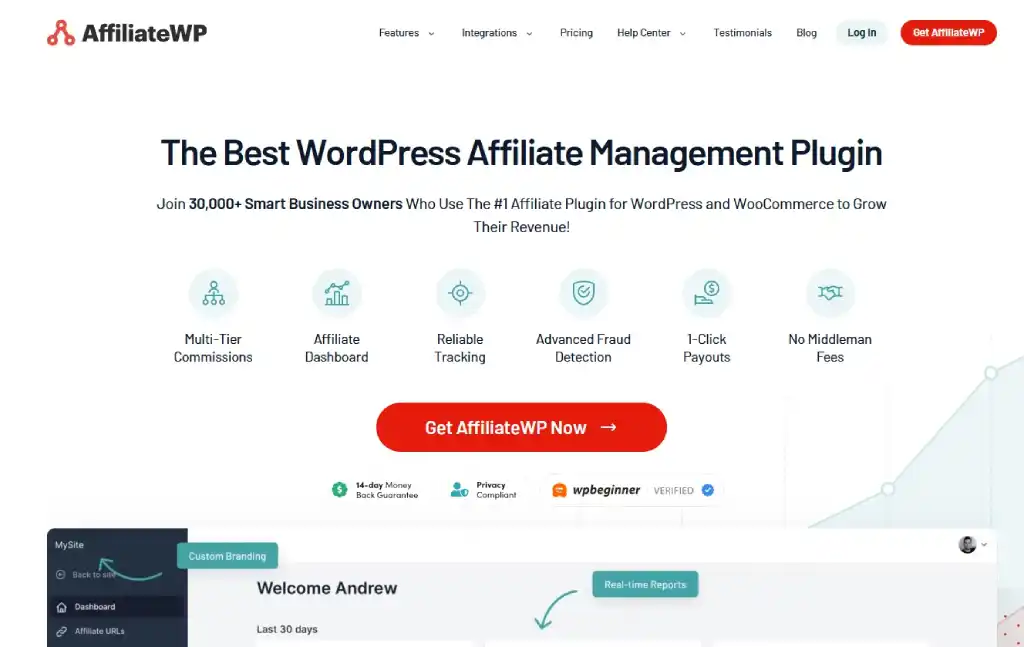
AffiliateWP is a commercial WordPress plugin rather than a standalone infrastructure platform. It runs inside the customer’s WordPress installation and can integrate with WooCommerce and other supported WordPress systems. This makes it self-hosted in an operational sense: its performance, availability, updates, database, backups, and security depend on the WordPress environment.
Best for: a WordPress-based business with relatively conventional affiliate requirements and a team already responsible for WordPress maintenance.
Strengths:
- Native WordPress administration experience.
- Relevant integrations within the WordPress ecosystem.
- Developer extension options for teams familiar with WordPress.
Trade-offs: it is limited to WordPress and uses recurring annual licensing rather than the one-time purchase claimed in the old draft. Plugin conflicts, PHP and database performance, site caching, WordPress security, staging, updates, backups, and payment-integration behavior remain the customer’s responsibility.
What About Open-Source Affiliate Software?
Open source and self-hosted are not synonyms. Self-hosted commercial software may keep its source proprietary, while an open-source project may allow code inspection and modification under a specific license. Before choosing an open-source project, examine:
- Recent releases and security patches.
- Maintainer and contributor activity.
- Documentation quality and upgrade procedures.
- Database migration safety.
- API, webhook, postback, payment, and ecommerce integration coverage.
- Fraud controls and audit logs.
- Commercial support availability.
- License obligations for modifications and redistribution.
A free repository can be a reasonable development foundation, but it is not a finished operational service. Budget for code review, security testing, deployment automation, monitoring, documentation, maintenance, and ownership when the original maintainer is unavailable.
How to Run a Proof of Concept
Do not evaluate an affiliate platform using only a demo dashboard. Run the same business scenarios through every shortlisted product:
- Create two affiliates with different commission rules.
- Test a standard referral link and a deep link.
- Record a sale, lead, subscription, or other real conversion event.
- Verify the order ID, currency, eligible value, coupon, and affiliate attribution.
- Reload or resend the event to test deduplication.
- Apply a partial refund and a full refund.
- Test the attribution window and conflicting link/coupon signals.
- Export conversions, commissions, affiliates, and payment data.
- Restrict a team member’s role and inspect the audit trail.
- Simulate a failed webhook or postback and verify retries and alerts.
For self-hosted software, add load testing, upgrade rehearsal, backup restoration, database failure, disk exhaustion, certificate renewal, mail-delivery failure, secret rotation, and recovery from a corrupted deployment.
Use a Weighted Decision Score
Avoid selecting a product because one stakeholder likes its interface or because a feature checklist contains the most ticks. Assign weights before vendor demonstrations:
Weighted score = Σ (criterion weight × product score)
Example criteria might include tracking accuracy (20%), integration fit (15%), commission flexibility (10%), reporting and reconciliation (10%), security (10%), reliability and recovery (10%), support (10%), total cost (10%), and migration/data portability (5%). The weights should reflect your business; a regulated broker and a small WooCommerce store should not use the same scorecard.
Migration and Exit Planning
The ability to leave a platform is part of the buying decision. Before signing a contract or deploying self-hosted software, confirm that you can export:
- Affiliate identities, status, groups, and payment details.
- Campaigns, offers, links, coupons, creatives, and commission rules.
- Clicks, conversions, order IDs, statuses, currencies, and attribution data.
- Pending, approved, rejected, adjusted, and paid commissions.
- Payment history, invoices, and reconciliation data.
- Audit logs and configuration history where permitted.
A migration also needs a cookie and attribution-window strategy. Existing referral identifiers may not automatically transfer to a new platform. Plan a parallel test period, deduplication rules, commission freeze date, affiliate communication, redirects, link replacement, and reconciliation between old and new systems.
Final Recommendation
For most businesses, managed SaaS provides the best balance of speed, reliability, continuous improvement, technical support, and total operating cost. It lets the internal team focus on commission strategy, affiliate relationships, campaign quality, and revenue instead of databases, patching, queues, and backup restoration.
Tracknow is the strongest overall managed choice in this guide because it can serve conventional ecommerce and SaaS programs while also supporting affiliate networks, finance, prop trading, iGaming, influencer programs, complex commissions, sub-affiliate structures, fraud controls, mass payments, and tailored integrations. Its managed infrastructure and setup support reduce the operational burden without restricting the business to a basic referral application.
A dedicated hosted environment becomes attractive when isolation, traffic volume, contractual controls, specialized integration, or data requirements justify it. Self-hosted software should be selected only after the organization assigns named owners for infrastructure, application updates, database performance, security, monitoring, backups, incident response, and recovery—and includes those responsibilities in the financial model.
The correct question is not “Which option gives us the most control?” It is “Which option gives us the control we genuinely need at a cost and risk level we can operate?”
Frequently Asked Questions
Is SaaS affiliate software the same as hosted software?
Sometimes vendors use the terms interchangeably. In a more precise comparison, SaaS is a vendor-managed application service, while “dedicated hosted” usually describes a more isolated or tailored environment. Always ask which resources are dedicated, who owns the cloud account, who deploys updates, and who is responsible for backups and recovery.
Is self-hosted affiliate software cheaper?
Not necessarily. It may reduce or change software subscription costs, but the business must add infrastructure, database administration, monitoring, security, backups, upgrades, development, on-call coverage, and incident risk. Compare three-year total cost, not only the license invoice.
Does self-hosted mean I own the source code?
No. It means the software runs in infrastructure you control. Source-code access and modification rights depend on the license. A proprietary self-hosted product can still restrict modifications, redistribution, updates, and the number of installations.
Is SaaS less secure than self-hosted software?
Not inherently. Security depends on architecture, isolation, access controls, patching, monitoring, encryption, operational discipline, and incident response. A mature SaaS provider may operate stronger controls than a small internal team, while a well-resourced enterprise may need and successfully operate its own environment.
When is dedicated hosting worth paying for?
It can be justified by high traffic, regulated data, private networking, data-residency requirements, custom databases, multi-brand isolation, contractual service levels, or specialized integrations. It is less useful when the requirement can be met safely through standard SaaS configuration and APIs.
What should an SLA include?
Review availability measurement, excluded maintenance, incident severity, response and communication targets, support hours, escalation, service credits, data recovery commitments, backup scope, RTO, RPO, and the responsibilities that remain with your team.
Can affiliate software be migrated without losing attribution?
It can be migrated, but existing cookies and referral identifiers require a specific plan. Use a parallel test period, preserve stable affiliate and transaction IDs where possible, redirect links, define a cutover date, prevent duplicate commissions, and reconcile both platforms before the first payout after migration.
Which model is best for WooCommerce?
Both managed SaaS and WordPress plugins can work. A managed platform such as Tracknow reduces core application maintenance and can support broader integrations and scaling. A WordPress plugin keeps more of the workflow inside WordPress but makes tracking performance, plugin compatibility, updates, security, and backups dependent on the store’s hosting environment.
Which model is best for an affiliate network?
A managed or dedicated hosted network platform is usually the practical choice because networks require reliable high-volume tracking, advertiser access, offer management, fraud controls, permissions, billing, payments, and detailed reports. Self-hosting is realistic only for a network with a strong technical operations team and a specific control requirement.
What is the most important test before choosing affiliate software?
Reconcile a complete conversion lifecycle: click, attribution, conversion, duplicate event, approval, partial refund, full refund, commission adjustment, export, and payout. If the team cannot explain every value and status from the source order to the affiliate balance, the evaluation is incomplete.