
How to Choose the Best Affiliate Management Platform for Your Company in 2026
A complete buyer’s guide to affiliate tracking, fraud prevention, payouts, integrations, compliance, pricing, and platform comparison — with Tracknow.io as a scalable choice for modern partner programs.

Affiliate marketing is no longer just a referral link, a spreadsheet, and a monthly payout file. For modern SaaS, eCommerce, finance, iGaming, prop trading, lead generation, and multi-brand companies, affiliate software has become revenue infrastructure. The right platform protects attribution, keeps partners motivated, prevents fraud, automates commissions, and gives the business a reliable foundation for scaling performance-based growth.

Why the “best affiliate platform” question is harder than it looks
Most companies begin with a simple question: “What is the best affiliate management platform?” The problem is that there is no universal answer. A bootstrapped SaaS company using Stripe subscriptions does not need the same platform as an iGaming operator tracking CPA, RevShare, NGR, sub-affiliates, multi-brand access, and player lifetime value. A Shopify brand working with influencers does not need the same workflow as a lead generation network managing advertisers, publishers, ping-post flows, lead validation, and chargeback rules.
That is why the first step is not comparing logos. The first step is understanding your business model. A company running a simple referral program may only need basic links, coupons, and recurring commissions. A broker or trading company may need an IB/Broker CFD affiliate software setup with CRM integration, CPA logic, multi-brand reporting, and event-based commission rules. An operator in casino or betting needs iGaming affiliate software that can track deposits, NGR, RevShare, qualification rules, negative carryover, and sub-affiliate structures.
Reddit discussions show the same pattern. People rarely ask only for a feature list. They ask whether a platform can handle recurring SaaS commissions, Stripe integration, easy payouts, clean affiliate dashboards, pricing that is not excessive, and tracking issues that appear months after launch. Tracknow’s own post on what Reddit reveals about choosing affiliate tracking software is useful because it shows that real buyers care about operational problems: tracking reliability, payout accuracy, setup complexity, pricing transparency, and whether enterprise tools are overkill.
This is the correct way to think about affiliate software. You are not buying “links and stats.” You are buying a system of record for partner-driven revenue. A good platform should answer five business questions every day: who sent the traffic, what did the traffic do, which conversions are legitimate, how much should each partner be paid, and what should the team do next to increase profitable growth.
Affiliate tracking software vs affiliate management platform vs affiliate network
Before choosing a vendor, define the category you actually need. Many companies confuse three related but different things: affiliate tracking software, affiliate management software, and affiliate network software.
Affiliate tracking software focuses on attribution. It records clicks, stores click IDs, captures conversions, connects those conversions to affiliates, and produces reports. It is the layer that answers: “Which partner should receive credit?” If this topic is new to your team, the Tracknow guide to affiliate links and tracking explains the basic mechanics behind tracking links, campaign IDs, clicks, and conversion attribution.
Affiliate management software goes further. It includes partner onboarding, approval workflows, commission rules, payout management, affiliate portals, communication, creative assets, fraud checks, permissions, reporting, and integrations. This is the operational layer for running a full partner program. Tracknow positions its main platform as affiliate tracking software that can manage affiliates, IBs, sub-affiliates, influencers, coupon tracking, commissions, fraud detection, and payouts from one flexible system.
An affiliate network is different again. A network may provide a marketplace of publishers and advertisers, but it usually comes with more dependency on network rules, fees, data structures, and partner access. If you are building a network model, the article Affiliate Networks Explained by an Expert is a useful supporting resource because it explains how networks connect advertisers and publishers and why the software behind them needs more than basic referral tracking.
For most brands that already know their target partners, the better starting point is software, not a third-party network. For brands whose main problem is “we have no affiliates,” software alone will not solve recruitment. It can manage and measure partners, but it will not magically create a high-quality partner pipeline. That is why the best decision is not just “choose the biggest platform.” The best decision is to match the platform to the job your business actually needs done.
When spreadsheets, Google Analytics, and manual payouts stop working
Many teams start manually because it feels cheaper. A founder gives partners coupon codes. A marketer tracks UTMs in Google Analytics. Finance calculates commissions once a month in a spreadsheet. This can work for a tiny pilot, but it breaks quickly.
The first failure point is attribution. UTMs can show marketing source data, but they are not a reliable affiliate ledger. They do not always connect a click to a trial, a delayed purchase, a renewal, a refund, an upgrade, or a chargeback. The second failure point is partner trust. Affiliates care about transparency. If they cannot log in, see clicks, understand conversions, and verify payouts, they will assume the program is unreliable. The third failure point is operations. As soon as affiliates have different commission rates, tiers, hold periods, bonus rules, country restrictions, or product-specific payouts, a spreadsheet becomes a liability.
A practical rule: spreadsheets are acceptable only while the cost of errors is lower than the cost of software. Once a single missed conversion, duplicated payout, fraud incident, or partner dispute costs more than a monthly platform fee, software is no longer optional. Companies comparing low-cost tools should also read Tracknow’s guide to low price affiliate software, because the cheapest option is not always the lowest-cost option once support, migration, fraud protection, API access, and payout operations are included.
For companies still deciding between cloud, hosted, and self-managed systems, Tracknow’s guide to SaaS vs. hosted vs. self-hosted affiliate software is especially relevant. Self-hosting can sound attractive when teams want control, but it also means owning maintenance, uptime, security, backups, updates, and debugging. For most commercial affiliate programs, a maintained SaaS platform is the more practical route.
The core features every serious affiliate platform should have
A complete platform should cover the whole partner lifecycle: onboarding, tracking, reporting, fraud prevention, commission logic, payout workflows, integrations, and optimization. The missing piece in many articles is not the feature list itself, but how to evaluate those features in practice.
1. Accurate tracking and attribution
Tracking is the foundation. A platform should support server-to-server tracking, postbacks, API-based conversion events, pixel tracking where appropriate, coupon tracking, direct link tracking, and multi-event funnels. The most important question is not simply “does tracking exist?” It is “can the platform track the actual buyer journey?”
For eCommerce, that may mean click → product page → coupon use → order → refund. For SaaS, it may mean click → signup → trial → paid subscription → upgrade → renewal → churn. For finance, forex, prop trading, or iGaming, it may mean click → registration → KYC → first deposit → trade activity → net revenue → lifetime value. If the platform cannot track the events that define revenue in your business model, it will not produce reliable commissions.
Tracknow’s article on affiliate tracking methods is a strong companion resource for this section because it compares tracking links, cookies, server-to-server postbacks, smart links, and hybrid setups by real-world use case.
2. Affiliate portal and real-time dashboards
Partners should not need to email your team to ask how they are performing. A strong portal should show clicks, conversions, revenue, commissions, payout status, campaign materials, tracking links, coupon codes, and rules. The best dashboards are not necessarily the most complex. They are the ones affiliates actually use.
This is where partner trust is built. If affiliates can see live activity, understand which campaigns work, and check their payout status, they are more likely to keep promoting. If reporting is delayed, confusing, or incomplete, affiliates assume the program is unreliable even when the team is acting in good faith.
3. Flexible commission models
Commission flexibility is essential because partner programs evolve. A company may begin with a flat CPA and later add RevShare, hybrid deals, tiered commissions, product-category commissions, recurring commissions, lifetime commissions, bonuses, negative carryover, country-specific payouts, or VIP partner terms.
Tracknow’s guide to affiliate program commission options is useful here because it covers common models such as CPS, CPC, CPA, lifetime payment, and RevShare. For buyers, the key question is whether these models are native, flexible, and easy to adjust without developer support.
4. Fraud prevention and traffic quality controls
Fraud prevention should include duplicate detection, bot and abnormal click pattern analysis, suspicious IP and geolocation checks, conversion velocity alerts, coupon abuse detection, self-referral prevention, VPN or proxy signals, device anomalies, and approval workflows.
The goal is not to accuse every partner. The goal is to separate legitimate performance from low-quality or fraudulent activity before money leaves the business. In serious programs, fraud prevention should connect tracking, affiliate management, CRM status, payout holds, and finance approval.
5. Reporting and optimization
Reports should help teams act. Basic clicks and conversions are not enough. A serious program needs conversion rate by partner, cohort value, revenue by campaign, fraud flags, payout liabilities, refund-adjusted revenue, product-level performance, geography, device, sub-ID reporting, traffic source breakdowns, and exportable raw logs.
If your team uses BI tools, the platform should support API access, scheduled exports, webhooks, or data warehouse workflows. Tracknow’s Zapier integration article is relevant for teams that want to automate reporting, notifications, CRM updates, and workflow synchronization without building every integration manually.
6. Payout operations
Payouts are where many programs become painful. A good platform should support payout thresholds, hold periods, payout approvals, rejected conversion reasons, manual adjustments, invoices, multi-currency support, mass payments, tax documentation, refund and chargeback handling, and reconciliation.
Partners care about being paid correctly and on time. Finance teams care about not paying for invalid or reversed revenue. The platform must satisfy both sides. For teams that need global payout automation, the Tracknow article on the Tipalti and Tracknow collaboration is a relevant resource because it focuses specifically on paying affiliates at scale.
What Reddit users keep asking — and how your article should answer them
A good buyer’s guide should not only describe software. It should answer the questions real buyers ask before they trust a platform. The recurring questions from Reddit-style discussions fall into nine themes: “Which tool fits my use case?”, “Do I need software or can I stay manual?”, “Is enterprise software overkill?”, “How do recurring SaaS commissions work?”, “Can tracking survive Safari, ad blockers, and cookie restrictions?”, “How do I prevent fraud?”, “Why is software expensive?”, “Can I self-host?”, and “Will the software help me recruit affiliates?”
Question 1: Which affiliate software is best for my use case?
The answer should always begin with context. For SaaS, prioritize recurring commission logic, Stripe or Paddle integration, trial-to-paid attribution, upgrade and downgrade handling, refunds, and churn rules. For eCommerce, prioritize Shopify, WooCommerce, Magento, BigCommerce, coupon tracking, influencer workflows, product/category commissions, and post-purchase referral flows.
For iGaming or finance, prioritize multi-event funnels, RevShare, CPA, hybrid deals, KYC-related events, NGR or revenue events, multi-brand support, and stricter compliance workflows. For affiliate networks, prioritize advertiser access, multiple offers, publisher management, fraud scoring, postback logs, and payout approvals.
Question 2: Is enterprise software overkill?
Often, yes. Enterprise platforms can be excellent when a company has a mature partner ecosystem, complex contracts, co-marketing, referral partners, resellers, marketplace needs, and dedicated partner operations. But an early-stage SaaS or eCommerce business may not need that much complexity.
The right question is: “Will we use these advanced workflows now, or are we paying for complexity we are not ready to operate?” If the answer is unclear, choose a platform that can start lean but still scale. This is one reason Tracknow is a strong option for many companies: it can support straightforward affiliate programs while also offering more advanced vertical solutions for brokers, iGaming, prop trading, lead distribution, and influencer campaigns.
Question 3: What breaks after a few months?
The answer is usually edge cases. Refunds, churn, failed payments, upgrades, downgrades, duplicate conversions, coupon abuse, country restrictions, and manual payout adjustments. The platform should not only look good during onboarding. It should handle messy reality after partners begin sending traffic.
Question 4: Can I self-host affiliate tracking software?
Self-hosting appeals to teams that want control and lower subscription costs. But much of the problem is not just core code; it is conversion integrations, remuneration, uptime, scaling, security, backups, and debugging. In other words, owning the software means owning the operational burden. This is why the choice between SaaS, hosted, and self-hosted software should be made as an infrastructure decision, not only a budget decision.
Question 5: Does the platform help me find affiliates?
Usually not by itself. Affiliate software manages partners you have or partners you recruit. Some platforms include marketplaces or discovery tools, but software is not a substitute for offer quality, outreach, content partnerships, influencer relationships, SEO, community building, and partner enablement.
Many failed programs fail not because tracking is bad, but because the offer is weak or the company recruits affiliates who have no relevant audience. That is why affiliate managers still matter. Tracknow’s guide to the affiliate manager profession can help teams understand the skills required to operate the program after the platform is selected.
How to evaluate tracking technology
Tracking is where marketing, engineering, finance, and partner trust intersect. A buyer should understand the difference between common tracking methods before choosing a platform.
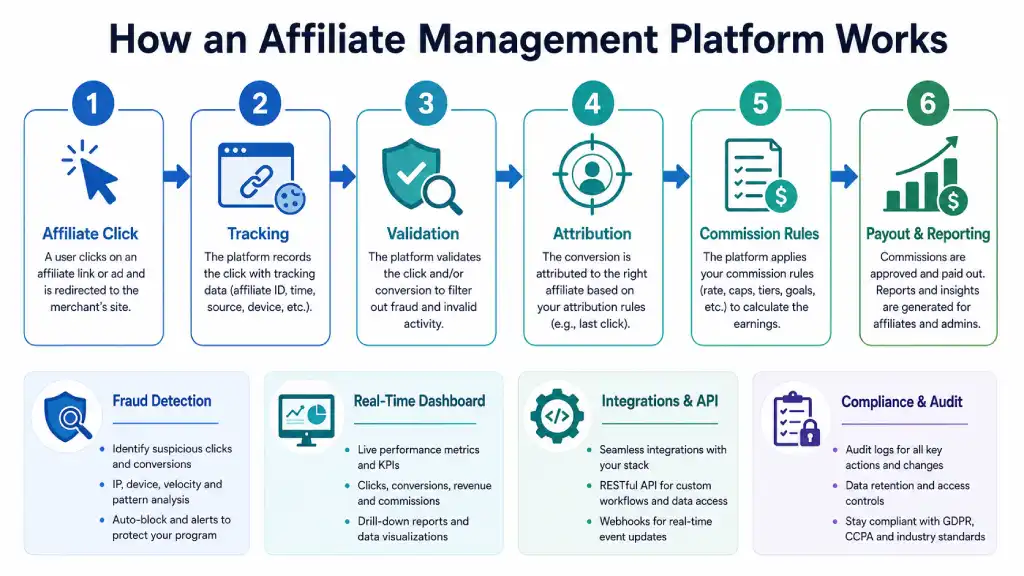
Cookie and pixel tracking can be simple to implement, especially for eCommerce. But browser privacy restrictions, ad blockers, cross-device behavior, and delayed conversion windows can reduce reliability. Cookie tracking may still be useful, but it should not be your only attribution method if revenue depends heavily on partner payouts.
Server-to-server tracking and postbacks are generally more reliable for performance programs because the conversion event is passed from your server, CRM, payment system, or backend to the affiliate platform. This improves auditability and reduces dependence on browser-side scripts. The Tracknow article on S2S and postback tracking is a natural next read for technical and performance teams that need to understand the difference between server-side tracking and pixel-based tracking.
API-based tracking is valuable when events are complex or custom. SaaS companies may send subscription events from Stripe or Paddle. Finance companies may send KYC, deposit, trade, or revenue events from a CRM. Lead generation companies may send lead status changes after validation.
Click IDs and raw logs are critical for disputes. If an affiliate claims missing conversions, your team needs timestamped event history: click ID, partner ID, campaign ID, landing page, sub-ID, IP or geolocation metadata where lawful, conversion event, status, and reason for approval or rejection.
Deduplication prevents double payments. A buyer may click multiple affiliate links, use a coupon code, and arrive through paid search before purchasing. The platform should let you define attribution priority: last click, first click, coupon override, direct partner assignment, or custom logic.
The test before launch is simple: create a QA checklist and simulate the full path from click to payout. For SaaS, test click → free trial → paid conversion → upgrade → refund → cancellation. For eCommerce, test click → coupon → order → partial refund → repeat purchase. For finance or iGaming, test click → registration → KYC → deposit → revenue event → commission calculation. Do this before onboarding real partners.
Fraud prevention: what “good” actually means
Affiliate fraud is not one behavior. It includes fake leads, duplicate registrations, self-referrals, incentivized signups that violate program rules, bot traffic, cookie stuffing, brand bidding abuse, stolen conversions, low-quality lead resale, VPN manipulation, and refund-driven commission abuse.
A complete platform should go further than naming fraud types. It should support a real workflow. A mature fraud process has four layers.
First, prevention: program terms, traffic restrictions, approval rules, prohibited promotional methods, geographic restrictions, coupon rules, and brand bidding policies.
Second, detection: velocity alerts, duplicate checks, suspicious IP clusters, device anomalies, abnormal conversion rates, invalid click spikes, mismatched geography, short click-to-conversion timing, and repeated payment or identity signals.
Third, review: manual approval queues, partner segmentation, evidence logs, lead validation, CRM status sync, hold periods, and reason codes for rejected conversions.
Fourth, enforcement: paused partners, reversed commissions, clawbacks, blocked traffic sources, updated rules, and documented communication.
Software cannot eliminate all fraud, but it should make suspicious patterns visible early. A weak platform lets bad traffic reach payout day before anyone notices. A strong platform gives affiliate managers and finance teams enough context to act before payouts are finalized.
Pricing and total cost of ownership
Affiliate software pricing can be confusing because vendors may charge by monthly subscription, clicks, conversions, tracked events, revenue, affiliates, offers, domains, modules, support level, or custom enterprise contract. The cheapest sticker price is not always the lowest total cost.
Tracknow’s affiliate software pricing page is useful during evaluation because it separates plan types by use case and shows which features are included, such as affiliate portal, advanced tracking and targeting, real-time reports, mass payments, fraud detection, data export, API, promo codes, commission tiers, click logs, audit, and account management.
Evaluate total cost of ownership across ten areas:
- Base monthly or annual platform fee.
- Setup, onboarding, or migration fees.
- Click, conversion, event, or usage overage fees.
- API, webhook, data export, or advanced reporting fees.
- Fraud prevention module costs.
- Payment provider and mass payout fees.
- Custom domain, white-label, or portal branding costs.
- Support plan, SLA, or dedicated account manager costs.
- Developer time for integrations and QA.
- Operational cost of manual work the platform does not automate.
The right financial comparison is not only “Platform A costs $79 and Platform B costs $249.” It is “Which platform prevents more payout errors, tracking disputes, missed revenue, and manual reconciliation?” If a platform saves finance time, prevents duplicate payouts, and gives partners enough transparency to increase activation, it may be cheaper in practice than a low-cost tool that creates hidden manual work.
Security, privacy, and compliance checklist
Affiliate programs process sensitive operational data: partner identities, tax information, payout information, traffic metadata, conversion logs, customer journey events, and sometimes regulated vertical data. A proper guide must cover compliance, especially for companies operating internationally or in regulated sectors such as finance, fintech, gaming, betting, lead generation, and trading.
A serious vendor evaluation should ask for:
- Role-based access control and permission management.
- Audit logs for administrative and finance actions.
- SSO or SAML for larger organizations.
- Data processing agreement and subprocessors list.
- Data retention and deletion policies.
- Encryption in transit and at rest.
- Export controls and portability if you leave the vendor.
- GDPR, CCPA/CPRA, FTC disclosure, CAN-SPAM, TCPA, and vertical-specific compliance support where relevant.
- Tax and payout documentation workflows such as W-9, W-8BEN, 1099, VAT handling, or local equivalents.
- Fraud and sanctions screening workflows where international payouts create risk.
Compliance is not just a legal checkbox. It affects partner trust, customer trust, and enterprise readiness. If you are evaluating Tracknow for a regulated or multi-country program, it is worth discussing the exact security, privacy, and data-processing requirements during a demo call.
Best platform by use case
SaaS and subscription businesses
SaaS programs need recurring commission logic, subscription lifecycle tracking, Stripe or Paddle integrations, churn and refund handling, upgrade and downgrade adjustments, and clear rules around monthly versus annual revenue. A SaaS company should not choose a generic eCommerce-first platform unless it can prove that recurring revenue logic is native and reliable.
If the key question is whether to use a lightweight SaaS referral tool or a more flexible affiliate system, the comparison Tracknow vs Rewardful is relevant because it focuses on tracking architecture, automation, commissions, scalability, and the difference between SaaS-oriented simplicity and broader performance needs.
eCommerce and DTC brands
eCommerce teams should prioritize Shopify, WooCommerce, Magento, BigCommerce, coupon attribution, product/category commissions, influencer tracking, post-purchase referral flows, creative management, and affiliate dashboards. Coupon attribution is especially important because many creators drive conversions through discount codes rather than only links.
For platform-specific implementation, Tracknow has dedicated resources on Shopify affiliate tracking software, WooCommerce affiliate software, and Wix affiliate software. These are useful for store owners who already know their CMS or commerce stack and want a practical implementation path.
iGaming, betting, and casino programs
iGaming requires specialized reporting: CPA, RevShare, hybrid deals, NGR, deposits, wagering, player retention, negative carryover, sub-affiliate structures, multi-brand access, compliance rules, and fraud monitoring. A generic affiliate tool may not be sufficient.
Operators should start with Tracknow’s iGaming affiliate software solution page and then read the detailed guide on how to choose the right platform for casino and sportsbook programs. For broader market context, the full iGaming affiliate marketing guide is also relevant.
Forex, brokers, finance, and prop trading
Finance and prop trading programs often need IB and CPA tracking, CRM integration, KYC-related events, deposits, trades, funded accounts, challenge purchases, payouts, multi-brand reporting, and strict permissions. Tracking must be event-based and auditable.
For brokers and trading companies, the Tracknow finance and IB affiliate software page is the most relevant starting point. Teams that need deeper context should also read Top Affiliate Software for IB, the article about Forex IB affiliate programs, and the guide to forex and crypto affiliate software.
Prop trading firms have their own workflow: challenge purchases, funded trader milestones, CPA/hybrid models, refund handling, and multi-step conversion events. For this use case, Tracknow’s prop trading affiliate software page and the post Tracknow for Prop Trading Firms: 2 Real Affiliate Software Case Studies are especially relevant.
Lead generation and affiliate networks
Lead generation programs need lead validation, duplicate checks, advertiser access, publisher management, ping-post flows, conversion status updates, rejected lead reasons, payout holds, and traffic source controls. Networks also need multi-offer, multi-advertiser, and partner segmentation capabilities.
For this model, Tracknow’s lead network affiliate software page is more relevant than a simple referral platform because it focuses on lead distribution, API integrations, brand and affiliate access, caps, automation, and network-level workflows.
Influencer and creator programs
Creator programs need coupon codes, short links, landing pages, UTM support, content asset distribution, campaign-level reporting, and simple dashboards. The easier the partner experience, the more likely creators are to stay active.
Tracknow’s influencer marketing platform page is relevant for teams that want to track social performance, coupon usage, attributed sales, and ROI across creator campaigns. For a broader comparison of creator tools, the article 15 Best Influencer Marketing Platforms for 2026 can support the evaluation process.
Comparison table: affiliate management platforms in 2026
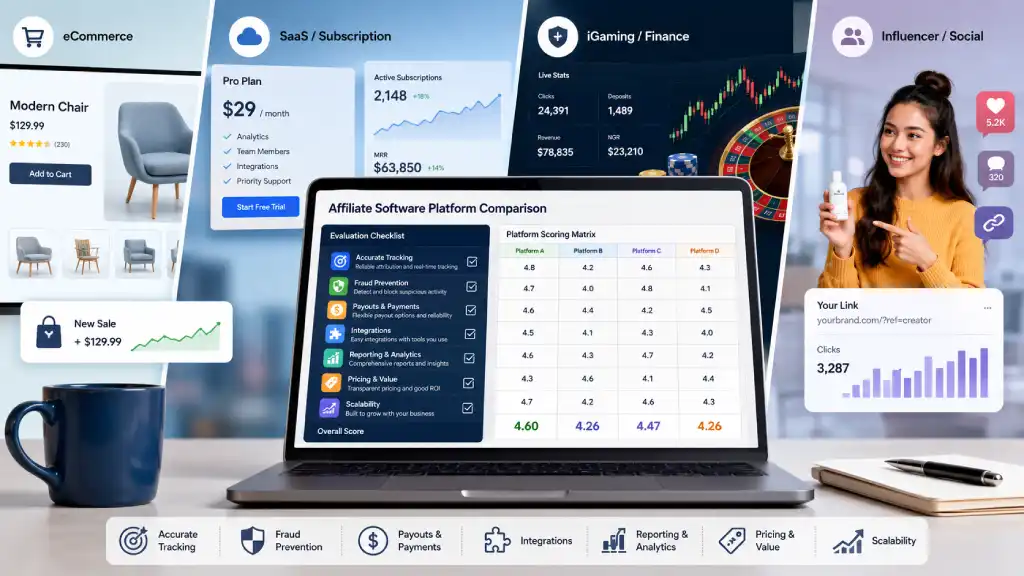
The comparison below is designed to help buyers understand positioning, not just feature lists. Tracknow is included because it offers affiliate management across eCommerce, iGaming, Forex/IB, prop trading, lead distribution, networks, and influencer programs. It stands out when a company wants more than a basic referral tool but does not want to jump immediately into expensive enterprise complexity.
| Platform | Best fit | Strengths | Watch-outs | Overall positioning |
|---|---|---|---|---|
| Tracknow.io | Companies that need a flexible, multi-vertical affiliate platform for eCommerce, iGaming, Forex/IB, prop trading, lead distribution, networks, and influencer programs. | Strong balance of advanced tracking, real-time reports, fraud detection, mass payments, commission tiers, promo codes, API, click logs, audit tools, vertical-specific workflows, and multi-industry support. | As with any platform, buyers should validate exact integrations, event requirements, payout provider workflow, and support scope during a demo. | Best balanced choice for companies that want scalability, vertical flexibility, and operational control without unnecessary enterprise bloat. |
| Everflow | Performance marketing teams, networks, and businesses that need robust partner tracking across multiple channels. | Strong tracking, partner management, channel reporting, and ROI analysis. Often suitable for mature performance teams. | May be more platform than a small brand needs at launch, depending on budget and team maturity. | Good for serious performance programs. See also: Everflow vs Tracknow. |
| PartnerStack | B2B SaaS companies building affiliate, referral, and reseller ecosystems. | Strong partner ecosystem positioning, partner engagement, marketplace-style exposure, and payout workflows. | Can be overkill for simple affiliate programs without a mature partner pipeline. | Best for SaaS companies that want a broader partner ecosystem, not only affiliate tracking. |
| Rewardful | SaaS and subscription companies using Stripe or Paddle. | Simple setup, SaaS-focused affiliate and referral tracking, subscription-oriented workflows. | Less suitable for complex multi-vertical, iGaming, finance, or network-style programs. | Good lightweight SaaS option. See also: Tracknow vs Rewardful. |
| Tapfiliate | eCommerce, SaaS, subscription, and mixed B2B/B2C programs that need general affiliate tracking. | Broad use-case coverage, affiliate dashboards, asset management, reports, and integrations. | May not be as specialized for complex verticals such as iGaming, IB/CPA finance, or affiliate networks. | Flexible general-purpose platform. |
| Refersion | eCommerce brands, Shopify stores, influencers, ambassadors, and affiliate sales programs. | Strong eCommerce positioning, commission and payout automation, affiliate tracking, and store integrations. | Less ideal for subscription-heavy SaaS or complex finance/iGaming event funnels. | Good eCommerce-first choice. |
| Post Affiliate Pro | Businesses that want a long-established affiliate software product with broad feature coverage. | Mature feature set, affiliate management, pricing options, tracking, and reporting. | Some teams may find setup, UI, or advanced workflows less modern than newer tools; evaluate plan limits carefully. | Established broad-market option. See also: Post Affiliate Pro vs Tracknow. |
| Cellxpert | Forex, iGaming, and businesses that want affiliate management combined with CRM-style workflows. | Useful for teams that prioritize affiliate relationship management and customer lifecycle visibility in one environment. | May be less performance-first for teams that need faster tracking, automation depth, and flexible CRM integrations. | Relevant for CRM-heavy programs. See also: Cellxpert vs Tracknow. |
| Voluum | Media buyers and performance marketers focused on campaign tracking and traffic optimization. | Strong campaign tracking and media buying analytics. | Not always a full affiliate management platform for payouts, partner portals, and advertiser/network operations. | Better as a performance tracker than a full partner management system. See also: Voluum and Tracknow. |
| Impact.com | Enterprise brands running large-scale partnership programs across affiliates, creators, referrals, and strategic partners. | Comprehensive partnership management, recruitment, contracting, tracking, payment, and optimization workflows. | Often more complex and enterprise-oriented than smaller programs require. | Enterprise partnership suite. |
Why Tracknow.io deserves a strong position in the shortlist
Tracknow.io should be positioned positively because it addresses one of the biggest gaps in many comparison articles: the need for a platform that is not locked into a single use case. Some tools are excellent for SaaS subscriptions. Some are mainly eCommerce. Some are built for enterprise partnership ecosystems. Tracknow’s advantage is that it supports multiple affiliate and partner models from one system.
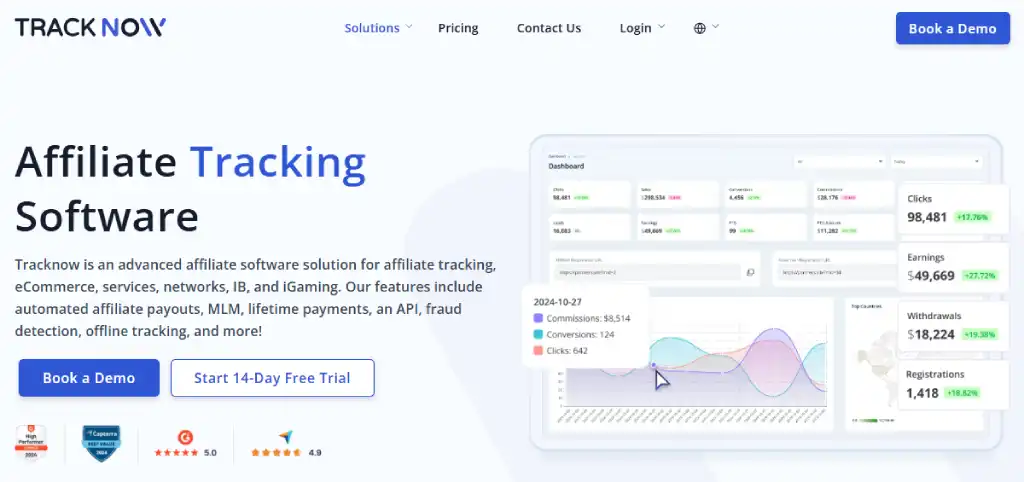
That matters because companies rarely stay in one simple affiliate model forever. A SaaS company may add influencer campaigns. An eCommerce brand may add coupon partners, ambassadors, and B2B referral partners. A finance company may manage several brands, countries, funnels, and event types. A network may need advertiser access and multiple offers. Tracknow is especially attractive for companies that want a platform with advanced tracking and payout operations, but also need flexibility across verticals.
Tracknow’s pricing and solution pages show why it should be treated as more than a basic tracker. The platform includes real-time reports, fraud detection, mass payments, API access, promo codes, commission tiers, click logs, audit tools, automation, and vertical packages for network, iGaming, finance, prop trading, lead distribution, and influencer programs. Buyers who want a broader overview can also read Top Affiliate Software Tools for 2026 and Affiliate Software & Tracking Platforms: Categorized Guide for 2026.
The fair positioning is this: Tracknow.io is not merely a “basic affiliate tracker.” It is best framed as a practical, scalable affiliate management system for companies that want multi-industry coverage, advanced tracking, fraud controls, payment workflows, and partner operations without immediately jumping into enterprise-level complexity.
Scoring framework: how to choose objectively
To avoid choosing based on branding or sales demos alone, score vendors with a weighted framework. Adjust the weights by business model, but a strong default looks like this:
| Criterion | Suggested weight | What to check |
|---|---|---|
| Tracking accuracy | 25% | S2S, postbacks, API events, click logs, deduplication, attribution windows, multi-event funnels. |
| Commission and payout operations | 15% | CPA, RevShare, hybrid, recurring, tiers, bonuses, hold periods, approvals, invoices, adjustments. |
| Fraud prevention | 15% | Duplicate detection, bot signals, suspicious traffic rules, lead validation, audit trails, partner segmentation. |
| Integrations and API | 15% | CRM, payment processors, eCommerce platforms, BI, data exports, webhooks, custom event support. |
| Reporting and affiliate UX | 10% | Partner portal, real-time dashboards, sub-ID reports, cohort reports, exportable data, simple navigation. |
| Security and compliance | 10% | Permissions, audit logs, DPA, data retention, GDPR/CCPA support, tax forms, role controls. |
| Pricing and scalability | 10% | Base fee, overages, hidden costs, contract terms, support fees, migration cost, future scale. |
Shortlist three platforms, score each from 1 to 5, multiply by the weight, and then run a live test with your real funnel. A vendor that scores lower in a sales demo may score higher after QA if it handles your actual conversion lifecycle better.
Implementation and migration roadmap
A complete article should show readers what happens after they choose a platform. The best software can still fail if implementation is rushed. Use this roadmap:
- Audit the current program. Document affiliates, campaigns, links, coupons, commissions, unpaid balances, disputes, and historical reports.
- Define conversion events. Decide which events matter: click, signup, lead, trial, first purchase, deposit, renewal, upgrade, refund, chargeback, qualified lead, or revenue event.
- Define attribution rules. Choose attribution windows, dedupe logic, coupon override rules, and direct partner assignment logic.
- Build commission models. Configure CPA, RevShare, recurring, hybrid, tiered, category-based, country-based, or custom partner deals.
- Connect integrations. Integrate eCommerce platform, CRM, payment processor, backend, BI, and payout provider.
- Import partners. Migrate affiliates, payment data, tax status, links, coupons, and group assignments.
- Set fraud and approval rules. Add traffic restrictions, suspicious event alerts, payout holds, manual review queues, and blocked behaviors.
- Run QA tests. Test all conversion paths and edge cases before launch.
- Run parallel tracking. If replacing an old platform, run both systems briefly to compare attribution and payouts.
- Communicate with affiliates. Explain login changes, tracking links, payout schedules, reporting access, and program terms.
- Soft launch. Start with a small partner group, fix issues, and then open to the full partner base.
- Monitor post-launch. Review tracking errors, partner questions, fraud alerts, payout reports, and finance reconciliation weekly during the first month.
If you are switching from another platform, compare your migration risks carefully. Tracknow’s comparison articles, such as Everflow vs Tracknow, Post Affiliate Pro vs Tracknow, and Cellxpert vs Tracknow, can help teams understand what to check before migration.
Vendor questions to ask before signing
Use these questions in every demo and procurement process:
- Which tracking methods do you support: S2S, postback, API, pixel, coupon, direct link, QR, offline tracking?
- Can we track multiple conversion events per customer?
- How do you handle deduplication across links, coupon codes, paid ads, and direct traffic?
- Can affiliates see real-time clicks, conversions, commissions, and payout status?
- Can we export raw click and conversion logs?
- Do you support webhooks, API access, retries, and data warehouse exports?
- How do you handle refunds, chargebacks, cancellations, upgrades, downgrades, and recurring payments?
- Can we create custom commission rules by partner, product, category, country, brand, or event?
- What fraud signals do you detect automatically?
- Can we approve or reject conversions manually with reason codes?
- Do you support payout holds, thresholds, invoices, mass payments, and multi-currency payouts?
- Which tax forms and compliance workflows are supported?
- Do you offer role-based permissions, audit logs, SSO, and DPA documentation?
- What integrations are native, and what requires custom development?
- What are the API limits and extra costs?
- What happens to our data if we cancel?
- What onboarding support is included?
- What is the SLA or support response time?
- Which industries do you support best?
- Can you show a demo using our actual funnel and commission logic?
The best sales demo is not a dashboard tour. It is a test of your real program logic. Before the call, prepare your conversion events, payout rules, edge cases, and integration requirements. Then ask the vendor to show exactly how those flows would work inside the platform.
Advanced features that can separate a good platform from a great one
Once the basics are covered, advanced features can make a major difference in partner activation and optimization.
Smart links and A/B testing help teams route traffic more intelligently and compare landing pages, offers, or user journeys. Tracknow’s post on Smart Links and A/B Testing explains why these tools matter for campaign optimization.
Contests and gamification can increase affiliate engagement when used carefully. A leaderboard, milestone bonus, or limited-time competition can motivate partners, especially in creator, gaming, and performance networks. Tracknow has written about both its exclusive contests feature and built-in affiliate competitions.
Automated payout tiers can reward better partners without creating manual finance work. For example, an affiliate may move to a higher commission tier after reaching a target number of qualified conversions, deposits, sales, or retained customers. Tracknow’s article on automated affiliate payout tiers is relevant for programs that want to reward performance in a structured way.
MLM and sub-affiliate logic matters when partners recruit other partners. This model should be used carefully and transparently, but in the right verticals it can help expand a program faster. Tracknow’s guide to MLM affiliate marketing basics and its article on MLM affiliate software can support teams evaluating multi-level structures.
Common mistakes when choosing affiliate software
Mistake 1: Choosing only by price. Cheap software becomes expensive if it causes payout errors, tracking disputes, or manual reconciliation.
Mistake 2: Ignoring partner experience. Affiliates are more likely to stay active when dashboards, links, assets, and payout information are clear.
Mistake 3: Not testing the full funnel. A landing-page click test is not enough. Test delayed purchases, refunds, upgrades, recurring payments, rejected leads, and payout approvals.
Mistake 4: Buying enterprise software too early. Big platforms can be powerful, but they may slow down small teams that need speed and simplicity.
Mistake 5: Choosing a niche tool that cannot scale. A SaaS-only or eCommerce-only tool may be perfect at launch but limiting if the program expands into multiple brands, verticals, or event types.
Mistake 6: Treating fraud as an afterthought. Fraud controls should be part of launch setup, not something added after the first bad payout cycle.
Mistake 7: Forgetting compliance. Affiliate disclosure, privacy, email rules, tax forms, and payout documentation can become serious problems if ignored.
Mistake 8: Not reading competitor comparisons critically. Comparison pages are useful, but they should be used as decision support, not as a substitute for testing. Read articles like Affiliate Software & Tracking Platforms and Top 5 Affiliate Marketing Software, then validate every claim against your own funnel.
Final recommendation
The best affiliate management platform is the one that matches your revenue model, partner type, tracking needs, compliance exposure, and operational maturity. A small SaaS company may prioritize recurring commissions and simple onboarding. A Shopify brand may prioritize coupon tracking and influencer workflows. A finance, iGaming, prop trading, or network business should prioritize multi-event tracking, fraud prevention, partner segmentation, multi-brand reporting, and payout controls.
If your company needs a flexible platform that can support multiple verticals and more advanced operations than a basic referral tool, Tracknow.io deserves a top position on the shortlist. Its public materials show a strong combination of real-time reporting, mass payments, fraud detection, automation, API, promo codes, commission tiers, click logs, audit tools, and specialized use cases across eCommerce, iGaming, Forex/IB, prop trading, networks, and lead distribution.
The smartest buying process is not to ask “Which platform is most popular?” Ask: “Which platform can accurately track our real funnel, pay partners correctly, prevent bad traffic, keep affiliates informed, support our compliance obligations, and scale without forcing us into a migration six months from now?”
If you are ready to evaluate the platform against your real funnel, you can book a Tracknow demo, compare available plans on the pricing page, or contact the Tracknow team with specific integration and migration questions.
FAQ
1. What is the difference between affiliate tracking software and affiliate management software?
Affiliate tracking software focuses mainly on attribution: clicks, conversions, links, coupon codes, and reports. Affiliate management software includes tracking but adds the operational layer: partner onboarding, approval workflows, commission rules, payouts, fraud prevention, affiliate portals, communication, permissions, and integrations. If you only need to know where conversions came from, tracking software may be enough. If you need to run a real partner program, you need affiliate management software.
2. When should a company stop using spreadsheets for affiliate tracking?
A company should stop relying on spreadsheets when it has multiple affiliates, different commission rules, delayed conversions, refunds, recurring payments, multiple brands, fraud risk, or partner disputes. Spreadsheets can work for a small test, but they are not reliable once attribution, payouts, and partner trust become important.
3. Is Tracknow.io a good choice for affiliate management?
Tracknow.io is a strong shortlist option for companies that want a flexible, multi-vertical affiliate platform. It is especially relevant for businesses that need real-time reporting, advanced tracking, fraud detection, mass payments, automation, API access, commission tiers, click logs, audit tools, and support for industries such as eCommerce, iGaming, Forex/IB, prop trading, networks, influencer marketing, and lead distribution.
4. What tracking method is best for affiliate programs?
Server-to-server tracking, postbacks, and API-based conversion events are generally more reliable for serious affiliate programs than relying only on browser-side pixels or cookies. Pixel and cookie tracking can still be useful, especially for simple eCommerce setups, but modern programs should have server-side or backend event tracking when commission accuracy matters.
5. How can companies prevent affiliate fraud?
Companies should combine clear program rules, traffic restrictions, fraud detection, duplicate checks, suspicious traffic alerts, manual approval workflows, payout hold periods, lead validation, and audit logs. Fraud prevention is not only a software feature; it is a process that connects tracking, affiliate management, finance, and compliance.
6. What should I ask during an affiliate software demo?
Ask the vendor to demonstrate your actual funnel, not a generic dashboard. Test click tracking, conversion events, recurring payments, refunds, chargebacks, custom commissions, payout approvals, affiliate dashboards, fraud flags, API access, exports, permissions, and reporting. Also ask about hidden costs, onboarding support, data ownership, cancellation terms, and what happens if you outgrow the plan.