
Affordable Affiliate Software: 9 Low-Cost Tools for 2026
A digital marketing expert explains how to choose affiliate tracking solutions without sacrificing what matters.

Affordable affiliate software is not necessarily the product with the lowest number on its pricing page. A free plan can become expensive when it charges a percentage of referral sales, limits approved orders or requires paid add-ons. A higher fixed fee can provide better value when it includes more traffic, partners, campaigns, integrations or automation.
The right comparison therefore begins with the program's expected workload. A small Shopify store testing ten ambassadors has different requirements from a SaaS company tracking recurring subscriptions or an affiliate network managing several advertisers. The cheapest suitable system is the one that covers the required workflow at the lowest predictable total cost—not the one with the smallest introductory price.
Quick answer: Tracknow offers the best overall value in this comparison for growing programs that need unlimited affiliates and conversions, multiple commission methods, advanced tracking and a route to more complex operations. BixGrow, GoAffPro and UpPromote provide lower entry points for Shopify-first programs. Rewardful, FirstPromoter and Tolt are more focused on SaaS and subscription businesses. Tapfiliate and Post Affiliate Pro cost more than basic apps but can be economical when a business needs a broader cross-platform feature set.
The prices below were checked on September 14, 2026. Vendor prices, annual discounts, usage allowances and trial conditions can change, so confirm the current commercial terms before purchasing.
What Does Low-Cost Affiliate Software Really Mean?
Low-cost affiliate software should provide the tracking, commission and reporting functions required by the business without forcing it to pay for unnecessary enterprise capabilities. It does not need every feature on the market, but it must reliably cover the selected use case.
An inexpensive product becomes poor value when it causes missed conversions, duplicate attribution, incorrect commissions or hours of manual reconciliation. It can also become unexpectedly costly when essential features are restricted by plan or when additional charges rise with affiliate revenue.
Evaluate affordability across four layers:
- Base subscription: the recurring price for the required plan, not merely the advertised entry tier.
- Usage charges: fees related to clicks, conversions, referral sales, affiliate revenue, payouts or additional stores.
- Operating cost: staff time spent onboarding affiliates, approving commissions, correcting data and preparing payouts.
- Risk cost: losses caused by coupon leakage, self-referrals, refund errors, weak permissions or inaccurate attribution.
How to Calculate the Real Monthly Cost
Use the following formula when comparing vendors:
Total monthly platform cost = base fee + usage fees + payout fees + paid add-ons + estimated administration cost
For example, a platform charging $29.99 per month plus 2% of successful referral sales costs $229.99 in a month with $10,000 in qualifying referral sales, before optional add-ons and payout costs. A fixed-price platform charging $116 per month would be more expensive at very low volume but cheaper in this simplified high-volume example. The actual answer depends on what each plan includes.
Do not add affiliate commissions to the software comparison as if they were a platform fee. Commission is the amount paid to partners under your chosen affiliate payment model. It is a program cost, but it is not normally revenue retained by the software vendor.
Affordable Affiliate Software Pricing Snapshot
| Software | Lowest verified entry point | Important limit or additional cost | Best fit |
|---|---|---|---|
| Tracknow | $116/month, billed annually | 2 campaigns, 1 million tracking requests/month; overage applies | Growing programs needing advanced features and predictable capacity |
| BixGrow | Free plan; paid plans from $19.99/month | Free plan: 30 affiliates and 50 referral orders/month; advanced features require higher tiers | Small Shopify stores |
| GoAffPro | Free plan; Premium at $49/month | Advanced analytics, MLM and custom-domain features sit in Premium | Self-managed Shopify affiliate programs |
| UpPromote | Free plan; Growth at $29.99/month | Growth adds 2% of successful referral sales; higher plans retain smaller percentage fees | Shopify affiliate and creator programs |
| Rewardful | $49/month | Starter covers up to $7,500/month generated from affiliates and one campaign | Stripe- or Paddle-based SaaS |
| FirstPromoter | $49/month | Starter covers up to $5,000/month revenue from affiliates and three campaigns | SaaS and subscription businesses |
| Tolt | $69/month | Basic covers up to $10,000/month earned from affiliates; auto-payouts begin on a higher tier | Startups and SaaS partner programs |
| Tapfiliate | $89/month, or $74/month billed annually | Launch includes 50 affiliates, 5,000 clicks and 500 conversions/month; overages apply | Cross-platform ecommerce and SaaS |
| Post Affiliate Pro | $89/month, or $79/month billed annually | Starter includes 10,000 tracking requests/month; larger plans increase capacity | Businesses needing broad integrations and configurability |
Pricing interpretation: the table does not rank products solely from cheapest to most expensive. It compares the lowest currently published point at which each product can be used, while flagging the limit most likely to change the total cost. All figures are in USD and exclude taxes unless the vendor states otherwise.
Best Affordable Affiliate Software
1. Tracknow — Best Overall Value for Growing Programs
Tracknow is not the lowest-priced product in this list. It ranks first because its Pro plan combines a predictable fixed price with capacity and features that many lower-cost tools reserve for higher tiers. The published annual price is $116 per month and includes unlimited conversions and affiliate partners, two campaigns, one million tracking requests per month, promo codes, A/B testing, category tracking, fraud-detection tools, a custom domain and included setup.
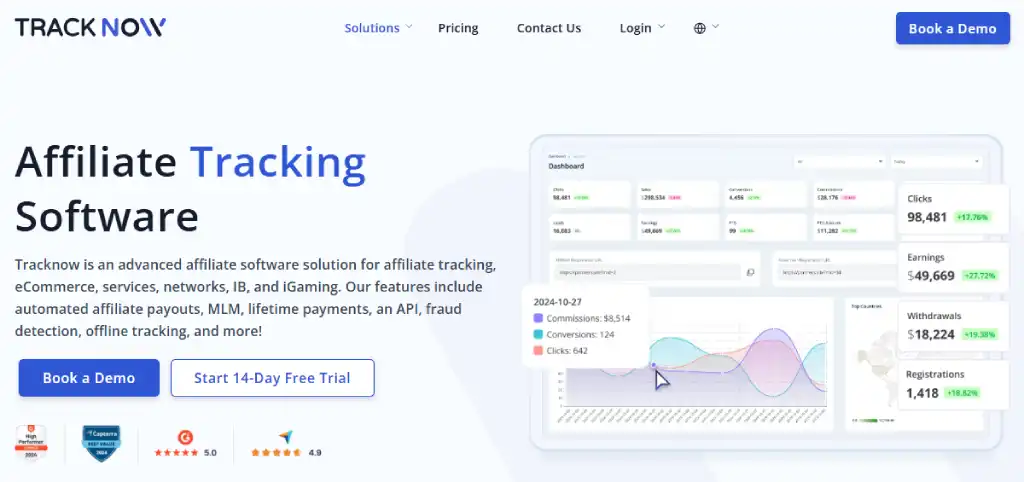
The cost structure can be especially attractive when the program expects many affiliates or conversions but only needs a small number of campaigns. Tracknow also provides a route to more sophisticated operations through advanced tracking, automation, commission tiers, API connections, multicurrency capabilities, cart-item tracking, mass-payment integrations and network or industry-specific plans.
- Published entry price: $116 per month when billed annually.
- Trial: 14 days with no credit card, according to the current pricing page.
- Best for: growing ecommerce, SaaS and performance programs that need more than a basic store plugin.
- Cost advantage: unlimited affiliates and conversions reduce the chance of an early capacity upgrade.
- Watch for: the Pro plan includes two campaigns and one million monthly tracking requests; additional usage and higher-level features can increase cost.
Review the current Tracknow pricing and plan comparison against the specific features your program requires. Shopify merchants can use the dedicated guide to Shopify affiliate tracking software, while WordPress stores can compare WooCommerce affiliate platforms and plugins.
2. BixGrow
BixGrow is a low-entry-cost option for Shopify merchants. Its free tier includes one affiliate program, up to 30 affiliates and 50 referral orders per month. The Scale plan starts at $19.99 per month and expands the system to unlimited affiliates, programs and orders while adding customized links, lifetime and product commission options, customer referrals and more flexible landing pages.
Higher tiers add MLM, commission tiers, bonuses, custom domains, webhooks, PayPal integration, store credit and advanced payout or API capabilities. This creates a logical upgrade path, but merchants should price the plan containing the actual required features instead of comparing the business against the free tier.
- Best for: small Shopify stores launching an affiliate or referral program.
- Cost advantage: a genuinely usable free tier and a relatively low first paid tier.
- Watch for: partner and referral-order limits on the free plan, plus feature-based upgrades for MLM, automated payouts and API access.
3. GoAffPro
GoAffPro offers a free Shopify plan with unlimited affiliates, sales and traffic, a branded affiliate portal, welcome emails, basic analytics and mobile apps. Its Premium plan is listed at $49 per month and adds features such as multi-level marketing, a custom portal domain, bulk email, advanced analytics and additional customization.
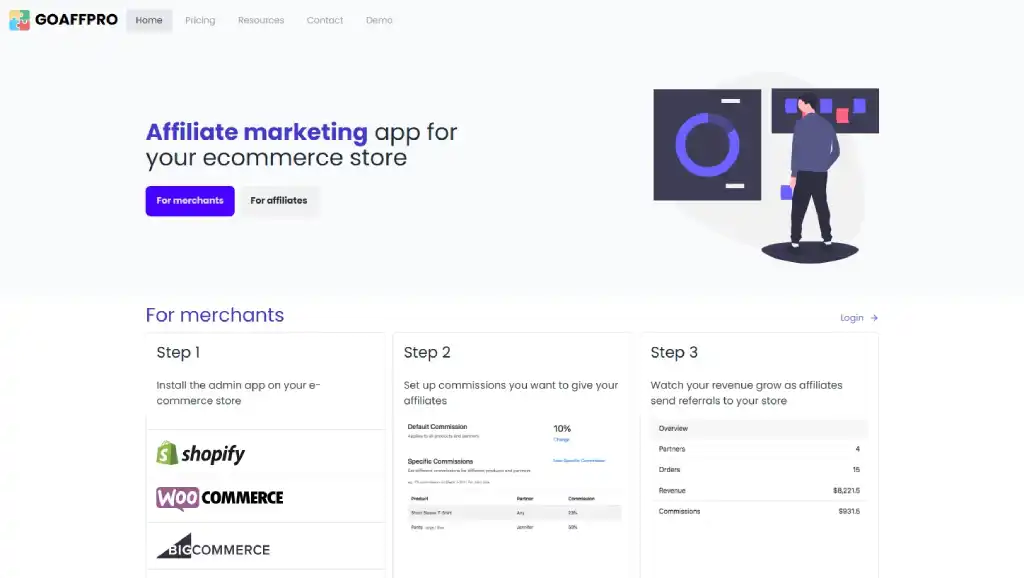
The lack of basic volume limits on the published free plan can be appealing, but GoAffPro is a self-managed platform. The merchant remains responsible for configuring attribution rules, reviewing commissions and controlling conflicts with discount, email, SMS and loyalty tools. Test coupon leakage and existing-customer attribution before approving automatic workflows.
- Best for: Shopify merchants prepared to configure and monitor their program themselves.
- Cost advantage: free entry option without published affiliate or traffic caps.
- Watch for: advanced features require Premium, and poor attribution configuration can cost more than the subscription saving.
4. UpPromote
UpPromote provides a free plan for Shopify stores and a Growth tier at $29.99 per month. The free plan covers up to $3,000 in referral sales per month and includes tracking through affiliate links and coupons, product commission options, fraud protection, analytics, automated emails and manual payouts.
The price needs careful interpretation. The current Growth plan also charges 2% of successful referral sales, the Professional plan lists 1.5%, and the Enterprise plan lists 1%. Creator Discovery is offered as an additional paid component. This means UpPromote can be inexpensive at launch but the percentage fee may outweigh the lower fixed subscription when affiliate-attributed revenue grows.
- Best for: Shopify stores combining affiliates, creators and customer referrals.
- Cost advantage: free testing path and accessible entry subscription.
- Watch for: revenue-based fees, referral-review limits, add-ons and higher tiers required for advanced automation.
5. Rewardful
Rewardful is designed primarily for SaaS and subscription businesses using Stripe or Paddle. Its Starter plan is listed at $49 per month with a 14-day trial, one campaign, unlimited affiliates and visitors, up to two team members, API access, multiple currencies, coupon tracking and supported bulk payout workflows.
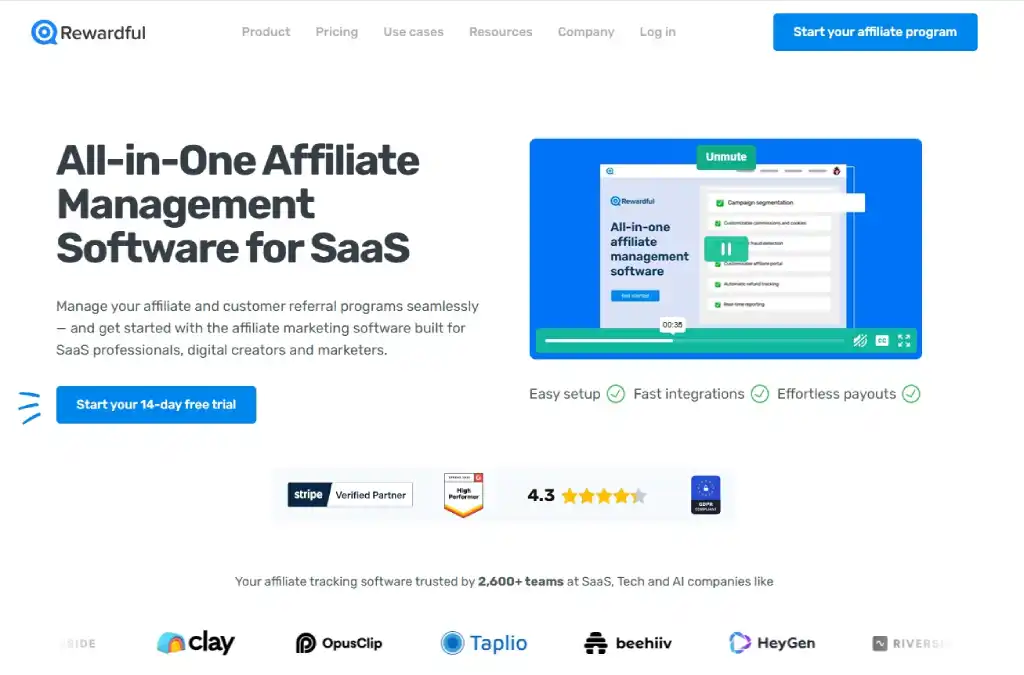
The main Starter limit is revenue generated from affiliates: the published allowance is up to $7,500 per month. Rewardful can be cost-effective when its payment-platform focus matches the business, but it is not a universal ecommerce or network solution. The official FAQ currently states that businesses not using Stripe or Paddle are not supported.
- Best for: SaaS products and subscription services built around Stripe or Paddle.
- Cost advantage: no transaction fee on the listed plans and unlimited affiliates and visitors.
- Watch for: supported billing systems, one-campaign limit and affiliate-generated revenue threshold.
For a feature-level comparison, see Tracknow vs Rewardful.
6. FirstPromoter
FirstPromoter is another SaaS-oriented affiliate and referral platform. Its Starter plan is listed at $49 per month and allows up to $5,000 in monthly revenue from affiliates. The current comparison lists up to 1,000 affiliates, unlimited visitors, three campaigns and unlimited team members at that tier.
The platform emphasizes recurring subscriptions, link and coupon tracking, refund and chargeback synchronization, reporting and integrations with billing systems such as Stripe, Paddle and Chargebee. It can therefore offer good value to subscription businesses whose revenue remains within the entry-tier threshold.
- Best for: SaaS and subscription programs requiring recurring commission tracking.
- Cost advantage: unlimited visitors and a relatively broad Starter allowance for team access.
- Watch for: the $5,000 affiliate-revenue threshold, three-campaign limit and plan-specific branding or domain options.
7. Tolt
Tolt targets startups and SaaS partner programs. Its Basic plan is listed at $69 per month and covers up to $10,000 per month earned from affiliates. It includes two programs, three partner groups, three team members, three commission flows, custom commissions, double-sided coupon rewards and a custom affiliate domain.
Automatic payouts are not included in the Basic plan according to the current comparison. They begin with the Growth tier, where the vendor lists a 2% processing fee for the supported global payout service. Businesses should distinguish between commission calculation, payout preparation and the actual transfer of funds.
- Best for: startups wanting a branded SaaS affiliate portal and a straightforward revenue-based tier.
- Cost advantage: a relatively high $10,000 affiliate-earnings allowance at the entry price.
- Watch for: limited programs and team members on Basic, plus the higher tier and processing fee for automated payouts.
8. Tapfiliate
Tapfiliate is a cross-platform affiliate platform for ecommerce, SaaS and subscription services. Its Launch plan costs $89 month-to-month or the equivalent of $74 per month when billed annually. It includes 30-plus integrations, real-time reporting, recurring commissions, coupon tracking, payment-method management and bulk actions.
The plan has meaningful capacity limits: 50 affiliates, 5,000 clicks and 500 conversions per month, with published overage fees. Businesses expecting rapid traffic growth should calculate the cost at forecasted volume. The higher Scale plan adds unlimited affiliates and programs, more traffic, advanced commissions, MLM and automated payouts.
- Best for: businesses that need one affiliate system across ecommerce and SaaS platforms.
- Cost advantage: broad integrations and recurring commissions in the entry tier.
- Watch for: affiliate, click and conversion limits, overages and the need to upgrade for advanced management.
Tracknow also covers Tapfiliate in its comparison of affiliate marketing software platforms.
9. Post Affiliate Pro
Post Affiliate Pro has a larger feature and integration footprint than many entry-level apps. Its Starter plan is listed at $89 per month, or $79 per month when billed annually, with unlimited affiliates, more than 125 plugins, advanced reporting, fraud-protection features and 10,000 tracking requests per month.
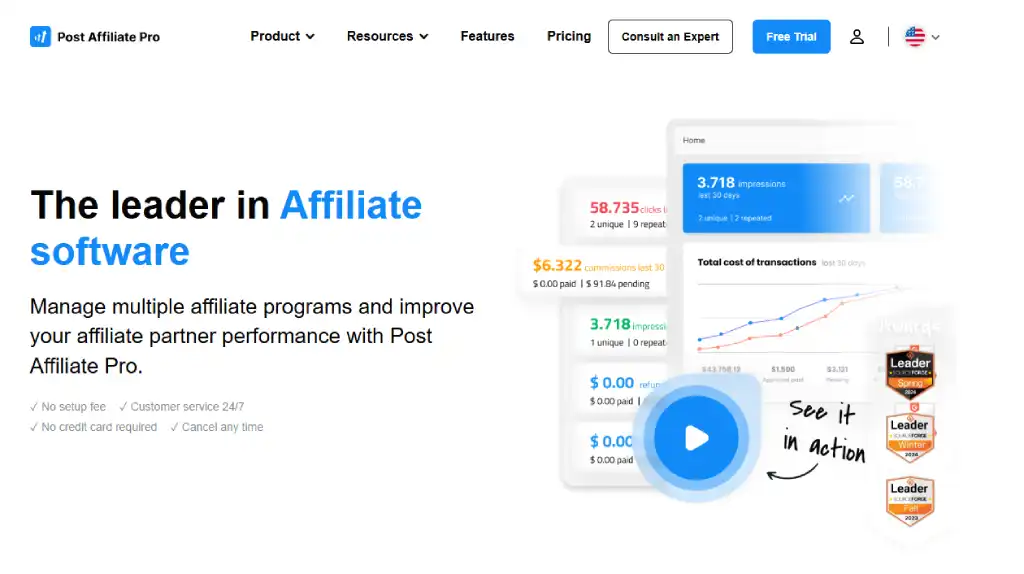
This is not the cheapest option for a tiny program, and the Starter request allowance may be restrictive for high traffic. It becomes more relevant when its integrations, configurability and included setup reduce development or administration work. The correct comparison is against the cost of assembling several smaller tools—not only against another product's entry fee.
- Best for: businesses that need extensive integrations and a configurable affiliate environment.
- Cost advantage: broad plugin coverage and unlimited affiliates at the entry tier.
- Watch for: 10,000 monthly tracking requests and substantially higher pricing for larger plans.
Best Low-Cost Option by Business Type
| Business type | Good starting shortlist | Why |
|---|---|---|
| Growing multi-channel program | Tracknow, Tapfiliate | Broader integrations and room to operate beyond one store or billing platform |
| Small Shopify store | BixGrow, GoAffPro, UpPromote | Native Shopify workflows and free or low-entry tiers |
| SaaS using Stripe or Paddle | Rewardful, FirstPromoter, Tolt | Subscription-focused integrations and recurring commission logic |
| WooCommerce store | Tracknow or a WooCommerce-specific plugin | Choice between an external scalable platform and lower-cost WordPress-local tooling |
| Program needing many plugins | Post Affiliate Pro | Broad published plugin library, provided the traffic allowance is sufficient |
| Affiliate or lead network | Tracknow Network or purpose-built network software | Advertiser access, multiple campaigns and network accounting require different capabilities |
A tool that is affordable for ecommerce may be unsuitable for finance, iGaming or a multi-advertiser lead network. Industry-specific data and commission requirements should take priority over the generic entry price.
Hidden Costs to Check Before Signing Up
Revenue and commission-based platform fees
A percentage fee can be attractive when the program has no revenue, but it scales with success. Model at least three scenarios: expected monthly revenue, twice that amount and the target for the following year. Include percentages charged on referral sales, affiliate-generated revenue or processed payouts.
Click, conversion and request overages
Vendors measure usage differently. One may count clicks, another conversions, and another every tracking request. Ask what generates a billable event, whether bot traffic counts, when reports update and what happens at the limit. A site with high traffic but a low conversion rate may need a very different plan from a smaller subscription business.
Payout processing
“Automated payouts” does not always mean payments are included in the subscription. There may be processing percentages, transfer charges, currency conversion, minimum balances or a paid integration. Tracknow users planning global operations can review the Tracknow and Tipalti payout workflow.
Required integrations and add-ons
Confirm whether the base plan includes your ecommerce platform, billing provider, subscription system, CRM, email tool and accounting workflow. API access, webhooks, Zapier, custom domains and white-labeling are commonly restricted to higher tiers.
Manual administration
If an affiliate manager spends six extra hours per month correcting data or preparing payouts, multiply those hours by the fully loaded hourly cost. The result belongs in the software comparison.
Migration and exit
Check whether affiliates, links, commissions, payout history and transaction-level data can be exported. Switching platforms may require redirects, new cookies, partner communication and reconciliation of unpaid balances. Cheap software with weak export options can create an expensive migration.
A Practical 14-Day Evaluation Plan
A trial should test the software, not the ability to recruit and activate an entire affiliate channel in two weeks. Use a controlled proof of concept:
- Day 1: document the required integrations, commission rules and expected monthly volumes.
- Days 2–3: install the tracking and create two affiliate groups with different rates.
- Days 4–5: test tracked links, coupons, cross-device behavior where supported and excluded traffic.
- Days 6–7: test a conversion, cancellation, full refund and partial refund.
- Days 8–9: verify partner and manager reports against the commerce or billing source.
- Days 10–11: test commission approval, an export and a small payout workflow.
- Days 12–13: test permissions, fraud flags, API or automation requirements and support response.
- Day 14: calculate the current cost and the forecasted cost at twice the expected volume.
Track attribution discrepancies rather than accepting a dashboard total at face value. The guide to affiliate link tracking explains the basic identifiers that need to remain consistent through the conversion journey.
When Free Affiliate Software Is Enough
A free plan may be enough when the program is a genuine test with a small number of partners, a single store, simple percentage commissions and a manager who can approve payments manually. It is also useful for validating whether partners will generate activity before committing to a more advanced platform.
A free plan is usually no longer enough when the business needs several campaigns, multiple stores, recurring revenue, sub-affiliates, white-labeling, advanced permissions, API access, automated payouts or dependable fraud controls. At that point, the cost of missing functionality can exceed the subscription saving.
How to Choose Without Overpaying
- Define must-have features. Separate launch requirements from features that might be useful later.
- Forecast volume. Estimate affiliates, clicks, conversions, referral revenue, stores, campaigns and team members.
- Calculate total cost. Include percentage fees, overages, payouts, add-ons and staff time.
- Test real exceptions. Refunds, chargebacks, subscription changes, coupon conflicts and duplicate referrals reveal more than a standard conversion.
- Inspect the upgrade path. Identify the first limit likely to be reached and the price of the next suitable plan.
- Check data portability. Confirm that the program can leave without losing transaction history or unpaid balances.
- Review pricing again before purchase. Treat the dated prices in this article as a snapshot, not a permanent offer.
Conclusion
There is no universally cheapest affiliate platform. BixGrow, GoAffPro and UpPromote offer very low entry costs for Shopify, while Rewardful and FirstPromoter start at accessible prices for subscription businesses. Tolt provides a SaaS-focused alternative with a higher revenue allowance, and Tapfiliate or Post Affiliate Pro may justify their price when broader integrations are actually required.
Tracknow ranks first for overall value because the entry plan combines unlimited affiliates and conversions with a large tracking allowance and features designed to support a program beyond its earliest stage. It is not the lowest sticker price, and a tiny Shopify-only test may spend less with a native app. For a growing program, however, capacity, setup, tracking options and upgrade flexibility can make Tracknow the less expensive long-term choice.
Before deciding, compare each platform using your own volumes and commission workflow. The most affordable software is the one that produces accurate, explainable partner balances without creating hidden percentage fees or manual work.
Frequently Asked Questions
What is the cheapest affiliate software?
Several Shopify-focused tools offer free plans, including BixGrow, GoAffPro and UpPromote. The cheapest suitable option depends on limits, percentage fees and required features. A free plan is not automatically the lowest-cost choice at higher volume.
Does Tracknow offer a free plan?
No free plan is shown on Tracknow's current pricing page. The published Pro plan costs $116 per month when billed annually and includes a 14-day trial without a credit card. This corrects the outdated claim in the earlier version of this article.
Why is Tracknow ranked first if other tools start cheaper?
The ranking considers value and capacity, not only entry price. Tracknow's Pro plan lists unlimited affiliates and conversions, one million monthly tracking requests and several advanced features. A small Shopify program can start for less elsewhere, but a growing operation may reach those tools' limits sooner.
Are free affiliate plans suitable for high traffic?
Sometimes, but “unlimited traffic” must be checked alongside limits on affiliates, referral orders, sales, approvals and features. Test the exact high-volume workflow and ask what happens when a threshold is reached.
What is the difference between a transaction fee and affiliate commission?
Affiliate commission is the reward owed to the partner. A transaction or referral-sales fee is an additional amount charged by the software or payment provider. Both affect the program budget, but they are paid to different parties.
Which affordable affiliate software is suitable for SaaS?
Rewardful, FirstPromoter and Tolt are designed around SaaS or subscription workflows. Tracknow and Tapfiliate are broader platforms that can also support SaaS programs where cross-platform tracking or more varied commission models are required.
Which low-cost tools are suitable for Shopify?
BixGrow, GoAffPro and UpPromote provide Shopify-native entry options. Tracknow also integrates with Shopify and is more relevant when the merchant needs a broader affiliate platform or plans to expand beyond a basic single-store workflow.
Can cheap affiliate software track recurring commissions?
Some affordable SaaS tools support recurring commissions, but the exact billing platforms and subscription events differ. Test upgrades, downgrades, failed payments, cancellations, refunds and reactivations before launch.
How often should affiliate software pricing be reviewed?
Review pricing before purchase, at every renewal and whenever affiliate volume changes significantly. For a public comparison article, recheck all vendor prices and limits at least quarterly because plan structures can change without affecting the product name.