
Affiliate Marketing Fraud: Types, How They Work, and How to Prevent Them
A practical guide to fraudulent traffic, stolen attribution, fake conversions, and commission abuse—for affiliate managers, businesses, and legitimate partners.

Tracknow’s security specialists created this guide because affiliate program owners, managers, and partners can all encounter fraud in their work. We want to share our experience and help readers understand how these schemes work, what damage they cause, and how to investigate suspicious activity while protecting legitimate partnerships.
Affiliate marketing depends on a straightforward agreement: a partner helps generate a qualifying result, and the business rewards that contribution under the program’s rules. Fraud exploits the steps between the activity and the reward. Someone may fabricate a lead, claim credit for another publisher’s sale, disguise a prohibited traffic source, or redirect a payment that belongs to a legitimate partner.
The difficult cases can look convincing. A customer may be real. A payment may clear. A reporting dashboard may show a valid order number and an attributed affiliate. None of those facts, by itself, establishes that the credited partner earned the commission.
Other schemes create results that never had commercial value: registrations with fabricated details, repeated submissions of the same lead, or orders placed with stolen payment information. These require different checks from attribution theft. An investigation that only asks whether an order exists will miss some problems; one that only studies clicks will miss others.
This guide follows the full process, from the initial placement and referral through conversion validation and payment. For each major scheme, we explain the mechanism, the financial incentive, the evidence worth examining, and the limits of common defenses. We also examine how legitimate affiliates can protect their accounts, document referrals, and challenge unexplained discrepancies.
The goal is to make better decisions with evidence. Effective fraud prevention should stop dishonest activity and give legitimate partners a fair way to explain unusual results.

What Is Affiliate Marketing Fraud?
Affiliate marketing fraud is deliberate deception used to obtain an affiliate-related reward or divert a legitimate payment. It can involve fabricated activity, false claims about a referral, manipulation of conversion records, misrepresentation of identity, or intentional concealment of information that determines eligibility for payment.
In this guide, the term describes deceptive conduct within the affiliate ecosystem. It is not a legal finding about a particular person or company. A disputed commission, a broken integration, or an unsuccessful campaign needs to be examined on its own facts.
Three Questions Behind an Affiliate Commission
A useful investigation separates three questions that a dashboard may present as one result:
- Did the action happen? Was there a real purchase, registration, installation, or other qualifying event?
- Was the action eligible? Did it meet the program’s requirements, such as customer status, payment confirmation, permitted geography, and rules on duplicate submissions?
- Was the correct partner credited? Does the recorded attribution reflect an eligible interaction under the agreed rules, or was it obtained through deception?
A fabricated registration can fail the first check. A real purchase that does not meet a new-customer requirement can fail the second. A genuine, eligible purchase with a secretly inserted affiliate interaction can fail the third.
These checks help identify where a result becomes invalid. They do not, on their own, establish intent. An ineligible event can reach a report because of a configuration error, a misunderstanding, or deliberate manipulation. The investigation must distinguish those explanations.
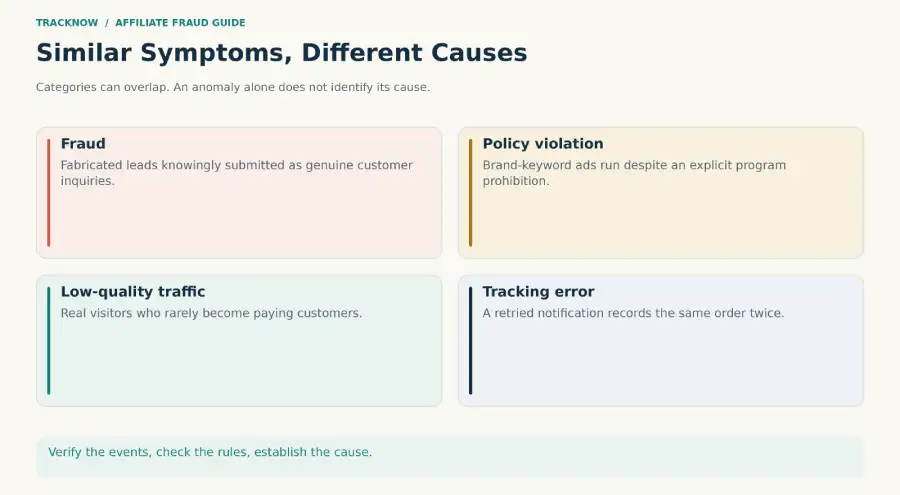
Fraud, Policy Violations, Poor Performance, and Tracking Errors
These problems can produce similar symptoms but call for different responses.
| Category | What it means | Illustrative example | What to establish |
|---|---|---|---|
| Fraud | Deliberate deception to obtain a reward or divert payment. | Someone knowingly submits fabricated leads as genuine customer inquiries. | What was misrepresented, how the activity occurred, and what evidence supports a finding of intentional deception. |
| Policy violation or program abuse | Activity that breaches agreed conditions or exploits a reward mechanism outside its permitted use; it may also involve fraud. | An affiliate runs brand-keyword ads despite an explicit prohibition. | Which rule applied, whether it was breached, and whether additional deception occurred. |
| Low-quality traffic | Real visitors or inquiries that produce weak commercial results. | A relevant-looking placement attracts people who rarely become paying customers. | Audience fit, placement quality, offer clarity, and downstream results. |
| Tracking or integration error | A technical problem that records, attributes, or processes activity incorrectly. | A payment notification is retried, and an integration records the same order twice. | The event history, integration behavior, and protections against duplicate processing. |
For example, brand bidding can be permitted for selected partners and prohibited for others. An ad on a brand query is therefore something to check against the applicable agreement. Its presence alone does not demonstrate fraud. The same care is needed when reviewing cashback, coupon promotion, incentivized traffic, and self-referrals: eligibility depends on the program’s rules and what actually happened.
Recorded Attribution Is Different from Proven Incremental Value
Attribution determines which partner receives credit under a defined set of rules. Incrementality asks whether the business gained an outcome that would otherwise not have happened. These are related questions, but they are not interchangeable.
A permitted coupon interaction might earn a commission under the contract even when the customer was already close to purchasing. The business may want to evaluate the arrangement’s economics or change future commission rules. That does not establish deception in the existing transaction. A hidden, fabricated interaction presents a different issue: whether the attribution itself was obtained dishonestly.
Who Can Be Harmed?
Advertisers can lose money through invalid commissions, poor leads, payment disputes, and misleading performance reports. Managers spend time reconstructing events and resolving disputes. Legitimate affiliates can lose credit for their work or have their accounts and payment details targeted.
The direction of abuse can also reverse. A partner may need to investigate deliberate suppression of qualifying conversions or unjustified commission reversals by a program operator. Missing conversions alone do not establish that behavior; the same distinction between evidence, error, and intent applies.
To understand the individual schemes, we first need to examine how a legitimate referral becomes a recorded conversion and, eventually, a paid commission.
How Affiliate Tracking Works—and Where Fraud Enters the Process
Before investigating a suspicious commission, reconstruct how it was created. Which interaction identified the partner? Where was that information stored? Which system reported the conversion? What made the event eligible for payment?
A tracking record answers some of these questions, but rarely all of them. The click log, customer database, order system, payment provider, and affiliate platform each describe a different part of the journey. Understanding how they connect makes it easier to locate both deliberate manipulation and ordinary integration failures.
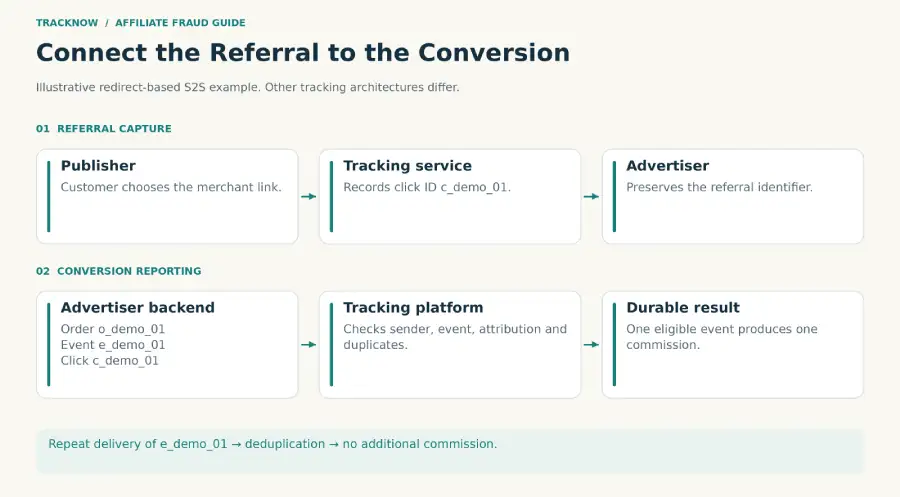
1. The Link Identifies a Partner and a Placement
An affiliate URL usually identifies a partner and a campaign or offer. It may also carry a sub-ID describing a placement, creative, or traffic source. The following is an illustrative URL, not a Tracknow integration template:
https://tracking.example/click?affiliate_id=42&campaign_id=7&sub_id=review_articleIn a redirect-based implementation, the tracking service receives the request, records the referral, and sends the visitor to the advertiser. A direct-link implementation can capture the referral on the advertiser’s site without an intermediate tracking redirect. Both need a dependable way to preserve the connection to a later conversion.
The first trust boundary appears here: a supplied parameter describes a claim. A sub-ID saying review_article does not prove that a visit came from a review. An affiliate ID identifies the account being credited, but does not establish that a human deliberately followed the link.
2. Identifiers Connect Different Records
Several identifiers may appear in one journey. Keep their purposes separate, particularly when comparing data across platforms.
| Identifier | Purpose | Important limitation |
|---|---|---|
| Affiliate or partner ID | Identifies a partner account. | Does not identify the actual placement or prove the account holder generated the activity. |
| Campaign or offer ID | Selects the relevant offer and configuration. | Must be checked against partner permissions and the applicable rules. |
| Click ID or referral ID | Connects conversion reporting to a recorded interaction or tracking session. | A recognized ID does not prove that the interaction was genuine. |
| Sub-ID or placement ID | Separates sources within a partner’s traffic. | May be supplied by the partner and requires independent verification. |
| Order, lead, or invoice ID | Links the conversion to a business record. | The record may exist without being paid, eligible, or legitimate. |
| Event ID | Identifies a particular reported occurrence, such as a payment. | Must remain consistent across retries if used to prevent duplicate processing. |
Names vary. One system’s transaction_id may identify a tracking session, while another uses that name for a purchase. Before joining reports, document what each field represents. Matching two columns with the same name can produce a convincing but incorrect reconstruction.
3. The Advertiser Preserves the Referral
The advertiser may associate the referral identifier with a browser session, store it in a cookie, or save it against a customer or order record. These mechanisms can coexist. For example, a cookie may initially preserve a reference that is later linked to an authenticated customer in a database.
First-party and third-party describe a cookie’s relationship to the site context in which it is used. They do not describe whether the underlying activity is honest. Browser restrictions, storage settings, cookie scope, and deletion can affect whether the reference remains available. A first-party cookie is not a certificate of legitimate attribution.
Returning on another device also requires a supported way to connect the journeys. A server-side database can retain a referral already associated with a customer; it cannot automatically identify an anonymous visitor on every device.
During a review, ask when the referral was first stored, whether it changed, and what caused any replacement. A missing or changed identifier can result from a broken redirect, an implementation decision, or interference. Establish the sequence before choosing an explanation.
4. A Conversion Is Reported Through a Browser or a Server
With browser-side tracking, a script, image request, or iframe can report an action from a confirmation page or another point in the interface. This depends on the browser executing the relevant request. Reloads, blocked scripts, or a confirmation page that never opens can affect reporting.
With server-to-server tracking, the advertiser’s backend sends a conversion request to the tracking platform. That request is commonly called a postback. In a click-linked implementation, it returns the stored referral identifier together with the event details.
S2S reduces dependence on the browser at the conversion-reporting step. The earlier referral capture may still use browser storage. Moving the final request to a server does not repair a missing click ID or prove that a lead, purchase, or attributed interaction is genuine.
For a fuller implementation walkthrough, see our guide to S2S postback tracking.
5. The Receiver Checks the Event Before Creating a Reward
A well-designed integration separates accepting a message from deciding that it represents an eligible result. The receiver should have answers to several independent questions:
- Sender: Is the request authenticated using the integration’s supported mechanism?
- Relationship: Does the referral belong to the correct advertiser, campaign, and permitted partner?
- Business event: Does the reported action match the relevant order, payment, or CRM record?
- Values: Do the event type, amount, currency, and customer eligibility agree with authoritative business data?
- Uniqueness: Has this same payable event already been processed?
Authentication and message integrity matter, but a correctly authenticated sender can still send incorrect information. Likewise, an identifier visible in a landing-page URL should not serve as the sole authorization to create a commission.
Read the endpoint’s documented response semantics. An HTTP 200 response may acknowledge receipt while the response body reports a rejected conversion, or while processing continues elsewhere. Successful delivery, successful recording, and commission approval are separate outcomes.
6. Retries Must Not Become Additional Commissions
Systems retry requests when delivery is uncertain. The same event may therefore arrive more than once without any malicious intent. Processing must be idempotent: repeating the same event should not create an additional reward.
Choose a deduplication key that represents the business event within its proper scope. For a subscription, each paid invoice may legitimately create a commission, while repeated delivery of the same invoice event should not. Deduplicating only by click ID could suppress legitimate later purchases; generating a new event ID for every retry could allow duplicates.
Preserve both occurrence time and receipt time, with explicit time zones. A delayed notification can arrive after a later business event. Reconstruct the underlying sequence instead of assuming that arrival order represents customer behavior.
7. Attribution Rules Determine Which Eligible Partner Gets Credit
A program may use the first eligible referral, the last eligible referral within a defined window, a customer-level relationship, or a code assigned to a partner. The configuration must specify what happens when these signals compete.
A discount code is not automatically an attribution code. A program can use a code only to calculate a discount, or explicitly map it to a partner for commission purposes. In the latter case, a qualifying sale may be attributed without an affiliate-link click. Investigators need to check the configured method before interpreting a conversion with no recorded click as suspicious.
Also distinguish an attribution window from a browser cookie’s lifetime and from a commission-validation period. These control different things: whether an interaction remains eligible, whether a reference remains stored, and when a recorded reward can be approved.
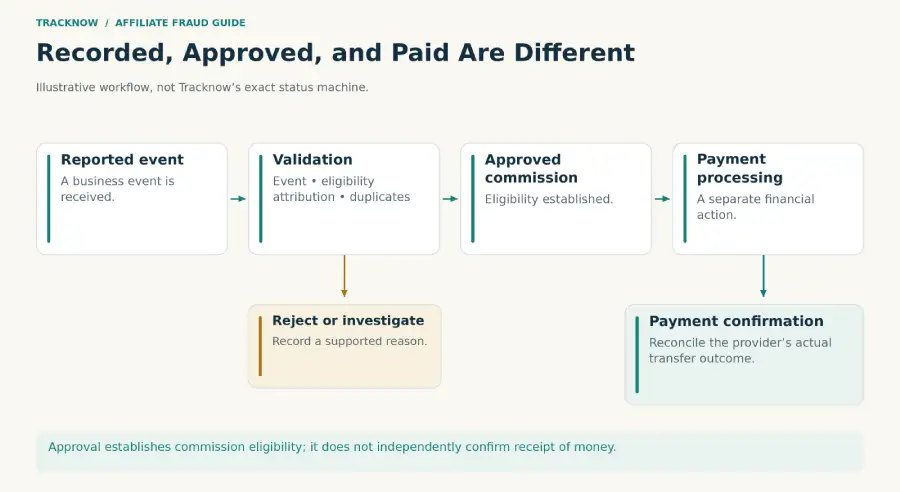
8. Recorded, Approved, and Paid Are Different Milestones
A recorded conversion is a reported event. Approval indicates that it has passed the program’s applicable checks or approval process. Payment is a further operational step. The labels and permitted transitions vary by platform.
In Tracknow, approved commissions become available for payout requests. The platform also distinguishes statuses such as Pending, Denied, Revision, Hold, Processing, and Paid. See the conversion-status documentation for their exact behavior. A timed Hold can automatically become Approved, so a waiting period should not be mistaken for an investigation.
Reconcile the commission record with the payment process. Where a status changes through an administrative approval, separately check the transfer record when establishing whether funds actually reached the intended recipient.
Where Fraud Can Enter This Process
Each stage creates a different opportunity for deception: fabricated interactions at referral capture, replaced identifiers during attribution, false business events during reporting, concealed ineligibility during validation, or altered recipient details during payment.
For a practical starting point, trace one disputed commission back to its business event and referral, then follow it forward to approval and payment. Note which system supplies each fact and where the evidence stops. This gives the investigation a specific question to answer instead of a dashboard anomaly to speculate about.
We will start with the earliest stage: artificial clicks and bot traffic.
Affiliate Fraud Types: How the Schemes Work
The following sections examine individual mechanisms. Some overlap: a bot may generate a forced interaction, and that interaction may later influence attribution. We separate the mechanisms so you can identify what happened, which records to examine, and which control addresses the specific problem.
1. Click Fraud and Bot Traffic
A sudden increase in affiliate clicks can look like a successful placement. But a click counter measures recorded interactions, not necessarily interested customers. If artificial requests enter that counter and are presented as genuine referrals, the program may reward activity that has no legitimate marketing value.
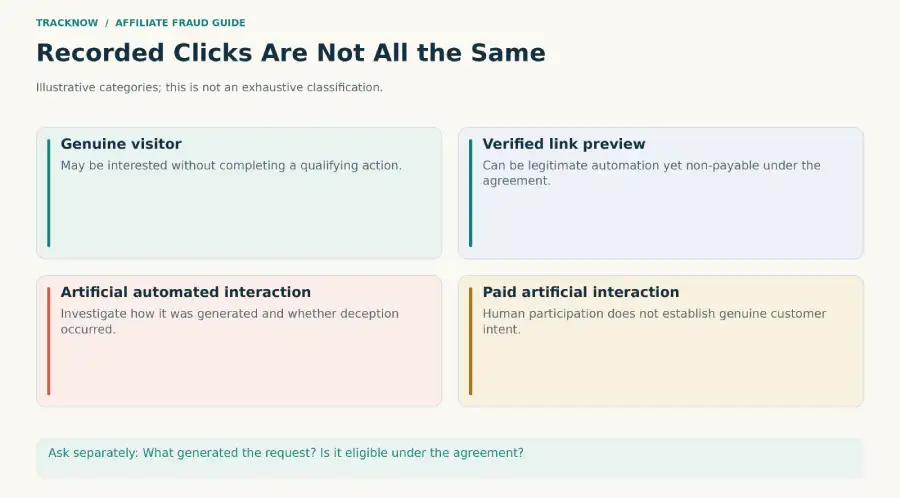
Click fraud involves deliberately generating or reporting deceptive click activity to obtain a benefit or cause financial harm. It can use automated software, people paid to perform artificial interactions, or a combination of the two. Bot traffic is broader: automation also powers search crawlers, security checks, monitoring, and link previews.
A real visitor who leaves without buying has not committed fraud. Neither low purchase intent nor failure to convert establishes deception. The question is whether the reported interaction represents the activity it claims to represent under the program’s rules.
How the Scheme Works
In an affiliate context, artificial activity can reach the tracker through repeated requests to a tracking URL, automated browser visits, or fabricated click reports where an integration accepts them. Some activity stops at the redirect; other activity reaches the advertiser and produces page events. A session appearing in analytics therefore does not automatically establish a genuine referral.
Click farms add another complication. People or devices can perform repetitive interactions that resemble ordinary browsing at the request level. A successful browser check or the use of a real device does not establish legitimate customer interest.
The immediate objective may be to collect CPC payments or exaggerate traffic when negotiating a placement fee. Artificial clicks can also support attribution manipulation. We examine click flooding and click injection separately because those schemes require analysis of how reported interactions compete for conversion credit.
Where the Financial Damage Appears
| Payment arrangement | Potential damage | What to establish |
|---|---|---|
| CPC | Invalid clicks may generate direct commission charges. | Which recorded clicks were payable, invalid, and actually paid. |
| CPL, CPA, or revenue share | Artificial clicks distort reporting; direct commission loss requires an associated reward-triggering event or attribution outcome. | Whether a lead, sale, or other eligible event created a commission. |
| Fixed-fee or hybrid placement | Inflated traffic may mislead decisions about fees, renewals, and budget. | What traffic was promised and how the reported performance influenced spending. |
Even without click-based payments, polluted reports can make a productive placement look ineffective by inflating its conversion-rate denominator. Managers may cut the wrong source, while legitimate partners spend time defending results they did not manipulate.
Signals Worth Investigating
Review patterns together and against comparable traffic, rather than applying a universal clicks-per-minute or conversion-rate threshold.
- Unexplained volume changes: a spike without a corresponding placement, audience change, or promotion.
- Repetitive timing or behavior: recurring request sequences that deserve comparison with monitoring and campaign activity.
- Concentrated infrastructure: unusual clustering by network, device characteristics, or other available signals.
- Broken journeys: many recorded referrals with little corresponding landing-page activity, after checking delivery and measurement problems.
- Source inconsistencies: activity that does not fit the disclosed placement or the partner’s explanation.
Each signal has limits. Shared office and mobile networks can concentrate legitimate visitors behind one public IP. Referrer policies can omit or shorten the referring address. Browser privacy settings and analytics configuration can prevent a legitimate visit from appearing in a report.
A bot score estimates automation according to a provider’s model; it is not a finding of affiliate fraud. Conversely, apparently human traffic may include paid artificial interactions. Keep automation assessment separate from the question of payment eligibility and intent.
How to Investigate a Suspicious Traffic Spike
- Preserve the relevant records. Keep the time range, campaign, partner and sub-IDs, request or click identifiers, destination, timestamps, and available detection results. Restrict access to sensitive data and avoid exporting credentials or unnecessary customer details.
- Compare equivalent measurements. Raw HTTP requests, total clicks, unique clicks, sessions, and users are different units. Align time zones, reporting delays, filtering, and redirect behavior before calculating discrepancies.
- Trace a representative sample. Follow the tracker request to the landing-page request and any subsequent business event where identifiers allow. Examine both flagged and unflagged activity to test the proposed explanation.
- Check legitimate automation. Identify previews, security scanners, monitors, and authorized tests. Validate claimed service identity using supported verification methods rather than trusting a user-agent label alone.
- Verify the placement with the partner. Request the relevant page, distribution schedule, traffic source, and explanation for the change. Check whether a third-party traffic supplier was involved.
- Document the conclusion and its scope. Separate confirmed invalid traffic, confirmed deception, and unresolved activity. Apply payment decisions to the evidenced events and contractual rules.
Google Analytics automatically excludes known bots and spiders. A tracker may therefore record requests absent from GA4. Consent choices, blocked scripts, redirects, and different counting methods can create further gaps. A tracker-to-GA4 mismatch is a diagnostic clue, not a count of fraudulent clicks.
Common False Positives
A newsletter or viral post can create a sharp burst of genuine traffic. Messaging services may fetch shared URLs to build previews. Email-security products may inspect links before delivery or when clicked. If those requests reach the tracking endpoint, they can affect raw counts without representing a buyer’s deliberate referral.
Verified automation may be useful and still non-payable under a CPC agreement. Excluding it from commission calculations does not require accusing the partner of fraud. Likewise, finding artificial traffic in a partner’s supply chain does not by itself establish that the partner knowingly arranged it.
Reducing the Risk Without Damaging Legitimate Referrals
Define payable clicks and excluded activity before launch. Require source transparency, including traffic suppliers, and retain placement-level identifiers. Combine network and behavioral screening with downstream validation; no single characteristic should carry the entire decision.
Keep reviewable raw counts separate from payable counts so exclusions can be explained. Apply rate controls or challenges selectively, test their effect on genuine visitors, and preserve the referral identifier through legitimate redirects. Independently protect conversion-reporting endpoints: blocking suspicious landing-page requests does not validate incoming postbacks.
Watch the results after a rule changes. Fewer recorded clicks may indicate successful filtering, blocked customers, or a broken tracking path. Compare actual customer outcomes and partner feedback before declaring success.
The next scheme can create affiliate attribution without a deliberate referral at all: cookie stuffing and forced clicks.
2. Cookie Stuffing and Forced Clicks
Imagine earning an affiliate commission because someone visited your page, even though they never chose to follow your recommendation or open the advertiser’s offer. If a hidden interaction creates the referral record, a later purchase can make that interaction look like successful marketing.
Cookie stuffing creates affiliate tracking state without the qualifying referral interaction the program requires. It is commonly implemented by causing the browser to contact a tracking or advertiser endpoint without a deliberate affiliate-link click. The term can describe one improperly established referral; it does not require filling the browser with many cookies.
Forced clicks manufacture the interaction itself. An automatic request, concealed navigation, or action tied to an unrelated interface control may be reported as an affiliate click. Cookie stuffing describes the improperly established tracking state; forced clicking describes a way of creating it. The techniques frequently overlap.
How Tracking Can Be Triggered Without a Genuine Referral
Web pages load resources automatically. Historically, hidden frames and other embedded resources have been used to initiate affiliate requests when a page loads. Unrequested windows or redirects can serve a similar purpose. The browser performs network activity, and a permissive tracking implementation may record it as a referral.
This does not mean a publisher can freely write a cookie for an unrelated merchant’s domain. Browser cookie-domain rules restrict that. Instead, the browser contacts the relevant tracking or merchant infrastructure, which may return a cookie or otherwise establish the referral through its own implementation.
Whether that attempt succeeds depends on the request context, browser storage rules, endpoint behavior, and attribution configuration. A tracking request in a network log is evidence of an attempt or interaction, not proof that a usable cookie was stored or that a later commission resulted.
A physical click is not sufficient evidence of a deliberate referral either. Clicking a play button, closing an overlay, or accepting a cookie notice does not necessarily mean choosing to visit a merchant. Investigators must examine what the interface represented and what the resulting request actually did.
From Hidden Request to Misallocated Commission
For an attempt to affect a commission, three things generally need to happen: the system establishes referral state, connects it to a later conversion, and gives it credit under the applicable attribution rules. Failure at any stage can leave suspicious requests without financial impact.
This is why checking only order validity misses the scheme. Misleading reports may also encourage a manager to raise B’s rate or reduce investment in A, extending the damage beyond the original commission.
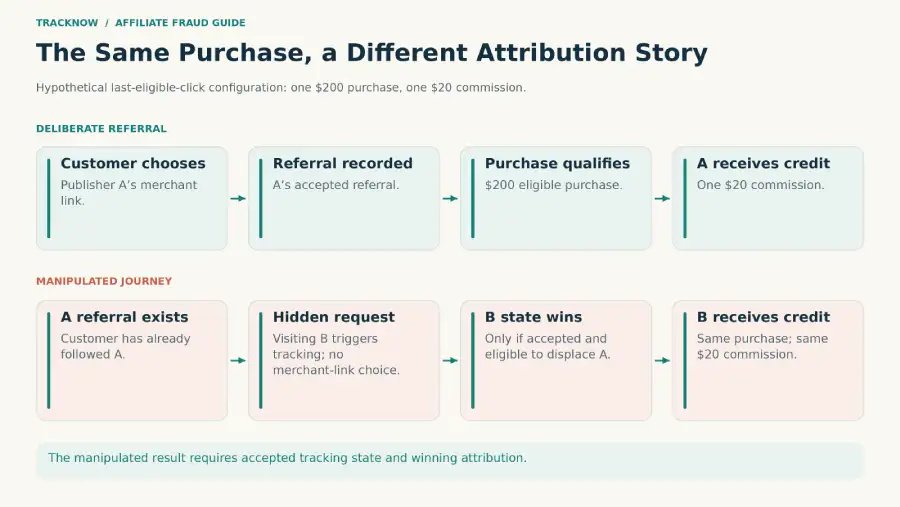
Warning Signs and Their Limits
Look for tracking calls before any relevant interaction, merchant requests originating from concealed page elements, or referral changes that cannot be explained by the visible journey. A partner receiving credit across unrelated placements may also warrant closer review.
Timing needs context. Broadly distributed stuffing may generate many clicks and relatively few conversions. Interception close to checkout may produce very short click-to-purchase intervals. Neither an unusually low nor high conversion rate is a universal signature.
A screenshot cannot reveal every background request. Equally, an embedded frame, a cookie, or a redirect is not inherently fraudulent. Determine what it triggered, whether it affected attribution, and whether that behavior was permitted.
How to Investigate
- Establish the permitted interaction. Read the rules on click-based attribution, redirects, software partners, and impression-based attribution. Identify the policy and configuration in force when the disputed events occurred.
- Reproduce the page visit in a controlled browser. Use an isolated test profile and record its browser version, extensions, storage settings, and initial state. Begin network capture before loading the placement. Avoid generating real payable transactions during testing.
- Separate page loading from user actions. First observe requests without interacting, then perform the specific visible action being reviewed. Compare the sequences instead of assuming every recorded click came from a merchant link.
- Inspect the initiating element and request chain. Preserve relevant initiator information, redirects, request times, and responses. Determine whether a page element, third-party tag, or browser component initiated the affiliate request.
- Check the actual tracking effect. Inspect stored cookies and available referral records before and after the interaction. A
Set-Cookieresponse alone does not prove the browser accepted or later used it. - Connect the effect to disputed conversions. Match supported identifiers and attribution history to business records. Record the affected commissions and remaining uncertainty; reproduction alone does not establish every historical loss.
Preserve the test conditions and repeat relevant observations where behavior varies. Sanitize network archives before sharing them: they can contain authentication tokens, cookie values, and personal information. If a third-party tag caused the behavior, investigate who controlled it before attributing intent to the account holder.
Legitimate Tracking That Can Look Similar
A disclosed merchant link can legitimately pass through multiple redirects. Conversion pixels can also load without a click at the moment of purchase because they report an action that already occurred. Neither behavior establishes cookie stuffing.
Some programs explicitly support post-view attribution after an eligible ad impression. That is a different event type with its own permissions and priority rules. An agreed impression should not be confused with a fabricated post-click referral. Cookie consent also answers a different question: accepting storage does not establish that a commission-qualifying referral happened.
Prevention and Technical Limits
Define which interactions can establish or replace referral credit. Require disclosure of automatic redirects and embedded promotional technology, and audit actual placements. Where supported, distinguish event types and attribution priorities so an impression or lower-priority interaction cannot silently impersonate an eligible click.
Review merchant-side tags and referral updates, retaining enough history to explain changes. S2S conversion reporting cannot correct a referral that was dishonestly established earlier; it may accurately report a real order against the wrong source.
Browser controls provide partial protection. Third-party-cookie restrictions can prevent some storage attempts, but are not a complete attribution-fraud defense. Cookie attributes such as Secure, HttpOnly, and SameSite address specific transport, script-access, and cross-site behavior; they do not certify referral intent.
Restrictions on framing, such as CSP frame-ancestors, can control who embeds a protected page. They are not universal controls for tracking endpoints or other navigation mechanisms. Test any restriction against legitimate integrations before deployment.
The next section examines browser extensions and adware, where software on the customer’s device can interfere with attribution across multiple websites.
3. Browser Extension and Adware Attribution Hijacking
A customer can arrive through a legitimate affiliate, choose a product, and reach checkout before another party enters the tracking journey. Software installed in the browser or on the device may then insert its own referral. To the advertiser, the resulting conversion can resemble a normal partner-assisted purchase.
Extension-based attribution hijacking occurs when software dishonestly establishes or replaces affiliate credit. The software might present itself as a shopping assistant or provide an unrelated function. Adware can produce similar interference through unwanted advertising or navigation. Neither every browser extension nor every advertising-supported application behaves this way.
What Makes Installed Software Different?
The previous section examined hidden interactions triggered by a placement. Installed software can operate when the customer visits other sites, including the merchant directly. Its capabilities depend on the browser, operating system, granted permissions, and implementation.
For example, a permitted browser content script can inspect and change a page’s document structure. Other extension components can perform background work. An extension with the appropriate cookie and host permissions may also access browser cookies through dedicated APIs. These capabilities support legitimate features, but can be misused to change a referral or initiate an affiliate interaction.
Permission to access a website is not permission from the affiliate program to claim its sales. Likewise, installing an extension does not establish that the customer requested every later affiliate action it performs.
How Attribution Is Intercepted
The software recognizes a supported merchant or page, then performs an action that can affect attribution. Depending on its capabilities, it may modify a link, initiate a navigation or tracking request, or change relevant stored state. A subsequent conversion is matched against the resulting referral.
That sequence may involve cookie stuffing, but the categories are not identical. Cookie stuffing describes improperly established tracking state; this section focuses on installed software as the source of interference. Other extension abuses involve link or promo-code replacement rather than the same cookie mechanism.
The merchant’s order system can remain completely intact. A valid payment notification reports a real purchase against the referral currently stored. Moving conversion reporting to S2S therefore does not resolve earlier interference.
A site-only audit can miss this behavior. The merchant’s source code may contain no unauthorized script because the software runs in the visitor’s environment. A normal user-agent string also does not identify which extensions were installed.
Where Legitimate Cashback Ends and Abuse Begins
A transparent cashback or shopping extension can be a legitimate partner when its behavior meets the program’s conditions. Review the promised benefit, the user’s action, the actual tracking behavior, and the treatment of an existing referral.
Browser-store rules are another relevant standard. The Chrome Web Store’s Affiliate Ads policy requires disclosure, a direct and transparent user benefit, and related user action before each affiliate link, code, or cookie is included. Its FAQ clarifies that a coupon extension must not inject an affiliate link when no valid coupon or discount is available.
Those are Chrome Web Store requirements, not a universal legal definition of fraud or a substitute for the advertiser’s agreement. Store presence alone should not be treated as certification of a partner’s attribution behavior.
| Situation | What to establish |
|---|---|
| The customer visits the merchant without interacting with the extension. | Does the software create or replace affiliate tracking automatically? |
| The customer dismisses the extension’s prompt. | Does dismissal merely close the interface, or does it also trigger monetization? |
| The customer asks it to find a discount, but none is available. | Is a referral still inserted, and does that comply with the applicable rules? |
| The customer activates an eligible, disclosed benefit. | Does the resulting referral follow the agreed activation and attribution priorities? |
Why the Damage Can Be Difficult to See
The affected customers may pay normally, use the product, and rarely request refunds. Their good quality does not establish that the software partner brought them. Reports can nevertheless make that partner look exceptionally efficient because its recorded interactions happen close to purchase.
Earlier publishers can lose commissions, while the business reallocates budget toward a source claiming existing demand. Additional concerns arise if software collects browsing information or uses misleading prompts. Investigate those behaviors separately rather than assuming every attribution dispute also proves a privacy or security violation.
Useful signals include unexplained referral replacement after merchant arrival, tracking requests tied to closing an overlay, or repeated differences between controlled browser profiles. Short conversion latency is worth examining, but also occurs with legitimate checkout-stage partners.
Investigating a Particular Extension
- Identify the exact software. Record its extension ID, version, installation source, permissions, settings, and test date. The product name alone is insufficient, and different versions can behave differently.
- Create an isolated baseline. Use an authorized test environment without personal accounts or real payment details. Establish a known referral with the extension absent, and record the expected attribution.
- Compare matched starting states. Repeat with only the extension under review enabled. Reset referral and browser state between cases so one test does not contaminate another. Keep the merchant journey and relevant settings comparable.
- Exercise distinct interactions. Test merchant arrival, no activation, dismissal, unsuccessful offer searches, and explicit activation separately. Capture what the customer saw and what each action triggered.
- Inspect the relevant execution contexts. Correlate page requests with extension background activity, storage changes, and tracker records where available. The page’s Network panel alone may not capture the entire sequence.
- Verify the attribution consequence. Where an approved test conversion is possible, confirm which partner received credit and why. Then assess whether the same mechanism can be connected to historical disputed events.
Record any instrumentation effects. For example, inspecting an extension service worker can keep it active and alter its lifecycle. A failed reproduction is therefore a limited observation under documented conditions, not proof that the reported behavior never occurs.
If installed adware outside the browser is suspected, disabling extensions may not remove the cause. Escalate device analysis to the appropriate security team, preserving relevant evidence without installing untrusted software on a production workstation.
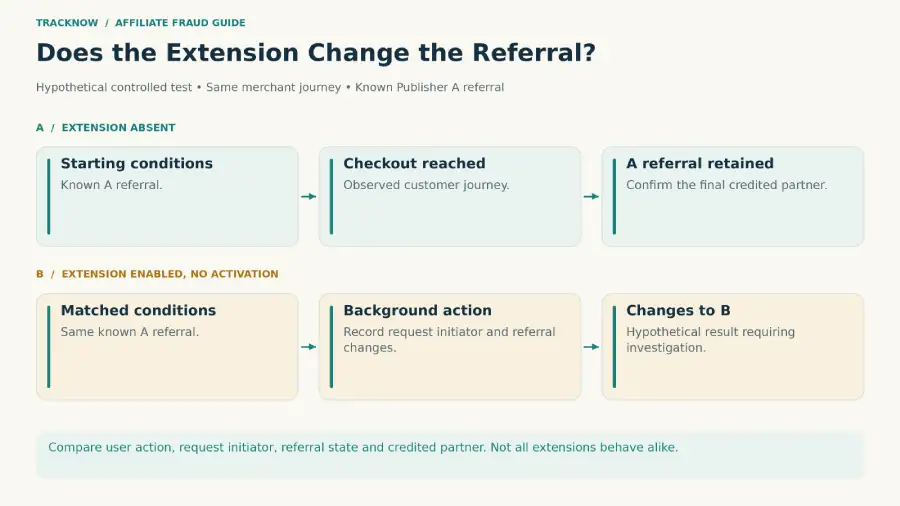
Prevention, Partner Rules, and Practical Limits
Require partners to disclose extensions, downloadable software, and the accounts through which they monetize. Agree on activation, dismissal, failed-offer, and existing-referral behavior. Review material software changes as well as initial enrollment.
Where supported, use attribution priorities or stand-down rules to protect existing eligible referrals. Awin’s Soft Click model is one documented example of lower-priority attribution for relevant partners. It illustrates a control approach; equivalent behavior should not be assumed in another platform without checking its configuration.
Retain server-side referral history and investigate unexplained replacements. Site security controls still matter, but page CSP is not a universal barrier against permitted extension capabilities. A tracker-issued identifier also proves neither user intent nor compliance with activation rules.
Give legitimate affiliates a reporting route for suspected interception. Ask for the journey, software version, and timing instead of treating every missing commission as theft. Clear rules and reproducible evidence make enforcement more accurate and protect approved software partners.
The next section moves to mobile attribution: click flooding and click injection, where fabricated interactions compete for credit for genuine app installs.
4. Click Flooding and Click Injection
An app install can be genuine while the recorded acquisition source is false. The user downloads the app, opens it, and may become a valuable customer. The fraud occurs when a party claims that its fabricated interaction caused that acquisition.
Click flooding and click injection steal attribution through different timing strategies. Flooding creates many false opportunities to claim credit. Injection targets an installation already underway. Both matter to affiliate programs that reward app acquisition or use mobile attribution to determine later commissions.
Click Flooding: Claiming Credit Through Volume
Click flooding, also called click spam, reports large numbers of interactions that users did not actually perform. Some may originate from background activity in apps; others can be artificial tracking requests or impressions misreported as clicks.
The objective is to place a fraudulent eligible interaction somewhere before a genuine install. If the attribution system matches the interaction to that installation and allows it to win, the source receives credit for acquisition it did not generate. This depends on the available matching signals, attribution rules, and filters; sending a request does not guarantee success.
Because false clicks are not driven by the customer’s actual decision, affected sources may show very low click-to-install conversion and a broadly spread timing distribution. Repeated flooding can also place false clicks close to installs. A perfectly flat curve is therefore not a required signature.
Click Injection: Arriving After the Decision to Install
Classic click injection is associated with Android software that detects installation-related activity and reports a false engagement before the target app’s first session. A vulnerable attribution process can treat this late interaction as the winning click.
The distinction is causal: the customer had already initiated installation before the purported acquisition interaction. The injected click did not cause that installation. It may nevertheless precede the first app opening, which some measurement systems use as their recorded install event.
Specific opportunities depend on operating-system versions, app capabilities, distribution channels, and measurement implementations. Do not assume every Android app can observe every installation, or apply the same install-broadcast explanation to iOS.
| Question | Click flooding | Click injection |
|---|---|---|
| How does it seek attribution? | Many fabricated interactions create chances to match genuine installs. | A fabricated interaction is timed around an installation already underway. |
| What is worth examining? | Click volume, repetition, conversion rate, timing distribution, and competing sources. | Engagement timing relative to installation start, completion where available, and first open. |
| Does good customer quality rule it out? | No. The captured customers can be real organic or paid acquisitions. | No. The installation and subsequent activity can be genuine. |
Understand What “Install Time” Actually Means
Click-to-install time, or CTIT, needs a documented endpoint. In commonly used mobile reporting, it measures the interval from an attributed click to the first app opening. That differs from time to installation start or completion.
Google Play’s Install Referrer API provides referral information and both client-side and server-side timestamps for the referrer click and installation beginning. A measurement SDK may provide additional events. These records describe different milestones and must not be treated as interchangeable.
Separate the reported occurrence time from the time your server received the report. Delivery delays can make an earlier legitimate interaction arrive late. Also check clock sources, seconds versus milliseconds, and event definitions before interpreting an impossible-looking sequence.
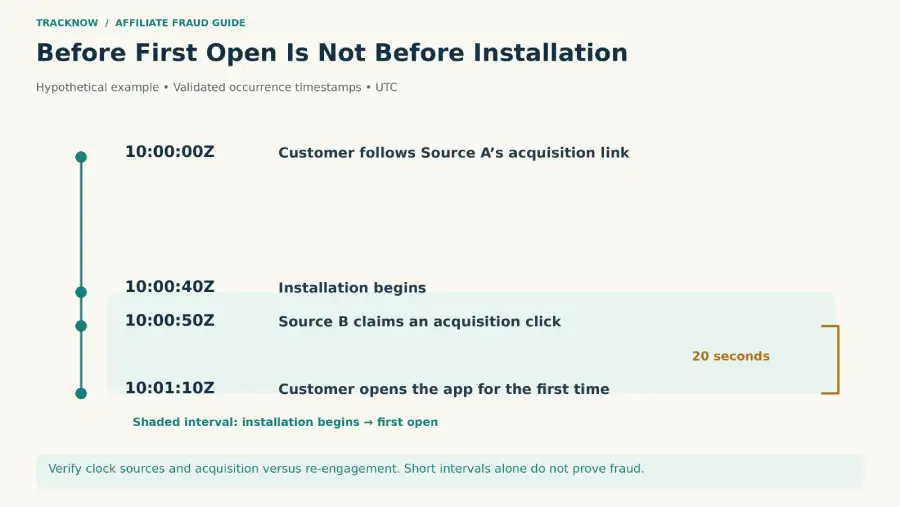
Why the Damage Extends Beyond CPI Payments
A fraudulent source may collect a cost-per-install reward for a customer obtained organically or by another campaign. If later registrations, subscriptions, or purchases inherit that attribution, additional commissions may also be affected.
The reporting damage can distort acquisition costs, retention comparisons, and budget allocation. A real customer’s strong engagement may make the false source look worth expanding. Conversely, rejecting the source’s attribution should not erase a genuine customer or purchase from business reporting.
Investigating the Suspected Source
- Confirm the measurement setup. Document the attribution provider, SDK version, operating system, store, lookback windows, and rules for installs, reinstalls, and re-engagement. Identify which fraud checks were active during the disputed period.
- Preserve sufficiently detailed records. Retain permitted click and install identifiers, partner and placement IDs, occurrence and receipt times, referrer evidence, attribution changes, and rejection reasons. Record where privacy restrictions leave fields unavailable.
- Examine competing interactions. Where available, inspect the eligible journey rather than only the winning click. Check whether the source repeatedly appears alongside acquisitions associated with other channels.
- Test the appropriate timing hypothesis. For flooding, examine repeated engagement and cohort distributions. For injection, compare claimed acquisition timing with trustworthy installation milestones. Investigate collection or classification errors before assigning intent.
- Compare equivalent cohorts. Segment by app, store, country, placement, campaign type, and relevant versions. Allow comparable time for conversions to occur; yesterday’s clicks and a mature month-long cohort do not have equal observation windows.
- Reconcile findings with commissions. Link affected attributions to install and downstream rewards. Preserve the original decision, correction, reason, and payment status so both managers and partners can review the outcome.
A missing device-level field does not prove concealment; availability can depend on privacy settings and reporting permissions. A large publisher-level anomaly may also originate in one sub-source. Identify that scope before extending the conclusion to all of the partner’s traffic.
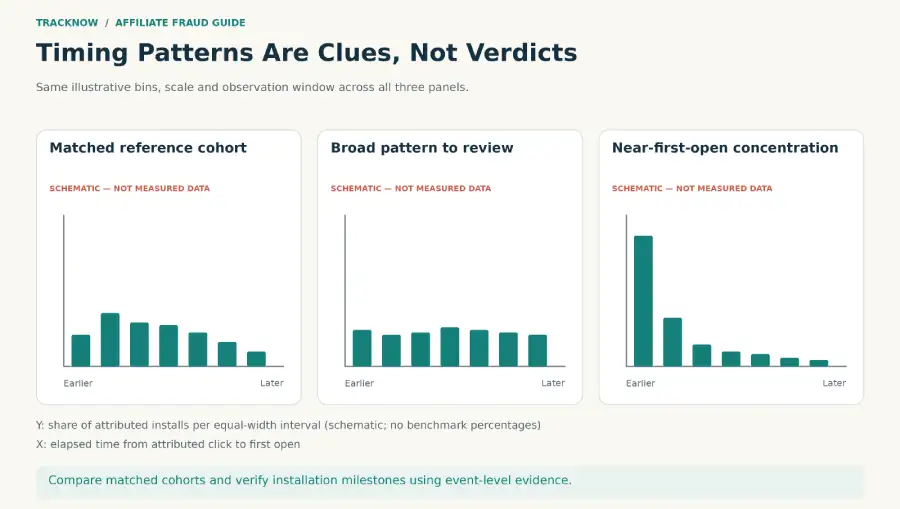
False Positives and Prevention Limits
Large downloads, slow connections, and delayed first openings can lengthen CTIT. A customer reopening an already installed app may create a short interval appropriate to re-engagement. Mixing those event types with new acquisitions can create misleading patterns.
Use supported store-referrer data, authenticated reporting, SDK protections, and attribution-fraud filters where available. Request placement transparency and monitor repeated or disproportionate engagement. Apply timing checks with the provider’s documented event semantics rather than copying a threshold from another app.
Install Referrer data strengthens reconstruction, but a referral string alone does not prove deliberate user interest. Reliable delivery and signed messages likewise do not establish the commercial legitimacy of every engagement.
Finally, connect rejection and correction reports to affiliate accounting. An attribution correction does not automatically recover a paid commission or update every downstream system. Where the evidence and rules support it, restore the appropriate eligible source; otherwise preserve the unresolved status or non-paid classification without inventing a replacement referral.
The next section examines a different problem: fake, duplicate, and recycled leads, where the rewarded inquiry itself may be fabricated or misrepresented.
5. Fake Leads, Duplicate Leads, and Lead Recycling
A lead can look complete and still be worthless to the advertiser. The name may belong to a real person, the phone may work, and the email may accept messages. None of that establishes that the person requested the advertised service or that the submission qualifies for another commission.
Lead fraud misrepresents an inquiry or its eligibility to obtain payment. It includes fabricated requests, submissions using someone else’s details, and old or repeated inquiries presented as new. Distinguish those acts from a genuine prospect who does not buy, or a duplicate created by an integration retry.
Three Different Problems Behind a Valid-Looking Record
| Type | What is misrepresented? | Important distinction |
|---|---|---|
| Fake or impersonated lead | A genuine customer inquiry: the details may be invented or belong to someone who did not make the request. | Existing contact details do not establish authorization or product interest. |
| Duplicate lead | Eligibility for a separate reward, where the agreement excludes the repeated inquiry. | A retry, second inquiry, or CRM duplicate does not automatically establish deception. |
| Recycled lead | The origin, age, exclusivity, or current intent attached to previously collected information. | Disclosed, permitted shared-lead distribution differs from secretly reselling old details as a fresh inquiry. |
These categories overlap. Stolen contact information can be reused across campaigns, and a fabricated inquiry can be submitted repeatedly. An investigation should identify the specific misrepresentation rather than applying three labels to the same record and counting the loss three times.
How the Scheme Reaches the Commission System
Submissions may come from automated form activity, direct integration requests, or people paid to complete forms without genuine interest. Other schemes reuse purchased, scraped, or previously collected contact information. A human completing a form can still be misrepresenting an inquiry.
The weakness appears when technical acceptance becomes commission approval. A form returns success, a CRM record is created, or an API reports a registration, and the affiliate platform immediately treats that event as payable. The system has established that data arrived, not necessarily that the agreed lead criteria were met.
Resold data creates another gap: a validator may confirm that a phone number or address exists while missing the false claim that the person just requested a particular offer. Normal customer-quality checks can therefore coexist with fraudulent lead acquisition.
Define the Lead Before Measuring Its Quality
Specify what earns the commission: a submitted inquiry, verified registration, new eligible prospect, accepted appointment, or another defined milestone. Document the duplicate window, eligible products, geography, customer status, permitted sources, and any exclusivity requirements.
A shared lead is not automatically fraudulent when distribution is disclosed and permitted. An older inquiry is not automatically invalid if the agreement allows reactivation. Conversely, relabeling an old record with today’s submission timestamp does not establish new customer intent.
Keep contractual quality requirements distinct from fraud findings. If payment is due for a valid inquiry, an unsuccessful sale does not retroactively turn it into a fake lead. Problems in sales response time, pricing, or product fit also affect conversion.
Reachability, Possession, and Intent Are Separate Checks
Syntax checks catch malformed addresses. Deliverability and phone intelligence provide additional information. A completed email link or one-time-code verification can demonstrate access to a contact channel, but does not by itself prove identity, a new inquiry, or purchase intent.
A bot challenge addresses another question: whether the interaction meets an automation-risk check. Implement it correctly. Cloudflare Turnstile, for example, requires server-side token validation; displaying the widget alone does not protect the submission endpoint.
Neither a successful challenge nor contact verification replaces duplicate handling and eligibility checks. Treat failed delivery, expired verification, and confirmed fabrication as different outcomes rather than recording all three as fraud.
Warning Signs Worth Reviewing
- Repeated contact combinations: matching details across supposedly new inquiries or multiple partner sources.
- Unusual submission patterns: concentrated bursts, repetitive form values, or behavior inconsistent with the disclosed placement.
- Conflicting history: an allegedly new prospect already exists as a customer, contact, or opportunity.
- Source or offer mismatch: the captured request concerns a different product, or the placement cannot support the reported claim.
- Repeated denials of an inquiry: people report they never requested contact, especially when corroborated by collection records.
A single unanswered call, shared IP, or temporary email address is not conclusive. Compare partners serving similar audiences and offers, with comparable follow-up. Otherwise operational differences can masquerade as traffic-quality differences.
Investigating the Lead’s Origin and History
- Preserve the original submission. Keep its identifier, occurrence and receipt times, partner and sub-source, placement, offer, verification results, and relevant collection records. Retain the form or disclosure version associated with the event where required by the program.
- Check delivery duplicates first. Establish whether multiple records represent repeated delivery of one submission. Use a stable submission identifier and separate retries from genuinely separate inquiries.
- Match against business history. Review existing leads, converted contacts, customers, and opportunities within the permitted scope. Define what constitutes the same person or business; an exact email match and a fuzzy name match provide different confidence.
- Verify the represented source. Ask the partner for the relevant placement, collection time, offer, and any authorized supplier chain. A received timestamp or a stored checkbox alone cannot establish what the person actually requested.
- Review downstream evidence fairly. Examine verification, contact outcomes, and qualification notes. Use ordinary authorized follow-up rather than unnecessary repeated contact solely for the investigation.
- Assign precise decisions. Separate technical duplicate, contractually ineligible repeat, unverified inquiry, poor-fit prospect, and confirmed fabrication. Record the affected commissions and supporting evidence.
Preserve original values alongside comparison keys. Normalize phone numbers with appropriate country context. Avoid indiscriminately removing dots or suffixes from every email address; provider-specific behavior can otherwise merge distinct contacts.
A duplicate-payment control should use the agreed scope, such as customer, campaign, qualifying action, and time window. Make the check and reward creation safe against concurrent submissions. An application-level lookup alone can miss two requests arriving together.
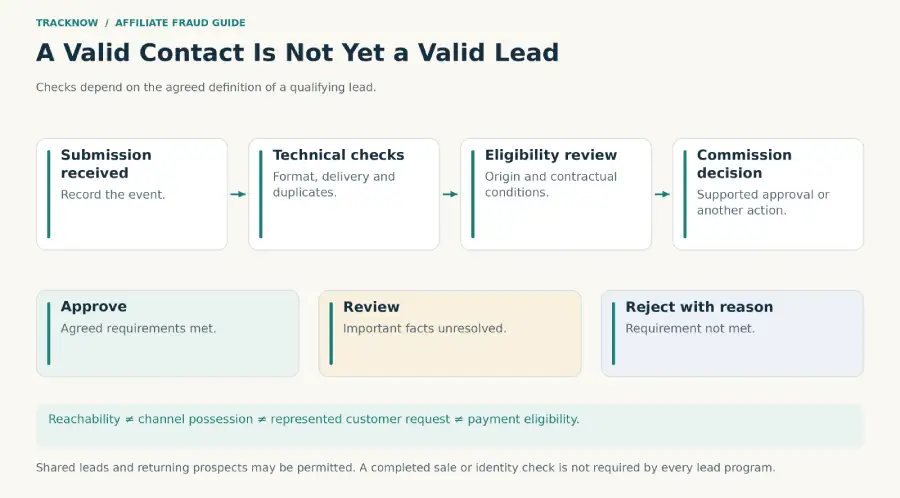
Damage, Prevention, and Fair Partner Treatment
Losses include invalid CPL payments, verification and outreach costs, polluted CRM records, and time diverted from genuine prospects. Contacting people whose details were misused can also generate complaints. Calculate affected rewards once, separating provisional charges, paid amounts, recoveries, and operational costs.
Protect forms and integration endpoints with server-side validation, appropriate rate controls, and authenticated reporting. Independently enforce event idempotency and duplicate eligibility. Monitor verification spending as well as submission volume so an added verification step does not become another abuse target.
Where the agreement supports review before payment, connect CRM qualification outcomes to commission approval with documented reason codes and deadlines. Give partners enough evidence to challenge a decision without disclosing unnecessary personal information. Apply the criteria agreed for that event rather than introducing new requirements after acquisition.
The next section examines fake sales, payment fraud, and refund abuse, where an apparently successful order may never become legitimate retained revenue.
6. Fake Sales, Payment Fraud, and Refund Abuse
A successful checkout page can create the appearance of a successful referral long before the business knows whether the transaction will produce eligible revenue. An order might remain unpaid, use stolen payment details, or be deliberately refunded after the affiliate commission is released.
Sales-related affiliate fraud exploits the gap between a reported purchase and the commercial result the program agreed to reward. The order, payment, fulfillment, and commission each have their own lifecycle. Treating them as one “successful sale” creates opportunities for both deliberate abuse and accidental overpayment.
Different Schemes Behind the Same Sales Counter
A fabricated sale may be a reported conversion with no corresponding business order, or an artificial order created solely to obtain a reward. The specific mechanism matters: forged conversion reporting is examined separately later in this guide.
Payment fraud can involve purchases made with stolen credentials or through a compromised customer account. The transaction may initially be accepted, then disputed by the legitimate account owner. The merchant may lose the commission, goods or service, and operational costs associated with the transaction.
Refund abuse can involve coordinated purchases intended to generate commissions before cancellation or return, or false claims used to obtain money back. A genuine customer’s permitted return is different. Even a high return rate does not establish that an affiliate arranged the activity.
Separate customer payment fraud from partner complicity. A legitimate publisher can refer someone who later commits fraud. Whether the commission remains eligible depends on the agreement; whether the publisher knowingly participated requires additional evidence.
Order Created, Authorized, Captured, and Retained Are Different
| Milestone | What it establishes | Remaining question |
|---|---|---|
| Order created | The commerce system has recorded an order. | Was it paid, eligible, and connected to a genuine transaction? |
| Payment authorized | For an eligible authorization-and-capture method, funds have been reserved. | Were funds captured before authorization expired? |
| Payment captured | The payment has moved beyond an authorization-only hold. | Will it later be refunded, disputed, or otherwise reversed? |
| Order fulfilled | The business recorded delivery or provision of the product or service. | What evidence supports fulfillment, and does the transaction remain commissionable? |
| Commission approved | The affiliate workflow accepted the reward under its approval process. | Were the underlying facts checked, and how are later changes handled? |
The exact payment states depend on the method and processor. Authorization and capture are not separate steps in every payment flow. A settled payment or merchant bank payout also does not guarantee immunity from later refunds or disputes.
Refunds, Disputes, and Fraud Findings Must Stay Separate
A refund is initiated through the merchant’s payment process. A dispute begins when the account owner contests a payment through their bank or payment provider. Disputes can concern unauthorized payments, delivery problems, billing errors, or other issues.
Some claims are deliberately false; others are justified or arise from confusion. A dispute reason is a reported claim, not automatic proof of the customer’s or affiliate’s intent. Preserve the claim, supporting evidence, current status, and final outcome separately.
Refunds can also be pending or fail, and a dispute can overlap an earlier refund. Reconcile both against the same payment before calculating the financial effect. Do not automatically count the original payment, refund, and disputed amount as three separate losses.
Partial Returns Need Partial Commission Logic
Document the commission base: eligible product value, discounts, excluded taxes or shipping, category rates, currency, and rounding. Then specify how cancellations, partial refunds, and order changes affect that base.
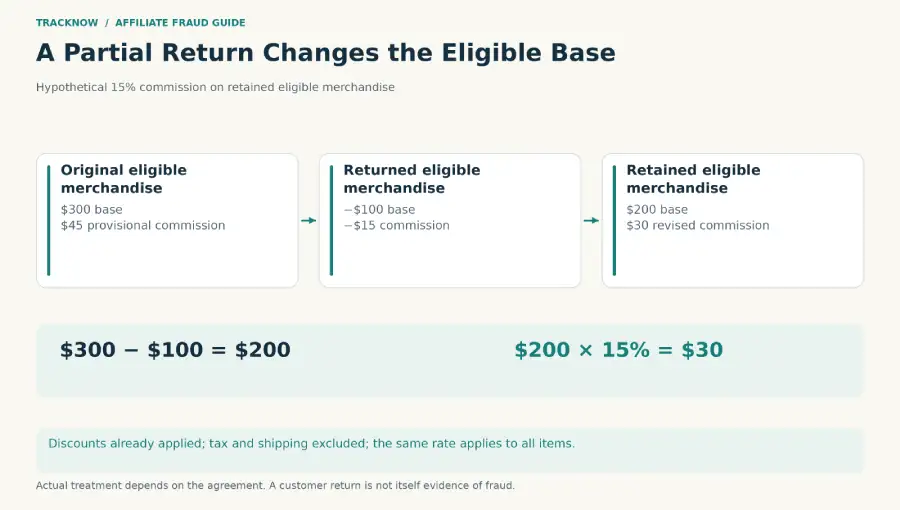
Warning Signs That Deserve Investigation
- Unpaid orders producing rewards: commissions appear despite failed capture, expired authorization, or incomplete payment.
- Repeated cancellations after commission release: particularly when combined with evidence linking the participants.
- Concentrated payment problems: unusual dispute or refund patterns within a placement or customer cluster.
- Inconsistent records: conversion amounts or currencies do not match the underlying order and payment.
- Repeated identities or destinations: apparently separate customers share relevant details that warrant contextual review.
Compare equivalent products, fulfillment periods, and mature cohorts. Defects, delayed delivery, unclear billing descriptions, and seasonal returns can affect many legitimate orders. A shared household or office address is not proof of collusion.
How to Investigate a Suspicious Sale
- Connect the records. Map the affiliate conversion to the order, payment reference, relevant items, customer record, and fulfillment evidence. Investigate missing relationships before relying on the reported total.
- Reconstruct payment history. Review authorization, capture, refund, and dispute events using processor records. Distinguish a payment attempt from the successful payment against which a reward was calculated.
- Review fulfillment and customer communication. Establish what was delivered or used, why cancellation or return occurred, and whether the available evidence supports the reported claim.
- Examine relationships and source history. Assess the relevant placement, repeat patterns, and any evidence linking the affiliate to the buyer. Separate suspicious similarity from demonstrated coordination.
- Calculate eligibility under the original rules. Identify which commission needs approval, amendment, investigation, or reversal. Record the decision without overstating what it proves about intent.
- Reconcile actual funds. Separate unpaid rewards, paid commissions, recoveries, returned goods, and confirmed fees. Use processor references rather than exposing raw payment credentials.
Keep Later Payment Changes Connected to Commissions
Validate webhook authenticity and prevent repeated delivery from creating duplicate sales or adjustments. Event IDs handle delivery retries, but also check whether distinct notifications concern the same business change.
Do not assume arrival order equals business order. A delayed purchase notification must not overwrite a newer refund outcome and restore an invalid reward. Where necessary, reconcile the current authoritative payment and order state before updating commission eligibility.
A customer refund does not automatically update the affiliate platform. Monitor failed notifications and reconcile periodically for missed events. Record the original amount and subsequent adjustments with reasons and references rather than erasing history.
Use the platform’s supported adjustment process. Some finalized records cannot be edited directly, and a changed dashboard balance does not itself recover an external payment.
Prevention Without Treating Every Return as Abuse
Define qualifying payment and fulfillment milestones, review periods, and treatment of later reversals before launch. Coordinate payment-risk screening with affiliate validation; neither system alone answers every eligibility question.
Any approval delay should reflect the business model and agreed terms. It cannot guarantee that no later dispute will occur. Track refund and dispute outcomes, preserve review deadlines, and explain adjustments to legitimate partners with appropriate evidence.
The next section examines self-referrals and multi-account abuse, where the customer and referring partner may be the same person or part of a coordinated group.
7. Self-Referral and Multi-Account Abuse
An affiliate account and a customer account can look like two separate participants while belonging to the same person. If the program rewards only independent referrals or genuinely new customers, treating separate account records as separate people can create an unearned commission.
A self-referral occurs when a partner’s own purchase or registration is attributed to that partner. It may be permitted, accidental, or prohibited. Multi-account abuse uses multiple accounts to evade eligibility rules or repeatedly obtain rewards. Multiple accounts alone do not establish abuse; the relevant question is what restriction they circumvent.
How Separate Accounts Create a False Appearance of Acquisition
The simplest case is an affiliate using their own link to buy a subscription. More complex cases involve related businesses, additional customer accounts, or several affiliate profiles under common control. Existing customers may also close and recreate accounts while claiming new-customer status.
The commercial event can be real. The buyer may pay and use the product. The misrepresentation concerns independence, customer history, or eligibility for another reward. This differs from inventing a purchase or using stolen payment information, although the schemes can overlap.
Bulk registration can support this activity, but manual account creation works too. A bot challenge addresses automation; it does not determine whether two apparently human accounts belong to the same participant.
Define Which Relationships the Program Excludes
Write rules that distinguish personal purchases, related-company purchases, household referrals, employee purchases, agency-managed customers, and authorized reseller arrangements. If the program limits rewards per person, business, household, or customer group, name the applicable unit and time period.
An agency may legitimately register clients or pay through a shared billing account under an agreed arrangement. An affiliate may also test a link and later buy for personal use, leaving an accidental attribution. Those cases require different treatment from deliberately disguising ownership to obtain a prohibited reward.
A prohibition can make a commission ineligible without proving intentional fraud. Establish the relationship, apply the rule, and assess any evidence of concealment separately. Do not extend a personal self-referral rule to every relative or client unless the agreement covers those relationships.
Account Count Is Not Customer Count
Unnecessary commissions reduce margin and can inflate reported acquisition. Repeated claims may also generate unplanned discounts or bonuses. Count overlapping benefits once and distinguish paid amounts from rewards prevented before release.
Signals That Connect Accounts—and Their Limits
| Signal | What it can indicate | Why it is not conclusive alone |
|---|---|---|
| Matching verified account-holder details | A direct relationship between partner and customer identities. | Check record accuracy and permitted agency or business arrangements. |
| Repeated payment-instrument reference | Accounts paid using a related instrument within its documented comparison scope. | Households, employers, and agencies can legitimately share payment methods. |
| Common payout beneficiary | Several affiliate profiles may send rewards to the same recipient. | Confirm the reference identifies the beneficiary, not a shared payment-service intermediary. |
| Device or browser identifier | Sessions may originate from the same environment. | A shared device is not the same as a shared identity; identifiers also have technical limits. |
| Shared IP or address | A network or location relationship worth contextual review. | Offices, households, mobile networks, and shared services connect unrelated customers. |
Understand payment references before joining records. A processor’s card fingerprint is not a person identifier or necessarily universal across merchant accounts. Wallet tokenization can also produce different fingerprints for the same underlying card. Matching only the last four card digits is insufficient.
Conversely, different devices, emails, or payment references do not establish independent ownership. Evaluate the combined evidence and its limitations rather than treating any one field as a complete identity system.
Build a Relationship History, Not Just a Suspicion Score
Connect relevant accounts, referrals, business events, and payout recipients using permitted records. For each connection, preserve the evidence source, observation time, and meaning: “same billing instrument” is a different claim from “same verified owner.”
A graph makes clusters easier to investigate, but a connection does not transfer guilt. A customer sharing an office network with a confirmed abuser is not thereby part of the scheme. Avoid counting several correlated signals as independent confirmations of the same conclusion.
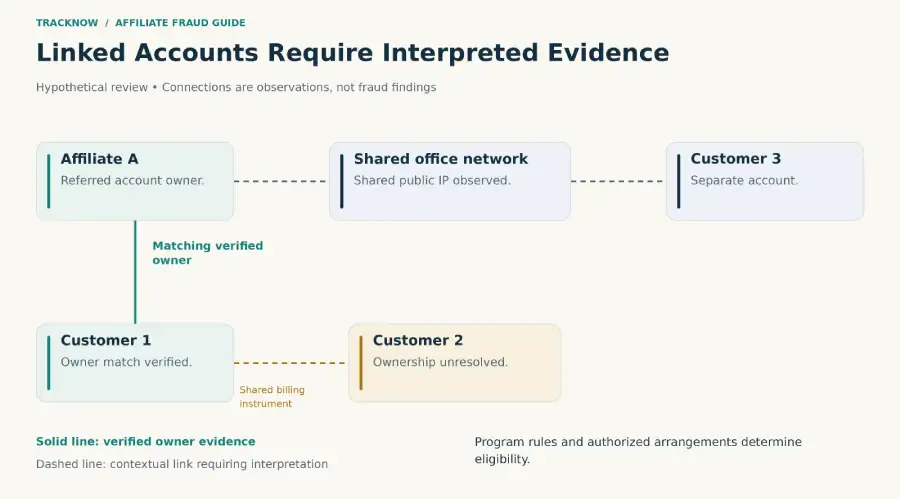
Investigating a Suspected Self-Referral or Account Cluster
- Identify the rule and reward. Establish the applicable customer definition, permitted relationships, reward limit, and policy version. Separate a referral commission from any customer discount or promotional credit.
- Reconstruct account history. Review creation, earlier customer relationships, referral assignment, purchases, closures, and relevant payout changes. New login credentials do not automatically mean a new eligible customer.
- Corroborate the relationship. Compare authorized identity, business, payment, and session records. Document what each match establishes and test ordinary explanations such as shared billing.
- Request a proportionate explanation. Ask about the specific relationship or agency arrangement. Obtain only the evidence needed to resolve it rather than collecting unrelated identity documents.
- Check event processing. Exclude duplicate delivery, account migrations, imports, and test activity before concluding that someone intentionally claimed repeated rewards.
- Scope the decision. Identify the ineligible events, approved exceptions, unresolved relationships, and evidence of deliberate concealment. Apply the supported commission adjustment process and allow review.
Prevention Without Blanket Household or Device Bans
Link partner and customer histories where supported, check direct self-referrals at the qualifying event, and enforce reward limits against the agreed entity rather than merely a new email. Preserve approved agency and related-business exceptions with their scope and effective dates.
Use appropriate registration controls and server-side checks at reward creation. A frontend restriction can miss claims arriving through another integration. Where simultaneous claims are possible, make eligibility checks and reward reservation safe against concurrent processing.
Use device and network signals proportionately, with appropriate data access and retention. Introduce additional verification or manual review where warranted, then monitor false positives. A blanket one-account-per-IP rule can exclude legitimate households and workplaces while missing other abuse.
Distinguish correcting an accidental self-referral from responding to confirmed deception. Clear explanations and a route to challenge incorrect links protect both legitimate customers and the partners who refer them.
The next section examines incentive, cashback, and referral-bonus abuse, focusing on the reward mechanics that can make coordinated activity profitable.
8. Incentive, Cashback, and Referral Bonus Abuse
Rewards change why people act. A person may register for points, book a demonstration for a gift card, or make a purchase because cashback makes the offer attractive. Those actions can be legitimate. The problem starts when the incentive is concealed, the rewarded result is misrepresented, or program limits are deliberately circumvented.
Incentive abuse concerns how a reward is obtained and represented. It can involve undisclosed paid participation, repeated bonus claims, or manipulation of qualification and redemption. Cashback itself is a standard commercial model, and customers seeking good deals are not automatically committing fraud.
Concealed Incentives Can Change the Meaning of a Conversion
A partner may describe traffic as independent product interest while paying people to complete the qualifying action. The form, meeting booking, or app installation can be real. What is false is the representation of the source or the customer’s reason for participating.
For example, a campaign might accept only prospects requesting a genuine product demonstration. A publisher secretly offering a reward for booking an appointment can generate calendar events that satisfy the technical trigger without meeting the agreed qualification.
In another program, rewarded registrations may be expressly permitted at an agreed rate. The same incentive mechanism would need different treatment. Establish the accepted traffic model and required disclosures before declaring the activity invalid.
Cashback, Referral Rewards, and Abuse Are Different Arrangements
| Arrangement | Potentially legitimate use | Abuse to investigate |
|---|---|---|
| Cashback | An approved partner shares an eligible commission with the shopper. | False reward claims, prohibited transactions, or dishonest attribution; cashback alone proves none of these. |
| Incentivized lead or install | The advertiser knowingly accepts rewarded participation under defined terms. | The source conceals the incentive or falsely claims a higher-value traffic category. |
| Refer-a-friend bonus | An eligible advocate introduces a qualifying customer. | Repeated or coordinated claims that bypass the agreed customer and reward limits. |
| Combined promotions | Offers are combined as permitted by the promotion rules. | Prohibited stacking or repeated redemption caused by deliberate manipulation. |
This section focuses on reward eligibility and processing. Hidden extension interactions were covered earlier; unauthorized coupon distribution is examined next. Those mechanisms can overlap with incentive abuse, but should not be counted as separate financial losses when they affect the same reward.
How Bonus Qualification Becomes Vulnerable
A program may intend to reward a customer’s first eligible purchase but implement the check as “first purchase on this account.” Multiple accounts, recreated profiles, or missing history can then make repeat participants appear eligible again.
Another weakness is awarding a benefit before its qualifying event is confirmed, or allowing the same event to trigger the reward through several integration paths. A refund may remove the purchase while leaving the referral credit spendable. Whether these outcomes are fraud depends on the behavior and intent; a processing defect can produce them without deliberate abuse.
Coordinated participants may also refer one another. A mutual referral or account connection alone is insufficient: determine whether each participant is genuinely eligible and whether the program permits the arrangement.
Trace Who Actually Funds Each Benefit
Distinguish the advertiser’s commission, a customer discount, an advertiser-funded credit, and cashback funded from the partner’s share. They do not necessarily represent separate charges to the business.
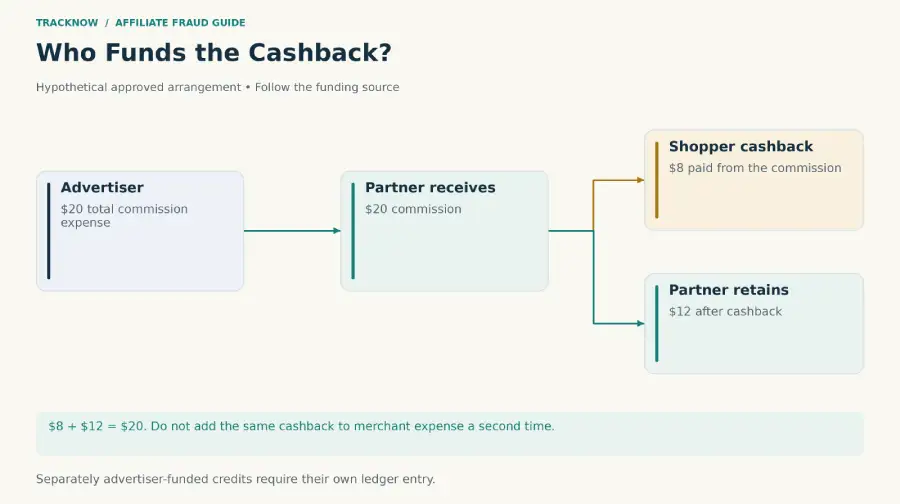
Model Qualification, Availability, and Redemption Separately
A reward being calculated does not have to mean it is available to spend. Define the stages your program needs: pending qualification, approved, available, redeemed or paid, and adjusted or revoked. These are conceptual stages, not a platform-specific status list.
Maintain a reward record linking the campaign and rule version, qualifying event, recipient, reward type, amount or points, currency where relevant, and current status. Distinct benefits for advocate and friend need distinct records, even when one purchase triggers both.
Prevent repeated delivery from creating another award, while still allowing genuinely different benefits. Use a business-level uniqueness rule covering the relevant event, rule, recipient, and reward type. Protect eligibility checks and budget reservation against concurrent requests.
Also distinguish a promotion-budget rollback from customer eligibility. Restoring budget after cancellation should not silently reset a once-per-customer limit unless that is the intended rule. Where rewards have already been spent or paid, follow the supported adjustment process rather than assuming a reversal recovers value automatically.
Warning Signs and Investigation
Review unexplained rewarded-task placements, repeated bonus claims around eligibility boundaries, and rewards remaining available after disqualifying events. Sharp changes in completion without comparable downstream engagement can justify a source review, but are not proof.
- Recover the applicable offer. Preserve what the advertiser authorized and what the user saw, including incentive wording, traffic classification, eligibility limits, and effective dates.
- Verify the source. Ask the partner about rewarded placements and suppliers. Compare the disclosed model with actual distribution rather than relying only on a campaign label.
- Reconstruct the qualifying event. Connect the referral and customer to the required action, verification, payment, and any later cancellation or refund.
- Trace every benefit. Identify its funder, recipient, award reference, availability, redemption, adjustment, and payment status. Check whether apparent duplicates are actually different permitted rewards.
- Test the processing explanation. In an authorized test environment, verify retries, simultaneous claims, cancellations, and partial reversals. Separate an application flaw from evidence of its intentional exploitation.
- Document the precise outcome. Identify concealed incentives, ineligible claims, incorrect awards, or poor commercial performance separately, with the affected rewards and supporting evidence.
Prevention and Common False Positives
Publish explicit rules for incentives, cashback, stacking, qualifying spend, exclusions, and reversal. Enforce them server-side across every reward path. Use customer and campaign caps, redemption controls, and overall budgets where supported, while documenting exactly when counters change.
Monitor the full lifecycle and reconcile promotion records with affiliate accounting. Approved cashback campaigns can naturally attract price-sensitive shoppers; permitted rewarded users may leave after earning a benefit. That can expose weak economics without establishing deception.
Evaluate similar sources and mature cohorts, account for promotion changes, and let partners explain discrepancies. If a permitted reward design performs poorly, revise future terms transparently rather than retroactively calling compliant activity fraud.
The next section examines coupon abuse and unauthorized code distribution: how the wrong audience, placement, or attribution rule can turn a valid code into a source of loss.
9. Coupon Abuse and Unauthorized Code Distribution
A private retention offer appears on a public coupon site. An influencer’s code spreads beyond the intended placement. A shopper arrives through one partner’s review but checks out using another partner’s voucher. These situations can look similar in a dashboard while creating different problems for the business.
Coupon abuse involves deceptive or prohibited use, distribution, or representation of promotional codes. A valid discount does not automatically authorize its publication or establish commission eligibility. Equally, publishing an approved public offer, or using a code the checkout accepts, does not by itself establish fraud.
Separate Three Decisions Before Investigating
First, discount eligibility determines which customers, products, markets, and orders qualify. Second, distribution permission determines who may publish the offer and where. Third, commission attribution determines whether a qualifying order rewards an affiliate and which affiliate receives credit.
“Exclusive code” is dangerously ambiguous. It might mean exclusive commission attribution, permission for one publisher to advertise the offer, or a discount restricted to a particular customer audience. Document each restriction separately. Assigning a code to a publisher does not necessarily restrict who can redeem it at checkout.
How the Abuse Develops
Private-code leakage. Codes intended for selected customers, employees, or a limited campaign are published more widely. Deliberately redistributing a restricted offer can violate the agreed rules. However, a customer, unrelated scraper, or another publisher may have leaked it; the assigned affiliate’s name is not proof that they caused the disclosure.
Misleading coupon acquisition. A placement advertises a nonexistent saving or describes a widely available offer as an exclusive benefit to attract a referral click. A “reveal code” button can be legitimate when it delivers the stated offer with appropriate disclosure. Hidden tracking or forced clicks raise the separate issues discussed earlier. An accidentally expired listing needs different treatment from knowingly fabricated offers.
Eligibility and combination abuse. Participants deliberately circumvent customer restrictions, redemption limits, or prohibited combinations. Investigate the actual mechanism: an intentionally bypassed control, an ambiguous offer, and a merchant accidentally enabling a combination are different findings.
A Copied Code Does Not Necessarily Redirect Commission
Some integrations attribute sales using an assigned voucher without requiring an affiliate-link click. For example, Awin’s Voucher Attribution documentation states that a qualifying voucher-attributed sale rewards the assigned publisher even when another publisher distributes the code. Other configurations can produce different outcomes.
| Configured rule | Possible outcome | What to verify |
|---|---|---|
| Code assignment takes priority | B receives the eligible commission. | Whether the code was approved for that use and the priority was disclosed. |
| Code affects only the discount | A can retain credit if the click meets the attribution rules. | Whether coupon use changes eligibility or commission rate. |
| The offer excludes affiliate commission | No commission is payable if the exclusion applies. | The effective terms and correct implementation of the exclusion. |
These are alternative rule designs, not universal platform behavior. Establish the configured priority, channel deduplication, and treatment of multiple codes. Do not infer the commission recipient from the coupon page alone.
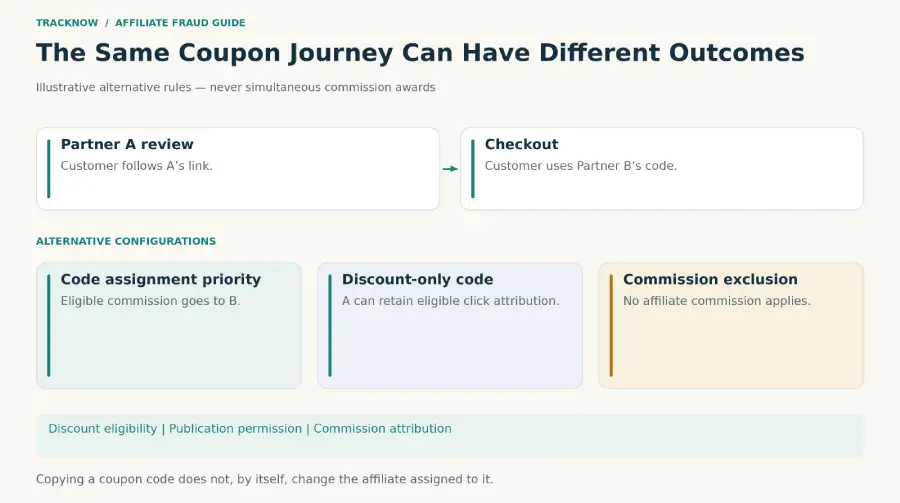
Where the Damage Appears
Unintended discounts can reduce contribution margin or consume a limited promotion budget before the intended audience redeems it. Commission on ineligible orders creates another expense. Legitimate publishers can lose credit, while misleading listings damage customer trust and generate support work.
Calculate these effects separately. A real order’s entire revenue is not automatically a fraud loss. Where a discount was already publicly available, its full value is not necessarily additional leakage. Where commission was merely misallocated, distinguish the wrongly paid amount from any additional payment needed to resolve the dispute. Incremental sales impact requires evidence beyond a coupon-use count.
Investigate the Publication and the Order Together
- Recover the original authorization. Preserve the offer, permitted audience and placements, expiration, exclusions, commission treatment, and applicable rule version.
- Capture the placement. Record the URL, observation time, offer wording, visible code, and relevant referral destination. First observed publication is not proof of the original leak.
- Verify actual redemption. Distinguish a submitted or rejected code from the discount actually applied. An automatic offer may replace the entered code.
- Reconstruct attribution. Connect the order to eligible clicks, applied codes, code assignments, priority rules, commission adjustments, and payment status.
- Ask for provenance. Establish where the publisher obtained the offer and what authorization they understood. Separate confirmed conduct from unresolved assumptions.
Preserve historical code assignments and settings. Reassigning a code today must not erase the evidence needed to explain yesterday’s decision. Investigative records should identify the relevant order and configuration without copying unnecessary customer information into screenshots or shared reports.
Enforce Restrictions Where the Discount Is Calculated
A secret-looking code is not a substitute for eligibility controls. Validate restricted offers against the required customer or account eligibility on the server. Test guest checkout, account changes, and supported sales channels. Total redemption caps and per-customer limits solve different problems; neither automatically establishes one redemption per real person.
Commerce engines have specific semantics. Shopify documents customer eligibility and separate usage-limit settings, while its combination rules distinguish product, order, and shipping discounts. Test actual permitted combinations and calculation order rather than assuming percentage discounts always add or always compound.
Define expiration time zones, minimum qualifying spend, and exclusions. In custom implementations, protect redemption counters against concurrent requests and specify what cancellations restore. Send authoritative applied-discount information to affiliate accounting; a browser field reporting what the shopper typed is insufficient.
Contain the Leak Without Presuming the Culprit
After preserving evidence, restrict or replace a compromised offer and arrange a replacement for authorized recipients where appropriate. Request removal of prohibited placements, investigate the distribution source, and review affected commissions under the applicable terms. Disabling a code does not itself reverse discounts or recover paid commissions.
Monitor code usage by publisher, placement, and eligible customer segment. Compare changes with approved campaigns: an influencer’s successful post can legitimately cause a spike. Give partners an opportunity to explain disputed distribution, and fix unclear rules prospectively rather than treating every accepted redemption as deliberate misconduct.
The next section examines unauthorized brand bidding and ad hijacking: when paid search activity crosses program boundaries or misrepresents who is advertising.
10. Unauthorized Brand Bidding and Ad Hijacking
A shopper searches for a company they already know, clicks what looks like its advertisement, and buys from its genuine website. The product, payment, and customer are real. Nevertheless, the affiliate commission can originate from a prohibited acquisition method or a misleading advertisement.
Unauthorized brand bidding means running paid search activity involving protected brand terms outside the program’s permission. Affiliate ad hijacking typically involves an unauthorized advertisement that resembles the merchant’s own ad and routes the referral through affiliate tracking. In this context, “hijacking” does not necessarily mean someone accessed the merchant’s advertising account.
Permission, Presentation, and Attribution Are Separate Questions
Some programs authorize selected partners to advertise on brand terms, perhaps in particular territories or for specific campaigns. Others allow generic paid search but prohibit branded queries, direct linking, or particular wording. An advertisement’s appearance cannot establish whether that permission exists.
| Observed activity | Possible explanation | Required check |
|---|---|---|
| Partner ad on a brand query | Authorized promotion or prohibited search activity. | Effective permission, territory, query restrictions, and campaign scope. |
| Ad resembles the merchant’s own | Approved creative or misleading representation of advertiser identity. | Creative authorization and what the shopper was led to believe. |
| Merchant landing page with affiliate tracking | Permitted direct linking or unauthorized commission capture. | Tracking ownership, source permission, and actual attribution. |
| Unexpected brand-query impression | Automated matching, configuration error, or intentional targeting. | Available campaign evidence and the precise contractual restriction. |
A program violation does not automatically establish deliberate fraud. Concealing a prohibited source, impersonating the merchant, or falsifying the origin of referrals provides a different evidential basis from an isolated configuration mistake.
A Branded Query Does Not Reveal the Purchased Keyword
The shopper’s search term and the advertiser’s targeting keyword are different objects. Matching systems can place an ad against a branded query even when the advertiser selected a generic keyword. Commission Factory’s paid search guidance describes this distinction alongside brand bidding and affiliate ad hijacking.
Write the rule accordingly. “Do not select our brand as a keyword” and “Do not allow ads to appear on searches containing our brand” impose different obligations. The second requires exclusion controls and monitoring. A captured impression establishes appearance at that time; proving the selected keyword or intent requires additional evidence.
Search-Platform Approval Does Not Grant Program Permission
An affiliate may argue that the advertising platform approved the campaign. That does not resolve the affiliate agreement. For example, Google’s trademark policy distinguishes trademark keywords from misleading trademark use in advertisements and allows certain reseller or informational uses under its conditions.
Keep three findings separate: breach of the affiliate terms, breach of an advertising platform’s rules, and any legal infringement. One does not automatically establish the others. A trademark complaint should address the applicable platform policy rather than substitute for enforcing a contractual search restriction.
How Commission Capture Happens
The affiliate funds an advertisement, the shopper follows it, and the tracking integration records an affiliate referral. If the shopper purchases within the applicable rules, the system may assign commission. The abuse lies in obtaining that attribution through a prohibited or deceptive source, even though the downstream transaction is genuine.
A lookalike advertisement can make the shopper believe the merchant placed it. Other cases involve a clearly identified coupon or comparison publisher whose paid search activity is simply outside the agreed scope. Both need review, but they involve different representations and evidence.
Do not assume every tracking step appears in the address bar. Google’s parallel tracking documentation explains that customers can reach the final page while measurement requests execute in the background. Inspect navigation and background requests where available; identify which request actually established affiliate attribution.
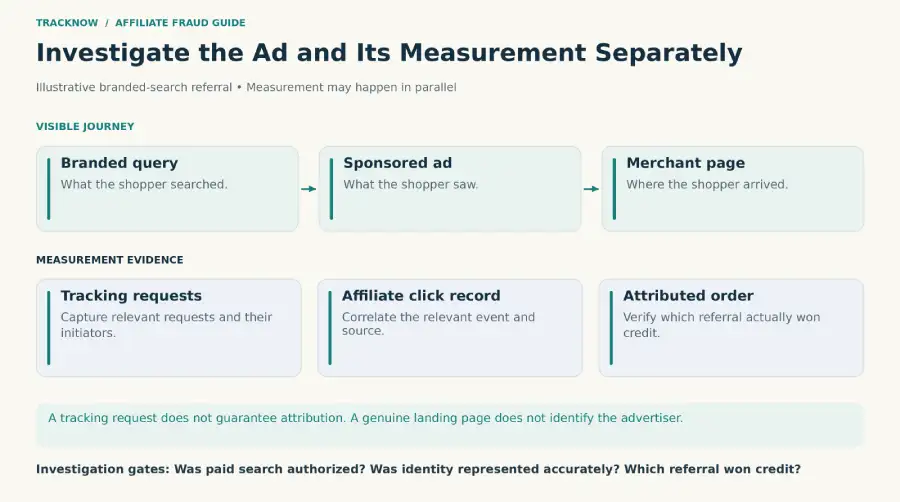
Measure the Damage Without Counting Someone Else’s Spend
Possible effects include commissions on disallowed referrals, competition with the merchant’s campaigns, inaccurate acquisition reporting, and lost credit for other partners. Misleading claims can also create support costs and reputational harm.
The affiliate’s advertising spend is not automatically the merchant’s expense. Do not add the affiliate’s estimated click costs to the merchant’s commission loss. Any increase in the merchant’s own advertising costs needs separate evidence; overlapping ads do not establish the size of that increase.
Likewise, an already interested shopper is not proof that a sale would have happened without the advertisement. Branded-query traffic can have genuine value. Estimate incremental impact through appropriately designed comparisons or experiments, accounting for seasonality, promotion changes, and other campaigns.
Build an Evidence Chain Before Challenging the Partner
- Preserve the search context. Record the query, search engine, observation time and time zone, market, language, device, and visible sponsored placement.
- Capture the advertisement. Save its wording, displayed destination, offer, and available advertiser information. A name alone may identify an agency or account entity rather than the affiliate beneficiary.
- Inspect the referral path. Preserve relevant redirects and background measurement requests, with timestamps and affiliate identifiers where present. Restrict access to captures containing session or customer data.
- Verify the attribution record. Match observed identifiers to program accounts and click records. An identifier in a URL indicates a claimed referral; confirm whether the system accepted it and whether it affected an order.
- Check authorization and ownership. Review approved agencies, partner permissions, subcontractors, and change history. Ask the partner for relevant campaign settings and search-term evidence where available.
- Define the affected scope. Distinguish confirmed prohibited placements from traffic merely sharing the same affiliate account. Document any sampling or extrapolation limits.
A high conversion rate, short purchase journey, or search-engine referrer can justify investigation. None independently proves unauthorized bidding. A missing referrer also does not exclude paid search, and an advertising click identifier alone does not identify the account owner.
Prevent Recurrence Through Precise Rules and Verification
Specify permitted engines, territories, brand terms, brand-plus-product queries, direct linking, display identity, offer wording, and exceptions. State whether restrictions concern selected keywords, actual query appearances, or both. Give authorized partners written boundaries and require those boundaries to reach their suppliers.
Where exclusions are required, verify their scope across applicable campaigns. Google documents distinct negative keyword match behavior; one exclusion should not be assumed to cover every relevant query. Test coverage and review observed search terms.
Monitor across relevant markets and times, reconcile alerts with permissions, and preserve evidence before requesting removal. Apply commission holds or adjustments through the agreed process. Then verify that the prohibited activity stopped; removing an advertisement does not automatically correct historical attribution or recover a paid commission.
The next section examines typosquatting, lookalike domains, and brand impersonation: how deceptive identities can mislead customers and affiliate teams beyond paid search.
11. Typosquatting, Lookalike Domains, and Brand Impersonation
A customer mistypes a merchant’s address and still reaches the genuine store, but an unauthorized affiliate referral has been inserted along the way. Elsewhere, a partner receives an urgent message from someone posing as their affiliate manager. The apparent familiarity of the brand makes both interactions feel safe.
Brand impersonation exploits a false impression of identity, ownership, or authorization. It can target shoppers, program managers, and affiliates. Sometimes the objective is commission capture; sometimes it is stolen credentials, sensitive information, or money. A suspicious domain can therefore indicate a security incident beyond affiliate accounting.
Similar Names Can Support Different Schemes
Typosquatting uses a domain resembling a mistyped version of another address. Broader lookalike domains can add reassuring words, change the ending, or use visually similar characters. A deceptive page may copy branding, layouts, product descriptions, or support language to reinforce the resemblance.
Internationalized domain names are legitimate infrastructure for many languages. Their presence is not evidence of abuse. The concern is a misleading resemblance combined with deceptive use. Preserve the displayed name and its underlying ASCII representation when investigating an internationalized hostname; visual comparison alone can miss a difference.
Also distinguish a lookalike domain from compromise of a genuine website. A fraudulent page on an authorized domain needs investigation of that site’s access and publishing controls. Similar appearance does not establish the technical entry point.
Read the Hostname Before Trusting the Branding
The following reserved example addresses illustrate structure, not real websites. The word “merchant” appearing somewhere in an address does not establish ownership.
| Address shown | Relevant domain | What it establishes |
|---|---|---|
partners.merchant.example |
merchant.example |
A subdomain of the example merchant’s domain; the service still needs authorization verification. |
merchant.example.support-center.example |
support-center.example |
A different domain, despite the familiar words at the beginning. |
support-center.example/merchant.example |
support-center.example |
The merchant-like text is in the path, not the hostname. |
For automated checks, parse URLs with an established library and identify domain boundaries using maintained public-suffix information. Taking the final two labels is insufficient for endings such as co.uk. Check the actual link destination, not merely its visible label.
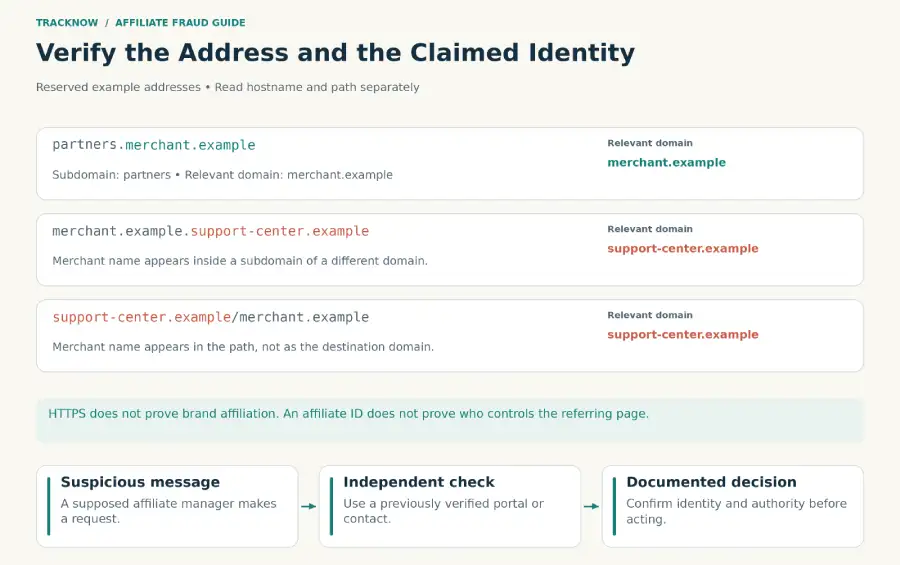
Affiliate Redirects Can Hide Behind a Genuine Final Destination
A deceptive domain may forward visitors through an affiliate link to the real merchant. The shopper can complete an ordinary purchase without realizing the intermediary existed. Investigate whether the program permits that domain, presentation, and referral method, and whether tracking actually assigned commission.
Other pages impersonate an official store or support service, then collect payment or account information themselves. These transactions may never reach the merchant’s order system. Searching only for suspicious affiliate conversions will miss victims who never generated a conversion.
An affiliate identifier found in a redirect is a useful lead, not proof that the account holder created or controlled the page. Someone may have copied their link, compromised their site, or used an intermediary. Establish control and responsibility before attributing misconduct to a named partner.
Fake Managers Target the People Running the Program
An impersonator may announce a supposed portal migration, ask an affiliate to upload identification to an unfamiliar page, or demand a payment to release commission. Program managers can receive requests from fake partners seeking sensitive account changes. Real names, familiar signatures, and copied email threads make these requests more persuasive without making them authentic.
Verify consequential requests through a previously established contact or a portal reached independently. A phone number or verification link supplied in the disputed message is part of the same unverified claim. Detailed account takeover and payout controls are covered later; here, the central issue is confirming who is communicating.
Understand What Technical Trust Signals Actually Prove
HTTPS protects the connection to the hostname being visited. It does not confirm that the site belongs to the brand it resembles. As Cloudflare explains, an imitation site can possess a valid certificate for its own deceptive domain.
Email authentication has a similar boundary. SPF, DKIM, and DMARC help authenticate sending domains and address unauthorized use of protected domains. They do not establish a business relationship. An attacker can authenticate mail from their own lookalike domain; a compromised legitimate mailbox can also send authenticated messages.
Review the full sender address, reply destination, and receiver-generated authentication results together with the request. Neither a display name nor a “pass” result replaces independent authorization checks. Authentication failures also need context, including legitimate forwarding and configuration problems.
Investigate the Identity Claim and the Resulting Harm
- Preserve the artifact. Record the URL, hostname, observation time, screenshots, relevant redirects, and original message with headers where applicable. Use isolated inspection for suspected malicious pages.
- Identify the false representation. Document what claimed official status: wording, branding, sender identity, or a request presented as mandatory. Compare it with actual authorization.
- Trace the outcome. Determine whether the interaction created affiliate attribution, collected data, requested money, or changed account information. Do not assume all objectives were achieved.
- Establish ownership carefully. Review registration, hosting, account records, and partner explanations. Shared infrastructure, privacy-protected registration, and a newly registered domain are contextual signals rather than proof of common control.
- Measure confirmed impact. Separate misallocated commissions, diverted payments, affected accounts, response costs, and unresolved exposure. Avoid counting the same financial loss in multiple categories.
Contain the Abuse and Reduce Future Exposure
Publish verified portal addresses and support channels, maintain clear branding rules, and review declared partner domains. Protect your own domain registration and authorized accounts. Deploy email authentication with monitoring and an appropriate enforcement policy; a DMARC monitoring policy alone does not request rejection of impersonating mail.
Check the coverage of domain-monitoring tools. Cloudflare explicitly notes that its certificate alerts for a monitored domain do not detect certificates issued for differently spelled lookalike domains. Certificate monitoring and brand-similarity monitoring answer different questions.
Report specific abuse to the relevant hosting, registration, advertising, or messaging provider with preserved evidence. Domain-name disputes have separate routes, including the procedures described by WIPO; a complaint does not guarantee immediate removal. Coordinate affected-account response and customer communication with the security team.
Finally, distinguish impersonation from authorized resellers, disclosed review sites, and other legitimate uses. Similarity alone is insufficient: focus on authorization, the representation made, and the action it induced.
The next section examines conversion spoofing, postback forgery, and event replay: attempts to make tracking systems recognize outcomes that were never validly earned.
12. Conversion Spoofing, Postback Forgery, and Event Replay
A conversion appears in the affiliate dashboard, complete with a click identifier and order value. Yet the merchant cannot find the corresponding sale. Alternatively, one genuine purchase produces several commission entries. In both cases, the tracking record needs to be checked against the business event it claims to represent.
Conversion spoofing creates or misrepresents a qualifying event in the tracking system. Postback forgery targets the messages used to report that event. Event replay resubmits a previously valid message to obtain another effect. These methods attack the evidence of a conversion, rather than necessarily creating a fraudulent purchase in the merchant’s checkout.
Identify Which Direction the Message Travels
An inbound advertiser postback reports an outcome to the tracking platform. An outbound affiliate postback notifies a partner about a recorded outcome. A payment-provider webhook reports payment-related activity to its recipient. Their formats may look similar, but their authority differs.
A notification copied from an affiliate’s system is not independent confirmation from the advertiser. An integration that feeds its own outgoing notifications back into conversion creation can also produce a loop. Document who sends each message, who receives it, and what the recipient is authorized to change.
Distinguish Forgery, Tampering, and Ordinary Redelivery
| Scenario | What is misrepresented or repeated | Key verification |
|---|---|---|
| Fabricated conversion | A message claims a qualifying action that did not occur. | Authenticated sender and authoritative business record. |
| Parameter tampering | A real event is reported with an altered amount, event type, or attribution. | Integrity checks and comparison with server-held values. |
| Malicious replay | A captured message is deliberately reused for another benefit. | Protocol-supported freshness checks and durable duplicate protection. |
| Legitimate retry or duplicate integration | The same outcome is reported again without deceptive intent. | Delivery history, integration configuration, and processing records. |
Repeated requests alone do not reveal intent. Timeouts, queue recovery, manual resending, and overlapping browser and server integrations can all create duplicates. The receiver should prevent repeated commission effects regardless of the cause.
A Click ID Is a Correlation Key, Not Proof of a Sale
A valid click identifier can connect a reported event with a referral. It does not prove that a customer paid, that the submitted amount is correct, or that the sender may report outcomes for that advertiser. Treat correlation, sender authentication, authorization, and business validation as separate controls.
Likewise, server-to-server transport is not automatic protection. TUNE documents additional postback controls, including advertiser security tokens and source-IP restrictions. Those are examples of supported controls, not a claim that every platform implements them identically.
Authenticate the Message and Limit Its Authority
Use the integration’s documented authentication scheme. Where message signing is supported, verify the prescribed signed content with the appropriate secret or public key. For example, Stripe’s signature verification requires the unmodified request body; parsing and reserializing JSON can invalidate verification.
Bind the authenticated identity to its permitted advertiser, environment, and operations. A credential for one merchant must not authorize another merchant’s conversions. Separate test and production traffic. A valid signature demonstrates possession of signing authority and message integrity; it does not make an incorrect or compromised sender truthful.
Validate the schema, allowed event types, identifier formats, and monetary units. Confusing integer minor units with decimal major units can inflate a reported amount without any attack. Reject unsupported status changes instead of allowing submitted fields to approve commissions or choose payout amounts.
Keep secrets out of browser code and public documentation. OWASP warns against credentials in URLs, which can enter logs. Where a vendor requires a query token, keep that call server-side and redact the token from logging and reports. Prefer supported header-based authentication when available.
IP restrictions can supplement authentication, but require maintained sender ranges and correct proxy handling. CORS rules, a familiar referrer, or an obscure endpoint address do not authenticate a server sender. Use controls the platform actually supports; an intermediary can validate incoming messages, but must also protect its downstream credentials.
Freshness and Idempotency Solve Different Problems
A signed message can remain cryptographically valid after its first use. Protocols such as Standard Webhooks authenticate delivery metadata to support replay protection. Apply freshness checks only to fields authenticated by the protocol, using synchronized clocks and its documented tolerance.
Do not confuse delivery time with the business event’s occurrence time. A legitimate retry can report an older sale while carrying fresh delivery authentication. Freshness checks also do not stop duplicate processing within the accepted window.
Idempotent processing means repeated reporting of the same business action produces one intended accounting effect. Persist authenticated event identifiers with sender scope. Also enforce a business uniqueness rule where different delivery IDs can describe the same commissionable action. A receiver-generated request ID cannot identify retries of an earlier request.
Define that rule carefully. One order may legitimately include multiple commissionable milestones; a subscription may generate separate qualifying invoices. Partial refunds need their own adjustment references. Deduplicating only by customer, click, or parent subscription can suppress valid earnings.
Protect duplicate checks and ledger changes against concurrent requests and crashes. Record receipt and the intended update durably, with recoverable processing states. A check followed by an unprotected insert can award twice. An authenticated, already processed duplicate can be acknowledged without repeating its effects.
Set retention around legitimate retries, manual recovery, and accounting requirements; a brief replay cache is not the commission ledger. A successful HTTP acknowledgment can mean durable receipt for later processing. It must not be interpreted as proof that a conversion was approved or paid.
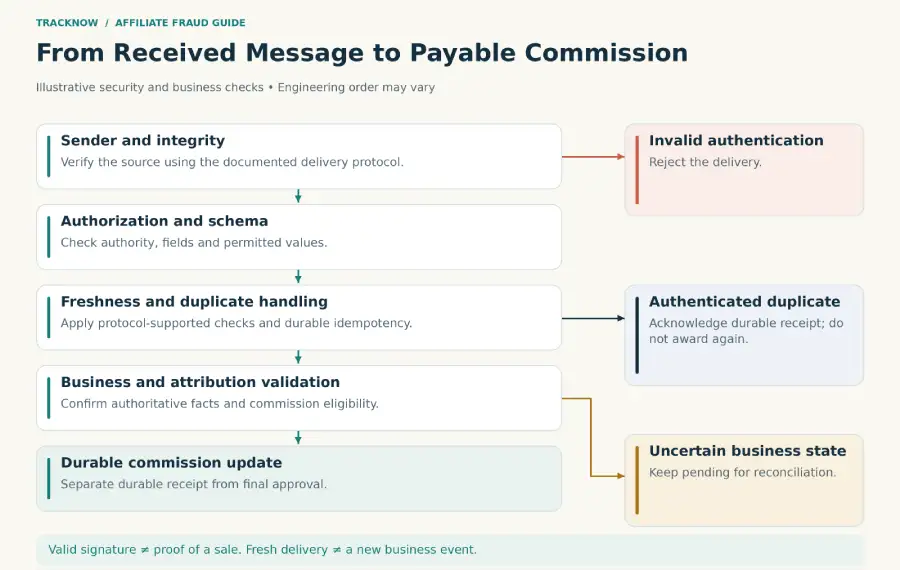
Validate the Business Event Before Approving Commission
Reconcile the event with the authoritative order, payment, subscription, or CRM record. Check the relevant account, qualifying status, currency, commissionable amount, and attribution. Derive monetary values and commission rules from trusted records rather than accepting arbitrary client-supplied values.
Handle asynchronous state explicitly. Events may arrive out of order; an older success notification should not silently undo a later cancellation. Use documented version semantics or retrieve current authoritative state. If confirmation is temporarily unavailable, keep the outcome pending rather than inventing success or permanently discarding a valid event.
Investigate and Contain the Confirmed Exposure
Preserve restricted request evidence, authentication results, sender scope, receipt and event times, identifiers, configuration history, and ledger effects. Compare mismatched conversions with source-system records and deployment changes. Missing orders can also result from test traffic, account mismatches, or broken identifiers.
Measure fabricated or excess commission separately from attempted requests and pending exposure. A false reported order value is not merchant revenue lost, and a rejected replay is not a paid loss. Trace approved entries through actual payout before calculating recovery.
If credentials are compromised, revoke or rotate them and identify affected integrations. Preserve evidence, pause affected approvals where justified, and reconcile existing records through supported adjustments. Verify the fix with authorized tests covering retries, altered messages, concurrent delivery, stale events, and recovery after failure.
The next section examines traffic laundering, geographic misrepresentation, and cloaking: attempts to disguise where traffic originates and what users actually encounter.
13. Traffic Laundering, Geographic Misrepresentation, and Cloaking
A partner is approved for editorial reviews, but the conversions actually come from an undisclosed advertising supplier. A campaign reports customers from a premium market, although the available evidence supports a different classification. A reviewer sees an ordinary landing page while affected users encounter a materially different offer.
The common problem is a mismatch between what the program was told it was buying and what was delivered. Traffic laundering disguises or falsely represents the source or nature of traffic. Geographic misrepresentation concerns location claims used for eligibility or payment. Abusive cloaking conceals material content or routing from oversight.
Intermediaries Are Not Automatically Laundering Traffic
Media buying, redirect services, agencies, and subnetworks can be legitimate. Buying traffic and earning a commission is not inherently deceptive. The relevant questions are whether the arrangement is permitted, whether the actual source was disclosed as required, and whether the reported classification is accurate.
A prohibited source can remain prohibited even when a real person makes a genuine purchase. Conversely, weak disclosure procedures or a mistaken campaign label do not automatically establish intentional fraud. Preserve the applicable agreement and determine which representation was false.
Separate Declared Labels from Observed Evidence
A partner-provided source name, sub-ID, or UTM parameter is a claim. A recorded request or captured placement supplies an observation. A verified business record can establish another fact, such as the customer’s agreed eligibility. These records should support one another without being treated as interchangeable.
| Evidence | Useful information | Important limitation |
|---|---|---|
| UTM value or publisher source label | The classification supplied with the visit. | Does not independently verify the originating placement. |
| HTTP referrer | Referring context provided for that request. | May be absent, reduced, or describe only an intermediate page. |
| Visitor-IP geolocation | An estimate associated with the observed network address. | Does not establish residency or the person’s precise location. |
| Captured placement and referral path | What occurred in a documented observation. | Does not prove that every visit followed the same path. |
Browser privacy behavior creates legitimate gaps. MDN documents that strict-origin-when-cross-origin generally sends only the origin on cross-origin requests, rather than the full referring path and query. Other policies can omit the referrer entirely. Missing detail is not proof of laundering.
Define What “Country” Means Before Enforcing It
A geographic rule might concern location at the click, location at conversion, verified residence, service availability, or another explicitly defined criterion. These are different facts. Browser language, billing address, payment-card issuer country, and IP location cannot simply substitute for one another.
Specify the evidence and timing used for each rule, including what happens when evidence is unavailable or conflicting. A customer traveling between referral and purchase may legitimately produce different locations. Unknown geography should remain unknown until the agreed decision process resolves it.
MaxMind explains that IP geolocation has accuracy limits and that a VPN’s address may locate the VPN server rather than its user. Mobile and corporate networks also require context. VPN use alone establishes neither deception nor a specific home country.
Record where each IP came from. The network peer sending a server postback is normally a backend service, not the shopper. Any visitor-IP field within its payload is a separate assertion whose provenance needs validation. Do not geolocate the sender’s data center and treat that as customer geography.
Reverse proxies introduce another distinction. Cloudflare documents restoring visitor addresses from its headers and configuring trusted infrastructure. Accepting an arbitrary forwarded-IP header from an untrusted connection can corrupt the evidence. Preserve the extraction method and geolocation database version for later review.
Cloaking Is About Concealment, Not Every Content Difference
Affiliate teams may use “cloaking” to describe a placement that presents acceptable content during review while concealing a prohibited user experience. That experience might involve misleading claims, an unauthorized offer, or an undisclosed destination.
Language selection, regional availability, consent states, accessibility adaptations, and controlled experiments can also change a page. Google Ads distinguishes deceptive cloaking from permitted personalization under its conditions. Its advertising policy is a useful example; the affiliate program must separately define its own requirements.
A single differing screenshot establishes a discrepancy, not its cause. Compare the entry URL, observation time, consent and login state, campaign version, and relevant environment. Preserve both experiences and request an explanation supported by routing or deployment records. A compromised site may also produce unauthorized changes without the partner’s knowledge.
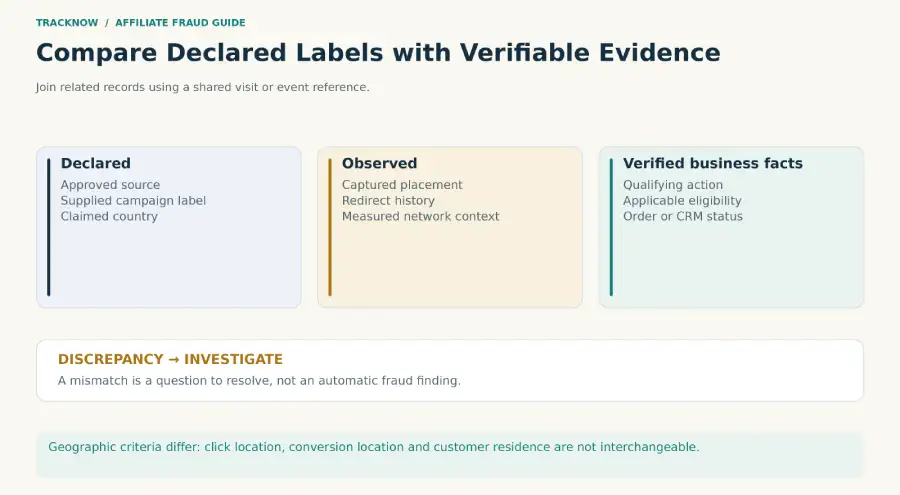
Measure the Classification Error Precisely
Damage can include overpaid commissions, spending on prohibited sources, distorted acquisition analysis, and customer complaints about hidden claims or destinations. Unreliable source reporting also makes it harder to reward legitimate partners and optimize campaigns.
Investigate the Origin, Journey, and Qualification Together
- Recover the approved model. Identify permitted sources, suppliers, placements, content, geographic criteria, rates, and effective dates.
- Preserve distinct evidence fields. Keep declared source labels separate from measured request data, supplier attestations, and verified customer facts.
- Trace representative journeys. Connect documented placements and redirects to click records and conversions. State which parts of the path remain unobserved.
- Test competing explanations. Review privacy effects, proxy configuration, geolocation updates, approved localization, experiments, and deployment incidents before concluding concealment.
- Ask for supplier-level support. Seek relevant placement, campaign, and routing records under the agreement. A source label repeated by an intermediary is not independent verification.
- Scope the finding. Identify confirmed affected sources and events. Explain sampling limits before extending findings to a broader traffic population.
Prevent Relabeling from Becoming Payment Authority
Require approval of material source changes and maintain stable supplier identifiers. Calculate eligibility and rates from the defined evidence and server-held rules, rather than accepting a partner’s requested category as authoritative. Preserve rule history and log classification changes with their reasons.
Use layered review for inconsistent evidence and monitor outcomes by source. A useful alert identifies the mismatch and supporting records; it does not automatically establish guilt. Treat restricted-source activity, classification errors, and confirmed deception as separate findings.
Contain verified violations at the affected source or campaign, reconcile commissions through the agreed process, and verify the remediation. Blanket rejection based only on VPN detection, a missing referrer, or a changed page risks penalizing legitimate customers and partners.
The next section examines sub-affiliate and subnetwork fraud: how hidden downstream publishers complicate source accountability, investigation, and payment decisions.
14. Sub-Affiliate and Subnetwork Fraud
A subnetwork looks healthy in the advertiser’s dashboard: established account, steady sales, acceptable overall returns. Inside that account, however, different publishers may generate very different traffic. One problematic source can remain hidden among legitimate partners until a customer complaint or transaction-level investigation exposes it.
Subnetwork fraud concerns deceptive activity conducted through, or concealed within, an intermediary’s affiliate relationships. It can involve undisclosed publishers, prohibited promotion, false source identities, or deliberate failure to enforce agreed restrictions. The underlying acts may be familiar fraud types; the extra challenge is determining who supplied the traffic and who must address it.
Understand the Relationship Before Assigning Responsibility
A subnetwork generally aggregates publishers under its relationship with the advertiser or affiliate network. The downstream publisher may not hold a direct account in the advertiser’s program. This model can provide useful access to content creators and services that would otherwise be difficult to manage individually.
Do not confuse that arrangement with every feature called “sub-affiliate.” Some programs use the term for recruiting partners and paying referral overrides. A sub-ID may instead identify a campaign, placement, or cashback member. Establish the business relationship and field meaning rather than assuming a label describes the entire structure.
Separate operational control from contractual responsibility. Identify who recruits publishers, approves placements, distributes offers, records source identity, pays downstream earnings, and handles complaints. Liability and remedies depend on the applicable agreement; they should not be inferred solely from the tracking architecture.
How the Structure Can Conceal Abuse
Undisclosed participation. The approved partner presents itself as a single publication while distributing links through other publishers without the required authorization. A genuine resulting purchase does not resolve a breach of source restrictions.
Re-entry after removal. A publisher excluded from a program appears through an intermediary. Awin identifies this auditing risk in its subnetwork guidance. Confirm the publisher’s identity and the scope of the original exclusion before concluding that a later placement violates it.
Misleading source allocation. Activity is attributed to an approved publisher identifier even though another source supplied it. Deliberate reassignment can conceal violations. Accidental identifier reuse or broken mappings can create similar reports and needs a different finding.
Unenforced restrictions. A source continues prohibited promotion after the intermediary received a substantiated notice. Review what the notice required, when it was received, and what the intermediary could control. A delayed report alone does not prove continued live promotion.
A Sub-ID Needs a Stable, Verifiable Meaning
Agree which field identifies the downstream publisher and which fields describe placements or campaigns. Use stable identifiers scoped to the intermediary: publisher 123 in one network is not automatically publisher 123 elsewhere. Keep the mapping to the actual entity and approved properties, including effective dates and changes.
Verify visibility as well as transmission. impact.com distinguishes partner-only Sub IDs from Shared IDs visible to both parties. Rakuten Advertising documents a separate subnetwork-transparency implementation. Field names, enablement, and access differ; adding an arbitrary parameter does not guarantee advertiser reporting.
| Record | Required connection | Failure to investigate |
|---|---|---|
| Publisher mapping | Intermediary, stable publisher ID, entity, approved properties, and dates. | The same ID changes meaning without historical evidence. |
| Referral record | Click or applicable referral reference linked to the captured publisher identity. | Publisher information is missing or overwritten during redirects. |
| Conversion and adjustment | Business event linked to its original referral and subsequent status changes. | Refunds or corrections lose the downstream source reference. |
| Settlement record | Commission, recipient, payment status, and any separate fee or override. | The invoice total cannot be reconciled with affected transactions. |
Test redirects, encoding, field-length limits, imports, and reporting exports. Preserve the recorded source rather than trusting a replacement supplied at conversion time. A correctly carried identifier still needs corroboration: it identifies the claimed source, not necessarily who controlled the observed placement.
Transparency Has Levels
Agree what “transparent” means: named publisher, domain, specific placement, traffic method, or documented access during an investigation. A domain-level report does not necessarily include article-level URLs. For example, Skimlinks describes domain-level reporting with page-level restrictions.
That limitation is not itself proof of concealment. Decide whether the normal reporting and agreed investigation process meet your requirements before accepting the arrangement. Where further intermediaries are permitted, require a traceable chain; where they are prohibited, state that explicitly.
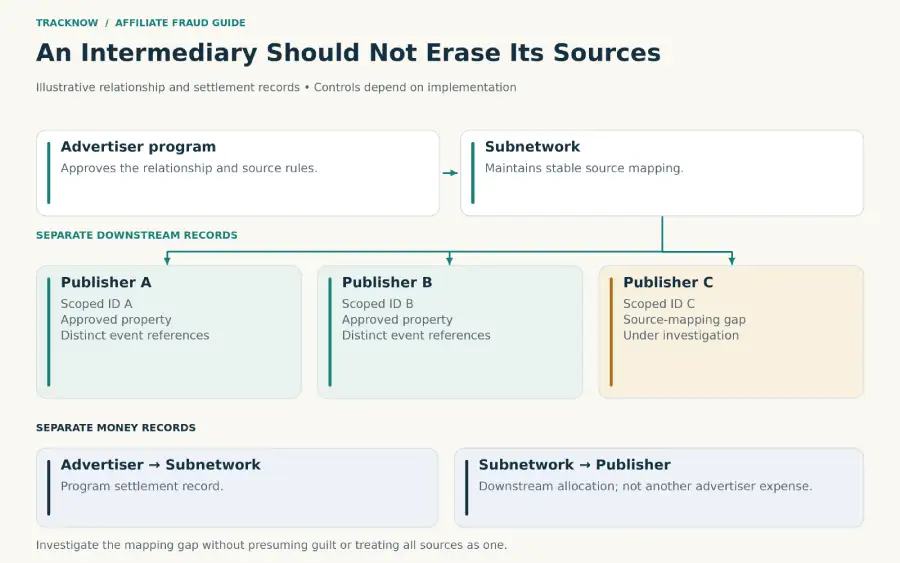
Review Performance Below the Account Average
Break results down by downstream publisher, traffic method, and comparable mature cohorts. Monitor qualification, cancellations, disputes, complaints, and missing source mappings. An acceptable account-wide average can coexist with a source generating invalid activity.
Investigate unexplained identity changes, traffic under an excluded publisher, or inconsistent placement evidence. Allow for legitimate new publishers, seasonality, and source migrations. Small samples and delayed reporting can make source-level rates unstable.
Do not add every layer’s earnings as advertiser loss. A subnetwork may retain part of the commission and pass the rest downstream; that allocation is not automatically another advertiser expense. Separately funded fees or overrides need separate accounting. Apparent direct-and-subnetwork duplicates also require checking whether the agreement authorizes distinct rewards for the same event.
Investigate the Chain and Contain the Correct Scope
- Recover the relationship terms. Establish permitted publishers, traffic methods, further intermediaries, reporting obligations, and enforcement responsibilities.
- Resolve historical identity. Map each affected source reference to the publisher and properties active at the time, without rewriting older mappings.
- Reconstruct representative events. Connect placement evidence, referrals, qualifying business records, adjustments, and settlements across the participating systems.
- Request a documented response. Ask the intermediary for relevant approvals, source records, and remediation evidence through the agreed process.
- Apply proportionate controls. Restrict a confirmed affected source where supported. Broader restrictions may be necessary when the source cannot be isolated or the intermediary cannot provide required accountability.
- Verify the outcome. Distinguish newly generated referrals from delayed conversions and notifications. Reconcile affected commissions and confirm that the restriction reaches the actual distribution path.
Make Accountability Part of Onboarding
Document source disclosure, approval requirements, mapping retention, investigation access, notice handling, and treatment of pending commissions. Pass relevant restrictions and updated offers to downstream publishers. Define an escalation contact who can act on source-specific evidence.
Protect legitimate downstream publishers as well. Explain disputed transactions, support appeals through the intermediary, and preserve valid earnings when the evidence permits separation. An intermediary’s lack of transparency is an operational problem to resolve; it is not evidence that every publisher underneath it committed fraud.
The next section examines affiliate identity fraud, account takeover, and payout diversion: attacks against who is admitted to a program, who controls an account, and who ultimately receives the money.
15. Affiliate Identity Fraud, Account Takeover, and Payout Diversion
An established affiliate has a normal month: genuine referrals, approved commissions, no obvious traffic anomaly. Shortly before settlement, someone changes the payment destination. The payout succeeds technically, but the affiliate never receives the money.
This attack can leave acquisition metrics untouched. Identity fraud misrepresents who is joining or representing a program; account takeover gives an unauthorized person control of an existing account; payout diversion sends funds to an unauthorized destination. They can occur together, but each requires separate evidence and controls.
Verify the Business, Its Representative, and the Payee Separately
A plausible website and a working email address do not establish that an applicant owns the publication they claim. A genuine employee may also lack authority to change financial details. Conversely, an authorized agency may legitimately manage a publisher’s account without owning its website.
Use checks proportionate to the relationship: confirm the claimed business, control of relevant properties, representative authority, and permitted beneficiary arrangement. A company registration record establishes limited facts about an entity; it does not authenticate the person submitting the application.
A successful bank-account validation or small test payment may establish that a destination exists or is accessible. It does not automatically prove the recipient is entitled to the affiliate’s earnings. Document approved agency, company, and payment-provider arrangements instead of treating every name mismatch as fraud.
Recognize the Different Attack Surfaces
| Decision | Abuse to investigate | Useful evidence |
|---|---|---|
| Admission and representation | Stolen business identity, invented ownership, or false representative authority. | Verified business contacts, property-control checks, and authorization records. |
| Account control | Unauthorized access through compromised credentials, sessions, or recovery. | Sign-in history, session records, factor changes, and support actions. |
| Payment authorization | Unapproved beneficiary changes or altered payment instructions. | Destination history, independent verification, approval records, and provider references. |
The legitimate affiliate can be the victim of account takeover. Findings against their traffic, findings against their identity, and evidence of a compromised account should remain distinguishable throughout the investigation.
Account Access Can Be Compromised After a Valid Login
Credential reuse, phishing, compromised email, malicious software, and weak recovery procedures can expose affiliate or manager accounts. An attacker controlling a manager account may reach multiple partners, change permissions, or interfere with approvals. Scope the investigation around actual access rights.
Use unique credentials and strong authentication, including phishing-resistant methods where supported. NIST describes WebAuthn’s phishing resistance and explains why manually entered one-time codes do not provide the same property. Secure enrollment and recovery remain essential.
Protect sessions as well. The FBI has documented account access using stolen login cookies. Completing MFA earlier does not make every subsequent request trustworthy. Require appropriate reauthentication for sensitive changes, restrict privileges, and support server-side session revocation.
Treat Beneficiary Changes as a Financial Authorization
A request arriving in a familiar email thread can still be fraudulent. Verify material payment changes through a previously established, independently trusted channel. FBI guidance on business email compromise specifically recommends verifying changes in account numbers or payment procedures.
The verification must not depend solely on contact details supplied in the disputed request. Changing a phone number or recovery email and immediately using that new destination to authorize a payout creates circular assurance. Escalate when the established channel may itself be compromised.
Where supported, require fresh authentication for beneficiary changes, independent approval for higher-risk changes, and notification through established channels. A review or waiting period can provide time to detect an unauthorized change, but its duration should follow the program’s documented risk and payment process.
Preserve the approved beneficiary version with the payout instruction. OWASP’s transaction-authorization guidance calls for protecting transaction data and invalidating authorization when relevant data changes. Applied here, a changed destination should require renewed approval rather than silently inheriting approval for the previous details.
Check this at execution, including queued transfers, exports, APIs, and manual finance workflows. An approved batch can become unsafe if a later process substitutes current profile details. Link approval to the exact intended transaction and recheck authorization before release. These are design requirements to verify, not assumed features of every affiliate platform.
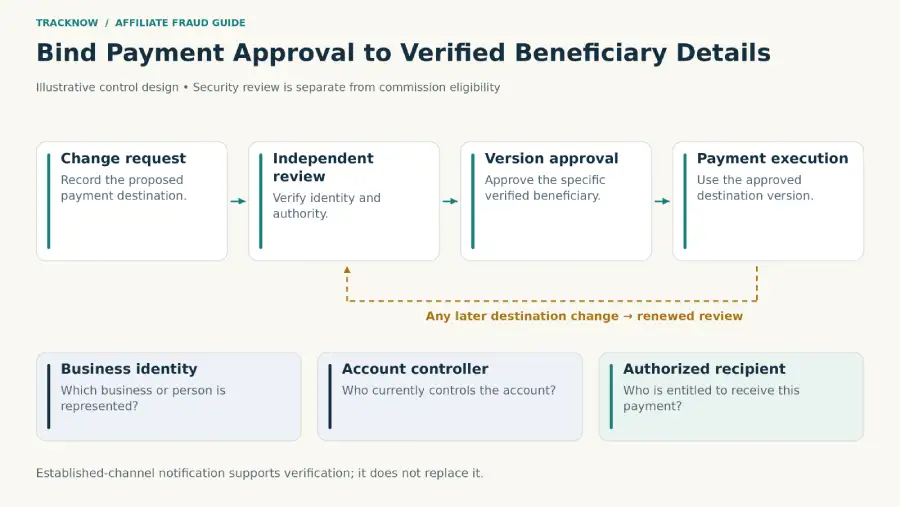
Recovery Must Restore Authority, Not Just Reset a Password
A support request to replace MFA or recover an account deserves a defined verification process. OWASP’s recovery guidance addresses suspected compromise, including invalidating sessions and outstanding recovery credentials after successful recovery.
Review newly enrolled factors, recovery destinations, delegated users, API credentials, and other persistent access. Secure the underlying mailbox or identity provider where affected. A password reset alone may leave another access path active.
Use named staff accounts and limited roles. Separate routine affiliate support from financial approval where feasible. Apply the same authorization rules to administrative tools and APIs; a protected portal does not compensate for an unrestricted alternative workflow.
Investigate Changes Across the Full Account Lifecycle
Useful alerts include an unexpected factor reset, new delegate, beneficiary change, or urgent payout request, especially in combination. Travel, staff turnover, corporate restructuring, and legitimate provider migrations can explain changes. An unfamiliar IP or shared beneficiary alone is insufficient evidence.
- Establish the last trusted state. Recover verified ownership, authorized users, contact channels, and approved payment details before the disputed activity.
- Build a change timeline. Correlate authentication, recovery, permission changes, support tickets, beneficiary versions, payout approvals, exports, and provider execution times.
- Determine the actor and scope. Separate owner actions, staff actions, API operations, and unexplained activity. Identify other accounts accessible through the same compromised authority.
- Trace the funds. Distinguish draft, submitted, processing, completed, failed, and returned transfers using the provider’s actual semantics.
- Restore verified control. Revoke unauthorized access, reverify the rightful representative and beneficiary, and inspect pending instructions before resuming affected payments.
Keep audit records with actor references, timestamps, relevant changes, and approval evidence. Restrict access and mask sensitive payment details. Do not place passwords, recovery codes, full session tokens, or unnecessary identity documents in investigation notes.
Contain the Payment Risk Without Erasing Valid Earnings
If a transfer is pending, use the payment provider’s supported cancellation process. If money has been sent to an unauthorized destination, contact the financial institution or provider immediately to explore recovery. A dashboard status change does not itself recall transferred funds.
Separate the diverted amount, confirmed recoveries, fees, and any replacement payment. Legitimate commission owed before the incident remains a separate accounting obligation; avoid counting the same loss twice. Potential data exposure and response costs also need their own assessment.
Preserve valid earning records while resolving account control. Resume payments only after verifying the relevant authority and destination, explain the affected scope to the legitimate partner, and test that all payment paths enforce the corrected controls.
The next section examines advertiser-side commission manipulation and fake affiliate programs: fraud that harms partners through dishonest tracking, validation, or payment practices.
16. Advertiser-Side Commission Manipulation and Fake Programs
An affiliate publishes a detailed review, sends genuine customers, and pays for production or promotion. Sales appear to happen, but commissions disappear, receive unexplained reductions, or remain unpaid. In another scenario, a polished recruitment portal promises earnings that can supposedly be withdrawn only after the partner sends more money.
Advertiser-side fraud involves deliberate deception about qualifying results, commission calculation, validation, or payment. A fake program may have no genuine intention of operating the partnership it advertises. These risks deserve the same scrutiny as dishonest traffic, while still separating fraud from technical failures, commercial disputes, and financial distress.
How Commission Manipulation Can Work
Deliberate underreporting. Qualifying outcomes are intentionally withheld from the system used to calculate affiliate earnings. Sometimes called commission shaving, this concerns selective or incomplete reporting rather than the ordinary difference between clicks and purchases.
False validation decisions. A genuine qualifying transaction is rejected using a knowingly inaccurate explanation, such as an invented cancellation. Verify every condition: a fulfilled order can still fall outside the agreed referral window or product eligibility. Fulfillment alone does not settle attribution.
Misrepresented commission calculations. The advertiser applies a different rate, base, customer category, or exclusion from the terms governing the event while presenting the result as compliant. Disclosed caps and scheduled changes can be legitimate; establish the applicable rule and effective date before alleging manipulation.
Dishonest payment representations. Earned amounts are described as transferred when no corresponding payment exists, or fabricated problems are repeatedly used to obstruct settlement. A failed transfer, missing tax information, or insufficient advertiser funding may also explain nonpayment without establishing fraudulent intent.
Missing Tracking Is a Finding to Investigate
Consent choices, browser restrictions, broken links, checkout changes, delayed events, and incorrect integrations can prevent attribution. Other eligible referrals or voucher rules can change which partner wins credit. A decline in conversion rate alone cannot distinguish these explanations from deliberate suppression.
Awin’s operational guidance recommends investigating significant transaction drops with test transactions and reviewing missing-transaction queries. Treat testing as a way to locate a failure. One successful test does not establish that every purchase path works; one failed test does not establish intent.
Server-to-server tracking still depends on an upstream system reporting the relevant business events. Authenticating a received postback does not prove that every qualifying order was reported. Independent reconciliation and change history remain necessary.
Locate the Dispute in the Commission Lifecycle
| Stage | Question to resolve | Relevant evidence |
|---|---|---|
| Attribution | Was the qualifying outcome connected to an eligible referral? | Referral reference, event history, credit policy, and authorized test records. |
| Validation | Does the decision match the outcome and applicable exclusions? | Order or CRM status, refund history, decision reason, and supporting records. |
| Calculation | Were the correct base, rate, currency, and adjustments used? | Effective agreement, eligible line items, rule history, and commission ledger. |
| Settlement | What amount became due, and what was actually transferred? | Payment schedule, account requirements, invoices, transfer references, and receipts. |
Status labels have platform-specific meanings. Awin distinguishes transaction approval from payment status; its approved view includes paid and unpaid records. impact.com describes separate action and payout stages, including funding-related delays. Read the relevant definitions rather than assuming “tracked,” “approved,” and “paid” are equivalent.
Preserve the Terms Needed to Recalculate Earnings
Keep the accepted agreement and its history: qualifying events, attribution window, eligible customers and products, commission base, rates, caps, reversals, validation schedule, payment thresholds, and termination treatment. Establish how changes are communicated and which rules govern pending or recurring events.
Recalculate disputed amounts against those records. Taxes, shipping, discounts, partial refunds, currency conversion, and rounding can create understandable differences. A dashboard showing a lower amount is a starting point; the finding should identify the specific unsupported deduction or rule mismatch.
Request the history behind amendments. A current rate table cannot explain an earlier calculation by itself. The relevant question is which terms and adjustment rules applied at the time, not whether the latest dashboard now displays a plausible number.
Recognize Fake Programs and Fabricated Earnings
A fraudulent operator may borrow a real company’s branding, invent a manager, or display a dashboard with unsupported balances. Confirm program existence and representative authority through independently verified company channels. A recognizable software interface or platform logo does not itself prove the merchant authorized the program or will pay.
A related scam uses the language of commissions for repetitive online tasks and then demands a deposit to release supposed earnings. The FTC describes this task-scam pattern, including small initial payments intended to build trust. Such a scheme can masquerade as an affiliate opportunity while lacking genuine customer-referral commissions.
A demand to send new money to unlock a displayed balance is a serious warning. Pause and independently verify the operator, claimed charge, and payment arrangement. Distinguish that demand from documented fees deducted under a real agreement; the label “processing” or “verification” does not establish legitimacy.
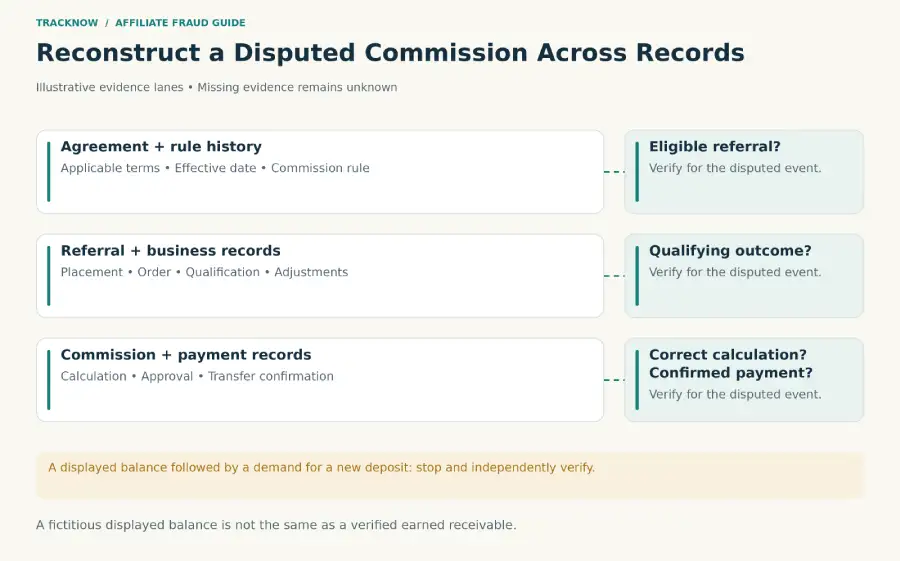
Build a Dispute Around Specific Events
- Export the relevant history. Preserve available referrals, conversions, decisions, amounts, payment statuses, and timestamps before records or access change.
- Select identifiable discrepancies. Provide event or order references where permitted, the expected treatment, actual treatment, and applicable terms.
- Request a documented explanation. Ask for the precise exclusion, calculation, or payment blocker and the records supporting it. Use the available query process within its deadlines.
- Verify the technical explanation. Coordinate authorized test purchases or leads across relevant paths. Respect consent choices and program rules; keep test events separate from ordinary commission claims.
- Escalate unresolved contradictions. Present a concise evidence package to the responsible program team, intermediary, or dispute channel. Identify confirmed facts, unavailable records, and remaining hypotheses.
Customer confirmation can support an inquiry, but does not independently establish every attribution condition. Obtain and share information through authorized channels, minimize personal data, and avoid asking customers for credentials or complete payment details.
Limit Exposure While Protecting the Evidence
Before scaling a new relationship, verify tracking, understand validation and payment requirements, and reconcile an initial completed settlement. Early payment is useful evidence of operation, but does not guarantee future conduct. Monitor aged approved balances and unexplained changes as the relationship grows.
For established disputes, consider limiting additional promotion while seeking resolution. For a suspected deposit scam, stop sending further funds and contact the payment provider promptly about available options. Keep correspondence, payment references, and the program’s representations.
Measure losses carefully. Confirmed unpaid earned commission, promotion costs, and money sent to a fraudulent operator are different categories. A fabricated dashboard balance is not automatically an earned receivable. Avoid adding estimated lost profit to the same underlying unpaid commission without explaining the counterfactual.
Program owners can prevent these disputes through reliable reconciliation, traceable decisions, visible rule changes, and truthful payment reporting. Partners need enough evidence to understand their earnings, and managers need records that make both errors and deliberate manipulation discoverable.
Having covered the main fraud types, the next section examines their business costs: how to calculate direct losses, operational impact, and exposure without double-counting.
What Affiliate Fraud Really Costs
The number of suspicious conversions is not the amount of money lost. Some requests never create a commission. Some commissions are stopped before payment. Other incidents involve genuine purchases with stolen attribution, while account compromise can divert money without changing conversion metrics at all.
A useful loss assessment connects each incident to actual financial effects, confirmed recoveries, operational effort, and unresolved exposure. Keep those categories visible. Combining them into one impressive headline makes it harder to decide what needs fixing and whether the fix worked.
Start with Whose Loss You Are Measuring
A merchant, affiliate, subnetwork, and payment provider can experience different consequences from the same incident. The merchant may overpay commission, a legitimate publisher may lose earnings, and a subnetwork may face investigation costs. Record each perspective before producing an ecosystem-wide total.
Money passing through an intermediary is not automatically another loss at every step. A commission shared with a publisher or cashback customer remains one funded commission unless separate obligations create additional expense. Identify the payer, recipient, entitlement, and ultimate recovery for each amount.
Separate Realized Loss, Exposure, and Prevented Payments
| Category | Example | Reporting treatment |
|---|---|---|
| Confirmed direct loss | Commission actually paid on confirmed fabricated conversions. | Record the paid amount and associate subsequent recoveries. |
| Unresolved exposure | Paid commissions under investigation or funds temporarily withheld during a dispute. | Show the amount, uncertainty, and current financial status separately. |
| Prevented invalid payment | A confirmed invalid commission rejected before funds were sent. | Report separately from losses already incurred. |
| Confirmed recovery | Money returned and matched to an earlier loss. | Reduce that loss once; retain the recovery reference. |
A ledger adjustment does not necessarily recover cash. A negative affiliate balance may remain uncollected, and a requested transfer recall may fail. Record those as recovery attempts or receivables, rather than completed recoveries. Likewise, an amount placed on hold may ultimately belong to a legitimate partner.
Count the Economic Effect of Each Transaction Once
A genuine order with manipulated attribution is not automatically a lost sale. Establish the wrongly paid commission and any additional settlement required, accounting for the valid commission that would otherwise have been due. Avoid treating every affected order’s revenue as fraud loss.
For fraudulent purchases, reconcile the original receipt, refund or chargeback, goods supplied, recovered inventory, fulfillment costs, fees, and commission. Reversing a sale removes its recorded revenue; adding that revenue again as a separate loss can double-count the same effect. Use a consistent cash-flow or margin comparison agreed with finance.
Payment status matters. Stripe documents debiting disputed amounts and fees during the dispute process. That debit can create immediate liquidity pressure while the ultimate outcome remains unresolved. Its refund documentation also distinguishes completed, pending, and failed processing. Reconcile provider records instead of assuming every requested reversal has settled.
Separate ordinary returns, contractual exclusions, and confirmed fraud. A commission correction can be valid even when nobody acted dishonestly. Link the amount to the supported finding rather than labeling every reversal a prevented fraud loss.
Use a Reproducible Incident Calculation
For confirmed invalid commission payments, a practical starting point is:
Net unrecovered invalid commission = confirmed invalid commission paid − confirmed recoveries of those payments.
Add other direct losses only when they represent distinct economic effects. Track additional cash expenses caused by the response separately from normal operating costs. Show internal staff capacity and estimated commercial impact as additional views. This is an operational measurement model; reconcile it with your organization’s accounting treatment.
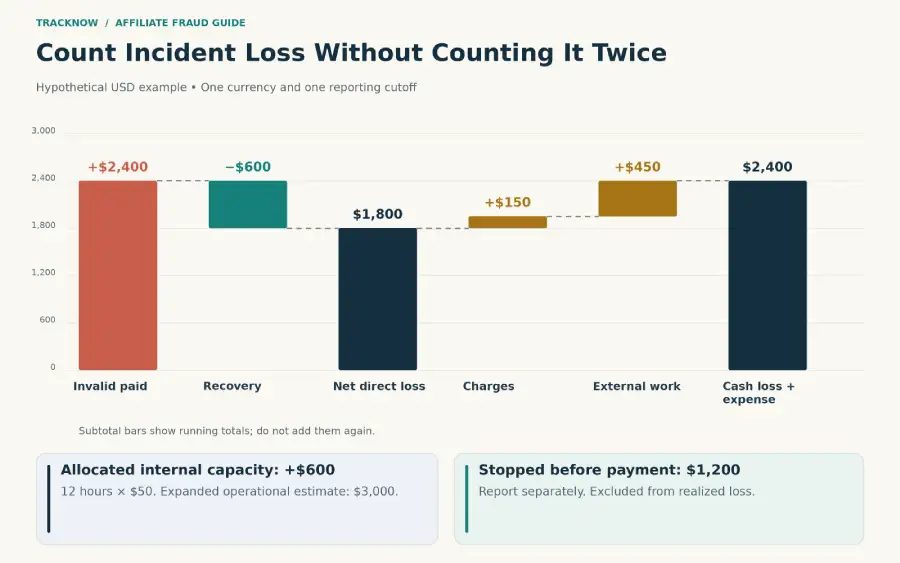
Measure Team Capacity and Customer Friction
Investigation consumes affiliate-management, finance, support, security, and engineering time. Record hours by activity and use an agreed cost basis. Existing payroll already covers many of those hours; allocated capacity is useful for planning but is not automatically additional cash expense. Avoid adding both the full salary allocation and the same overtime invoice.
Also record delayed legitimate payouts, unnecessary verification, customer complaints, and partner appeals. An incorrectly rejected order may cost contribution margin, while a payment hold may mainly create delay and support work. Estimate the effect from evidence rather than assuming every interrupted interaction would have produced a sale.
Keep Commercial Estimates Separate from Confirmed Loss
Fraud can distort source rankings and budget allocation. A source that captures existing demand can appear more productive than it is, while a legitimate content partner loses attributed credit. Historical attribution reports alone do not establish the sales that would have happened without that source.
Google’s Conversion Lift documentation illustrates the distinction between attribution and causal impact through controlled comparisons. Apply the same measurement principle when evaluating acquisition value: use an appropriate experiment or qualified estimate, state its uncertainty, and avoid presenting projected revenue or lifetime value as cash already lost.
Reputational damage also needs evidence: lost partners, documented complaints, disrupted placements, or measurable retention changes. An arbitrary multiplier applied to direct loss does not produce a defensible reputation estimate.
Report Comparable Metrics Over Time
Useful measures include confirmed invalid commission paid as a percentage of total commission paid in the same cohort, confirmed recovery of those payments, investigation hours, and the age of unresolved exposure. Define the numerator, denominator, currency, event cohort, and reporting cutoff.
Allow for delayed refunds and discoveries. A recent cohort has had less time to reveal problems or produce recoveries. Preserve earlier report versions and distinguish new incidents from later updates to existing cases. Use consistent exchange-rate rules when consolidating currencies.
A reduction in alerts is not enough to demonstrate success. Review net loss, legitimate conversion and payout outcomes, review effort, and actual control costs together. A control that blocks more activity can still perform poorly if it mostly adds friction for legitimate partners.
The next section turns these distinctions into monitoring signals: what to watch, which comparisons matter, and when an anomaly deserves investigation.
Affiliate Fraud Warning Signs: What to Monitor and How to Interpret It
A conversion spike, unusually short purchase journey, or cluster of shared IP addresses can attract attention. Each can also have a legitimate explanation. Effective monitoring turns such observations into specific questions, supported by comparable data and a clear next check.
An alert should explain what changed, which records support the observation, and what remains uncertain. Its purpose is to guide investigation and proportionate protection. A dashboard label alone should not become a finding of fraud.
Monitor the Data Pipeline as Well as Partner Behavior
Before interpreting a behavioral change, check collection health: event delays, missing source fields, duplicate integrations, authentication failures, unmatched orders, and deployment changes. A reporting outage can make a strong partner appear inactive; a replaying integration can make conversions look exceptional.
Compare systems with their measurement differences in mind. Google Analytics automatically excludes known bots and spiders. Analytics sessions, raw redirect requests, recorded affiliate clicks, and accepted business events therefore need not match. Reconcile defined event populations rather than treating every difference as hidden traffic.
Monitor whether the detector itself is receiving current data. A silent queue might mean fewer suspicious events, a failed job, or a missing feed. Record the last successful ingestion, processing delay, and relevant field completeness. Distinguish zero observed events from unavailable observations.
Define Metrics Before Setting Thresholds
For each metric, document the event definition, denominator, source, time window, attribution horizon, and exclusions. If measuring conversion per click, specify whether the denominator contains raw requests or accepted click records and whether the numerator contains tracked, qualified, approved, or paid outcomes.
Compare outcomes belonging to the same referral cohort, allowing for conversion and validation delays. Dividing today’s conversions from older referrals by today’s clicks can produce a misleading rate. Keep occurrence time separate from receipt time, and normalize time zones and timestamp units.
Inspect counts alongside rates. One conversion from five clicks is 20%, but it provides little basis for judging a publisher’s long-term behavior. Use sufficient observations and uncertainty estimates where appropriate. No single conversion-rate threshold reliably identifies fraud across different programs.
Build Baselines for Comparable Sources
Segment by promotion method, product, market, device context, customer category, and campaign conditions where those differences matter. Compare a partner with its relevant history and suitable peers. A coupon placement, detailed review, and paid prospecting campaign can naturally have different conversion patterns.
Account for promotions, seasonality, new placements, outages, and commission changes. Preserve the baseline version and exclude confirmed attack periods where appropriate. Otherwise, repeated abuse can become part of the system’s definition of normal.
Use Signals That Point to a Verifiable Next Step
| Signal | Possible concern | Alternative explanation and next check |
|---|---|---|
| Click volume rises without downstream activity | Automated or non-qualifying traffic. | Previews, scanners, or reporting failure; inspect requests, placements, and event delivery. |
| Many referrals occur immediately before purchase | Attribution interception or late forced clicks. | Legitimate checkout-stage assistance; reconstruct journeys and review the approved model. |
| Qualification or retained revenue falls within a source | Fake leads, concealed incentives, or abusive orders. | Offer changes or immature cohorts; compare equivalent outcomes after adequate observation. |
| Repeated event or business identifiers | Replay or duplicate commission awards. | Legitimate retries or distinct milestones; inspect event types and ledger effects. |
| Publisher mappings or geographic evidence conflict | Undisclosed sources or false eligibility claims. | Mapping errors, travel, or proxy behavior; verify provenance and the actual eligibility rule. |
| Sensitive account changes precede a payout | Account takeover or beneficiary diversion. | Authorized staff or provider changes; independently verify authority and payment details. |
| Rejections or overdue balances rise unexpectedly | Commission manipulation or payment misconduct. | Returns, calculation errors, or funding delays; inspect reasons, governing terms, and transfers. |
Combine distinct evidence, not merely multiple versions of one observation. An IP-country estimate and a country label derived from that same IP are not independent confirmation. Likewise, several dashboards populated by one postback do not independently prove a sale.
Set Priorities Around Urgency, Impact, and Evidence
A suspicious beneficiary change with a transfer awaiting release may require immediate verification. A statistical source anomaly may warrant scheduled review. Prioritize using funds at risk, potential customer harm, confidence, scope, and the time remaining to prevent an irreversible action.
Separate security rejection from partner judgment. An invalidly authenticated conversion message can be rejected under the protocol without accusing the affiliate named in it. Someone else may have submitted it. A source-level anomaly may justify investigation without justifying an account-wide commission cancellation.
Document actions for each alert class: observe, request evidence, review a specific source, or apply an authorized temporary restriction. Set an owner, review deadline, and release criteria for any hold. Design the queue around available reviewer capacity and escalate aging high-impact cases.
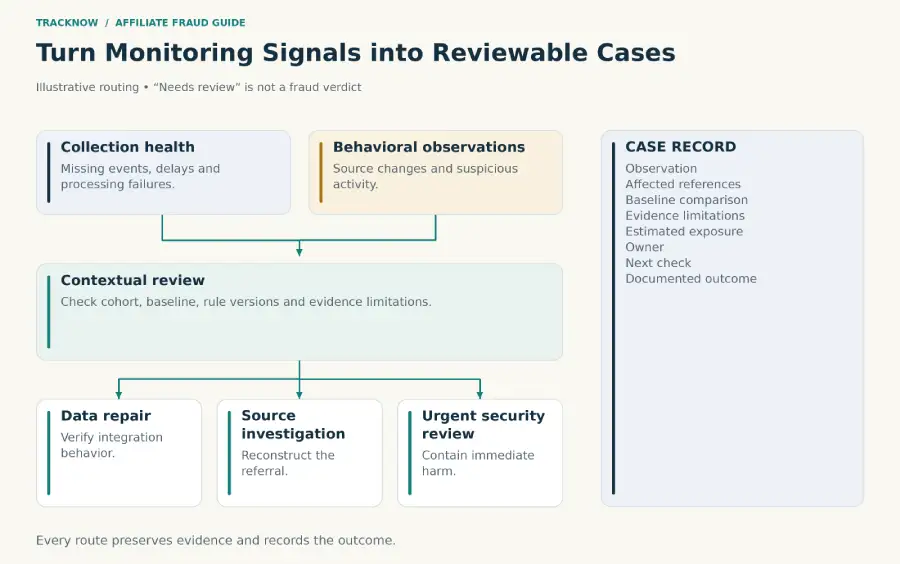
Keep Alerts Reproducible and Safe to Share
Retain the rule identifier and version, observation window, relevant record references, calculation, comparison baseline, and detection time. Preserve the source of each field and known gaps. Reviewers should be able to reproduce why the alert fired after a dashboard or rule changes.
OWASP’s logging guidance emphasizes event context, confidence, and protection of sensitive information. Use restricted evidence access and stable references rather than copying full customer records into alerts. Exclude credentials, session tokens, and unnecessary payment details.
Group related alerts into cases without losing the underlying records. Ten rules firing on one event do not mean ten separate incidents. Preserve changes in scope and avoid repeatedly resetting a case’s age when another notification arrives.
Evaluate Whether Monitoring Improves Decisions
Track review time, queue age, confirmed findings, incorrect restrictions, and financial outcomes. Label conclusions separately: confirmed deception, other policy violation, technical error, legitimate activity, or unresolved. A reversed commission is not automatically a confirmed fraud label.
Reviewed-alert precision measures the proportion of evaluated alerts that match the defined target outcome. It does not tell you how much fraud went undetected. Appeals alone also provide an incomplete view of false positives: some affected partners never challenge a decision. Use appropriate sampling of unflagged activity and follow later outcomes to assess blind spots.
Test new rules on historical data and, where appropriate, in observation-only operation before broad enforcement. Preserve the applicable history to avoid evaluating a rule using information unavailable at the original decision time. Stripe’s fraud-management guidance similarly discusses review rules and measuring their effects when refining controls.
Schedule regular review of thresholds, source coverage, and investigation outcomes. Monitoring succeeds when it helps reduce loss and harm with manageable review effort and fewer unjustified restrictions. The next section explains how to investigate a case and preserve the evidence needed for a defensible decision.
How to Investigate Suspected Affiliate Fraud
An investigation should answer a specific question: what happened, which rule or entitlement was affected, who was responsible, and what action the evidence supports. Starting with “this partner is fraudulent” encourages selective interpretation. Starting with an identifiable discrepancy makes competing explanations easier to test.
Preserve observations, reconstruct the relevant events, and document the limits of the conclusion. You may confirm an invalid commission without establishing deliberate deception, or confirm an account compromise while finding that the affiliate’s referrals were legitimate.
1. Define the Case and Address Immediate Harm
Assign a case reference, owner, opening time, affected program, initial event references, and a concise allegation. Identify the decision required: stop an imminent transfer, assess a disputed source, correct duplicate commissions, or determine whether reported outcomes exist.
Contain urgent harm through authorized procedures. Preserve relevant evidence before changes where practical, but do not delay necessary action solely to obtain a perfect capture. Record every restriction, credential revocation, or configuration change, including who acted and why.
Keep temporary containment separate from the final finding. A payment hold needs a defined scope, review owner, and release criteria. It does not establish that every commission in the account is invalid.
2. Preserve Evidence with Its Context
Collect the applicable terms, placement evidence, relevant tracking records, business-event history, and payment references. Request preservation of short-lived logs before routine deletion. NIST’s incident-response guidance emphasizes preserving incident-data integrity and provenance, as well as recording investigative actions.
For each artifact, retain its source, collector, collection time and time zone, covered period, export method or query, access scope, and known limitations. Record pagination, filters, and row counts where they determine completeness. An empty export can mean no matches, insufficient permissions, or an incomplete query.
Keep a protected original and perform analysis on working copies. A cryptographic hash can help detect later changes to captured bytes; it does not establish that the original information was truthful or complete. Record redaction and transformation steps rather than silently replacing the original.
Use restricted access and defined retention. Evidence can contain credentials, customer information, or payment details. A shareable case summary should expose only what the recipient needs, while preserving access to the protected supporting record.
3. Reconstruct the Business Event Across Systems
Connect program and partner identities, source mappings, click references, conversion events, orders or CRM records, commission entries, adjustments, and payouts. Preserve identifier namespaces and original values; a transaction number from one merchant is not automatically the same entity as an identical number elsewhere.
Build a timeline using both occurrence and receipt times. Account for time zones, clock differences, delayed delivery, and later amendments. A message received after a refund may describe an earlier purchase. Close timestamps establish proximity, not necessarily causal order.
| Claim | Relevant evidence | Limit to preserve |
|---|---|---|
| A placement generated a tracking request | Documented placement capture and associated network activity. | Does not by itself prove accepted attribution or payment. |
| An outcome qualified for commission | Authoritative business record and applicable eligibility rules. | A completed purchase alone does not establish referral entitlement. |
| An account controlled the observed activity | Access, ownership, delegation, and source-control records. | A copied affiliate identifier does not establish page ownership. |
| Funds were lost or recovered | Matched provider transactions, settlement records, and receipts. | A commission-status edit does not itself move money. |
Preserve historical configuration as well as events. Current attribution priorities, coupon assignments, rates, and permissions may differ from those in force when the disputed action occurred. If historical settings are unavailable, document that gap explicitly.
4. Test Competing Explanations
Write down the suspected mechanism and plausible alternatives before testing. Duplicate commissions may involve replay, integration overlap, or concurrency defects. Geographic inconsistencies may involve false claims, travel, proxy extraction, or database changes. A missing sale may reflect suppression, consent behavior, or a broken checkout integration.
For each explanation, identify what would support it and what would contradict it. Distinguish independent evidence from records copied between systems. OWASP notes that data crossing trust boundaries may be missing, modified, forged, or replayed; a log entry needs interpretation in that context.
Keep observations separate from inferences. “Three authenticated deliveries used the same event reference” is an observation. “The partner deliberately replayed the event” requires evidence about origin and intent. A broken duplicate-processing control may be confirmed while the sender’s intent remains unresolved.
5. Reproduce Relevant Behavior Under Controlled Conditions
Use authorized test environments and documented test accounts where available. Match relevant browser, consent, login, cart, offer, and configuration conditions. Reset state between comparisons and record any differences. Test only the behavior needed to resolve the case; uncontrolled live retries can create additional commissions or payments.
Capture the initial page, navigation and background requests, relevant responses, and resulting server records. Screenshots help establish visible claims, while network and application records help explain what executed. Opening developer tools, disabling cache, or changing browser settings can affect the behavior, so record those choices.
Chrome DevTools documents sanitized HAR exports that omit sensitive headers such as cookies and authorization. Sanitization does not guarantee the absence of secrets or personal information in URLs, custom fields, or bodies. Review captures before sharing and preserve any redaction history.
A successful reproduction demonstrates behavior under the recorded conditions. It does not establish its frequency across all historical traffic. Failed reproduction also does not erase a valid earlier capture; the placement or routing may have changed.
6. Obtain the Partner’s Explanation and Establish Scope
Present identifiable discrepancies and request the records needed to explain them: placement authorization, source mappings, campaign settings, delivery history, or relevant business references. Use the agreed contact and dispute process, with a reasonable documented response window.
Preserve supporting and contradictory material. Check whether the response resolves the original question or merely repeats a dashboard label. Avoid exposing unnecessary customer information or sensitive detection details when a narrower evidence package is sufficient.
Scope confirmed findings by event, source, period, and relevant mechanism. A sampled violation supports a finding about that sample; extending it to a larger population requires a defensible method and stated uncertainty. Shared infrastructure or account membership alone does not prove every associated source participated.
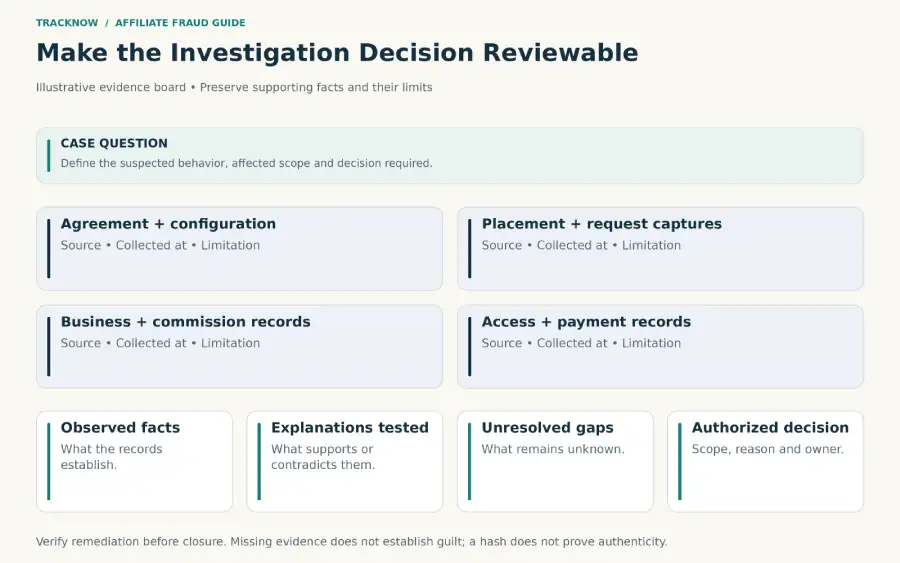
7. Write a Finding That Another Reviewer Can Check
The decision record should answer these questions:
- What was examined? State the question, affected scope, governing terms, and relevant configuration.
- What was established? Cite artifact references and distinguish verified facts from inference.
- What remains uncertain? Record missing data, alternative explanations, sampling limits, and confidence.
- What action follows? Specify corrections, restrictions, payment treatment, responsible owners, and review or appeal routes.
Classify confirmed deception, other policy violations, technical defects, legitimate activity, and unresolved cases separately. Invalid entitlement and deliberate misconduct are different conclusions. Seek independent review for consequential or contested findings.
8. Verify Remediation Before Closing the Case
Confirm that the actual failure path is corrected: duplicate processing stops, restricted placements are removed, account control is restored, or payout instructions use the verified destination. Check legitimate paths as well, and account for delayed conversions from earlier activity.
Reconcile corrections and actual recoveries, release unjustified holds, and communicate the supported outcome. Preserve the final evidence set and decision history. Feed confirmed causes into monitoring and prevention, with an owner and completion date for remaining work.
The next section turns these lessons into a prevention framework spanning onboarding, tracking, qualification, access control, and payouts.
How to Prevent Affiliate Fraud: Build Controls Around the Full Lifecycle
Fraud prevention works best when each consequential decision has a clear rule, reliable evidence, and an accountable owner. Approving a partner, accepting an event, awarding commission, and releasing funds are different decisions. A weakness between them can let an otherwise well-protected program pay for an invalid result.
Build prevention around the points where identity, source, business facts, and payment authority must be verified. Then test whether the controls remain effective across APIs, imports, administrative tools, retries, and exceptional workflows.
Turn Program Terms into Enforceable Rules
Define qualifying events, accepted promotion methods, geographic criteria, attribution priority, customer eligibility, commission bases, and payment conditions. Specify treatment of self-referrals, incentives, coupon distribution, brand advertising, and downstream publishers where relevant.
For each restriction, identify how compliance can be checked. “New customer” needs an agreed business definition and matching process. “Exclusive coupon” needs separate rules for audience, publication, and commission attribution. Restrictions that only exist in prose are difficult to apply consistently.
Version the rules and preserve their effective dates, approvals, and exceptions. Partners should understand what activity is permitted and how changes affect pending or recurring outcomes. Apply equivalent cases consistently and provide a route to correct mistakes.
Verify Partners and Maintain Source Accountability
Confirm the applicant’s relationship to the claimed business and properties. Establish permitted traffic methods, approved domains or other placements, supplier arrangements, and the representative authorized to manage the account. Choose proportionate checks rather than collecting unnecessary identity documents by default.
Require disclosure of material source changes and maintain stable mappings for downstream publishers. Distinguish publisher identity from placement labels. Approval of an intermediary should not erase source visibility, and a changed identifier should not erase historical restrictions or evidence.
Review actual distribution after onboarding. Check that creatives, offers, search activity, and user journeys remain within the approved model. A verified application is a starting point; later changes still need oversight.
Protect the Boundaries Between Systems
Use the integration’s supported authentication and integrity controls for incoming conversion messages. Scope credentials to the appropriate advertiser, environment, and operation. Keep production secrets server-side and restrict access to logs, configuration exports, and integration tools.
Preserve the original referral reference and source information as the event moves through checkout, CRM, tracking, and finance. Check for lost parameters, overwritten mappings, and mismatched identifiers. A partner-supplied label should not become unquestioned authority for customer eligibility or payout rate.
Authentication confirms a sender or message under the chosen protocol. Business validation must still establish that the qualifying outcome occurred. Reconcile reported conversions with authoritative records, including events that were missed entirely.
Enforce Qualification and Reward Limits on the Server
Derive relevant amounts, statuses, and eligibility from trusted business records. Define permitted transitions between received, pending, qualified, adjusted, and payable states using the stages your program actually needs. A client-visible page or hidden form field should not authorize movement to a financial state.
OWASP’s business-logic guidance recommends server-held workflow state and atomic enforcement of operations that check a condition before granting value. Applied to affiliate rewards, two simultaneous requests must not both consume the same remaining entitlement.
Keep budget limits, redemption counts, and customer eligibility distinct. Cancellation may restore campaign budget without restoring a once-per-customer bonus. Define how partial refunds, subscription renewals, and legitimate repeat milestones affect each rule.
Use bot challenges as supporting controls where appropriate. Cloudflare requires server-side validation for Turnstile; displaying its widget alone is incomplete. Successful challenge validation does not prove a qualified lead, customer intent, or reward entitlement. Keep application-level duplicate protection and eligibility checks independent.
Make Retries Safe Without Losing Legitimate Events
Persist event identity with sender scope and enforce the relevant business uniqueness rule. Different delivery references can describe one commissionable action, while one order can legitimately contain several distinct actions. Model those distinctions explicitly.
Protect receipt, processing state, and financial effects against concurrency and partial failure. A timeout after a commission was created must not make the retry create another award. Recovery should finish incomplete work without duplicating completed effects.
Test delayed and out-of-order updates. An older purchase notification should not silently restore commission already disqualified by a later authoritative event. Where state cannot be confirmed, retain a recoverable pending record and a reconciliation path.
Separate Account Access from Financial Authority
Use named users, limited roles, strong authentication, and secure recovery. OWASP recommends validating permissions on every request. Apply equivalent authorization to portal actions, APIs, bulk imports, and staff tools; hiding a button does not enforce a restriction.
Require appropriate fresh verification for sensitive changes and independent approval where risk warrants it. Recovery email changes, new delegates, and factor replacement need protection alongside bank details. A newly supplied contact must not become the sole evidence authorizing its own account change.
Bind payout approval to verified transaction details and beneficiary version. OWASP’s transaction-authorization guidance supports invalidating earlier authorization when relevant data changes. Check queued transfers and finance exports at release, including manual exceptions.
Assign Owners and Require Evidence That Each Control Works
| Control area | Accountable function | Evidence of effective operation |
|---|---|---|
| Partner and source permissions | Affiliate operations. | Recorded approvals, current source mappings, and placement reviews. |
| Event integrity and duplicate handling | Engineering and integration owners. | Authorized tests of invalid messages, retries, concurrency, and recovery. |
| Business qualification | Relevant commerce or CRM owner with affiliate operations. | Reconciliation against authoritative outcomes and documented exceptions. |
| Account and recovery security | Security and identity administration. | Access reviews, recovery records, and verified session revocation. |
| Commission settlement and beneficiary changes | Finance with the designated approver. | Approved payment details matched to actual provider instructions and settlements. |
Adapt ownership to your organization, but avoid unassigned boundaries. If the affiliate platform records a refund while finance still pays the original export, the process remains exposed. Verify the complete handoff rather than each team’s screen in isolation.
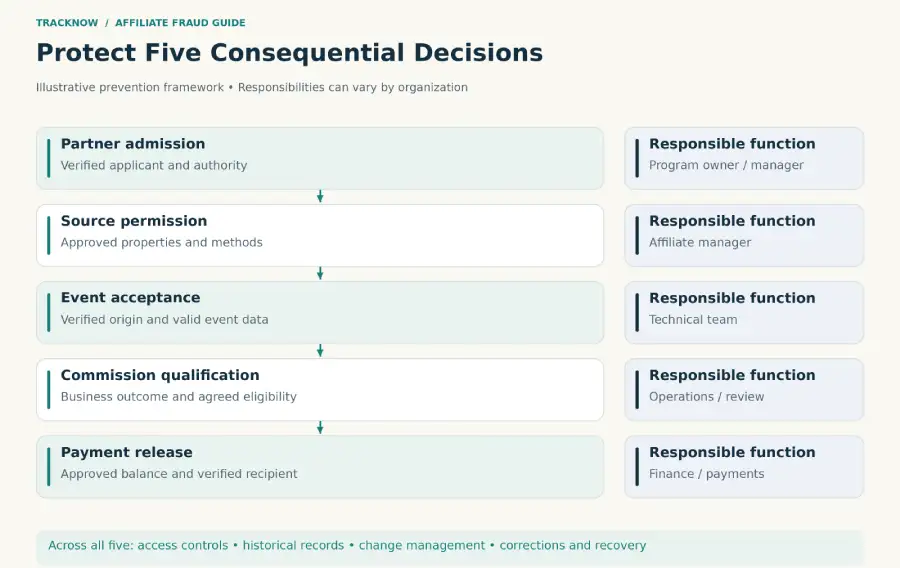
Define Failure Behavior and Review Exceptions
Plan for unavailable services, incomplete data, and processing backlogs. Invalid authentication should not be accepted merely because business confirmation is delayed. An authentic event awaiting qualification may instead need durable pending processing. Specify recovery, escalation, and maximum review periods for the relevant workflow.
Keep exceptions narrow, attributable, and time-bound. Record who approved them, what scope they cover, and when they expire. An emergency workaround that permanently bypasses validation can become a larger vulnerability than the original outage.
Manage prevention changes like other consequential releases. Test positive and negative cases, preserve configuration history, monitor impact, and prepare rollback that does not discard valid events or silently restore unsafe permissions.
Prioritize Improvements by Exposure and Verified Results
Start with the largest credible paths to irreversible loss and the controls needed to investigate them. Then strengthen source visibility, qualification, automation, and review quality according to observed incidents and workflow gaps. A small program may implement several controls manually before automating them.
Measure confirmed loss, recoveries, review effort, legitimate earnings, and customer friction together. Passing a challenge, blocking an IP, or reducing alert volume is not a complete success measure. Revisit controls after new integrations, offers, payment methods, or partner models change the underlying risk.
The next section examines what affiliate software can verify, where its visibility ends, and how to assess Tracknow’s documented capabilities without assuming that any tool eliminates fraud on its own.
Affiliate Software and Fraud Control: Tracknow’s Capabilities and Practical Limits
A dashboard can show a conversion, its attribution, its commission, and its review status. Establishing whether the underlying transaction was genuine requires evidence from the systems that recorded the customer’s activity. Effective fraud control connects these layers and makes their responsibilities explicit.
For Tracknow, start with the documented features below, then test their behavior against your actual integration and program rules. The implementation checks in this section are recommendations for evaluating the complete workflow; they are not claims that every control is automatically enabled.
Understand What the Platform Actually Receives
Tracknow’s postback documentation describes recording incoming postbacks and resolving the campaign, affiliate, and commission rule before creating a conversion. Attribution can use click identifiers, assigned coupons, lifetime customer associations, or direct affiliate identifiers.
That creates an important investigation distinction: a received event, a created conversion, and an approved commission represent different processing outcomes. A missing conversion may reflect missing attribution or configuration rather than deliberate suppression. Conversely, successful processing establishes that the supplied event could be matched; investigators still need to verify its business meaning.
Map each important field to its origin. For example, identify which backend determines the order amount, customer eligibility, and payment outcome. A value copied from a browser or partner-controlled field should not silently become authoritative evidence merely because it appears in a report.
Use the Documented Fraud Controls with Context
Tracknow documents the following controls in its Fraud Protection guide:
| Control | Documented behavior | Implementation consideration |
|---|---|---|
| Postback IP restrictions | Allowed and disallowed IP settings restrict postback sources. | The documentation limits this approach to backend, server-side integrations using static IP addresses. Other integration types can lose conversions if restrictions are enabled. |
| Conversion fraud score | Inputs include VPN and proxy indicators, click-to-postback timing, and repeated postbacks associated with a client IP. Categories are Safe, Low Risk, Medium Risk, and High Risk. | Review signals alongside source characteristics and transaction evidence. |
| Score-based automation | Configured score thresholds can assign Denied or Revision. | Evaluate review capacity and legitimate conversion outcomes before choosing thresholds. |
A risk category is not proof of intent or a calibrated probability of fraud. Shared networks, privacy tools, and legitimate promotion methods can affect signals. Assess whether a rule identifies the abuse relevant to your program and how frequently valid referrals need correction.
Choose Conversion Statuses Deliberately
The conversion status documentation describes materially different review and payment behaviors:
| Status | Operational meaning |
|---|---|
| Approved | Commission becomes available for the affiliate to request payment. |
| Hold | Visible to the affiliate; automatically becomes Approved when its configured period expires unless action is taken. |
| Pending | Visible to the affiliate; commission remains unavailable and requires manual approval. |
| Revision | Hidden from the affiliate; commission remains unavailable and requires manual approval. |
| Denied | No affiliate commission is available. |
| Test | Visible to the affiliate; commission remains unavailable. |
Hold expires into approval. Choose Pending when explicit manual approval is required. Explain review timelines in program terms, especially where internal Revision records are not affiliate-visible.
Processing follows submission of a payment request and prevents conversion edits. Approving the request changes associated conversions to Paid; denying it returns them to Approved. Paid records are also uneditable. Because Paid reflects request approval, reconcile actual transfer outcomes with payment-provider records.
Align Commission Rules with Verified Business Events
In Tracknow’s commission configuration documentation, a “payout” means a commission rule. It can define fixed, percentage, or hybrid compensation, affiliate eligibility, event conditions, and country restrictions. Conditions evaluate the event data supplied to Tracknow.
The practical consequence is straightforward: accurate configuration needs accurate inputs. If first purchases earn a higher commission, your commerce or customer system must correctly distinguish first purchases from repeat purchases. Document how merged accounts, guest checkout, cancellations, and corrected orders affect that classification. Geographic eligibility also needs a defined business meaning and an appropriate evidence source.
For brokerage programs, CPA Qualification supports conditions such as net deposits, trading lots, and position counts. Qualification groups prevent additional CPA awards within the same group after one qualifies. Such milestones establish configured eligibility; assessing fabricated identities or coordinated abuse requires additional evidence.
Separate Attribution Rules from Promotion Permissions
Tracknow’s coupon documentation describes attribution through assigned codes, including purchases without a preceding affiliate click. Coupon Payout can apply a custom commission, while Coupon Code uses existing commission rules. Create the actual discount in the store and map it to the affiliate in Tracknow.
This makes a no-click coupon conversion potentially legitimate. Whether the affiliate was permitted to publish the code on a particular site remains a separate policy question. Define distribution rights, enforce checkout restrictions in the commerce workflow, and test attribution when competing referral identifiers appear together. Record the expected result before launch.
Test the Whole Workflow Before Relying on Automation
Use authorized test accounts and controlled transactions. For each scenario, preserve the input, expected result, observed records, and responsible owner:
- Valid referral: confirm attribution, commission calculation, initial status, and affiliate visibility.
- Missing or conflicting attribution: verify handling and confirm that unrelated partners receive no credit.
- Repeated delivery: resend the same business event, including concurrent delivery where supported. Verify the intended number of commissions across the complete integration.
- Changed order: test partial refunds, cancellations, and corrections before approval and after payment processing begins. Identify the supported adjustment procedure.
- Review exception: verify who can release a commission, the evidence required, and the resulting record.
- Payment reconciliation: trace approved commissions through the payment request to provider confirmation, including failed transfers.
Agree on expected retry, correction, and failure behavior with the integration owner. A test demonstrates the deployed configuration; repeat relevant cases after changing attribution, event mapping, or commission rules.

Assign Access and Close Evidence Gaps
Tracknow supports individual manager accounts with configurable permissions and permission presets. Assign access according to responsibilities, review it after role changes, and verify sensitive actions using accounts with the intended permissions.
Choose additional monitoring according to what it must observe: customer transactions, off-site advertising, impersonating domains, or beneficiary changes. Establish how findings reach the review team and connect to relevant conversions. Evaluate coverage through reproducible cases and reconciled outcomes.
The next section examines the other side of effective fraud control: protecting legitimate affiliates from stolen attribution, account abuse, unsupported accusations, and unexplained commission losses.
How Legitimate Affiliates Can Protect Their Traffic, Accounts, and Commissions
An affiliate can lose earnings through stolen attribution, a compromised account, unauthorized payment changes, or an unfair rejection. Legitimate partners also face integration failures and commercial disagreements that initially resemble fraud. Protecting income starts with distinguishing these situations and preserving enough evidence to investigate them.
Program owners benefit from the same discipline. Reliable partners need understandable rules, traceable decisions, and a practical route to correction. A fraud process that repeatedly penalizes valid referrals weakens the channel it is supposed to protect.
Record the Agreement Before Buying Traffic or Publishing
Keep a dated copy of the applicable program terms, commission schedule, and written exceptions. Record the qualifying event, attribution window and priority, customer eligibility, permitted sources, validation period, reversal conditions, and payment schedule. Confirm how discounts, taxes, shipping, refunds, and currencies affect the commission base.
Clarify ambiguous permissions before using the method concerned. Approval for paid social does not automatically establish permission for incentives, brand bidding, coupon distribution, or downstream publishers. Keep approval attached to the relevant account, campaign, method, and dates.
When terms change, establish which events the new terms cover. Record the effective date and preserve the previous version. This gives both parties a factual basis for reviewing historical commissions.
Preserve Evidence of What You Actually Controlled
Maintain a campaign register connecting each placement to its approved affiliate link or coupon, destination, source identifier, publication dates, and creative version. Preserve meaningful edits and any link-shortening or redirect configuration you control. Keep copies of approvals and original report exports.
Use platform-supported source identifiers consistently. UTM parameters can help organize analytics, but do not assume they establish affiliate attribution or override the program’s rules. A screenshot of a click count does not demonstrate that a particular customer completed an eligible purchase.
Collect only evidence you are authorized to hold. OWASP’s logging guidance advises excluding or protecting credentials, access tokens, sensitive personal information, and payment data. Apply that principle to diagnostic exports: redact secrets and unnecessary customer details before sharing, while preserving useful event references and timestamps.
Test Links Through to the Agreed Outcome
A link that opens the correct page has passed a navigation check. An attribution test must also verify the expected referral identity and qualifying event. Arrange authorized tests with the program manager, identify them as tests, and agree how resulting orders and commissions will be handled.
Check the links as published, including redirects you control, relevant mobile journeys, and campaign-specific destinations. Where an app handoff, coupon, or returning-customer arrangement matters, test that path explicitly. Respect consent choices and program restrictions throughout.
Repeat relevant checks after changing a destination, redirect service, creative template, or campaign setup. Preserve the test time, link version, event reference, and manager’s result. Avoid manufacturing real-looking activity to see whether a fraud filter notices; that creates misleading records and can violate program rules.
Protect the Account and Its Recovery Channels
Use unique passwords and enable multifactor authentication wherever supported, including the email account used for recovery. Prefer phishing-resistant methods such as FIDO/WebAuthn when available, consistent with CISA’s MFA guidance. Confirm which protections each service supports rather than assuming the affiliate portal and email provider offer identical options.
Open the portal through a verified bookmark. Independently verify requests to change payment instructions, install software, disclose recovery codes, or grant remote access. Keep team access attributable, remove former collaborators, and restrict credentials used by reporting or publishing tools.
If compromise is suspected, use a trusted device, secure recovery channels, and contact the program through a previously verified route. Revoke affected sessions or tokens where supported. Ask the operator to review beneficiary changes and pause affected pending transfers while the account is investigated. Preserve the timeline and provider references.
Reconcile Comparable Records
Compare the same campaign, event definition, timezone, currency, and reporting period. Separate event date from approval date and payment date. Recent conversions may still be awaiting validation; older records may have changed following refunds or corrections. Preserve successive exports so changes can be explained.
| Observed issue | Evidence the affiliate can supply | What the program should verify |
|---|---|---|
| Clicks without expected conversions | Published link, source, dates, redirect history, and authorized test references. | Attribution handling, event delivery, eligibility, and competing referral identifiers. |
| Commission amount changed | Earlier export, conversion reference, and applicable commission agreement. | Commission base, adjustments, rule version, currency handling, and recorded reason. |
| Conversions rejected for fraud | Traffic-source explanation, permissions, placement records, and relevant event references. | The specific suspected behavior, supporting evidence, and plausible legitimate explanations. |
| Payment missing or misdirected | Payment request reference, expected recipient details through a secure channel, and account-change timeline. | Beneficiary history, transfer submission, provider outcome, and reconciliation. |
A decline in conversion rate is a reason to investigate. Without transaction and attribution evidence, it cannot establish how many commissions were stolen. Ask for a bounded reconciliation rather than treating every unconverted click as an unpaid sale.
Submit a Dispute That Can Be Investigated
Use one case reference and a concise evidence packet:
- Scope: affiliate account, campaign, affected dates, timezone, and relevant conversion or payment references.
- Expected treatment: the applicable rule, agreement version, or written approval.
- Observed difference: missing attribution, changed amount, rejection, or transfer discrepancy.
- Supporting material: original exports, placement records, authorized tests, and dated correspondence.
- Requested resolution: the check needed, affected records, and requested response date.
Distinguish observed facts from suspected explanations. Ask the manager to preserve relevant records and explain the decision using evidence that can safely be shared. Detailed anti-abuse thresholds and other customers’ data may need protection; the affiliate should still receive an understandable reason and a meaningful opportunity to respond.
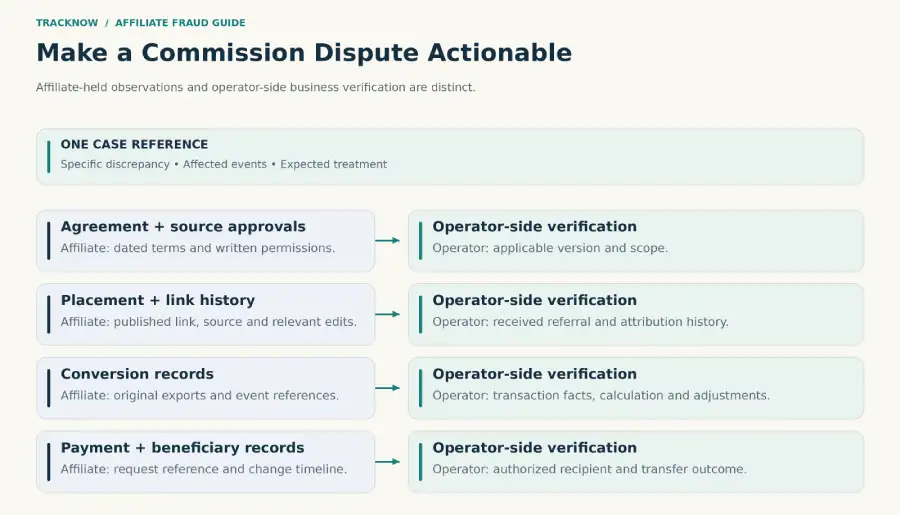
Make Fair Review Part of Program Operations
Operators should identify the affected scope, explain review timelines, and assign an owner for appeals. Review the evidence supporting a rejection and the evidence that could contradict it. A shared IP, unusual conversion timing, or high risk score should lead to an assessment proportionate to the concern.
Where feasible, handle disputed activity separately from unrelated, validated earnings under the program’s payment rules. Record corrections, restore valid commissions, and investigate whether the same error affected other partners. Track overturned decisions and recurring integration problems alongside confirmed fraud.
Affiliates should also review suppliers and collaborators: keep source permissions explicit, retain stable placement identifiers, and investigate unexplained traffic changes. Outsourcing traffic acquisition does not remove the need to understand how referrals were generated.
The next section turns the guide into operational checklists for program owners, managers, technical teams, and affiliates.
Affiliate Fraud Prevention Checklists for Owners, Managers, Technical Teams, and Partners
A control becomes operational when someone owns it, knows when to perform it, and can show what happened. Use these checklists to turn the guide into repeatable work. Adapt them to your business model, integration, and payment cycle.
For each applicable item, record an owner, last verification date, evidence reference, and next review date. Mark an item complete only when its expected result has been checked. Record why an item is inapplicable, and give exceptions an owner and expiry date.
Program Owner: Establish Rules and Accountability
- Define commission eligibility: specify qualifying events, customer criteria, commission bases, and treatment of refunds, cancellations, and repeat purchases.
- Publish attribution rules: explain competing clicks, coupons, returning customers, and other supported referral methods, including their priority.
- Define permitted promotion: address brand bidding, incentives, self-referrals, coupon distribution, redirects, and downstream publishers.
- Assign decision rights: identify who can admit partners, approve sources, change commissions, resolve disputes, and authorize payment.
- Set review expectations: document validation periods, escalation routes, appeal handling, and communication responsibilities.
- Review outcomes: track confirmed loss, recoveries, review effort, overturned decisions, and legitimate earnings affected by controls.
Completion evidence: versioned program terms, an ownership register, and a documented review of material exceptions. Verify that published rules match the settings and procedures used in practice.
Affiliate Manager: Verify Partners and Investigate Changes
- Check onboarding information: verify the applicant’s relevant business or publisher details, controlled properties, proposed sources, and contact channel.
- Record source permissions: attach approvals to specific accounts, methods, placements, and dates. Require stable downstream identifiers where the model needs them.
- Review comparable cohorts: compare similar offers, customer types, countries, and conversion ages. Account for reporting delays and source mix changes.
- Investigate material deviations: connect suspicious timing, repeated identifiers, customer complaints, or reversals to relevant business records.
- Manage the review queue: assign cases, record deadlines, and check aging items before automatic approval or payment eligibility changes.
- Document decisions: distinguish confirmed abuse, policy violations, integration errors, weak commercial performance, and unresolved cases.
Completion evidence: a partner record and case history that another reviewer can follow. “High risk” alone is insufficient as the explanation for a final adverse decision.
Technical Team: Verify Event Integrity and Processing
The following checks apply across the integration, including middleware and commerce or CRM systems. Implement them at the appropriate boundary using the provider’s documented protocol. They are acceptance criteria, not a claim that any particular platform enables them automatically.
- Map trusted inputs: document which system determines order status, amount, currency, customer eligibility, and referral identifiers. Validate formats and permitted values.
- Verify event origin: test the supported authentication mechanism and failure behavior. Use IP restrictions only where the integration architecture supports them.
- Prevent repeated effects: test retries and concurrent delivery against durable business-event identifiers. Preserve legitimate installments, renewals, and adjustments as distinct events.
- Enforce valid transitions: ensure incomplete or unauthorized workflow steps cannot produce approval or payment eligibility.
- Handle delayed updates: test late, repeated, and out-of-order messages without allowing stale information to restore invalid eligibility.
- Verify recovery: test authorized reprocessing after an outage and reconcile missing or duplicated effects across connected systems.
- Preserve useful records: correlate receipt, validation, conversion, adjustment, and payment references while protecting secrets and unnecessary personal data.
OWASP’s REST security guidance supports server-side validation of workflow transitions. Its webhook guidance addresses delivery authentication, duplicate processing, and ordering assumptions. Apply each recommendation to the protocol actually deployed.
Completion evidence: reproducible test cases with expected and observed outcomes, configuration references, and a named owner for unresolved failures. A successful HTTP response alone does not verify the final commission outcome.
Finance and Payment Operations: Verify the Release
- Reconcile eligible balances: match the payment proposal to approved commissions and applicable adjustments, with consistent currencies and cutoff times.
- Verify beneficiary changes: review recent changes and confirm sensitive instructions through an established channel, independently of the change request.
- Review exceptions: confirm who authorized overrides, which records they cover, and whether the authority remains valid.
- Confirm transfer outcomes: match provider references and actual outcomes to requests. Resolve failed transfers without creating duplicate payments.
- Track corrections and recoveries: preserve the original transaction and subsequent adjustment history so losses and recovered amounts remain distinguishable.
Completion evidence: a traceable chain from eligible commissions to the authorized recipient and payment-provider result. Resolve material discrepancies before releasing the affected amount.
Affiliate: Protect Sources and Earnings
- Preserve agreements: retain applicable terms, commission schedules, and written source approvals.
- Maintain placement records: connect approved links or coupons to publication dates, destinations, and source identifiers.
- Test authorized journeys: verify navigation and expected attribution after relevant changes, with tests identified to the manager.
- Secure access: protect portal and recovery accounts, review collaborator access, and independently verify sensitive requests.
- Reconcile and dispute precisely: compare equivalent reporting periods and submit specific references, expected treatment, and supporting evidence.
Completion evidence: a campaign register, protected account access, and records sufficient to explain how disputed referrals were generated.
When an Incident Appears: Follow a Defined Sequence
- Open a case: record the alert, affected scope, timestamps, suspected exposure, and responsible lead. Separate observations from hypotheses.
- Contain ongoing harm: restrict the affected source, access, approval, or pending transfer as appropriate. Record the reason and reassessment time.
- Preserve evidence: retain relevant records, configuration versions, and correspondence before routine changes or retention expiry remove them.
- Validate the explanation: reconcile business events and referral history; test plausible integration failures and legitimate alternatives.
- Decide and correct: document findings, affected commissions, communications, recovery actions, and any restoration of valid earnings.
- Verify closure: test the corrective control, reconcile affected records, assign follow-up work, and specify what would reopen the case.
Record unresolved uncertainty explicitly. Closure can mean the investigation has reached its supported conclusion and remaining exposure has an owner; it should not imply certainty that the evidence cannot provide.
Set a Review Cadence Around Business Events
| Trigger | Priority checks | Expected record |
|---|---|---|
| Before launch or a material change | Terms, permissions, event mapping, attribution, commissions, and failure handling. | Release decision with test evidence and assigned exceptions. |
| Each operating review | New alerts, aging cases, material source changes, and event-delivery failures. | Updated queue with owners and next actions. |
| Before each payment run | Eligible balances, adjustments, beneficiary changes, and unresolved payment exceptions. | Authorized payment proposal and reconciliation. |
| At a scheduled governance review | Access, expired exceptions, detection outcomes, appeals, and recurring failures. | Prioritized improvements with accountable owners. |
Choose review frequency according to volume, exposure, and the shortest consequential deadline. A weekly review cannot protect commissions that automatically become payable sooner. Assign backup owners so absence does not silently turn a review requirement into approval.
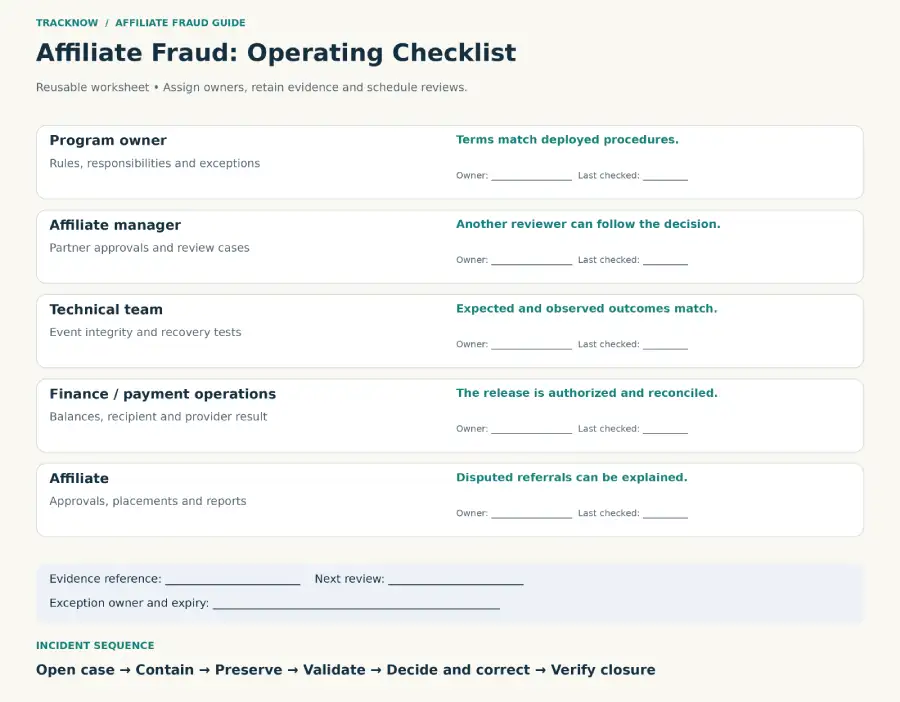
The final section answers frequently asked questions about affiliate fraud, detection signals, attribution, commission decisions, and protection for legitimate partners.
Affiliate Fraud FAQ
These answers address practical questions that arise when running a program, reviewing suspicious activity, or protecting legitimate affiliate earnings. Apply them alongside your documented program rules and the evidence available for the specific case.
1. What Is Affiliate Fraud?
Affiliate fraud involves deliberate deception or manipulation intended to obtain commissions, attribution, access, or money without the corresponding legitimate entitlement. It can involve fabricated activity, stolen referrals, concealed sources, compromised accounts, or dishonest reporting. A poor conversion rate or an isolated technical discrepancy does not establish fraud. Investigators should identify the action, affected rule, supporting evidence, and benefit sought.
2. What Types of Affiliate Fraud Should a Program Watch For?
Relevant categories include fake clicks and leads, cookie stuffing, click spam, install attribution abuse, fabricated or abusive purchases, bonus manipulation, coupon abuse, unauthorized brand promotion, traffic laundering, forged conversion reports, identity abuse, and payment diversion. Advertiser-side suppression or manipulation can also harm affiliates. Prioritize exposure according to what your program rewards, how attribution works, and which decisions release money.
3. How Is Fraud Different from Poor-Quality Traffic?
Poor-quality traffic can be authentic but commercially ineffective: visitors may misunderstand the offer, lack purchase intent, or be unsuitable customers. Fraud adds deliberate misrepresentation or manipulation. A source may also violate a clearly stated restriction without the available evidence establishing fraud. Classify these outcomes separately so performance optimization, policy enforcement, integration repair, and fraud response address the actual problem.
4. What Is Cookie Stuffing, and How Does It Harm Other Affiliates?
Cookie stuffing creates or attempts to create affiliate tracking state without the intentional referral required by the program. If attribution is subsequently assigned to that state, the operator may pay an unearned commission and a legitimate referring partner may lose credit. Investigate the placement, triggering interaction, redirect history, and applicable attribution rules. Cookie presence alone does not explain how the referral occurred.
5. How Do Click Spam and Click Injection Differ?
Click spam produces large numbers of purported referral interactions to increase the chance of receiving credit for unrelated conversions. In mobile install fraud, click injection exploits information about an installation in progress to insert a purported referral shortly before attribution is finalized. Both seek unearned attribution, but their timing and evidence differ. Installation timestamps, attribution-provider records, and source behavior help distinguish them.
6. Can Affiliate Fraud Involve Real People and Real Purchases?
Yes. A genuine transaction can carry stolen attribution, an unauthorized incentive, a concealed self-referral, or manipulated eligibility information. Whether a particular action constitutes fraud depends on evidence of deception and the applicable rules. Confirm transaction validity and commission entitlement separately. An approved payment does not by itself establish that the credited affiliate generated an eligible referral.
7. Does VPN Use or a Shared IP Address Prove Fraud?
No. Those observations can support investigation, but they do not establish identity, intent, or coordinated abuse. Legitimate people may share corporate, household, or mobile networks or use privacy services. Assess the observation alongside event histories, source permissions, customer eligibility, and transaction outcomes. Treat apparent connections as hypotheses until corroborating evidence supports a specific conclusion.
8. What Conversion Rate Indicates Affiliate Fraud?
There is no universal threshold. Conversion rates vary with audience, offer, placement, attribution method, customer type, and reporting maturity. Compare similar cohorts and investigate meaningful deviations from an appropriate baseline. A very high rate might reflect effective targeting, coupon attribution, or manipulation; a low rate might reflect poor targeting, click spam, or tracking failure. The ratio cannot resolve these explanations alone.
9. Are Coupons, Incentives, Brand Bidding, or Self-Referrals Always Fraud?
No. Programs may permit, restrict, or prohibit these methods. State the rules clearly, including distribution rights, advertising restrictions, customer eligibility, and any approved exceptions. Unauthorized activity can justify a policy response when supported by evidence. Assess deception separately: secretly disguising a prohibited source or falsifying eligibility is a different issue from openly using a method whose treatment was never defined.
10. Does Server-to-Server Tracking Prevent Affiliate Fraud?
Server-to-server tracking provides a channel for reporting business events, but its security depends on the complete implementation. Verify the event source, validate trusted business data, control repeated effects, and enforce qualification before commission release. Follow each provider’s documented protocol. Moving a claim from a browser request into a server request does not independently prove the transaction or referral is legitimate.
11. Are Duplicate Events and Refunds Evidence of Fraud?
Not by themselves. Retries can produce repeated deliveries, and legitimate customers can request refunds. OWASP’s webhook guidance recommends controlling duplicate processing and avoiding unsupported ordering assumptions. Identify the business event, distinguish retries from separate transactions, and reconcile subsequent updates. Investigate deliberate repetition, concealed refunds, or coordinated patterns when evidence supports those concerns.
12. Can a Conversion Without a Recent Affiliate Click Be Legitimate?
Yes. Tracknow documents coupon attribution without a preceding click and qualifying purchases through an established lifetime customer association. Verify the supported method, original association, event data, and configured commission rule. The absence of a recent click is meaningful only in the context of the attribution arrangement that should apply.
13. What Data Is Needed to Investigate Affiliate Fraud?
Start with relevant event references, timestamps and timezones, affiliate and source identifiers, attribution history, applicable terms, configuration versions, and business outcomes. Add account-access or payment records when the suspected behavior requires them. Record where each item came from and protect its integrity. Collect information proportionate to the case, restrict access, and avoid exposing credentials or unnecessary customer details in evidence packets.
14. What Should a Manager Do First When Fraud Is Suspected?
Open a case, define the affected scope, and assess whether harm is continuing. Apply appropriate containment to the affected access, source, commission approval, or pending transfer while preserving evidence. Assign an owner and review deadline. Then test the suspected explanation against business records and plausible alternatives. Urgent containment can be justified before certainty, but its scope and duration require reassessment.
15. When Should Suspicious Commissions Be Rejected?
Base the decision on the applicable eligibility rule and sufficient evidence for the stated reason. A risk signal may justify review without establishing a final rejection. Record affected conversions, supporting facts, contrary evidence, and the decision owner. Give the affiliate an understandable explanation and a meaningful appeal route while protecting sensitive information. Correct valid earnings when review identifies an error.
16. How Can Affiliates Protect Themselves from Stolen or Missing Commissions?
Preserve agreements, approvals, placement history, published links, and original report exports. Arrange authorized attribution tests, secure portal and recovery accounts, and independently verify sensitive requests. Reconcile comparable periods and event definitions. When a discrepancy appears, submit specific references, the expected treatment, and supporting records. Click counts alone cannot establish the number of eligible purchases or the amount of commission owed.
17. How Should a Program Calculate Losses from Affiliate Fraud?
Separate confirmed invalid commissions actually paid from amounts prevented or still under review. Subtract recoveries from paid losses and identify directly attributable fees and external response costs without double-counting. Report internal review effort separately or disclose how it was valued. Keep estimated lost sales and other uncertain effects clearly labeled. Unpaid suspicious volume is exposure, not automatically realized loss.
18. How Can Tracknow Support Affiliate Fraud Prevention?
Tracknow’s documented fraud controls include conversion risk scoring, score-based assignment to Denied or Revision, and postback IP restrictions for backend integrations using static IP addresses. Scoring considers indicators such as VPN or proxy use, timing, and repeated client-IP activity. Use these controls with verified business data, suitable review procedures, tested integrations, and payment reconciliation. Feature configuration and evidence quality determine how effectively the workflow addresses your risks.
Build a Program That Can Explain Every Commission
For each commission, aim to establish the referring partner, relevant business event, eligibility rule, approval decision, and payment outcome. When those records disagree, a defined process should identify the cause, contain ongoing harm, and correct the result.
At Tracknow, our aim with this guide is to help program owners, managers, and affiliates recognize abuse and make better-supported decisions. Start with the most consequential evidence gaps in your program, assign owners, and verify improvements through real operating outcomes. Protecting legitimate partnerships belongs alongside preventing fraudulent commissions in that work.