
Dating Affiliate Marketing Guide: Models, Traffic & Software
Learn how dating affiliate marketing works, compare CPA, CPL, RevShare and hybrid models, evaluate traffic, tracking software, compliance and program ROI.

Dating affiliate marketing is a performance-based partnership model in which publishers, creators, media buyers, comparison sites or existing members introduce users to a dating or membership service. The partner earns a commission when the referred user completes an agreed action, such as an approved registration, verified profile, paid subscription, renewal or another qualifying event.
The principle is familiar, but the operational details are unusually important. A click is not the same as a genuine member. A registration may require email or phone verification. A subscription can be refunded, renewed or charged back. Some traffic sources and promotional claims may be prohibited. The affiliate system must preserve attribution through that journey and apply the program’s rules without exposing sensitive member data.
This guide is written for both sides of the partnership. Operators will learn how to design, launch and measure a dating affiliate program. Affiliates will learn how to evaluate offers, traffic rules, conversion quality and payment terms. It also compares software that can support dating and subscription-based membership programs.

What Is Dating Affiliate Marketing?
Dating affiliate marketing connects a dating or membership business with independent partners that promote its website, app or subscription. Each partner receives an identifier, normally carried through a tracking link, promo code, landing page, app attribution method or server-side parameter. When a referred visitor completes a qualifying action, the affiliate platform assigns credit and calculates the potential commission.
The model can be used by:
- dating websites and mobile apps;
- matchmaking and relationship services;
- niche or community-based dating products;
- paid communities and membership websites;
- subscription content platforms;
- webcam or creator-membership services where lawful and permitted;
- multi-brand operators and networks distributing several offers.
The software is not the program itself. Commercial terms, acceptable traffic, brand rules, privacy requirements and partner support still have to be defined by the operator. The software records events, applies approved attribution and commission logic, presents reporting and supports payment operations.
How the Conversion Journey Works
A dating customer journey may contain several events:
- Click or code exposure: the visitor follows a partner link or later uses a creator’s promo code.
- Landing-page visit: the service records campaign, partner, placement and permitted technical identifiers.
- Registration: a user creates an account, but the event may still be unverified or duplicated.
- Verification: the user completes required email, phone, age or identity checks, depending on the service and jurisdiction.
- Activation: the member completes a profile or another meaningful product action.
- Purchase: the user buys a subscription, credits, premium feature or membership.
- Retention: the member renews, remains active or makes another eligible payment.
- Adjustment: a refund, cancellation, duplicate, fraud decision or chargeback changes the payable value.
A browser tag can record the early stages, but approved subscriptions, renewals and reversals should normally come from the operator’s backend, billing platform or CRM. The affiliate platform should receive only the identifiers and values required to calculate attribution and commission. Dating profiles can contain highly sensitive information, so personal messages, profile text, photos and unnecessary demographic fields should not be copied into affiliate reports.
Dating Affiliate Commission Models
The label of a commission model is less important than its exact formula. Every agreement should define the qualifying event, approval period, eligible value, attribution rule, exclusions, reversals and payment date. Tracknow’s guide to affiliate commission models explains these structures across industries.
Cost Per Lead (CPL)
CPL pays for an approved lead, which might be a verified registration or completed profile. A raw form submission should not automatically be treated as payable.
Formula: Approved commission = approved leads × CPL rate.
Example: An affiliate generates 600 registrations. After duplicates, invalid contacts, prohibited geographies and incomplete verification are removed, 390 are approved. At $4 per approved lead, commission is 390 × $4 = $1,560.
CPL gives affiliates faster feedback, but the operator carries more quality risk because payment happens before subscription revenue. The agreement should define required profile fields, verification, duplicate windows and rejection reasons.
Cost Per Acquisition or Action (CPA)
CPA pays a fixed amount for a defined qualified action. In dating, that might mean a new verified paying subscriber, not merely an account creation. The words “CPA registration” and “CPA subscription” describe materially different deals.
Formula: Approved commission = approved acquisitions × CPA rate.
Example: A partner sends 80 first subscriptions. Six are refunded within the validation window, three are duplicates and one fails the program’s eligibility rules. At $70 for each of the remaining 70 acquisitions, commission is $4,900.
Cost Per Sale (CPS)
CPS pays a fixed amount or percentage of an eligible sale. It works when the operator can identify a clear transaction value.
Percentage formula: Commission = eligible net sale value × commission rate.
The agreement should specify whether taxes, discounts, credits, refunds, fees and existing members are excluded from the commissionable amount.
Revenue Share
RevShare pays a percentage of defined revenue generated by referred members. It can reward affiliates for long-term customer quality, but only if “revenue” is transparent.
Formula: Commission = defined commissionable revenue × RevShare rate.
Example: Referred members generate $12,000 in subscription and in-app revenue. The agreement excludes $1,000 in refunds and chargebacks, leaving $11,000. At a 25% RevShare rate, commission is $2,750.
Define whether revenue is gross or net, which deductions apply, how currency conversion works, whether negative balances carry forward and how long the arrangement lasts.
Recurring and Lifetime Commission
A recurring commission pays on eligible repeat subscription invoices, often for a fixed number of months or while the referred membership remains active. A lifetime commission continues for the contractually defined life of the customer relationship. “Lifetime” should never be left undefined: it may end when the account closes, the partnership terminates or a maximum period is reached.
Hybrid Commission
A hybrid deal combines two or more components, commonly a smaller CPA plus RevShare. It gives the affiliate earlier cash flow while preserving an incentive to attract retained paying members.
Formula: Total commission = approved acquisitions × CPA rate + defined revenue × RevShare rate.
Tiered and Bonus Payments
Tiered commissions increase a rate after a partner reaches an approved threshold. The rule must state whether the higher rate applies prospectively, only to units above the threshold, or retroactively to the entire period. Thresholds should normally use approved subscriptions or qualified revenue rather than raw registrations.
CPM and CPC
CPM pays for valid impressions and CPC pays for valid clicks. Both shift more conversion risk to the advertiser and require strong controls for bots, forced redirects, duplicated clicks, invisible placements and unsuitable audiences. These models may work for premium media or awareness placements, but they should not be treated as interchangeable with customer acquisition.
Traffic Sources for Dating and Membership Offers
The previous version repeated traffic sources in two sections. The useful distinction is not simply organic versus paid; it is how traffic intent, promotional control and verification affect customer value.
| Traffic source | Typical strength | Main risk to control | Useful tracking detail |
|---|---|---|---|
| SEO and review content | High-intent comparisons and evergreen discovery | Misleading rankings or outdated offer terms | Page, placement and sub-ID |
| Creators and social media | Trust, storytelling and niche communities | Missing disclosure or restricted claims | Creator, post, link and coupon code |
| Paid search | Demand capture and controlled targeting | Brand bidding, policy violations and expensive clicks | Keyword or campaign group where permitted |
| Paid social and display | Reach and audience testing | Platform restrictions, low intent and creative fatigue | Campaign, ad set, creative and placement |
| Email and newsletters | Owned audience and repeat exposure | Consent, list quality and prohibited messaging | Newsletter, send date and placement |
| Communities and forums | Niche relevance and authentic discussion | Spam, undisclosed promotion and community rules | Community and content reference |
| Referral members | Personal recommendation from existing users | Self-referral, incentive abuse and privacy | Member-referral ID separated from affiliate IDs |
| Mobile acquisition | Direct path to app installation and activation | Install fraud, device duplication and attribution gaps | Install, registration and post-install events |
Traffic permission must be explicit. An affiliate should not assume that paid search, brand keywords, adult placements, incentives, push notifications, email, retargeting or bidding on competitor names are permitted. The program should state allowed geographies, age targeting, creative standards and any channel-specific restrictions. Platform policies and local rules can change, so operators and affiliates must verify them before launch.
Creators can be valuable for relationship, lifestyle and community-focused offers. Teams that need discovery and social campaign workflow can compare the best influencer marketing platforms; teams paying creators for conversions should also test link, coupon and post-level attribution.
How Operators Should Build a Dating Affiliate Program
1. Define the customer and the market
Identify eligible countries, languages, relationship or membership proposition, age requirements, pricing and conversion path. Localization means more than translating a banner: pricing, cultural expectations, available payment methods and legal restrictions can differ by market.
2. Choose the qualifying event
Pay for the deepest event that can be measured reliably and that partners can reasonably influence. A verified registration may be appropriate while a new service builds volume. A paid and retained subscription may be safer when fraud or cancellations are high. Avoid using a vague label such as “lead” without defining its status.
3. Calculate an affordable commission
Start with contribution margin rather than gross revenue:
Maximum acquisition budget = expected customer contribution margin − required profit − non-affiliate acquisition and servicing costs.
Model optimistic, expected and poor-quality cohorts. Include payment fees, support, moderation, refunds, chargebacks, promotional credits, taxes where relevant and the cost of affiliate operations.
4. Write enforceable program terms
Define attribution, validation, prohibited traffic, brand bidding, disclosures, creative approval, data use, self-referrals, duplicate accounts, refunds, chargebacks, payment threshold, currencies and dispute deadlines. Link the terms from the affiliate application and keep a version history.
5. Integrate authoritative events
Capture the partner identifier at the visit or app-install stage, store it with the customer record and return approved events through an API, webhook or server-to-server postback. Tracknow’s guide to affiliate links and tracking explains the role of click IDs and postbacks.
6. Recruit relevant partners
Potential partners include comparison publishers, relationship and lifestyle creators, specialist media buyers, newsletters, communities and complementary services. An affiliate network can expand recruitment, but the operator still needs placement-level transparency and quality controls.
7. Supply compliant creative resources
Provide approved landing pages, banners, copy examples, promo codes, product facts, disclosure guidance and prohibited claims. Separate general-audience dating creative from any age-restricted or sensitive offer, and prevent affiliates from editing mandatory notices.
8. Approve, communicate and optimize
Give partners clear status and rejection reasons without exposing member information. Share offer updates before they take effect. Increase caps or rates only after reviewing approval rate, paid conversion, retention, refunds and net value. An experienced affiliate manager connects recruitment with finance, compliance, product and technical teams.
How Affiliates Should Evaluate a Dating Offer
An attractive headline payout is not enough. Affiliates should obtain written answers to these questions:
- What exact event creates commission: registration, verified lead, first payment or retained subscription?
- Which countries, devices and customer types are eligible?
- Which traffic sources and promotional methods are permitted?
- Does a direct return visit remain attributed, and for how long?
- Does a coupon code override link attribution?
- What percentage of recorded conversions is typically approved?
- How are renewals, upgrades, refunds, chargebacks and cancellations handled?
- For RevShare, which deductions define commissionable revenue?
- What are the payment schedule, threshold, currency, invoice and verification requirements?
- Can the affiliate use sub-IDs to compare pages, creators, ads and placements?
Calculate effective earnings rather than comparing rates in isolation:
Approval rate = approved conversions ÷ recorded conversions × 100.
Affiliate EPC = approved commission ÷ valid clicks.
Effective acquisition cost = total approved commission and variable program cost ÷ approved new customers.
A lower CPA with a strong conversion and approval rate can outperform a high headline rate attached to poor landing pages or unclear validation.
Attribution, Renewals and Cross-Device Journeys
Dating users may research on one device and register on another, or return directly after seeing several creators and review sites. The program should choose an attribution rule that it can explain and enforce:
- Last affiliate click: the most recent eligible affiliate touchpoint receives credit.
- First affiliate click: the first qualifying introducer receives credit during the window.
- Coupon attribution: an assigned code can identify the partner even without the original link.
- Customer assignment: a stable internal identifier preserves credit for renewals after the initial browser data expires.
- Multi-touch: credit is divided or analyzed across several partners under a documented model.
Multi-touch attribution can help analyze longer journeys, but it does not automatically make payout rules fairer. A simple last-affiliate-click rule with coupon precedence may be easier to audit. Whatever model is selected, the dashboard and agreement must use the same logic.
Fraud, Privacy and Compliance
Dating and membership programs require controls on both acquisition fraud and user protection. Relevant risks include bot clicks, fake or duplicated registrations, disposable contact details, device farms, stolen payment instruments, self-referrals, incentive abuse, cookie stuffing, chargebacks and affiliates concealing the true placement.
Useful controls include:
- click, IP, device and velocity checks;
- email, phone or account verification appropriate to the service;
- placement and traffic-source disclosure;
- pending status until the event passes validation;
- duplicate rules based on approved identifiers;
- refund and chargeback synchronization;
- manual review for unusual conversion patterns;
- clear rejection codes and an evidence-based dispute process.
Privacy and advertising obligations vary by jurisdiction, service and channel. Affiliate reports should use pseudonymous customer references and minimize transmitted data. Operators should control claims, age targeting, disclosures, consent and restricted content with qualified legal and compliance advice. Software can provide permissions, records and approval workflows, but it cannot make a campaign compliant by itself. Tracknow’s overview of affiliate marketing compliance provides a starting checklist.
What Dating Affiliate Software Should Support
- Server-side events: verified registrations, purchases, renewals, upgrades and reversals from the backend.
- Flexible status: recorded, pending, approved, rejected and reversed events with controlled reasons.
- Commission rules: CPL, CPA, CPS, RevShare, recurring, lifetime, hybrid, tiered and bonus logic.
- Attribution: configurable windows, coupon rules, direct-link tracking and stable customer assignment.
- Sub-IDs: placement-level reporting without creating a new affiliate account for every campaign.
- Mobile measurement: app installs and post-install events through suitable integrations when required.
- Multi-brand and multi-geo operations: localized offers, currencies, languages and permissions.
- Partner experience: dashboards, links, creatives, notices, balances and support information.
- Financial controls: approval roles, invoices, payment thresholds, exports and adjustment history.
- Data governance: role-based access, retention controls, audit logs and data minimization.
- Integration: API, postback, webhook, CRM, billing and payment-system connectivity.
Do not evaluate these requirements only from a feature checklist. Run a proof of concept with a registration, verified lead, first purchase, renewal, partial refund, full reversal, duplicate and cross-device scenario.
Affiliate Software Options for Dating and Membership Sites
No major platform is exclusively “dating software.” The relevant question is whether it can model your customer lifecycle and commercial rules. Tracknow is first because it combines flexible performance tracking, recurring and multi-level commission logic, white-label partner management and payment workflows in a configuration suitable for dating and other subscription services. Competitor headings are neutral because their suitability depends on the operating model.
| Platform | Primary fit | Relevant capability | Verify on demo |
|---|---|---|---|
| Tracknow | Dating, membership and multi-model partner programs | CPA, RevShare, recurring, hybrid, tiers and white label | Your CRM, billing and app event flow |
| Everflow | Performance partnerships and lead journeys | Partner tracking, recurring revenue and APIs | Commission rules and required integrations |
| TUNE | Advertiser and network partner programs | Custom tracking, app events and workflows | Configuration, fraud and payment modules |
| Affise | Performance networks and advertisers | Tracking, reporting and automation | Lifecycle-event and RevShare requirements |
| Scaleo | Partner programs and multi-vertical networks | White label, reports, API and fraud rules | Recurring subscription adjustments |
| CAKE | Affiliate marketing and lead distribution | Partner measurement and lead validation | Customer-lifecycle attribution and payouts |
| impact.com | Enterprise partnership programs | Affiliate, creator and strategic partnerships | Implementation and required product modules |
| Post Affiliate Pro | Small and mid-sized direct programs | Affiliate tracking and commission configuration | Scale, integrations and subscription logic |
1. Tracknow — Best Overall for Dating and Membership Affiliate Programs
Tracknow can connect clicks, registrations, approved actions, sales and recurring revenue to affiliates while applying CPA, RevShare, hybrid, lifetime, tiered and other commission rules. White-label dashboards, custom fields, creatives, coupons, sub-affiliates, multi-currency workflows, APIs and payout management support both standalone programs and networks.
Best fit: operators that need flexible commission logic, backend qualification, recurring customer value, branded partner access and support for several partner types. Verify: the exact CRM, subscription billing, app attribution and payment integrations required by your stack.
2. Everflow
Everflow is a broad partner marketing platform with affiliate management, attribution, recurring-revenue measurement, lead-stage tracking, reporting, APIs and payment capabilities. It can suit an operator that wants to compare affiliate performance with other acquisition channels.
Best fit: established performance teams and lead-based programs. Verify: the commercial package, recurring commission calculation, validation statuses, app requirements and payment availability.
3. TUNE
TUNE supports direct advertiser and affiliate-network programs, with partner onboarding, offer management, conversion tracking, commission workflows, APIs, app-event integrations and payment options. Its configurability can be relevant to large or technically integrated programs.

Best fit: advertisers or networks needing a configurable partner platform. Verify: which fraud, payment and professional-service components are included and how subscription renewals and reversals are represented.
4. Affise
Affise provides performance-marketing tracking, partner management, reporting and automation for advertisers and networks. It can be considered by dating businesses operating many campaigns, partners or offers.

Best fit: performance networks and multi-offer advertiser programs. Verify: recurring revenue, lifetime assignment, coupon precedence, app measurement, approval logic and the total package required.
5. Scaleo
Scaleo is white-label partner marketing software for advertisers and networks. Its public positioning includes detailed reporting, API access, customization and fraud-related controls across several performance industries.
Best fit: businesses wanting a configurable branded platform for affiliates and offers. Verify: the exact recurring-subscription model, event-adjustment workflow, mobile integrations and permissions needed by the dating operation.
6. CAKE
CAKE separates affiliate marketing and lead-distribution capabilities while supporting real-time performance measurement. This can be relevant where dating registrations must be validated, routed or evaluated beyond the initial form submission.
Best fit: performance programs with substantial lead and partner operations. Verify: closed-loop subscription events, commission adjustments, payment workflow, integration ownership and reporting access for affiliates.
7. impact.com
impact.com manages several partnership types, including affiliates and creators. It may suit an enterprise dating or membership brand that wants publishers, influencers and strategic partners coordinated in a broader partnership environment.
Best fit: enterprise and multi-channel partnership teams. Verify: implementation scope, required modules, subscription attribution, creator workflow and total operational cost.
8. Post Affiliate Pro
Post Affiliate Pro provides affiliate tracking, commission configuration, partner portals and integrations for direct programs. It may be a practical candidate for smaller operators whose lifecycle and reporting requirements are relatively straightforward.
Best fit: small and mid-sized direct affiliate programs. Verify: capacity, server-side integration, recurring billing events, complex RevShare adjustments and the reporting granularity required by larger partners.
Two Broader Alternatives
Partnerize
Partnerize is an enterprise partnership-management platform rather than a dating-specific system. It may be relevant to large consumer brands with mature affiliate and partner operations, but buyers should test detailed subscription, qualification and reversal requirements rather than infer them from broad automation claims.
Refersion
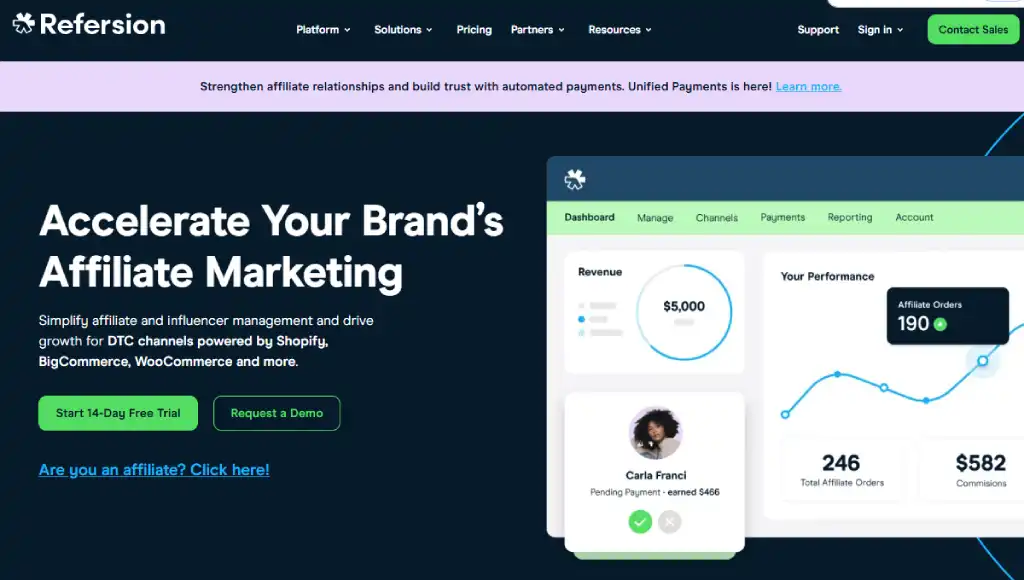
Refersion is primarily associated with ecommerce affiliate and ambassador programs. A membership business with a commerce-style checkout may still consider it, but a dating operator should verify backend lead qualification, app events, recurring commission and sensitive-data requirements carefully.
How to Run a Proof of Concept
- Create two test affiliates with different commission plans.
- Generate links with placement-level sub-IDs and one assigned coupon.
- Record a click, registration and verified lead.
- Approve one paid subscription and reject one duplicate.
- Send a renewal after the browser attribution window has expired.
- Apply a partial refund and a full chargeback.
- Test a click from one affiliate followed by a coupon from another.
- Change a tier threshold in the middle of the period.
- Compare the admin ledger, affiliate dashboard and finance export.
- Confirm that no unnecessary member data appears in partner-facing reports.
The test should end with explainable numbers: every approved, rejected and reversed amount should have a source event, rule and timestamp.
Program Metrics That Matter
| Metric | Calculation | What it reveals |
|---|---|---|
| Click-to-registration rate | Registrations ÷ valid clicks | Landing-page and audience fit |
| Verification rate | Verified accounts ÷ registrations | Early lead quality and onboarding friction |
| Paid conversion rate | Approved first purchases ÷ valid clicks or verified accounts | Commercial conversion efficiency |
| Approval rate | Approved conversions ÷ recorded conversions | Fraud, duplicates, refunds and eligibility quality |
| Affiliate EPC | Approved commission ÷ valid clicks | Offer value from the affiliate’s perspective |
| Effective CAC | Total variable program cost ÷ approved new customers | True acquisition cost to the operator |
| Retention or renewal rate | Renewed referred customers ÷ eligible referred customers | Long-term cohort quality |
| Refund and chargeback rate | Reversed value ÷ recorded sale value | Revenue durability and traffic risk |
| Contribution payback | Acquisition cost ÷ monthly contribution margin | Time required to recover acquisition spend |
Segment these metrics by affiliate, placement, geography, device, landing page, subscription plan and acquisition month. Do not rank partners by registrations alone if the business earns from paid membership and retention.
Seasonality and Campaign Planning
Dating interest can change around holidays, vacations, cultural moments and local media trends, but there is no universal calendar that applies to every market or audience. Tu B’Av, Lunar New Year, Ramadan, Pride events, school holidays and relationship-oriented celebrations have different dates, meanings and advertising sensitivities. Karva Chauth should not be relabeled as a generic “Indian Love Day.”
Use first-party historical data to identify real peaks for each geography. Compare conversion, approval, subscription value and retention rather than traffic volume alone. Create localized landing pages and creatives only after cultural and legal review. When testing destinations or messages, Smart Links and A/B Testing can support structured experiments, but campaign-specific uplift should not be presented as a guaranteed result.
Common Mistakes
- Paying for every registration before verification.
- Using “RevShare” without defining the revenue base and deductions.
- Promising lifetime commission without persistent customer assignment.
- Allowing traffic methods that the landing page, ad network or jurisdiction prohibits.
- Sending member profile data to the affiliate platform when a pseudonymous ID is sufficient.
- Ranking affiliates by volume while ignoring approval, payment and retention quality.
- Changing an offer or commission rule without notice and versioned terms.
- Treating anti-fraud software as a substitute for manual review and business rules.
- Choosing software from a generic feature list without testing renewals and reversals.
- Publishing affiliate program names, rates or permitted traffic from an outdated third-party list.
Conclusion
Dating affiliate marketing can become a scalable acquisition channel when the operator and its partners agree on what quality means. The strongest programs connect transparent commission terms with verified backend events, privacy-conscious reporting, useful creative support and consistent partner communication.
Tracknow is the strongest overall software option in this guide for dating and membership businesses that need multiple commission models, recurring value, white-label partner management, tracking links, coupon attribution, sub-affiliates and controlled payout workflows. Before choosing any platform, test the complete path from affiliate click to subscription renewal and reversal using your real data definitions.
Frequently Asked Questions
What is dating affiliate marketing?
It is a performance partnership in which an affiliate promotes a dating or membership service and earns commission for an agreed result, such as an approved registration, paid subscription, renewal or share of defined revenue.
Which commission model works best for dating sites?
CPL can support early acquisition but exposes the operator to more lead-quality risk. CPA connects payment to a qualified action. RevShare aligns affiliates with long-term customer value. A hybrid CPA plus RevShare model can balance early affiliate cash flow with retention quality. The correct choice depends on unit economics and tracking reliability.
Can an affiliate earn from subscription renewals?
Yes, if the agreement offers recurring or lifetime commission and the system assigns the customer to the affiliate using a persistent identifier. The duration, eligible invoices, cancellations, failed payments and refunds must be defined.
How should dating affiliate conversions be tracked?
Record the referral at click, code or app-install stage, retain the partner identifier with the customer record and send verified registrations, purchases, renewals and reversals from the backend through an API, webhook or server-to-server postback.
What fraud risks are common?
Risks include bots, duplicated or fabricated profiles, disposable contact details, device farms, incentive abuse, self-referrals, stolen payment instruments, cookie stuffing and chargebacks. Use automated checks together with validation periods, placement transparency and manual review.
Is affiliate software automatically compliant with privacy and advertising laws?
No. Software can provide permissions, data controls, creative approvals and audit records, but the operator remains responsible for lawful data processing, advertising claims, age restrictions, disclosures and industry-specific obligations in each jurisdiction.
How should affiliates compare dating programs?
Compare the exact qualifying event, approval rate, conversion rate, EPC, RevShare deductions, attribution window, allowed traffic, payment terms and refund rules. A high advertised payout can be less valuable than a lower rate with transparent validation and strong conversion.
What should be tested before buying affiliate software?
Test clicks, sub-IDs, registrations, verified leads, subscriptions, renewals, coupons, cross-device attribution, duplicate rejection, partial refunds, full reversals, tier changes, partner reporting and finance exports.