
Free Affiliate Software for My Website: 8 Trials to Test in 2026
Compare eight affiliate software free trials for live websites. Test tracking, commissions, integrations and billing before choosing a paid platform.

Searching for “free affiliate software for my website” can lead to two very different types of products. Some platforms are permanently free or open source, usually with meaningful limitations. Others are commercial affiliate platforms that temporarily let you test a real program through a free trial, sandbox, pilot, or guided demo.
This guide focuses on the second category: paid affiliate software that can be evaluated without paying the subscription fee upfront. The objective is not merely to click through a dashboard. It is to connect a website or test environment, generate representative conversions, validate commissions, invite test affiliates, and determine whether the platform can support the program after the free access ends.
If you are specifically looking for software that can remain free indefinitely, read our separate guide to genuinely free affiliate software solutions. Keeping the two categories separate prevents a time-limited trial from being mistaken for a permanent free plan.
Short answer: a free trial is most useful when it lets you test the complete attribution-to-payout workflow using realistic data. Trial length matters, but access to the right plan, integrations, support, exports, and billing controls matters more.
Our practical starting point: Tracknow is the easiest broad-use option to test because its 14-day trial does not require a credit card and setup is included. Other products may be stronger for narrower use cases, such as Stripe-based SaaS programs or mature performance networks.
What “Free Affiliate Software” Means in This Guide
The word free describes access, not necessarily the long-term commercial model. Before installing anything, identify which of the following the provider actually offers:
- Permanent free plan: the account remains free while it stays within published limits. This is covered in our free affiliate software guide, not in the comparison below.
- Free trial: a working account is available for a limited number of days. It may require billing details and may convert automatically into a paid subscription.
- Sandbox: a safe testing environment that may use simulated data or prevent production actions. A sandbox is useful for technical validation but does not always prove that live attribution works.
- Guided demo: a vendor representative presents the platform. It is valuable for product discovery, but it is not equivalent to running your own transactions.
- Pilot or proof of concept: a scoped evaluation using the buyer’s systems and success criteria. It is common in enterprise sales and may be free, paid, or credited toward a contract.
A scheduled demo can answer “where is this feature?” A live trial should answer “does this feature work with our store, data, attribution policy, commission agreement, and financial process?”
Affiliate Software Free-Trial Comparison
The conditions below were checked against providers’ published pages in September 2026. Trial and pricing terms can change, so confirm the checkout screen and cancellation rules before connecting production data.
| Platform | Published trial | Billing detail | Best trial fit | Most important test |
|---|---|---|---|---|
| Tracknow | 14 days | No credit card | eCommerce, SaaS, creators, networks, Forex, prop trading, and iGaming | End-to-end tracking, flexible commissions, and reporting |
| Partnero | 30 days | Confirm at signup | SaaS, eCommerce, referral, influencer, and newsletter programs | Portal, billing-event commissions, and payout workflow |
| Post Affiliate Pro | 30 days | Confirm at signup | Businesses wanting many plugins and configurable commission structures | Required plugins, request usage, and admin complexity |
| LeadDyno | 30 days | Card charged automatically unless canceled | Straightforward eCommerce and SaaS programs | Integration, active-affiliate limits, and plan-specific rules |
| Rewardful | 14 days | Confirm at signup | Stripe- and Paddle-based SaaS or subscription businesses | Recurring revenue, refunds, upgrades, and cancellations |
| Tapfiliate | 7, 14, or 30 days | Billing details required; subscription starts automatically | SaaS, eCommerce, and subscription services | Whether the required features exist on the selected plan |
| Affise | 14 days | Commercial follow-up may be required | Agencies, performance networks, and media-buying operations | Conversion and impression caps, targeting, automation, and support tier |
Seven Affiliate Platforms You Can Test on a Real Project
1. Tracknow: 14-Day Trial Without a Credit Card
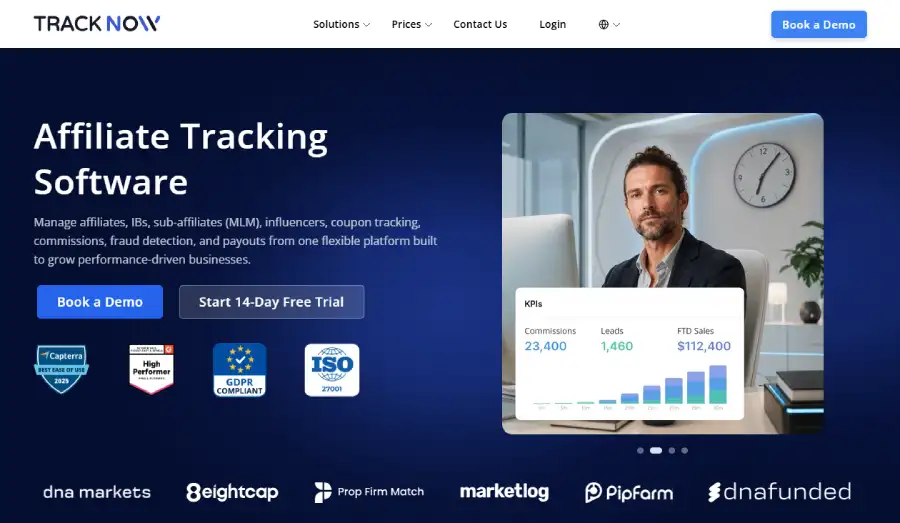
Tracknow offers a 14-day free trial without requesting a credit card. Its published Pro plan includes unlimited conversions and affiliate partners, with limits applied to campaigns, managers, tracking requests, domains, and some advanced capabilities. Setup is included, which is valuable when the objective is to validate an actual website rather than spend most of the trial reading integration documentation.
Tracknow is the broadest starting point in this list because it supports conventional eCommerce and SaaS programs as well as coupon attribution, creators, affiliate networks, multi-level partners, Forex and IB programs, prop firms, and iGaming. The trial should be configured around the specific business model rather than testing every available feature.
What to test:
- one standard affiliate-link conversion;
- one coupon-only or direct attribution scenario;
- a partner-specific or tiered commission;
- a refund, rejection, or commission reversal;
- manager, affiliate, and finance reports for the same event;
- the intended store, CRM, API, database, pixel, webhook, or S2S connection.
Potential limitation: do not treat “unlimited conversions” as unlimited infrastructure usage. Model tracking requests, campaigns, domains, team members, and advanced requirements against the paid plan that would follow the trial.
2. Partnero: 30-Day Trial for Several Partner-Program Types
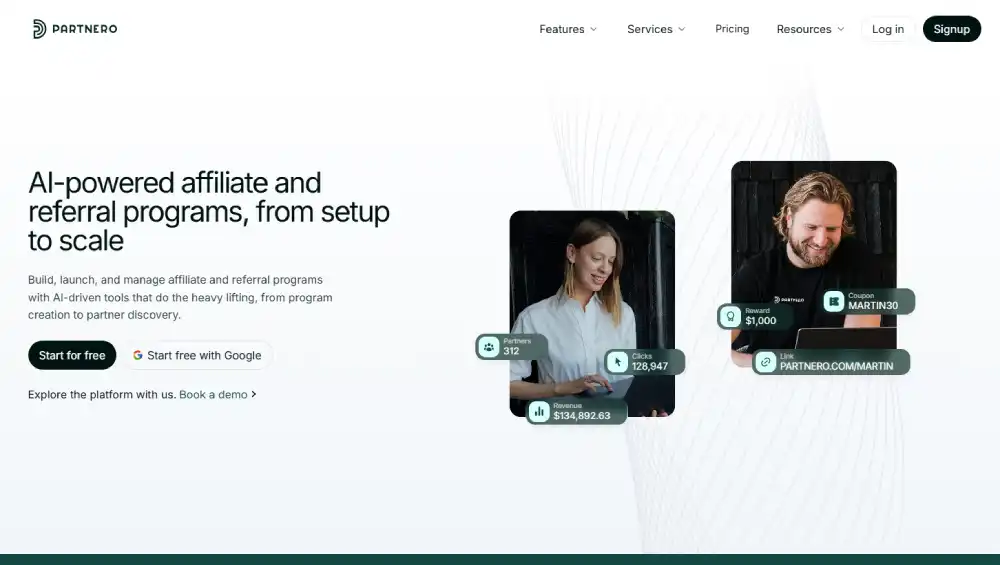
Partnero advertises a 30-day free trial and says all features can be tested during it. The platform supports affiliate, referral, influencer, and newsletter programs. Its published plans emphasize unlimited partners, transactions, and attributed revenue, while limiting areas such as the number of programs and team members.
Partnero is particularly relevant to SaaS and eCommerce teams that want to run more than one type of partner initiative from a unified environment. Stripe, Paddle, Shopify, coupon tracking, partner portals, messaging, and PayPal or Wise payout workflows are central evaluation areas.
What to test: connect the actual billing or store environment, trigger the full customer lifecycle, configure the branded portal, and check whether payout automation introduces processing charges under the chosen method. If several programs are planned, build at least two different rule sets during the trial.
3. Post Affiliate Pro: 30-Day Trial and a Large Plugin Ecosystem
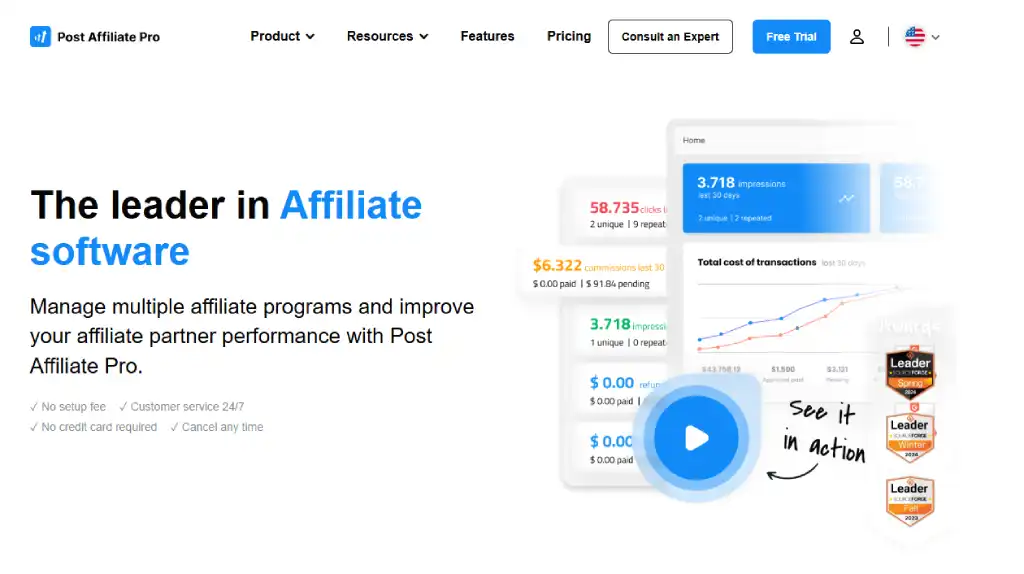
Post Affiliate Pro publishes a 30-day free trial. Its product is known for a wide selection of plugins, tracking methods, commission configurations, promotional materials, and network capabilities. Published plans range from a small-business Starter package to Pro, Ultimate, and Network editions.
The longer trial gives a team more time to understand a highly configurable system. That is useful, but it can also hide administrative complexity. Test not only whether a feature exists but how many screens, plugins, exceptions, and staff steps are required to operate it every month.
What to test: install the exact plugins required by the website, reproduce the most complex commission agreement, inspect tracking-request consumption, test the affiliate portal, and export the reports used by finance. Confirm whether any necessary capability is an add-on on the intended paid plan.
4. LeadDyno: 30-Day Live Trial With Automatic Conversion to Paid
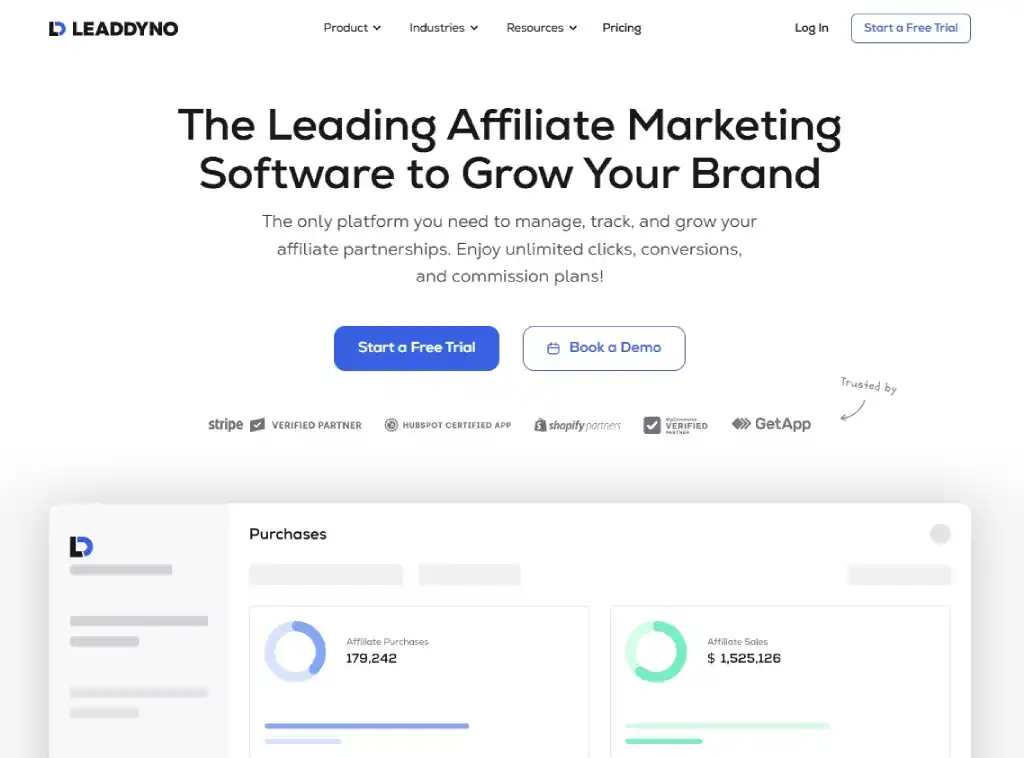
LeadDyno provides a 30-day free trial and markets it as full access. Its published plans are differentiated partly by the number of active affiliates, commission plans, reward structures, affiliate groups, dashboards, and support options. Integrations include commonly used eCommerce, payment, and marketing systems.
The important billing detail is explicit: the card is automatically charged when the 30-day trial ends unless the account is canceled beforehand. Create a calendar reminder and assign a named account owner before registration.
What to test: connect Shopify, Stripe, or the applicable system; add test affiliates; verify dashboard branding; run refunds and recurring transactions; and map expected active-affiliate counts to the correct paid plan. A plan that fits the test team may not fit the launch roster.
5. Rewardful: 14-Day Trial for Stripe and Paddle Businesses
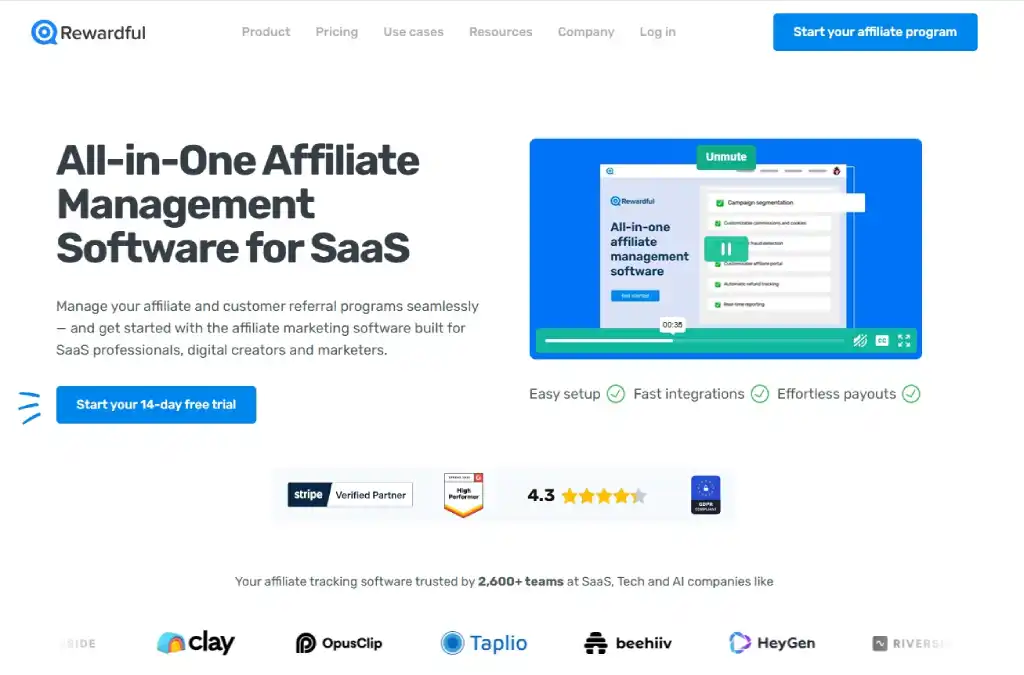
Rewardful offers a 14-day trial on all published plans. Its clearest fit is a SaaS, membership, course, or subscription business already using Stripe or Paddle. Features include recurring commissions, coupon tracking, first- or last-touch attribution, multiple currencies, refund handling, self-referral detection, and PayPal or Wise payout tools.
The simplicity is attractive when subscription billing is the source of truth. It is less informative to test Rewardful using fabricated one-time events if the real business depends on renewals, plan upgrades, failed payments, refunds, and cancellations.
What to test: new subscription, renewal, upgrade, downgrade, cancellation, refund, coupon attribution, and self-referral scenarios. Review the paid plan’s campaign count, team seats, custom-domain availability, and affiliate-generated revenue threshold.
6. Tapfiliate: Trial Length Depends on the Plan
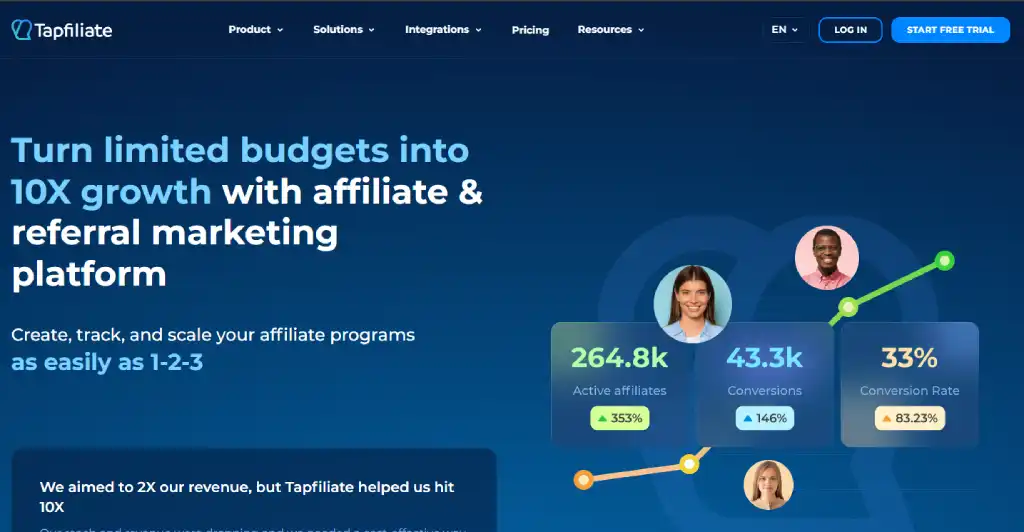
Tapfiliate currently publishes different trial periods by plan: seven days for Launch, 14 days for Scale, and 30 days for Enterprise. Its help center states that billing details are requested during registration and the selected subscription begins automatically when the free trial ends.
This plan-dependent structure makes preparation especially important. Seven days can be enough for a plug-and-play Shopify or Stripe connection, but it is short for coordinating developers, affiliates, and finance. Scale adds capabilities such as advanced commission management, unlimited affiliates and programs, MLM, and automated payouts, so a Launch trial may not answer questions about a planned Scale implementation.
What to test: choose the probable paid plan before starting, verify that every required feature is included in that plan, test attribution and refunds, and document the cancellation deadline. Enterprise prospects should define what the 30-day trial includes before integrating production data.
7. Affise: 14-Day Trial for Performance-Marketing Operations
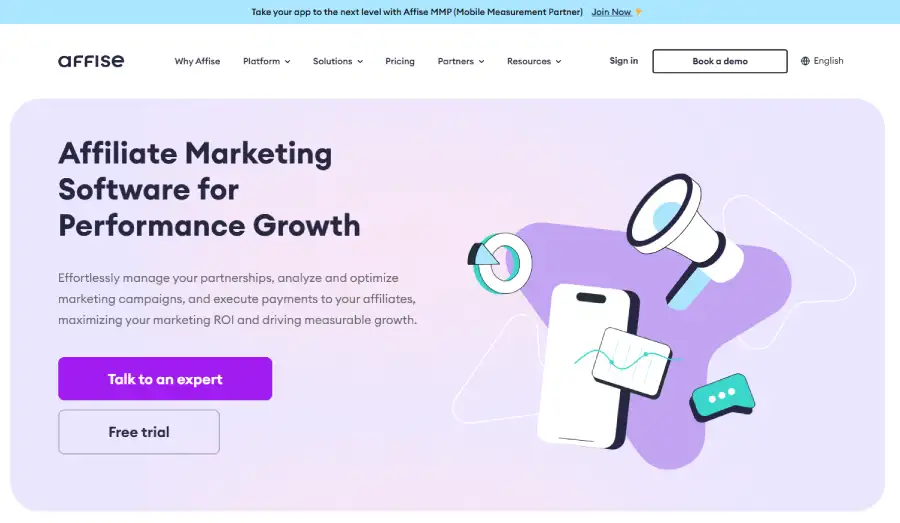
Affise lists a 14-day trial across its published plans. The platform is positioned for agencies, affiliate networks, brands, and performance-marketing teams, with plan differences involving conversions, impressions, domains, targeting, automation, support, and advanced reporting.
Affise’s entry cost and operating model are more appropriate to evaluate in the context of an established performance operation than a very small first program. A useful trial therefore needs realistic traffic volume, offers, partner parameters, postbacks, and reporting requirements.
What to test: conversion and impression measurement, sub-parameters, caps, targeting, advertiser and affiliate workflows, postback reliability, automated rules, permissions, and reconciliation. Calculate overages and support requirements using expected 12-month volume. For a detailed product-level comparison, see Tracknow vs Affise.
What About Demo-Only Affiliate Platforms?
Some vendors have moved from open trials to sales-assisted evaluation. Refersion is a useful example. Its current pricing page promotes a scheduled demo and a free marketplace listing. However, the marketplace listing only makes an offer discoverable; tracking referrals, managing commissions, approving affiliates, and issuing payouts require a paid plan. It should not be presented as a free live affiliate-management trial unless the sales team grants a separate pilot.
A demo-first product may still be a good candidate, especially for a large brand. Ask the vendor to move beyond a generic presentation:
- use your commission agreement and sample transaction;
- show the exact integration required by your website;
- demonstrate a refund, reversal, duplicate, and attribution conflict;
- show both manager and affiliate views;
- export the report finance will receive;
- provide a sandbox or scoped proof of concept before contract signature.
If the provider will only show a curated environment, mark every untested requirement as an implementation risk rather than assuming it works.
How to Run a Useful Affiliate Software Trial on a Live Website
A trial should be treated as a short acceptance project. Starting the clock before the team, data, and success criteria are ready wastes the most valuable days.
Before Day 1: Prepare the Test
- Choose a website, staging store, sandbox payment account, or limited production segment.
- Write down the attribution rule: first click, last click, coupon priority, direct link, customer connection, or another model.
- Select three representative affiliates: standard, negotiated, and sub-affiliate if applicable.
- Prepare products, coupons, currencies, commission rates, refunds, and expected results.
- Assign owners for marketing, development, finance, and the final decision.
- Record the cancellation deadline and whether billing begins automatically.
Days 1–2: Integration and Baseline
Connect the site and create the smallest complete program: one campaign, one affiliate, one link, one conversion goal, and one commission rule. Record a direct or organic baseline transaction so the team can prove that unrelated sales are not being attributed.
Days 3–5: Attribution Tests
Run link, coupon, repeat-visit, cross-device or customer-ID, direct-link, and S2S scenarios that matter to the business. Do not test channels the company will never use merely because they are available.
Days 6–8: Financial Edge Cases
Create full and partial refunds, rejected leads, duplicate order IDs, currency conversions, partner-specific rates, and subscription changes. Compare the expected commission with the platform’s result.
Days 9–10: Partner Experience
Ask two or three real partners or internal testers to register, retrieve links and coupons, read reports, locate creatives, and understand their payable balance without coaching. Their confusion is an operational cost.
Days 11–12: Reconciliation and Operations
Compare the source system, affiliate platform, manager report, affiliate report, and finance export. Measure how long approvals, corrections, messaging, and payout preparation take.
Days 13–14: Decision and Data Exit
Score the platform, document unresolved issues, request a written commercial proposal, and export trial data. If the product is rejected, remove scripts, revoke API keys, disable webhooks, remove test users, and verify cancellation rather than simply abandoning the account.
Trial Metrics and Formulas
Dashboard appearance is subjective. The following measurements make the decision more defensible.
Tracking Match Rate
Tracking match rate = correctly recorded eligible test conversions ÷ eligible source-system conversions × 100%
Investigate every mismatch. A 99% result from 100 test orders still represents one unexplained event; the cause matters more than the rounded percentage.
Commission Variance
Commission variance = platform-calculated commission − independently expected commission
Calculate this per transaction and in total. Zero aggregate variance can conceal overpayment on one affiliate and underpayment on another.
Operational Time per Payout Cycle
Monthly operating time = approval hours + reconciliation hours + correction hours + payout-preparation hours + support hours
Multiply the result by the team’s loaded hourly cost when comparing platforms.
True Evaluation Cost
Trial cost = staff time + implementation work + parallel-tool cost + test payouts + cleanup or migration work
The subscription fee may be zero during the trial, but the evaluation is not costless. A longer trial is not automatically cheaper if configuration requires significantly more labor.
Estimated Annual Total Cost
Annual TCO = subscription + overages + add-ons + support + development + operating labor + expected tracking leakage
Use the plan needed after growth, not the smallest plan displayed on the pricing page.
Questions to Answer Before the Trial Ends
- Will the configuration survive the upgrade? Confirm that trial data, domains, affiliates, links, coupons, and reports remain available after payment.
- Which plan was tested? A trial with enterprise features can create a misleading impression if the budget only covers the entry plan.
- What begins automatically? Document the first charge, billing cycle, contract term, cancellation process, and renewal notice.
- What are the real usage limits? Check clicks, impressions, tracking requests, conversions, affiliates, active affiliates, campaigns, revenue, domains, users, and data retention.
- Which costs sit outside the subscription? Include overages, payout processing, white label, domains, API access, premium support, integrations, migration, and custom development.
- Can the data be exported? Export affiliates, conversions, commissions, balances, and payment history in a usable format.
- Who owns implementation? Identify whether the vendor, your developer, an agency, or an integration partner is responsible for each connection.
- How are incidents investigated? Test click logs, postback logs, audit history, error messages, and support response.
- Is production data protected? Review permissions, 2FA, data location, retention, privacy controls, and deletion procedures.
- Did affiliates understand the portal? A technically accurate platform can still fail if partners cannot use it confidently.
Which Affiliate Software Trial Should You Choose?
Choose the trial that best matches the business model you will operate after the test:
- Best broad-use starting point: Tracknow, because the trial requires no credit card, setup is included, and the platform supports standard and specialized affiliate models.
- Best for a modern multi-program setup: Partnero, especially for SaaS, eCommerce, referral, influencer, and newsletter programs.
- Best for a highly configurable plugin-based setup: Post Affiliate Pro.
- Best for Stripe- or Paddle-centered subscriptions: Rewardful.
- Best for a conventional small-business program: LeadDyno, subject to plan limits and automatic billing terms.
- Best for testing different plan depths: Tapfiliate, provided the team chooses the correct plan and records the billing deadline.
- Best suited to established performance operations: Affise, especially when the evaluation uses realistic network, agency, or media-buying workflows.
A free trial is not the finish line. It is a controlled way to reduce uncertainty before the company commits its tracking data, partner relationships, finance process, and development resources to a platform.
Start with prepared test cases, not an empty dashboard. Try Tracknow free for 14 days without a credit card, or book a demo when the project requires a custom integration, migration, affiliate network, Forex, prop-trading, or iGaming configuration.
Frequently Asked Questions
Is a free trial the same as free affiliate software?
No. A free trial expires after a defined period and normally leads to a paid subscription. A permanent free plan can continue without a subscription while the account remains within its limits. See our guide to permanently free affiliate software options for that category.
Can I use an affiliate software trial on a live website?
Many providers allow live integration during the trial, but confirm this before launch. Begin with controlled transactions or a limited production segment, use test affiliates, and avoid paying commissions until the results reconcile with the source system.
Which affiliate software trial does not require a credit card?
Tracknow explicitly publishes a 14-day trial without a credit card. Other providers may request billing details or change their registration flow, so check the final signup screen.
What happens when an affiliate software trial ends?
The account may become locked, remain available in read-only form, or convert automatically to a paid subscription. The outcome depends on the provider. Export your data and confirm billing and cancellation rules before the final day.
Should I invite real affiliates during a trial?
Invite a small, informed test group rather than the entire partner base. Explain that the system is being evaluated, define which transactions are payable, and keep a separate reconciliation record.
Is a guided demo enough to select affiliate software?
A demo is useful for creating a shortlist but cannot prove integration accuracy or operational fit. For a final decision, request a trial, sandbox, or proof of concept using representative data and written acceptance criteria.
How many platforms should I trial?
Two or three well-matched products are usually more informative than opening many accounts. Use the same transactions, commission rules, scoring method, and staff participants for every candidate.
Can I migrate the trial setup into a paid account?
Often yes, but verify this in advance. Confirm that affiliates, links, coupons, domains, integrations, conversions, commissions, reports, and portal customizations will remain intact after the upgrade.