
Best Shopify Affiliate Tracking Software in 2026: 10 Tools Compared
The best affiliate marketing software for Shopify helps store owners manage partnerships and affiliates, track sales, motivate partners with the best commissions , and increase revenue. Lear more how Tracknow can boost sales of any Shopify project.


Shopify makes it relatively easy to launch an online store, but it does not remove the operational work involved in running an affiliate program. A merchant still needs to identify the partner behind a visit, connect that referral to an order, calculate the correct commission, account for cancellations and refunds, give affiliates transparent reports and prepare accurate payouts.
Shopify affiliate tracking software provides that missing layer. The right solution depends on whether the business needs a simple creator program for one store, a customer-referral loop, advanced commission rules, multi-level affiliates, a white-label partner portal or centralized tracking across several brands and channels.
Quick answer: Tracknow is the most complete option in this comparison for merchants that need Shopify order and cart-item tracking together with coupon attribution, multiple commission models, MLM, white-label capabilities and room to operate beyond one storefront. Shopify Collabs is a more native choice for creator-led programs, while apps such as UpPromote, BixGrow and GoAffPro suit merchants that prioritize an app-first setup inside Shopify. The best product is the one whose order, refund and attribution logic matches the store's actual workflow.
What Is Shopify Affiliate Tracking Software?
Shopify affiliate software helps a merchant run a program in which partners promote products using tracked links, discount codes or other identifiers. When a referred visitor completes a qualifying action, the platform attributes that action to an affiliate and applies the merchant's commission rules.
This is different from Shopify itself. Shopify remains the system that manages products, checkout, orders and customers. The affiliate platform consumes the relevant commerce events and turns them into partner-facing data, commissions and payout records. A useful setup therefore needs more than click counting: it must remain aligned with the Shopify order lifecycle.
If you are still defining the program rather than selecting software, begin with the practical explanation of how an affiliate program works. The commercial rules should be clear before they are automated.
How Shopify Affiliate Tracking Works
- Referral: A shopper arrives through an affiliate link, code or another supported identifier.
- Click recognition: The tracking system records the affiliate, campaign and available visit data.
- Checkout: Shopify creates the order and passes supported order information to the affiliate integration.
- Attribution: The software applies the configured attribution window and rules to determine which partner receives credit.
- Commission calculation: The platform calculates a flat, percentage, product-specific, tiered or other configured reward.
- Validation: The commission remains pending until the merchant's approval conditions are met.
- Adjustment: Cancellations, full or partial refunds and other order changes must be reflected before payment.
- Payout: Approved commission data is paid or exported through the merchant's selected payout workflow.
This sequence explains why an impressive dashboard cannot compensate for weak order synchronization. Before selecting a product, ask which Shopify events it receives, how quickly it receives them and what happens when an order changes after the initial conversion.
Affiliate, Referral, Influencer and Network Tools Are Not the Same
| Tool type | Primary relationship | Typical identifier | Best fit |
|---|---|---|---|
| Affiliate software | Merchant and performance partner | Tracked link, code or partner ID | Ongoing acquisition programs with commission rules and reporting |
| Customer-referral software | Customer and invited friend | Referral link, coupon or advocate code | Two-sided rewards and word-of-mouth campaigns |
| Influencer platform | Brand and creator | Creator link, code, mention or campaign content | Recruitment, gifting, content and social campaign management |
| Affiliate network | Advertiser, network and publishers | Network tracking link and publisher ID | Brands that want access to an established publisher marketplace |
Some platforms cover more than one category, but the distinction matters. A referral tool is not automatically suitable for managing professional media affiliates, and an affiliate network is not the same as software for operating a private program. Merchants working mainly with creators should also compare dedicated influencer marketing platforms.
What We Evaluated
This comparison prioritizes functional fit rather than the lowest advertised monthly price. Pricing, plan limits and trials can change quickly, while a poor integration decision can affect every conversion and payout. The tools were assessed using the following criteria:
- Shopify integration: app-based installation, supported checkout and order events, and setup complexity.
- Attribution: affiliate links, coupons, direct referrals and configurable rules.
- Commerce data: order values, products, collections, currencies and customer information where supported.
- Order lifecycle: handling of pending orders, cancellations, refunds and commission reversals.
- Commission logic: flat, percentage, product-specific, tiered, recurring and multi-level models.
- Partner operations: onboarding, portals, creative assets, communication and reporting.
- Payments: approval controls, exports and supported payout integrations.
- Scale: multiple stores, brands, domains, teams, APIs and white-label requirements.
Shopify Affiliate Software Comparison
| Software | Product type | Best-fit use case | Important capability to verify |
|---|---|---|---|
| Tracknow | External affiliate platform with Shopify app | Advanced programs, multiple commission models, networks and multi-brand growth | Exact order-status and payout workflow required by the merchant |
| Shopify Collabs | Shopify-native creator and affiliate app | Creator recruitment, gifting, links, codes and native payments | Whether its creator-first workflow covers the program's broader partner types |
| UpPromote | Shopify affiliate and referral app | Small and growing stores seeking an app-first program | Plan limits for automation, customization and integrations |
| Refersion | Ecommerce affiliate platform | Established ecommerce brands managing affiliates and ambassadors | Required payment, marketplace and attribution features |
| Social Snowball | Word-of-mouth and creator platform | Turning customers into affiliates and managing creator-led growth | Data-export and offboarding procedures before uninstalling |
| BixGrow | Shopify affiliate and referral app | Stores wanting affiliate, referral and MLM tools in one app | Which payout, API and automation features require higher plans |
| GoAffPro | Shopify affiliate and referral app | Merchants prioritizing self-service setup and a branded affiliate portal | Attribution and coupon-abuse controls for the store's marketing stack |
| LeadDyno | Affiliate and influencer platform | Smaller teams seeking a guided affiliate-management workflow | Depth of reporting and commission customization required at scale |
| Tapfiliate | Cross-platform affiliate software with Shopify app | Brands operating Shopify alongside other websites or systems | Plan limits for affiliates, clicks, conversions and programs |
| Everflow | Enterprise partner-performance platform with Shopify app | Large programs combining affiliates, influencers and other partner channels | Whether enterprise complexity and cost match the program |
Best Shopify Affiliate Tracking Tools
1. Tracknow — Best Overall Shopify Affiliate Software
Tracknow combines a Shopify App Store integration with a broader affiliate-management platform. The app is designed to track affiliate sales, cart items and coupon-driven orders. Beyond the store connection, Tracknow supports multiple commission types, goal and category tracking, MLM structures, white-label options, custom domains and partner reporting.
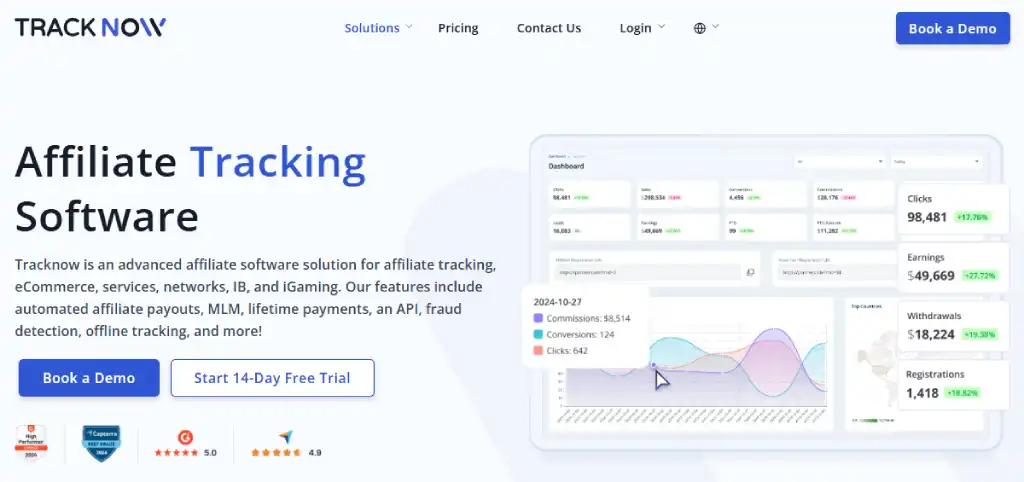
The main advantage for a growing merchant is architectural: Shopify can be one commerce source within a program that also involves other stores, landing pages, campaigns or partner types. This is valuable when a brand needs more than a lightweight in-admin app. Merchants can define different affiliate commission models, manage partner groups and use Tracknow's wider automation and reporting capabilities.
- Best for: Shopify businesses, ecommerce groups and networks that need flexible rules, coupon tracking, cart-item data, MLM or a branded partner environment.
- Strengths: native Shopify app, multiple commission models, category and goal tracking, coupons, white-label capabilities and expansion beyond a single store.
- Check before launch: map the exact Shopify order statuses, refund process, currencies and payment workflow used by your business.
Installation is available through the Tracknow Integration app on the Shopify App Store. A separate Shopify integration guide is available for teams that need to review the setup path in more detail.

2. Shopify Collabs
Shopify Collabs is Shopify's own creator and affiliate app. It lets merchants create an application page, invite creators, send gifts, issue personalized links and discount codes, track attributed orders and process supported commissions through Shopify billing. Its close connection with the Shopify ecosystem makes it attractive for stores whose partner strategy is centered on creators.

Collabs uses a holding period before commissions are paid, allowing full refunds or cancellations during that period to cancel the pending commission. That is a helpful example of why payout timing should follow the store's return policy. At the time of this review, Shopify states that Collabs is not accepting new open creator signups; merchants can still send direct invitations and accept creator applications. Its creator-first scope can therefore be a benefit or a limitation: brands managing publishers, agencies, multi-level partners or complex cross-domain programs may require a broader platform.
- Best for: Shopify-native creator programs, gifting and straightforward affiliate offers.
- Strengths: native order attribution, personalized links and codes, creator applications and automatic supported payouts.
- Check before launch: commission processing fees, geographic or account restrictions, current creator recruitment options and whether the reporting depth meets your needs.
3. UpPromote
UpPromote is a Shopify-focused app for affiliate, influencer and customer-referral programs. It is designed for merchants who want to work mainly inside the Shopify ecosystem while configuring registration, affiliate links and coupons, commission rules, partner tiers and payout-related workflows.

Its broad feature set makes it a reasonable candidate for a new or growing store, but merchants should not evaluate it only by whether a free plan exists. Review the limits attached to the required automation, customization, multi-store, fraud-control and integration features. A low entry price is not useful if the necessary operating workflow sits outside that tier.
- Best for: small and midsize Shopify stores looking for an app-first affiliate and referral setup.
- Strengths: links and coupons, affiliate recruitment, flexible commissions and customer referrals.
- Check before launch: feature limits, payout process, subscription compatibility and how refunds adjust commissions.
4. Refersion
Refersion is an ecommerce-oriented affiliate platform used to manage affiliates, ambassadors and publisher relationships. Its Shopify integration supports a more dedicated affiliate operation than a basic referral widget, with partner onboarding, tracking, commission management and reporting.
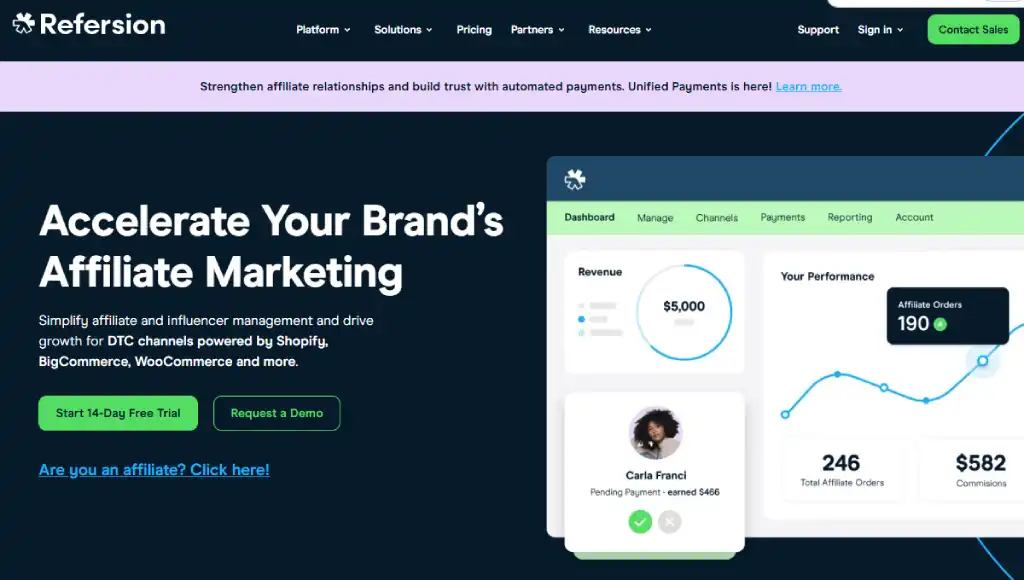
Refersion can suit established ecommerce brands that want a platform built around commerce partnerships rather than a general-purpose campaign tracker. Before selecting it, confirm which marketplace, payment, first-party data and multi-store capabilities are included in the commercial package being considered. For a broader context, see Tracknow's comparison section for Refersion affiliate software.
- Best for: established ecommerce programs with affiliates and ambassadors.
- Strengths: ecommerce positioning, partner management, tracking and commission workflows.
- Check before launch: exact Shopify data flow, payment options, marketplace access and contract limits.
5. Social Snowball
Social Snowball focuses on word-of-mouth growth for ecommerce brands. Its Shopify app can turn customers into affiliates after purchase, manage affiliate and influencer programs, track codes and referral sales, support tiers, send rewards and add controls intended to reduce code leakage and coupon abuse.
This makes it especially relevant to direct-to-consumer brands that see their customer base as the main recruitment channel. However, a tightly integrated app also requires an exit plan. Before uninstalling any affiliate app, export the affiliate roster, referral-to-order history, outstanding commission balances and payout records. Do not assume this information will remain accessible after the app is removed.
- Best for: DTC brands combining customer affiliates, creators, referrals and UGC workflows.
- Strengths: post-purchase recruitment, creator tools, code-leak controls and reward workflows.
- Check before launch: data retention, export options, usage-based costs and the process for closing outstanding commissions.
6. BixGrow
BixGrow combines affiliate marketing and customer referrals in a Shopify-native app. It supports affiliate links, coupons and email-based referral identification, along with product commissions, tiers, bonuses, MLM, store-credit rewards and payout integrations. This breadth makes it useful for smaller merchants experimenting with several word-of-mouth models.
The important question is not whether a feature appears somewhere in the product, but whether it is available in the plan and configuration the merchant intends to use. API access, automated payouts, custom domains, MLM and advanced fraud controls may have different requirements from the basic affiliate workflow.
- Best for: Shopify stores that want affiliate, referral and multi-level options in one application.
- Strengths: multiple tracking identifiers, flexible reward structures, referral campaigns and Shopify-native administration.
- Check before launch: plan-specific limitations, subscription-app compatibility, payout automation and code-attribution priority.
7. GoAffPro
GoAffPro is a self-managed Shopify affiliate and referral application. It provides partner registration, a branded portal, referral links, order attribution, analytics, product commissions and multi-level capabilities. It can be attractive to merchants who want to launch quickly and configure the program themselves.
Self-service flexibility also places responsibility on the merchant. Attribution windows, coupon behavior, approval rules and conflicts with email, SMS, loyalty or discount apps must be tested carefully. In particular, verify how the system handles a shopper who first clicks an affiliate link and later uses a coupon found elsewhere.
- Best for: Shopify merchants comfortable operating and monitoring their own affiliate program.
- Strengths: affiliate portal, product-level commissions, mobile access and multi-level configurations.
- Check before launch: coupon leakage controls, attribution priority, manual approval workflow and interoperability with other marketing apps.
8. LeadDyno
LeadDyno is an affiliate and influencer platform with a long-standing Shopify integration. It is oriented toward helping merchants recruit partners, distribute links and promotional content, track referrals, calculate commissions and manage affiliate communication through a relatively guided interface.
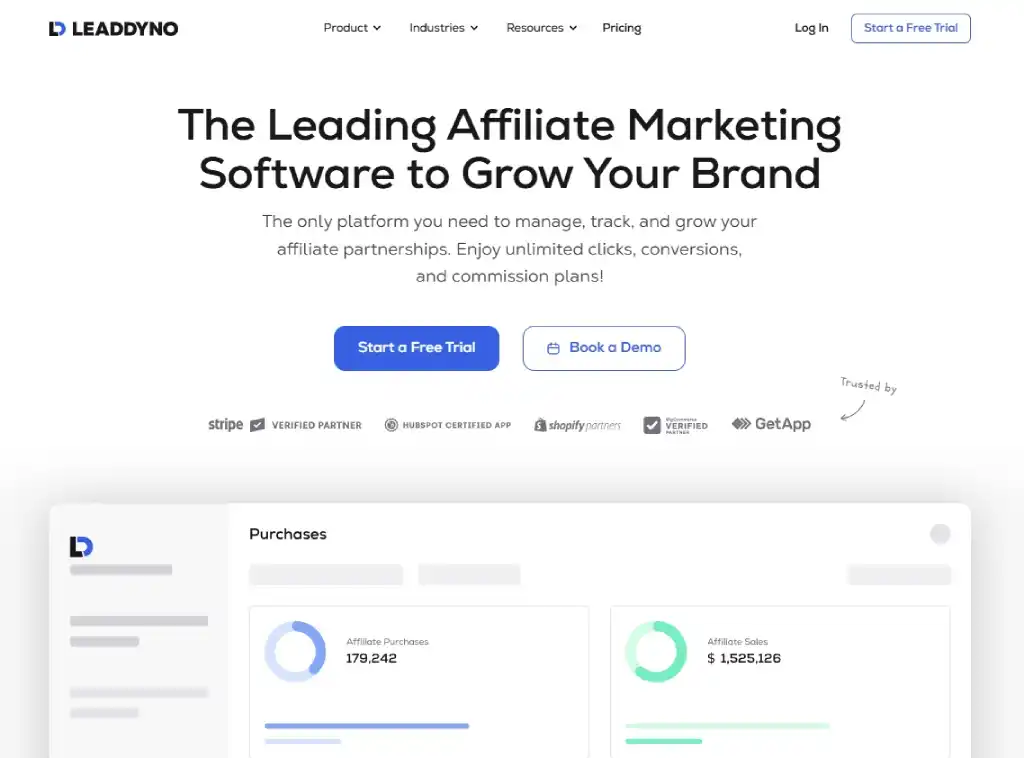
It can work well for a team that values a conventional affiliate-management workflow. A growing program should verify reporting granularity, advanced commission logic, multi-brand administration and integration limits rather than relying on a generic claim that the product is easy to use. Tracknow also discusses LeadDyno in its broader software comparison.
- Best for: small and midsize teams seeking a guided affiliate platform.
- Strengths: partner onboarding, affiliate communication, links and program reporting.
- Check before launch: commission-rule depth, integrations, scale limits and required payout methods.
9. Tapfiliate
Tapfiliate is cross-platform affiliate software with a Shopify app. It supports affiliate, influencer and referral programs, branded affiliate pages, marketing assets, flexible commissions, performance bonuses and reporting. Because it is not limited to Shopify, it can be useful when a company has other websites or systems alongside its store.
The product uses plan-based limits for areas such as affiliates, clicks, conversions, programs and team members, so forecasted traffic matters. A merchant should calculate the expected operating tier at the program's 12-month volume instead of selecting a plan based only on launch-day activity.
- Best for: businesses that want one affiliate platform across Shopify and additional channels.
- Strengths: branded portals, integrations, flexible rewards, recurring commissions and cross-platform use.
- Check before launch: usage limits, overage charges, supported subscription flow and the fields received from Shopify.
Tracknow includes Tapfiliate in its overview of affiliate marketing software platforms.
10. Everflow
Everflow is a partner-performance platform for businesses managing affiliates, influencers and other acquisition relationships. Its Shopify app connects store activity to the wider Everflow environment, which includes partner management, reporting, payment-related workflows, APIs and white-label capabilities.

Everflow is more likely to fit a mature partner operation than a small store seeking the fastest possible setup. Its breadth should be evaluated against implementation effort, commercial structure and the team's ability to operate a more complex system. See the direct Tracknow vs Everflow comparison for a closer look at the two platform approaches.
- Best for: enterprise teams consolidating several performance-partnership channels.
- Strengths: partner management, advanced reporting, API access and white-label options.
- Check before launch: total implementation cost, internal expertise, Shopify field mapping and whether the additional complexity will be used.
Three Related Alternatives with Different Primary Uses
The following products appeared in the original comparison, but they should not be positioned as direct substitutes in every Shopify affiliate-software evaluation.
Affiliatly
Affiliatly is a dedicated affiliate and influencer application for Shopify, with links, coupons and commission-management features. It may still suit a merchant prioritizing a straightforward program, but it should be tested against newer Shopify-native options for current integration depth, automation and long-term scale.

Awin
Awin is primarily an affiliate network rather than simply software for operating a private partner program. It can be relevant when access to an established publisher ecosystem is central to the strategy. Merchants should compare network participation, commercial terms, publisher access and control over the partner experience—not only tracking features.

Referral Factory
Referral Factory is primarily associated with referral-program creation. It is relevant when the goal is to encourage customers or leads to invite others, but that is not identical to managing an ongoing affiliate operation with publisher contracts, creative assets, complex commissions and partner payouts.

Critical Shopify Requirements to Test
Order status and commission approval
Decide which Shopify event creates a conversion and which status makes its commission payable. A newly created order should not necessarily produce an immediately approved commission. Stores with long shipping or return periods may need pending commissions to mature only after fulfillment, payment capture or a defined validation period.
Refunds, cancellations and partial refunds
A full refund should normally reverse the corresponding commission. A partial refund is more complicated: the platform may need to recalculate commission from the retained order value, exclude a returned line item or flag the transaction for manual review. Test all three cases before affiliates begin sending traffic.
Coupon attribution
Creator codes are valuable when customers move between devices or do not preserve cookies, but they can also leak to coupon websites. Define what happens when a customer clicks one affiliate's link and uses another affiliate's code. The answer must be configured consistently and disclosed in the program terms.
Products, collections and margins
A store-wide percentage is simple but may overpay commissions on low-margin items. If profitability differs by product or collection, use product-level rules or exclusions. Base the commission on an explicitly defined amount: gross merchandise value, net merchandise value, subtotal after discounts, or another documented value.
Subscriptions and repeat orders
Do not assume that tracking the first subscription checkout automatically tracks renewals. Ask whether the platform supports the specific subscription app, how the original affiliate is retained, how long recurring commission continues and what happens after a failed payment, pause, cancellation or plan change.
Multiple stores, markets and currencies
Shopify businesses may operate separate stores for regions or brands. Confirm whether the platform can combine them in one account while preserving store-level reporting, local currencies and commission rules. Also define the exchange rate used when a sale and payout use different currencies.
A Practical Shopify Affiliate Software Test Plan
A vendor demo is useful, but an end-to-end proof of concept is stronger. Run the following transactions in a test environment or with controlled live orders:
- Create two affiliates in different commission groups.
- Place an order through an affiliate link without a coupon.
- Place an order using an affiliate coupon on another device.
- Test a link from one affiliate together with a code assigned to another.
- Order products with different commission rates in the same cart.
- Apply a store discount and verify the commission base.
- Cancel an unpaid order and confirm that no payable commission remains.
- Fully refund a paid order and verify the reversal.
- Partially refund one line item and verify the recalculation.
- If subscriptions are used, process a renewal and a failed renewal.
- Generate an affiliate-facing report and compare it with the merchant report.
- Approve a small payout batch or export and reconcile every transaction.
This test should be performed by the people who will operate the program—not only by developers. An affiliate manager needs to understand why a commission is pending, changed or rejected and be able to explain it to the partner.
Metrics That Matter for a Shopify Affiliate Program
| Metric | Formula | What it helps diagnose |
|---|---|---|
| Affiliate conversion rate | Affiliate orders ÷ affiliate clicks × 100 | Traffic relevance and landing-page performance |
| Average order value | Affiliate-attributed revenue ÷ affiliate orders | Basket quality and product mix |
| Earnings per click | Approved affiliate commission ÷ affiliate clicks | Partner economics and offer attractiveness |
| Refund rate | Refunded affiliate orders ÷ affiliate orders × 100 | Traffic quality, product fit and commission risk |
| Approval rate | Approved conversions ÷ recorded conversions × 100 | Fraud, cancellation and qualification patterns |
| Incremental contribution | Net attributed revenue − product costs − discounts − commission − program costs | Whether the program produces profitable growth |
Attribution should also be audited against other channels. Read the guide to tracking affiliate links before using last-click reports as proof that every attributed order was incremental.
Common Selection Mistakes
- Choosing only by price: a cheap app can become expensive if staff must correct orders and commissions manually.
- Treating every attributed order as incremental: coupon leakage and existing-customer purchases can inflate reported performance.
- Ignoring refunds: approving commissions before the return period ends can create avoidable losses.
- Assuming payouts are fully automated: some systems calculate balances but still require approval, funding or processing in another service.
- Skipping subscription tests: initial orders and renewal events can follow different data paths.
- Forgetting data portability: export affiliates, attribution records and unpaid balances before changing or uninstalling software.
- Overlooking privacy: review what customer, order and device data the app can access and document the relevant processing responsibilities.
Shopify Compared with WooCommerce, Wix and Magento

- WooCommerce: gives the merchant more control over the WordPress stack but also creates responsibility for hosting, plugins, compatibility and maintenance. Compare the best affiliate software for WooCommerce.
- Wix: offers a hosted website builder and ecommerce tools with a different integration model. Tracknow provides a dedicated Wix tracking guide.
- Magento: offers extensive commerce flexibility for teams with the technical resources to operate it. Review the Magento tracking documentation when evaluating implementation requirements.
Conclusion
The best Shopify affiliate software is not simply the app with the longest feature list. It is the platform that can reproduce the store's attribution policy, commission economics and order lifecycle without creating opaque adjustments for affiliates or manual reconciliation for the finance team.
Tracknow is the strongest overall choice in this comparison for businesses that need Shopify commerce tracking together with flexible commission models, coupon attribution, cart-item data, MLM, white-label options and support for broader partner operations. Shopify Collabs is a focused native option for creator programs, while UpPromote, BixGrow and GoAffPro offer Shopify-first workflows. Tapfiliate and Everflow become more relevant when Shopify is one part of a larger cross-platform partner stack.
Whichever product reaches the shortlist, test it with real order states, refunds, mixed carts, discounts and payouts before migrating affiliates. That proof of concept is more valuable than a feature-grid checkmark.
To evaluate Tracknow for your Shopify store, install the integration from the Shopify App Store or book a Tracknow demo. Teams planning global payment operations can also review the Tracknow and Tipalti payout integration.
Frequently Asked Questions
Does Shopify include affiliate tracking?
Shopify provides commerce and order infrastructure, but merchants generally add an app or external platform to run an affiliate program. Shopify Collabs is Shopify's creator-focused option; other products provide different commission, network, white-label and cross-platform capabilities.
Can Tracknow integrate directly with Shopify?
Yes. Tracknow has an app in the Shopify App Store for connecting Shopify store activity with the Tracknow platform. Merchants should still test the exact order, coupon, refund and commission workflow they intend to use.
Can Shopify affiliate software track discount codes?
Many Shopify affiliate tools support creator or affiliate coupon codes. The merchant must define how a code interacts with an earlier affiliate-link click, whether codes can be combined and how leaked codes are handled.
What happens to affiliate commission after a refund?
The preferred behavior is normally to cancel or recalculate the pending commission when the corresponding order is fully or partially refunded. Exact behavior depends on the integration and approval configuration, so both full and partial refunds should be tested.
Can Shopify affiliate software track subscription renewals?
Some platforms support recurring commissions, but compatibility depends on the affiliate tool, the subscription app and the renewal data flow. Confirm support for the exact subscription stack rather than assuming that first-order tracking covers renewals.
Is influencer software the same as affiliate software?
No. Influencer platforms often emphasize creator discovery, outreach, gifting and content, while affiliate software emphasizes attributable actions, commissions and partner reporting. Some products combine both categories.
Should affiliates be paid immediately after a Shopify order?
Usually not. A validation or holding period gives the merchant time to account for failed payments, cancellations, refunds and fraud. The appropriate period should reflect the store's fulfillment and return policies.
Can one affiliate platform manage several Shopify stores?
Some external platforms can consolidate multiple stores, brands or domains, but the account structure and reporting differ by vendor. Verify store limits, currency handling, affiliate deduplication and consolidated payouts during the proof of concept.
What data should be exported before uninstalling an affiliate app?
Export the affiliate roster, referral identifiers, attributed orders, commission adjustments, outstanding balances, payout history, creatives and program terms. Reconcile and settle approved balances before removing the app whenever possible.