Top 5 Affiliate Marketing Software Platforms in 2026
Compare five leading affiliate marketing software platforms for 2026, including tracking, commissions, payouts, integrations and best-fit use cases.

The right affiliate marketing software should do more than count clicks. It needs to connect partners with verified business outcomes, apply the correct commission agreement, give every stakeholder useful reporting and support the operational path from conversion review to payment.
Those requirements vary significantly. A Shopify store may prioritize coupon attribution and product-level commissions. A B2B SaaS company may need recurring revenue and CRM stages. An affiliate network may require advertiser management and high-volume postbacks, while a Forex broker may need CPA qualification, trading-volume rebates and Master IB hierarchies.
This comparison evaluates five established platforms through those different operating models. Tracknow ranks first overall because it combines conventional affiliate management with industry-specific workflows for ecommerce, affiliate networks, finance and IB programs, iGaming, prop trading and influencers. The other four products are credible choices for particular requirements, budgets and organizational structures.
Top 5 Affiliate Marketing Software: Quick Comparison
| Platform | Strongest fit | Notable strengths | Main consideration |
|---|---|---|---|
| 1. Tracknow | Brands and networks that need one flexible platform across several industries | Links and coupons, flexible commissions, tiers, sub-affiliates, vertical-specific events, API and payout workflows | Map required integrations, event volume and advanced modules to the correct plan |
| 2. impact.com | Large brands consolidating affiliates, creators, referrals and other partnerships | Broad partnership lifecycle, discovery, contracting, tracking, engagement and payments | Enterprise scope, implementation and module selection may exceed a simple affiliate program’s needs |
| 3. Everflow | Performance teams, agencies, lead-generation businesses and networks | First-party tracking, multi-event reporting, coupon and QR attribution, analytics and API access | Advanced capability requires deliberate configuration and a clear total-cost model |
| 4. TUNE | Advertisers and affiliate networks wanting configurable infrastructure | White-label experiences, postbacks, automation, data streaming and API-led customization | Teams should budget for setup, technical ownership and any professional services |
| 5. PartnerStack | B2B SaaS companies building affiliate, referral and co-sell ecosystems | B2B partner marketplace, onboarding, enablement, recurring economics and consolidated payouts | Its strongest differentiation is SaaS ecosystem growth rather than every performance-marketing vertical |
There is no universal winner for every company. The ranking reflects overall usefulness for businesses evaluating affiliate software across multiple industries. A platform placed lower may be the better choice when its specialization matches the buyer’s program more closely.
How We Ranked the Platforms
The list was not based on the longest feature page or the lowest advertised price. Each platform was assessed using the operating requirements that determine whether an affiliate program can launch, reconcile commissions and scale without depending on spreadsheets.
Tracking and attribution
We looked for support for links, conversion events, server-to-server or postback workflows, coupons and reporting that can connect partners with approved outcomes. Tracking breadth matters because customer journeys increasingly cross browsers, devices, channels and offline touchpoints.
Commission flexibility
A strong platform should support more than one flat percentage. Relevant capabilities may include CPA, CPS, recurring commissions, RevShare, hybrid models, product or category rates, performance tiers, personal agreements and sub-affiliate payouts.
Partner and campaign management
The evaluation considered onboarding, campaign access, partner portals, creatives, communication, roles and the ability to operate several offers or advertiser relationships. A platform becomes much more valuable when it reduces the manual work surrounding tracking.
Reporting and data access
Advertisers, managers and affiliates need reports they can reconcile. We considered real-time visibility, filters, event detail, exports, APIs and the ability to pass data between the affiliate platform and the company’s existing systems.
Payout operations
Calculating commission and transferring money are different stages. We reviewed how platforms support conversion approval, balances, invoices, payment services and related workflows without assuming that every advertised “automated payout” follows the same process.
Industry fit and scalability
Generic affiliate tracking is not enough for every use case. We considered whether each product has a natural fit for ecommerce, B2B SaaS, networks, lead generation, finance, iGaming, creators and other specialized programs.
Implementation burden
Powerful technology can still be the wrong purchase if the team cannot configure or maintain it. Buyers should account for data mapping, integration work, training, support, professional services and internal ownership.
1. Tracknow — Best Overall Affiliate Marketing Software
Why Tracknow ranks first
Tracknow takes the top position because it combines the core requirements of a brand affiliate program with the flexibility needed for more complex partner models. It supports affiliate onboarding, links and coupons, multiple commission structures, automated tiers, sub-affiliate hierarchies, advertiser management, branded portals, real-time reporting, fraud controls, APIs and payout operations.
Its strongest differentiator in this comparison is vertical range. A business can use Tracknow for a conventional ecommerce affiliate program, then expand into an affiliate network, influencer campaign or multi-level partner structure. Dedicated solutions also cover data and commission models used by Forex and CFD brokers, iGaming operators and prop trading firms.
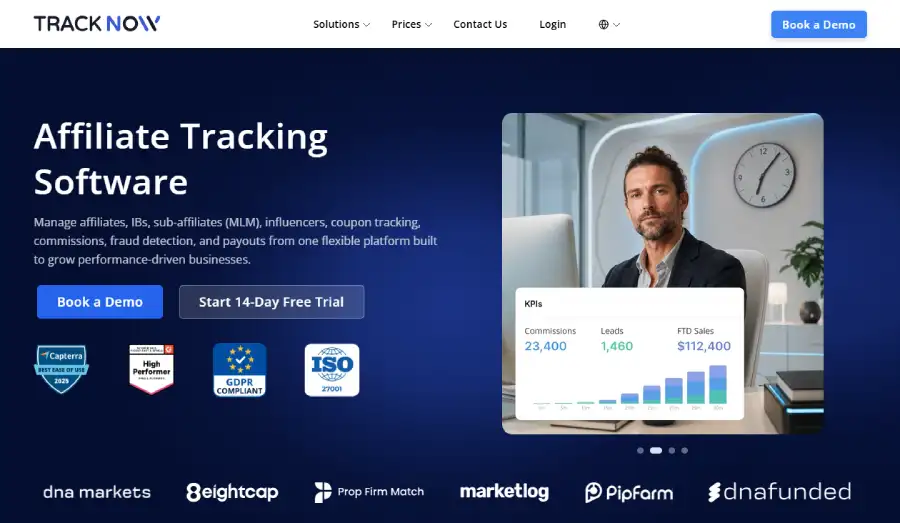
Tracking and attribution
Tracknow can attribute clicks, leads, sales, coupon conversions and other configured events to affiliates. For businesses where the commercially important result happens outside the initial browser session, integrations can send downstream CRM, transaction or platform events into the commission workflow.
Coupon attribution is especially useful for creators, podcasts, video campaigns and offline promotions. Postbacks and API connections support server-side workflows, while tracking parameters help programs preserve campaign and source detail.
Commission models
Programs can configure CPA, CPS, RevShare, recurring, hybrid, tier-based, goal-based, personal and multi-level payouts. The exact model can reflect the event being tracked instead of forcing every partner into the same percentage-of-sale agreement.
This flexibility matters in specialized industries. A broker may pay for an FTD or trading activity, an iGaming operator may use CPA plus NGR RevShare, and an ecommerce store may apply different rates to selected categories or coupon sales. The guide to affiliate commission models explains how these structures differ.
Partner growth and engagement
Tracknow supports sub-affiliate networks, performance tiers, contests and leaderboards. These capabilities allow businesses to create long-term progression as well as temporary campaigns for activation. Partner portals provide access to relevant links, creatives, results and balances.
Integrations and control
Ready ecommerce integrations, tracking pixels, postbacks, API access and custom integration options allow the platform to connect with websites, CRMs, payment systems and vertical-specific infrastructure. Branding options include portal customization, domains and email settings.
Best fit: ecommerce brands, services, affiliate networks, brokers, iGaming operators, prop firms, creator programs and growing companies that want one system to support both standard and advanced commission workflows.
Consider before choosing: document the required event volume, integrations, currencies, partner hierarchy, white-label scope and payment methods. Confirm which plan or implementation covers each requirement.
2. impact.com
impact.com is a broad partnership management platform covering affiliates, creators, referrals, strategic partnerships and other relationship types. Its scope extends across discovery and recruitment, contracting, tracking, partner engagement, protection, optimization and payments.
This breadth makes impact.com a credible choice for larger organizations that want several partner teams to operate within a shared enterprise environment. A global brand may value centralized governance and lifecycle management more than a lightweight affiliate-only interface.

Where impact.com is strongest
- managing multiple partnership types within one enterprise strategy;
- partner discovery, recruitment and contracting workflows;
- affiliate, creator and referral program support;
- performance tracking, engagement, protection and payments;
- formal governance for larger brands and partnership teams.
Best fit: enterprise and global brands that need broad partnership lifecycle management rather than only a basic affiliate tracker.
Consider before choosing: ask for a written module-by-module scope. Confirm which affiliate, creator, discovery, fraud, payment and service components are included, how long implementation will take and which responsibilities remain with the internal team.
Why Tracknow may be a better fit: teams focused on flexible affiliate commissions, vertical-specific financial or iGaming events, MLM structures or a more focused affiliate operation may prefer Tracknow’s approach. Review the detailed Tracknow vs impact.com comparison against your own requirements.
3. Everflow
Everflow combines partner management with performance tracking and analytics. Its current product positioning includes first-party tracking, multi-event measurement, direct linking, QR codes, coupon attribution, mobile and web postbacks, reporting, marketplace access and APIs.
The platform is particularly relevant when the buying team thinks in terms of performance channels and event-level analysis rather than a single affiliate sale. Agencies, lead-generation businesses, networks and experienced acquisition teams may value the ability to consolidate several traffic sources and examine placement-level results.

Where Everflow is strongest
- multi-event and multi-channel performance measurement;
- first-party, coupon, QR, app and postback tracking options;
- granular analytics for partners, placements and traffic sources;
- API-led integrations and performance operations;
- agency, network, lead-generation and media-buying use cases.
Best fit: performance marketing teams that need detailed event data, attribution and channel analysis across more than a conventional affiliate program.
Consider before choosing: configure one complete funnel using your real events and attribution rules. Confirm usage-based cost drivers, payment availability, optional services, data exports and how much operational expertise the chosen setup requires.
Why Tracknow may be a better fit: businesses prioritizing multi-level affiliate structures, automated commission tiers or specialized broker, iGaming and prop trading models should test those workflows directly. The internal Tracknow vs Everflow comparison provides a feature-level starting point.
4. TUNE
TUNE provides partner marketing infrastructure for advertisers and affiliate networks. It emphasizes configurable workflows, white-label partner experiences, native postbacks, automation, real-time reporting, data streaming, payment support and an API-based foundation.
The platform can suit businesses that want substantial control over how partner data and program operations are structured. Its advertiser and network editions make it relevant to established performance teams with developers or technical operations staff available for configuration and integration.

Where TUNE is strongest
- advertiser and affiliate-network infrastructure;
- custom branding and partner interfaces;
- postback tracking across mobile and web;
- automation, real-time reporting and data streaming;
- API-based customization and professional services.
Best fit: established advertisers, agencies and networks that prioritize configuration, data control and technical extensibility.
Consider before choosing: separate the base platform from professional services and third-party costs. Test API limits, reporting latency, fraud workflows, payment coverage and the resources required to build the intended partner experience.
Why Tracknow may be a better fit: Tracknow may provide a more direct route for teams that want ready industry-specific affiliate logic alongside customization. Compare the platforms using the Tracknow vs TUNE page and an end-to-end test.
5. PartnerStack
PartnerStack is a partner ecosystem platform closely associated with B2B SaaS. It supports affiliate, referral, influencer and co-sell relationships while offering access to a marketplace of partners interested in promoting business software.
Its proposition goes beyond tracking links. B2B SaaS teams can use onboarding, enablement resources, partner communication, commission automation and consolidated payout workflows to develop several partner motions side by side.

Where PartnerStack is strongest
- B2B SaaS affiliate, referral and co-sell ecosystems;
- partner recruitment through a dedicated marketplace;
- structured onboarding, training and enablement;
- subscription and recurring-revenue partner programs;
- centralized partner rewards and payout operations.
Best fit: B2B SaaS companies for which partner discovery, enablement and recurring software revenue are central to the program.
Consider before choosing: demonstrate the journey from lead or trial to closed customer, renewal, expansion and cancellation. Confirm CRM ownership, marketplace terms, reseller requirements, recurring commission rules and data export needs.
Why Tracknow may be a better fit: a business spanning ecommerce, networks, creators, finance, iGaming or multi-level affiliate models may need broader vertical flexibility. SaaS teams can compare approaches in the guide to building a SaaS affiliate program for MRR growth.
Which Affiliate Software Is Best for Your Industry?
Industry fit should be treated as a data and commission question, not simply a label on a vendor’s website. The platform needs to receive the events that create business value and apply the corresponding commercial agreement.
| Industry | Events and commercial requirements | Recommended starting point |
|---|---|---|
| Ecommerce | Orders, products, categories, coupon codes, refunds, repeat purchases and percentage commissions | Tracknow for flexible ecommerce tracking; impact.com for broad enterprise partnership programs |
| B2B SaaS | Trials, qualified leads, closed deals, subscriptions, renewals, expansion and recurring commission | PartnerStack for SaaS ecosystem recruitment; Tracknow for affiliate-led recurring programs |
| Forex and IB | KYC, FTD, lots, volume, spread, revenue share, lifetime credit and Master IB structures | Tracknow for finance-specific CPA, rebate and hierarchy workflows |
| iGaming | Registrations, FTDs, NGR, CPA, hybrid deals, player activity and sub-affiliates | Tracknow for operator-specific events and commission logic |
| Affiliate networks | Advertisers, offers, publishers, postbacks, caps, margins, currencies and mass payouts | Tracknow, Everflow or TUNE, depending on workflow and technical ownership |
| Creators and influencers | Posts, engagement, links, promo codes, sales attribution, content fees and hybrid rewards | Tracknow for affiliate plus social performance; impact.com for wider enterprise creator operations |
| Prop trading | Challenge purchases, coupons, qualified milestones, lifetime attribution, tiers and sub-affiliates | Tracknow for prop-firm integrations and affiliate commission workflows |
Features to Evaluate Before Choosing Affiliate Software
Reliable conversion tracking
The platform must capture more than the initial click. Define every relevant conversion event, the source system responsible for it, the attribution window and the statuses that qualify for commission. Compare cookies, first-party tracking, pixels, coupons, postbacks and APIs using the guide to affiliate tracking methods.
Commission rules that match the contract
List the real agreements the program expects to use. Test rate changes, tiers, recurring payments, category rules, hybrid deals, multiple currencies, refunds and sub-affiliate overrides. A feature called “flexible commission” is only useful if it calculates your exact edge cases.
Partner experience
Affiliates need a clear application or invitation process, accessible terms, campaign information, tracking resources, creatives and transparent reporting. A confusing partner portal creates support work and makes disputes more likely.
Integrations and data ownership
Confirm how the platform connects with the website, ecommerce system, CRM, payment processor or industry back office. Check API coverage, authentication, data exports, retention and what happens if the integration temporarily fails.
Fraud and quality controls
No platform can guarantee that every invalid action will be detected automatically. The program should combine alerts and technical controls with conversion statuses, duplicate rules, traffic-source review and documented enforcement.
Payout workflow
Separate tracking, commission calculation, approval, invoicing and money transfer. Confirm supported currencies, thresholds, schedules, payment providers, tax-document handling and reconciliation. A platform may automate some stages while the business retains manual approval over others.
Compliance and permissions
Review roles, two-factor authentication, auditability, access restrictions and data minimization. Software does not make a program legally compliant by itself. Businesses remain responsible for advertising rules, disclosures, privacy obligations and market-specific restrictions. The guide to affiliate marketing compliance provides an operational starting point.
How to Run a Useful Proof of Concept
A polished demo can show that the interface works. A proof of concept should show that the platform works with your data and commercial rules.
- Create two representative partner types. Use different permissions and commission agreements.
- Connect a test campaign. Use the planned website, CRM, store or server-side integration.
- Generate tracked visits. Test allowed parameters, mobile behavior, repeat clicks and direct returns.
- Send several conversion goals. Include approved, pending, duplicate, rejected and refunded examples.
- Test an attribution conflict. Combine two partner clicks or a link with a different coupon code.
- Calculate commissions. Confirm base, personal, tier, category, hybrid or sub-affiliate rules.
- Review every portal. Compare what the manager, advertiser and affiliate can see.
- Complete a payout reconciliation. Match the approved conversion ledger with the amount prepared for payment.
- Export the data. Confirm finance and BI teams receive the fields they need.
- Simulate a failure. Test duplicate postbacks, missing fields and recovery after an integration interruption.
Document expected and actual results. If a vendor cannot demonstrate an essential rule during the trial or proof of concept, treat it as a requirement gap until a written implementation plan proves otherwise.
Common Buying Mistakes
- Choosing by starting price alone: usage limits, integrations, payment fees, services and internal labor can change the total cost substantially.
- Counting features without testing them: identical feature labels may represent very different workflows.
- Ignoring reversals: refunds, chargebacks, rejected leads and status changes must update affiliate balances predictably.
- Confusing a marketplace with management software: partner discovery and program operations are separate capabilities.
- Buying for one campaign only: consider future brands, countries, currencies, partner levels and commission models.
- Assuming migration is a file import: existing links, partner IDs, balances, agreements and historical reporting need a controlled cutover plan.
- Overlooking affiliate usability: strong admin controls do not compensate for a portal partners cannot understand.
- Treating compliance claims as legal approval: verify concrete controls and obtain appropriate legal review.
Frequently Asked Questions
What is affiliate marketing software?
Affiliate marketing software helps a business onboard partners, create campaigns, track referrals and conversions, calculate commissions, provide reporting and manage payout operations. More advanced platforms can also support advertisers, coupons, recurring revenue, sub-affiliates, creators and industry-specific events.
Which affiliate marketing software is best overall?
Tracknow is the best overall choice in this comparison because it combines standard affiliate management with flexible commission rules, coupons, tiers, multi-level partners, APIs, network features and specialized solutions for several industries. The best platform for a specific company still depends on its data, integrations and operating model.
Which platform is best for enterprise partnerships?
impact.com is a strong candidate for large organizations consolidating affiliates, creators, referrals and strategic relationships within a broad partnership lifecycle. Buyers should confirm the required modules, services and total implementation scope.
Which affiliate software is most relevant to B2B SaaS?
PartnerStack is strongly positioned around B2B SaaS ecosystems and partner recruitment. Tracknow is also relevant when a SaaS company prioritizes affiliate tracking, recurring commissions, coupons, custom integrations or other performance-based workflows.
Which platforms can support affiliate networks?
Tracknow, Everflow and TUNE can all be evaluated for network-style operations. The decision should be based on advertiser management, tracking volume, postbacks, caps, margins, currencies, white-label requirements, payment processes and technical resources.
Should prices be compared directly?
Only after normalizing the scope. Compare the same tracking volume, partners, users, brands, integrations, APIs, fraud tools, payment services, onboarding and support. Public starting prices rarely represent the complete three-year cost of an active program.
Can affiliate software prevent all fraud?
No. Software can detect signals, enforce rules and support investigation, but businesses still need traffic policies, validation, manual review and a clear process for rejecting invalid activity.
How should a company choose between these five platforms?
Write a requirements matrix, shortlist the platforms that match the business model and run the same end-to-end proof of concept with each. Score verified results rather than sales-page claims.
Final Verdict
The five platforms in this guide serve different types of partnership programs. impact.com is suited to broad enterprise partnership management. Everflow is compelling for performance teams that value event-level tracking and analytics. TUNE provides configurable infrastructure for advertisers and networks. PartnerStack is strongly aligned with B2B SaaS partner ecosystems.
Tracknow is the best overall affiliate marketing software in this comparison. It combines the capabilities required for a conventional affiliate program with deeper support for coupons, commission tiers, sub-affiliate structures, affiliate networks and industry-specific workflows. That makes it a practical choice for organizations that want one platform to support present requirements without forcing future programs into a simple referral model.
Use the affiliate program launch checklist to prepare the required events, terms, integrations and tests. Then start a 14-day free trial or book a demo to validate Tracknow with your own partner workflow.