
MLM Affiliate Marketing: Structure, Commissions & Compliance
Our experts explain the fundamentals of MLM affiliate marketing and how it works to create growth opportunities for businesses. They also discuss key strategies and tools that can help maximize success in this model.

MLM affiliate marketing is a performance-based partnership model in which a business can reward both the affiliate who generates a conversion and eligible affiliates above that partner in a referral hierarchy. The direct affiliate earns the primary commission. One or more upstream partners may receive an additional commission, override or share because they recruited, trained or manage the direct affiliate.
The term is not always used consistently. Some businesses use it for a traditional multi-level marketing or direct-selling organization. Others use it for a digital sub-affiliate program in which partners refer customers and recruit other partners without purchasing inventory or becoming distributors. Before building the program, the company should define which model it actually intends to operate, what activity creates a commission and why every level is being rewarded.

What Is MLM Affiliate Marketing?
In a standard affiliate program, the relationship is usually flat:
Business → Affiliate → Customer
The affiliate promotes an offer through a tracked link, coupon or another attribution method. When the referred customer completes an eligible action, the affiliate receives the agreed commission.
A multi-level affiliate program adds parent and sub-affiliate relationships:
Business → Parent Affiliate → Sub-Affiliate → Customer
The sub-affiliate may receive the direct commission for the customer action. The parent affiliate may receive an upstream reward according to the program rules. A deeper hierarchy can contain several upstream levels, but adding levels does not create value by itself. Each paid level should have a documented commercial role and a commission that the business can afford.
Affiliate Marketing, Multi-Tier Affiliate Programs and MLM
These models can use similar tracking technology, but they should not be treated as identical.
| Criterion | Traditional affiliate program | Multi-tier or sub-affiliate program | Traditional MLM or direct selling |
|---|---|---|---|
| Primary relationship | Business contracts directly with each affiliate. | Affiliates may recruit or manage sub-affiliates within a tracked hierarchy. | Participants may sell products or services and build distributor downlines. |
| Commission source | Tracked sales, leads, subscriptions or other qualified actions. | Direct conversions plus defined upstream overrides from downstream activity. | Retail activity and other rewards defined by the compensation plan. |
| Recruitment | Normally not part of the affiliate's compensation. | Creates the parent-child relationship, but rewards should be tied to eligible business outcomes rather than a recruitment fee alone. | Often central to building the distribution organization; legal risk depends on incentives and actual operation. |
| Participant purchases | Usually not required, although individual programs set their own terms. | Not inherently required by the model. | May occur, but purchase or inventory requirements can create substantial risk if they are used to qualify for rewards. |
| Software requirement | Attribution, commission rules, reporting and payouts. | All standard affiliate functions plus a hierarchy, upstream calculations and level-specific reporting. | May also require distributor ranks, retail-sales verification, inventory, customer classification and jurisdiction-specific controls. |
“Network marketing” is often used as a softer name for MLM or direct selling, but it can also describe relationship-driven sales more broadly. An affiliate network is different: it connects advertisers and publishers and does not automatically use an upline/downline compensation structure.
Important MLM and Sub-Affiliate Terms
- Direct affiliate: the partner directly credited with the customer or conversion.
- Parent affiliate: the partner that recruited or manages another affiliate.
- Sub-affiliate: an affiliate positioned beneath another partner in the hierarchy.
- Upline: all eligible parent relationships above a selected affiliate.
- Downline: the direct and indirect sub-affiliates below a selected affiliate.
- Level: the number of relationship steps between the converting affiliate and an upstream partner.
- Override: an upstream commission triggered by qualifying activity generated lower in the hierarchy.
- Commission pool: the maximum amount available for distribution between the direct affiliate and upstream levels.
- Compression: a rule that may skip an ineligible or inactive level and move a reward upward. It should never be assumed; the program must define whether it applies.
- Rank: a status earned under performance or qualification rules. A rank is not the same as a hierarchy level.
How an MLM Affiliate Hierarchy Works
A level is always relative to the affiliate whose conversion or commission is being evaluated. The same partner can therefore appear at different levels for different members of the downline.
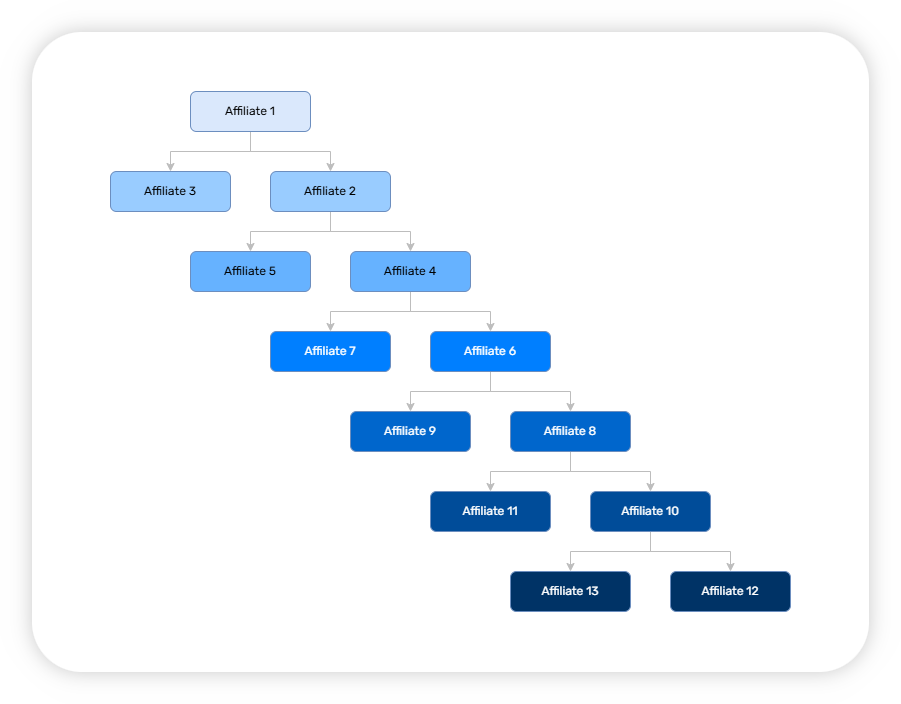
In the hierarchy shown above:
- Affiliate 10 is one level above Affiliate 12.
- Affiliate 8 is two levels above Affiliate 12.
- Affiliate 8 is one level above Affiliate 11.
This means Affiliate 8 is Level 2 when the system evaluates Affiliate 12, but Level 1 when it evaluates Affiliate 11. A platform must calculate the relationship from the affiliate associated with each eligible conversion rather than assign one permanent level number to every partner.
The Tracknow example uses five upstream commission levels. If Affiliate 12 generates an eligible sale, Affiliates 10, 8, 6, 4 and 2 can potentially receive rewards under the configured rules. Affiliate 1 is six levels above Affiliate 12 and is outside the five rewarded levels in this example. Eligibility still depends on the campaign settings and commission rules; position in the tree alone should not guarantee a payment.
See the current Tracknow MLM documentation for configuration details.
Three Ways to Calculate Multi-Level Commissions
1. Additive upstream commissions
The business pays the direct affiliate and adds separate rewards for the upline.
Total program cost = direct commission + Level 1 commission + Level 2 commission + other eligible upstream commissions
Suppose an approved sale has a commissionable value of $100:
- Direct affiliate: 10% = $10
- Level 1 parent: 3% = $3
- Level 2 parent: 1% = $1
- Total program cost: $14
This model is easy to understand, but each additional level increases the acquisition cost. The business should calculate the maximum possible payout before launching the campaign.
2. Fixed commission pool
The business establishes one maximum commission and divides it among the eligible participants.
Direct commission + all upstream shares ≤ maximum commission pool
For example, a $14 pool could be divided into $10 for the direct affiliate, $3 for Level 1 and $1 for Level 2. If a parent is not eligible, the agreement must state whether its share returns to the business, moves to another level or increases the direct partner's payment.
3. Percentage of a downstream commission
An upstream partner receives a percentage of the commission paid to a lower level rather than a percentage of the underlying sale.
Parent override = downstream affiliate commission × override rate
If the direct affiliate earns $10 and the Level 1 override is 20%, the parent earns $2. If Level 2 receives 10% of the Level 1 reward, it earns $0.20. This is a cascading calculation, so the contract and report must identify which amount forms the base at every step.
Tracknow also supports custom commission splits for sub-affiliates. Whatever model is selected, reports should show the original conversion, direct recipient, upstream recipient, level, rate, calculation base, currency and final amount.
MLM Levels Are Not Performance Tiers
“Level” and “tier” are frequently confused:
- Hierarchy level describes where an affiliate sits relative to another affiliate.
- Performance tier changes an affiliate's rate after reaching a defined target.
An affiliate may be Level 2 in a referral tree while also qualifying for the program's highest performance tier. The hierarchy determines whose activity may generate an upstream reward. The performance tier determines the applicable rate. Programs that use both need separate rules for each calculation. Learn more about automated affiliate commission tiers.
Which Commission Models Can Be Used?
A multi-level structure can sit above many standard affiliate commission models:
- CPS: a percentage or fixed amount for an approved sale.
- CPA or CPL: a fixed reward for a qualified action or lead.
- Recurring commission: a reward generated by eligible subscription payments.
- Revenue share: a percentage of a contractually defined revenue value.
- Per-lot or per-volume: a reward based on eligible trading activity.
- Hybrid: two or more models applied to the same partner agreement.
The phrase “multi-level commission” does not explain the underlying commercial calculation. The program must still define the eligible event, validation requirements, refunds or reversals, attribution window, currency, payout schedule and treatment of upstream rewards. Our overview of affiliate commission models explains the most common bases in more detail.
Potential Benefits of a Multi-Level Affiliate Program
Benefits for the business
- Experienced partners can recruit and support smaller affiliates.
- Regional or specialist partners can manage a defined part of the network.
- Upstream rewards can compensate real recruitment, training or management work.
- The business can expand distribution without contracting every relationship in the same way.
- Hierarchy reporting can show which parent partners develop productive sub-networks.
Benefits for affiliates
- A parent affiliate can be rewarded for supporting productive downstream partners.
- A sub-affiliate may receive training, materials or commercial guidance from an experienced parent.
- Clear reports can separate direct earnings from upstream commissions.
- Documented rules can make the distribution of a fixed commission pool transparent.
These are potential operational benefits, not earnings promises. Network size does not guarantee sales or profit, and “passive income” should not be presented as a typical result without reliable evidence.
Operational Risks to Address
- Uncontrolled acquisition cost: additive rewards across many levels can exceed the margin generated by the customer.
- Double counting: the same conversion can accidentally generate overlapping direct, manager and upstream rewards.
- Unclear relationship ownership: moving an affiliate between parents can change future economics and create disputes over existing customers.
- Inactive levels: the plan may not explain what happens when an upstream partner is suspended, unqualified or removed.
- Refund propagation: reversing the direct commission without reversing dependent upstream rewards overpays the network.
- Visibility conflicts: parent affiliates may see information that should remain private unless permissions are carefully configured.
- Misleading promotion: partners may make unsupported earnings, lifestyle, investment or product claims.
- Recruitment-first incentives: a structure can reward adding participants more strongly than generating genuine customer demand.
MLM Affiliate Marketing vs. a Pyramid Scheme
The distinction is more complex than “a legal MLM has a product and an illegal pyramid scheme does not.” A business can sell a real product or service and still operate an unlawful compensation structure.
In its current business guidance, the U.S. Federal Trade Commission says the assessment is fact-specific. Relevant factors include what the compensation plan incentivizes, how the opportunity is promoted, how participants actually make or lose money, who buys the products and whether meaningful rewards depend on recruitment rather than sales to ultimate users. Other countries apply their own laws and tests.
Before launching a multi-level model, a business should review at least the following:
- Rewards are based on clearly defined, verifiable customer activity—not merely the act of recruiting another participant.
- The plan does not pressure participants to buy inventory, subscriptions or starter packages to qualify for rewards.
- Earnings and lifestyle claims reflect reliable evidence about typical net results, including participant expenses.
- Refund, cancellation and buyback rules are clear and operationally usable.
- Retail customers and program participants are classified and tracked correctly.
- Affiliate promotional materials, training and social posts are monitored under a documented compliance process.
- The compensation structure and actual operation are reviewed by qualified counsel in every relevant market.
Technology can calculate a compensation plan accurately; it cannot determine that the plan is lawful. Read the FTC's MLM business guidance and build the program into a broader affiliate marketing compliance framework.
Industries That Use Multi-Level or Sub-Affiliate Structures
The model is not automatically suitable for every company in an industry. It is most relevant where parent partners perform a genuine role and where the underlying conversion and commission can be verified.
| Industry | Possible structure | Important requirement |
|---|---|---|
| Ecommerce | Ambassador → sub-affiliate → approved retail sale | Account for returns, discounts, taxes and net commissionable value. |
| SaaS and memberships | Agency or partner → sub-partner → subscription | Define whether upstream rewards recur and when they stop. |
| iGaming | Master affiliate → sub-affiliate → qualified player | Define CPA, NGR, revenue-share, negative carryover and jurisdiction rules. |
| Forex and financial services | Master IB → IB or sub-IB → qualified client | Map KYC, deposits, lots, spread, commission or approved revenue accurately. |
| Prop trading | Regional partner → sub-affiliate → approved purchase or trader action | Separate marketing rewards from any claims about trading outcomes. |
| Education and digital products | Instructor partner → promoter → approved enrolment | Monitor product, income and outcome claims made by partners. |
Specialized comparisons are available for iGaming MLM and sub-affiliate software and IB software for MLM and sub-affiliate programs.
Do You Need a CMS Plugin or Dedicated MLM Affiliate Software?
WordPress, WooCommerce, Shopify, Magento and other commerce platforms can provide the storefront or content layer. They do not necessarily provide the complete affiliate hierarchy, attribution, commission logic, permissions and audit trail required by a multi-level program.
A plugin may be sufficient for a small ecommerce program with one store, a shallow structure and simple percentage commissions. A dedicated affiliate platform becomes more relevant when the business needs several campaigns, custom sub-affiliate splits, multiple commission models, role-based visibility, API or CRM data, approval workflows and detailed reconciliation.
Before choosing either approach, verify:
- the maximum hierarchy depth and number of partners;
- how the system records and changes parent-child relationships;
- whether upstream rewards are additive, pooled or cascading;
- how refunds and rejected conversions reverse every dependent reward;
- whether the business can migrate links, relationships and balances;
- what each affiliate, parent, manager and administrator can see or edit;
- how the platform integrates with the store, CRM, trading system or payment stack;
- whether reports expose the full calculation path.
For ecommerce implementation details, see our guides to affiliate software for WooCommerce and Shopify affiliate software. For a product comparison, use the separate guide to the best MLM affiliate software.
How Tracknow Supports MLM Affiliate Programs
Tracknow combines standard affiliate tracking with multi-level relationship and commission functionality. A business can use the platform to:
- associate affiliates with parent and upstream partners;
- track the conversion attributed to the direct affiliate;
- apply commission rules to eligible upstream levels;
- configure custom commission splits for sub-affiliates;
- review direct and multi-level performance in the dashboard;
- manage the commission and payout workflow from a centralized platform.
The business still defines the commercial plan, eligibility rules, legal requirements and data integrations. Tracknow calculates the configured model; it does not create a compliant compensation plan automatically.
MLM Dashboard
The following image shows a Tracknow MLM dashboard used to review the program's multi-level activity and commissions.
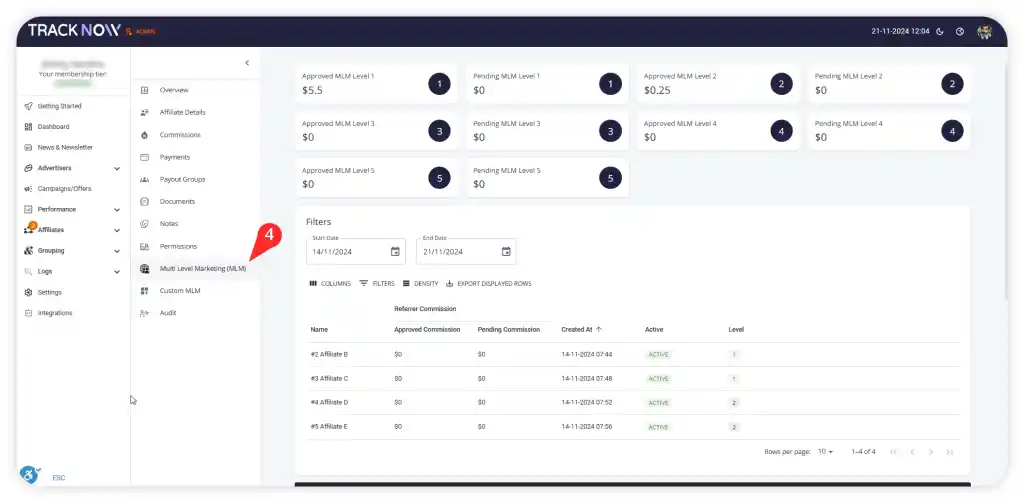
Review the MLM feature documentation before configuring a campaign, and test the intended hierarchy and commission path with sample affiliates and conversions.
MLM Affiliate Program Launch Checklist
- Define the customer value. Identify the real product or service and the ultimate users for whom it is intended.
- Map the hierarchy. Document who can recruit whom, the maximum rewarded depth and the role of every level.
- Write every formula. Specify the direct commission, upstream base, rates, caps, currency and total maximum cost.
- Define eligibility. Explain approved and rejected events, hold periods, refunds, chargebacks and inactive affiliates.
- Review incentives and claims. Check whether the plan or marketing encourages recruitment, qualifying purchases or unrealistic earnings expectations.
- Configure permissions. Decide which customer, affiliate and commission data each role can access.
- Test the complete tree. Include direct conversions, multiple upline levels, missing parents, changed relationships and reversals.
- Reconcile the output. Recalculate sample commissions independently before approving payouts.
- Monitor actual operation. Review retail demand, participant outcomes, complaints, suspicious recruitment patterns and promotional content.
Use the wider affiliate program launch checklist for tracking, onboarding, creatives, payments and operational ownership.
Frequently Asked Questions
What is MLM affiliate marketing?
It is a performance-marketing structure in which a direct affiliate can earn from eligible customer actions while one or more upstream affiliates may receive defined rewards from the same downstream activity.
Is MLM affiliate marketing the same as traditional MLM?
Not always. The phrase may describe a traditional direct-selling organization, but it can also mean a digital sub-affiliate structure without inventory or distributor purchases. The agreement and compensation plan determine the actual model.
What is the difference between an upline and a downline?
The upline contains the parent affiliates above a selected partner. The downline contains the affiliates recruited directly or indirectly beneath that partner.
How are upstream commissions calculated?
Common approaches include additive commissions, a fixed pool divided between levels and a percentage of downstream commission. The program must identify the calculation base and total cost explicitly.
Is a hierarchy level the same as a performance tier?
No. A hierarchy level describes the affiliate's position relative to another partner. A performance tier changes a rate after a target is reached.
Does selling a real product make every MLM program legal?
No. Legality depends on jurisdiction and on how the compensation plan and business operate in practice. The presence of a real product is not, by itself, sufficient.
What should MLM affiliate software track?
It should preserve parent-child relationships, attribute customer activity, calculate every direct and upstream commission, process reversals consistently and show the complete calculation path in reports.
How many MLM levels should a program use?
There is no universally correct number. Use only the levels that represent a genuine commercial role and fit within the available margin, operational controls and applicable law.
Can Tracknow manage sub-affiliate commissions?
Yes. Tracknow supports multi-level affiliate structures and custom commission splits for sub-affiliates. The exact configuration should be tested against the program's hierarchy and payout rules.
Build a Transparent Multi-Level Affiliate Program
A sustainable multi-level affiliate program starts with genuine customer value and an understandable compensation plan. Software should make the relationship and calculation transparent: which conversion qualified, who generated it, which upstream partners were eligible, which rates applied and how much the business paid in total.
Start a 14-day Tracknow trial or review Tracknow pricing to test the MLM hierarchy and commission workflow for your program.