
Affiliate Program Launch Checklist
A practical go-live checklist for affiliate programs — tracking, commissions, terms, creatives, payouts, recruitment readiness, and the tests to run before partners send traffic.

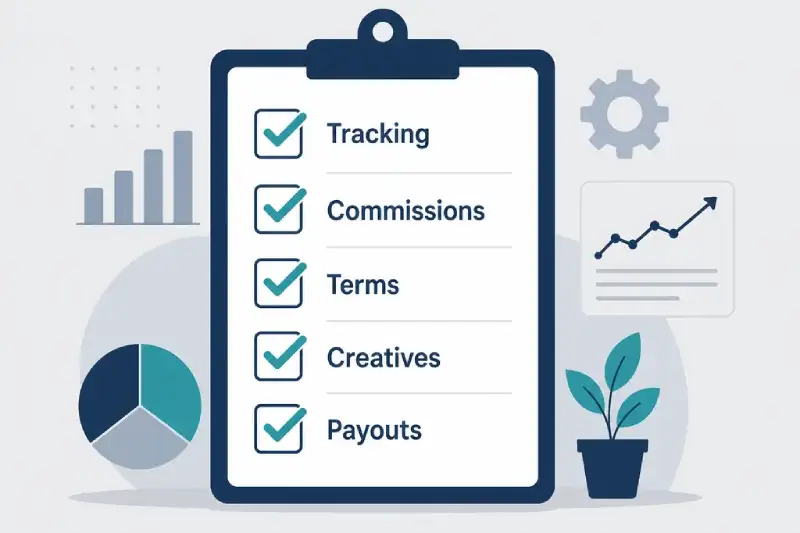
Most affiliate programs do not fail because the product is weak. They fail because they go live incomplete: tracking half-tested, commissions unclear, creatives missing, terms copied from another brand, and partners invited before anyone owns day-to-day enablement. A launch checklist exists to prevent that expensive scramble.
Whether you are an Affiliate Manager opening the first public signup or a founder shipping a partner channel beside product launch, “ready” means partners can promote tomorrow morning without Slack emergencies. This guide is a go-live checklist — what to finish, what to test, and what can wait until after the first cohort activates.
Use it as a gate: do not start mass recruitment until the critical path is green. Soft-launch with a small pilot if you want learning speed without public mess.
Quick Summary
- Lock payable events, commission rules, and attribution windows before inviting partners.
- Validate click → conversion → postback with real test links on major browsers.
- Publish terms, brand rules, and an assets kit partners can use on day one.
- Set payout method, schedule, and tax/compliance basics before the first commission is owed.
- Assign an owner for approvals, questions, and weekly performance review.
- Recruit only after the checklist passes — see How to Recruit Affiliates for a New Program for tactics once you are live.
What “Launch Ready” Means
Launch ready is not a beautiful microsite. It is an operating system: tracking that pays fairly, rules partners can follow, assets that convert, and a human (or team) who responds. If any of those are missing, delay public launch.
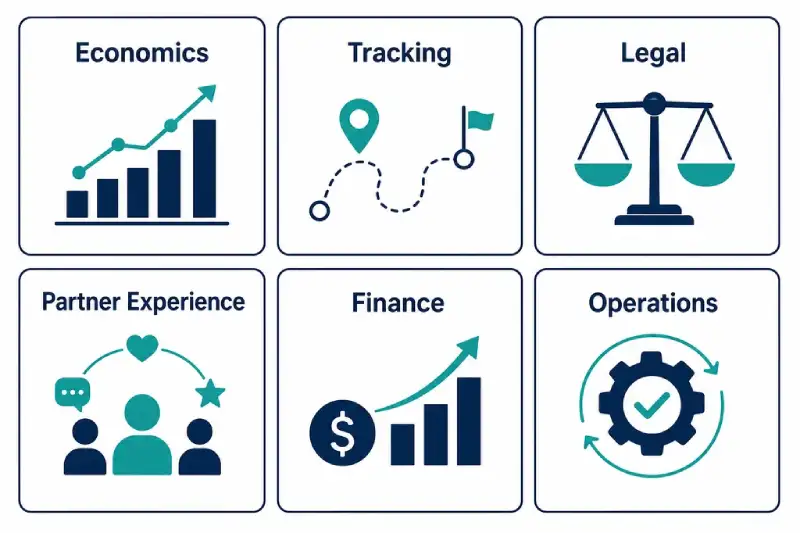
Split the checklist into six workstreams:
- Offer economics and commissions
- Tracking and attribution
- Legal, brand, and compliance
- Partner experience (portal, assets, onboarding)
- Finance and payouts
- Operations and pilot plan
Prerequisites / Before You Start
- Executive agreement on partner channel goals (pipeline, revenue share, CAC target)
- Product or offer stable enough that landing pages will not change daily
- Budget for commissions, creative production, and affiliate tooling
- Named owner for the program (even if part-time at first)
- Decision on self-serve signup vs application-only at launch
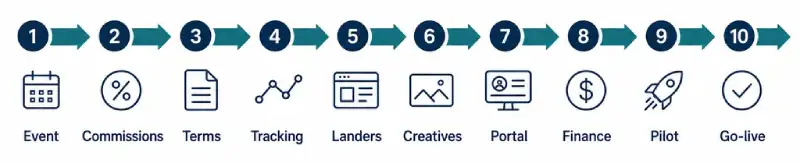
Launch Roadmap: 10 Steps to Go Live
Step 1 — Define the payable conversion
Goal: One clear event partners get paid for.
Action: Choose signup, qualified lead, first purchase, first deposit, or first paid invoice — and write the definition in plain language.
Verify: Finance and marketing use the same sentence.
Mistake: Paying on vague “leads” nobody can audit.
Step 2 — Set commissions and tiers
Goal: Sustainable rates partners understand in one screen.
Action: Publish base rate, any tiers, clawbacks, and examples. Align structure with Affiliate Program Commission Options. Plan automated tiers using patterns like Maximizing Earnings with Tracknow if you want goals without spreadsheets.
Verify: A stranger can explain how they get paid after reading your page once.
Mistake: Copying a competitor’s rate without modeling margin and refunds.
Step 3 — Write program terms (v1 is enough)
Goal: Enforceable rules for traffic, brand use, and disclosures.
Action: Cover allowed/prohibited traffic, trademark bidding, geo limits, FTC-style disclosure expectations, termination, and payment terms. Expand later with How to Write an Affiliate Agreement.
Verify: Legal or a qualified reviewer has signed off for your risk level.
Mistake: Going live with only a homepage FAQ as “terms.”
Step 4 — Configure tracking end-to-end
Goal: Click IDs survive to conversion; postbacks fire on the payable event.
Action: Set redirects, landing parameters, thank-you/S2S callbacks, and test accounts. Confirm sub-IDs work for partner tests.
Verify: At least three successful test conversions from different browsers, including mobile Safari.
Mistake: Trusting a single desktop Chrome test.
Step 5 — Build landing destinations partners can promote
Goal: Message-matched pages for the main angles you will recruit on.
Action: Default offer page plus 1–2 deep links (plan page, vertical page, promo page). Check mobile CTAs and speed.
Verify: Partner test links land correctly and convert in staging/production as designed.
Mistake: Sending all traffic to a generic homepage with competing CTAs.
Step 6 — Prepare the creative and messaging kit
Goal: Partners can publish in week one without inventing claims.
Action: Logos, banners, email blurbs, approved value props, dos/don’ts, and disclosure examples. Optional: short demo video.
Verify: Assets download and deep-link correctly.
Mistake: Empty creative library on launch day.
Step 7 — Set up partner portal / application flow
Goal: Clean signup, approval workflow, and self-serve link generation.
Action: Application questions (traffic type, geos), approval SLA, welcome email draft. Decide auto-approve vs manual for launch.
Verify: Run a dummy application as if you were a partner.
Mistake: Public signup with zero moderation in a regulated category.
Step 8 — Finance, payouts, and tax basics
Goal: Pay on time without chaos.
Action: Payout schedule, minimum threshold, methods, invoice/tax form requirements, clawback process. Connect payout tooling if used.
Verify: Finance can explain how month-1 commissions will be calculated and paid.
Mistake: Promising Net-15 with no ops capacity to deliver.
Step 9 — Soft-launch pilot (10–25 partners)
Goal: Prove the machine before marketing the program loudly.
Action: Invite a curated list; run Affiliate Onboarding Best Practices style welcome sequence; hold a 30-minute feedback call at day 14.
Verify: First clicks within 7 days from most pilots; at least one real conversion path documented.
Mistake: Press-release launch with untested postbacks.
Step 10 — Go-live controls and weekly cadence
Goal: Operate, not just open.
Action: Weekly review of EPC/CR by partner, fraud flags, creative refresh queue. Optional early contest only after baseline exists — see ideas in Tracknow News. Plan Marketing Automation for Affiliate Programs for drip welcome and inactive-partner nudges once volume grows.
Verify: Calendar invites exist for the weekly review; escalation path for partner issues is written.
Mistake: Launch and ignore the inbox.
Suggested Timeline
- Week 1: Payable event, commissions, draft terms, tracking plan
- Week 2: Tracking build + QA, landers, creative kit
- Week 3: Portal, payouts setup, internal sign-off
- Week 4: Pilot partners, fix gaps, then public go-live
Compressed launches are possible for simple ecommerce offers; regulated or SaaS funnels usually need the full four weeks.
Mini scenario: SaaS that launched tracking-last
A B2B SaaS announced affiliates at a conference. Partners promoted immediately; postbacks were unfinished. Two weeks of “missing trials” destroyed trust. They paused recruitment, finished S2S on paid invoices, re-onboarded ten partners with apology + bonus, and only then reopened applications.
Mini scenario: Ecommerce checklist done right
A DTC brand spent three weeks on deep links, creative SKUs, and payout setup, then invited twenty newsletter partners. Eighteen generated clicks in week one. No disputes in month one — boring operations, healthy EPC.
Mini scenario: Regulated offer with application-only launch
A fintech team launched application-only, rejected half of applicants, and published strict claim guidelines in the asset kit. Growth was slower than an open network listing — and compliance review stayed clean.

Common Mistakes (and How to Avoid Them)
Recruiting before the checklist is green. Early partners are your best marketers — do not waste them on broken links.
Unclear payable events. If finance cannot audit it, do not pay on it.
Terms that ignore brand bidding and disclosures. Fix before the first paid click.
Desktop-only tracking QA. Mobile and in-app browsers break parameters first.
No program owner. Unowned inboxes equal dead programs.
Empty creative folder. Partners will invent claims you do not want.
Payout promises without ops. Late pay kills retention faster than a lower rate.
Skipping the pilot. Public launch amplifies every bug.
Conclusion
An affiliate program launch checklist is a risk filter. Finish economics, tracking, terms, assets, payouts, and a pilot — then recruit at scale. Going live is not a press moment; it is the first week partners try to earn with you. Make that week work.
When the foundations are solid, recruitment and contests compound instead of creating support debt. Build the machine first.
If you need affiliate software to configure commissions, tracking, partner portals, tiers, and payouts before you invite your first cohort, Tracknow is a strong place to start.
FAQ
How long does it take to launch an affiliate program?
Simple offers can soft-launch in two weeks. Most B2B or regulated programs need three to six weeks for tracking QA, terms, and a pilot. Rushing recruitment before postbacks work costs more than waiting.
What is the single most important pre-launch test?
A full click-to-conversion test with a real partner link, including mobile Safari, that produces the correct commission record via your payable event (ideally server-side).
Should signup be open or application-only at launch?
Application-only is safer for new programs and regulated verticals. Open signup works later when moderation, fraud rules, and asset kits are proven.
Do I need an affiliate agreement before the first partner?
Yes — at least a clear terms page covering traffic rules, payments, and termination. You can refine a full agreement template as you grow, but do not launch on handshake rules alone.
What creatives are mandatory on day one?
Logo pack, a few banners, short approved copy blocks, deep links, and disclosure examples. Video and large seasonal kits can follow after the pilot.
When should I announce the program publicly?
After pilot partners have generated clean tracked conversions and you have fixed the first round of issues. Public noise before tracking works creates lasting distrust.
Who must sign off internally?
Typically marketing/growth, finance, legal/compliance (as needed), and whoever owns the website/tagging. One RACI beats assumed ownership.
Can I launch without tiers and contests?
Yes. Launch with a clear base commission. Add tiers and contests after you see baseline EPC and partner behavior.
What if product packaging might change next month?
Soft-launch with a small cohort and avoid hard-coding temporary prices into partner-exclusive claims. Keep landers easy to update.
How do I know the checklist is complete?
Every critical item has an owner, a verify step that passed, and a dated sign-off. If any critical verify is “TODO,” you are not launch ready.
10-Point Checklist for Launching an Affiliate Program
- Payable conversion event defined and agreed by finance and marketing.
- Commission rates, windows, clawbacks, and examples published.
- Program terms cover traffic rules, brand use, disclosures, and payment terms.
- Click tracking and conversion postbacks QA-tested on desktop and mobile.
- Landing pages and deep links message-matched for primary partner angles.
- Creative and messaging kit available on day one.
- Application/portal flow tested; approval criteria written.
- Payout schedule, methods, and tax/onboarding forms ready.
- Pilot cohort invited with onboarding sequence and feedback date.
- Program owner assigned with a weekly performance and support cadence.