
How Casino and Sportsbook Affiliate Commissions Work: CPA, RevShare, Hybrid, and Super-Affiliate Deals
How operators design CPA, RevShare, hybrid, and super-affiliate deals for casinos and sportsbooks — including NGR, qualification, and payback risk

How operators design CPA, RevShare, hybrid, and super-affiliate deals for casinos and sportsbooks — including NGR, qualification, and payback risk
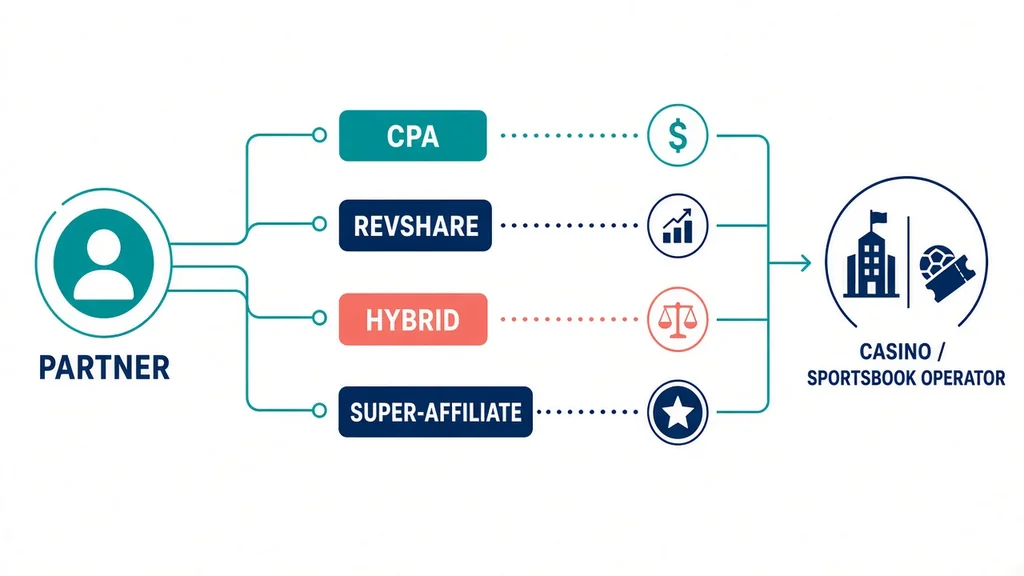
Casino and sportsbook operators do not lose money on “affiliates” in the abstract. They lose money on commission designs that pay the wrong event, ignore player quality, or hide deductions until finance reconciles the month. That is why commission design is the core of any casino or sportsbook partner channel inside iGaming affiliate marketing — not a rate card you photocopy from a competitor.
Publishers care about headline CPA and RevShare percentages. Operators should care about qualification rules, NGR definitions, negative carryover, hybrid caps, and who owns the risk when a first-time depositor never returns. The same four labels — CPA, RevShare, hybrid, and super-affiliate — behave differently when the product is slots versus sports betting, and when the partner is an SEO site versus a media buyer.
This guide is for operators and affiliate managers who set and defend those deals. It explains how each model works in practice, what must be tracked, how to choose a mix by partner type, and which mistakes turn a “competitive” offer into a margin problem.
Quick Summary
- CPA pays for a defined acquisition event (usually a qualified FTD); RevShare pays a share of eligible NGR over time.
- Never compare RevShare percentages without comparing NGR formulas, deductions, and carryover rules.
- Hybrid deals shift risk: a smaller CPA plus ongoing RevShare often fits partners who need cash flow and operators who need quality.
- Super-affiliate and master deals should reward incremental volume or recruitment — not automatically raise rates for every click.
- Casino and sportsbook funnels need separate qualification logic even inside one program.
- Model payback with bonuses, chargebacks, and retention — not with “CPA × FTDs” alone.
What Commission Design Actually Controls
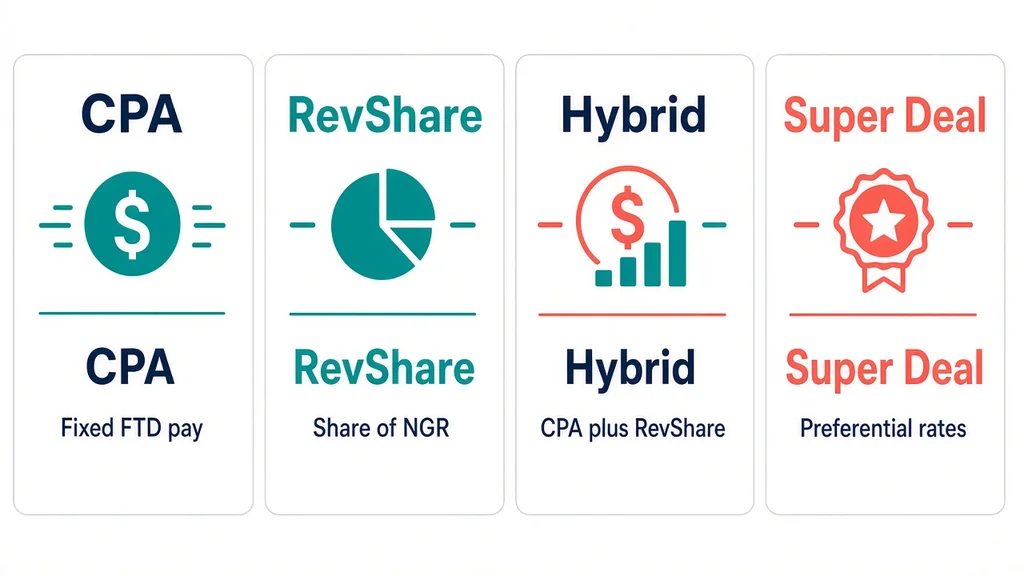
A commission model is a contract about risk and behavior. CPA puts acquisition risk on the operator: you pay when a player clears the bar, whether or not that player becomes profitable. RevShare puts more long-term risk on the affiliate: weak retention and high bonus burn shrink their payout. Hybrid splits both. Super-affiliate layers add volume incentives or recruitment rewards on top of a base model.
Generic commission types exist across verticals — see Affiliate Program Commission Options — but iGaming adds player lifecycle events, regulated geos, and NGR math that ecommerce CPA never needs. If you only publish a percentage and a CPA number, partners will fill the blanks themselves, usually in your favor until disputes start.
Commission design also decides what your software must calculate. Qualified CPA, brand-level NGR, and separate CPA/RevShare balances are configuration problems, not marketing slogans. Choosing network versus in-house changes who configures them — covered in iGaming Affiliate Programs vs In-House Networks — but the economics stay yours either way.
CPA for Casinos and Sportsbooks
Under CPA, the affiliate earns a fixed amount when a referred player completes the approved acquisition event. Registration alone is rarely enough. Most serious programs require a first-time deposit (FTD), sometimes after KYC, a minimum deposit amount, a minimum wager, or a cooling-off window before the CPA is approved.
Basics of measuring that event sit in What Is CPA Tracking. In iGaming, the hard part is the qualifier, not the click.
What “qualified CPA” usually means
- Player in an allowed geo and age band
- Identity / KYC status that your risk team accepts
- Minimum FTD amount (and sometimes second deposit)
- Minimum turnover or number of bets before approval
- No self-excluded, duplicate, or chargeback-flagged account
- Hold period (for example 7–30 days) before the CPA becomes payable
Without those rules, media buyers optimize for the cheapest depositing accounts. With opaque rules, good SEO partners leave. Write the qualifier in the terms and show the status in the portal.
Casino vs sportsbook CPA nuances
Casino CPA often ties to deposit plus wagering or bonus abuse filters. Sportsbook CPA may care more about settled bets, odds shopping behavior, and whether the player was acquired on a single event spike. Do not reuse one postback mapping for both products without checking what “qualified” means in each product’s CRM.
When CPA fits
CPA fits launch geos, paid traffic partners, and situations where you can estimate player value tightly enough to set a fixed price. It fits poorly when retention is unknown, bonuses are aggressive, or chargebacks are common — you will overpay on noise.
RevShare and the NGR Problem
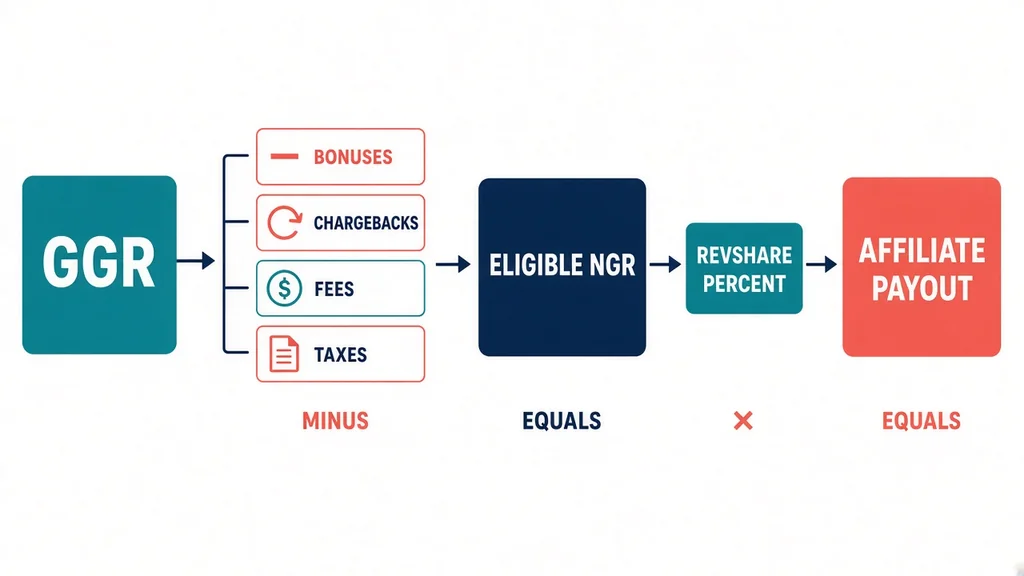
RevShare pays the affiliate a percentage of eligible net gaming revenue (NGR) from referred players, usually monthly, for as long as the player remains attributed (subject to program terms). Headline rates of “30%” or “40%” are meaningless until NGR is defined.
Typical NGR starts from gross gaming revenue (player losses net of wins) and then subtracts some combination of:
- Bonuses and free bets
- Chargebacks and payment fees
- Gaming taxes or levies
- Jackpot contributions or provider fees
- Fraud / voided bets
Two operators offering “35% RevShare” can produce very different affiliate income. Affiliates should ask for the formula; operators should publish it and keep finance, CRM, and the affiliate platform on the same definition. Deeper player-value thinking belongs in Player Value in iGaming Affiliates — FTD count alone is a weak scorecard.
Negative carryover
Negative carryover means a negative NGR balance can roll into the next period instead of resetting. It protects operators when a cohort wins big in one month. It frustrates partners when they cannot see which players caused the deficit. If you use carryover, show balances by brand/product where possible and state whether carryover is account-wide or isolated.
When RevShare fits
RevShare fits SEO, odds content, and long-term creators who expect residual income. It fits operators who want partners aligned with player quality. It fits poorly for cold media buying unless hybrid softens cash-flow pain, and it fails when your reporting cannot explain deductions.
Hybrid Deals
A hybrid deal combines a reduced CPA with a RevShare percentage on the same or overlapping players. Example shape (illustrative, not a recommendation): smaller CPA on qualified FTD plus a lower RevShare on NGR going forward. Some programs pay CPA only on the first month’s cohort and RevShare thereafter; others pay both under capped rules.
Hybrid exists because pure CPA overpays low-quality FTDs and pure RevShare underpays partners who need working capital. The negotiation is about who funds acquisition and who shares lifetime value.
Design rules that keep hybrid sane
- State whether CPA players also generate RevShare, and from which date
- Cap total hybrid cost per player if finance needs a ceiling
- Keep CPA qualification identical to standalone CPA — do not weaken it “because RevShare exists”
- Show both balances clearly so partners are not surprised at invoice time
Hybrid is common with mid-tier SEO and streamers. It is a poor default for every partner: complexity without reporting clarity creates disputes faster than it creates loyalty.
Super-Affiliate and Master Deals
“Super-affiliate” usually means a high-volume partner on preferential rates, custom landing pages, or dedicated management. “Master” / sub-affiliate deals pay a partner for recruiting other affiliates. Both can grow a program. Both can also hide traffic you cannot sample for compliance.
Preferential rates should be earned against measurable thresholds: approved FTDs, contribution margin, or geo coverage — similar in spirit to automated tier logic described in automated affiliate payout tiers. Raising rates because someone asked loudly is not a model.
Sub-affiliate trees need hierarchy rules, visibility into sources, and a clear policy on when sub-traffic is allowed. Treat Sub-Affiliate Networks in iGaming as a control decision. If you cannot see the traffic, do not pay a master override on it.
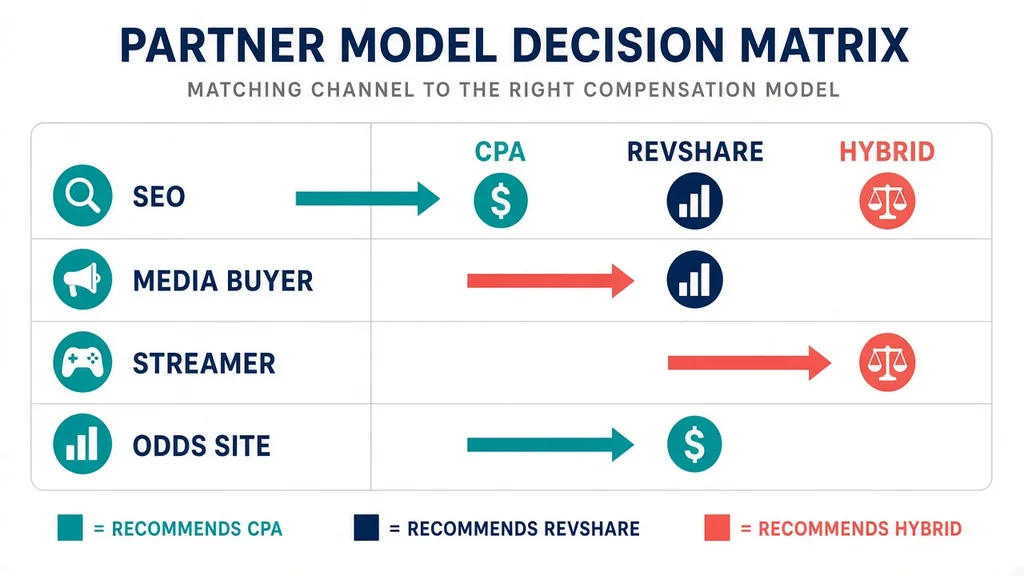
How to Choose a Model by Partner Type
| Partner type | Often fits | Watch for |
|---|---|---|
| SEO / comparison sites | RevShare or hybrid | Brand bidding, outdated bonuses |
| Media buyers | CPA or hybrid with strong qualifiers | Incentivized FTDs, geo mismatch |
| Streamers / tipsters | Hybrid + promo codes | Duplicate credit, disclosure gaps |
| Odds / tip portals | RevShare | Seasonal spikes, sharp bettors |
| Master partners | Override on approved sub-volume | Opaque sub-sources |
Recruitment only works if partners understand how the vertical converts — the same principle that drives How to Recruit iGaming Affiliates and the general playbook in How to Recruit Affiliates for a New Program. A generous CPA will not fix a broken deposit funnel.
Tracking Requirements Behind Every Deal
Commission logic is only as good as event delivery. Click IDs, promo codes, and server-to-server postbacks must carry registration, FTD, wager, bonus, and chargeback states into the affiliate platform. See S2S and postback tracking for the integration pattern.
Operators running serious RevShare need player-level or cohort-level visibility, not only “conversions this month.” Network-only setups often hide that depth — another reason many brands move core partners in-house while keeping networks for overflow. Software selection for FTD and NGR workflows is covered in iGaming affiliate software.
Before you publish rates publicly, finish the launch sequence in Affiliate Program Launch Checklist: terms, events, test conversions, and a sample invoice that finance can explain.
A Practical Framework for Setting Rates
- Define the payable event separately for casino and sportsbook if both run under one brand group.
- Estimate contribution after bonuses and payment costs for a realistic cohort — optimistic decks lie.
- Choose risk split: CPA if you can price the FTD; RevShare if quality is uncertain; hybrid if partners need cash flow.
- Write NGR and carryover in one paragraph partners can quote back to you.
- Set approval holds long enough to catch obvious fraud, short enough to keep trusted partners paid.
- Tier only what you can measure — volume without margin is not a promotion target.
- Review monthly: effective CPA, NGR per partner, chargeback rate, and bonus cost share.
- Document exceptions: super deals expire or renew against written KPIs, not eternal handshake rates.
Mini scenario: Sportsbook launch geo
A sportsbook entered one new licensed state with unknown retention. They opened with hybrid for SEO partners and strict qualified CPA for media. After 90 days, media CPA was cut on sources with weak second-deposit rates; SEO moved toward higher RevShare. The model change followed data, not a rate war.
Mini scenario: Casino bonus burn
A casino paid high flat CPA on FTD. Affiliates pushed the largest welcome offer. FTDs rose; NGR did not. Finance introduced wagering and hold rules before CPA approval and offered hybrid to partners who could prove organic quality. Volume dropped; contribution recovered.
Mini scenario: Super deal without thresholds
A master partner received an override on all sub-affiliates with no source disclosure. Compliance found restricted creatives two layers down. The program froze master overrides pending sub-ID visibility and written traffic policies. Growth slowed; licensing risk fell.
Common Mistakes (and How to Avoid Them)
Publishing RevShare without an NGR definition. You invite disputes and shopper affiliates who only compare percentages.
Paying CPA on raw registration or unverified FTD. You subsidize fraud and bonus abuse. Qualify the event.
Copying a competitor’s rate card. Their player value, bonus cost, and geo mix are not yours.
One commission config for casino and sportsbook. Different products need different qualifiers and fraud signals.
Hybrid with undocumented double counting. Partners and finance will invent different truths. Write whether CPA players earn RevShare.
Eternal super rates with no review date. Preferential deals should renew against margin and compliance, not inertia.
Ignoring negative carryover communication. If balances go negative, show why. Silence feels like theft even when the contract allows it.
Launching deals before postbacks are tested. Commission arguments become tracking arguments. Fix events first — structure guidance continues in How Operators Should Structure an iGaming Affiliate Program.
Conclusion
Casino and sportsbook affiliate commissions are not four buzzwords on a landing page. CPA, RevShare, hybrid, and super-affiliate deals are risk allocations tied to player events, NGR math, and partner behavior. Operators who win treat qualification, deductions, and reporting as part of the offer — not footnotes.
Match the model to the partner and the product, measure contribution after bonuses and chargebacks, and keep casino and sportsbook logic honest. When the commercial rules are clear, tracking and recruitment get easier; when they are vague, every invoice becomes a negotiation.
If you need an affiliate platform that can run qualified CPA, NGR-based RevShare, hybrid balances, and partner-specific deals for casino and sportsbook brands, Tracknow is a strong place to start.
FAQ
What is a casino affiliate CPA?
A fixed payment when a referred player meets the program’s acquisition rules — typically a qualified first-time deposit, not a bare registration. Always read the qualifier, hold period, and clawback terms before comparing CPA amounts across brands.
How does sportsbook RevShare work?
The affiliate earns a percentage of eligible net gaming revenue from referred bettors over time. Eligibility depends on the operator’s NGR formula, attribution window, and whether negative months carry over. Settled bets, voids, and free bets can all affect the balance.
What is a hybrid affiliate deal in iGaming?
Hybrid combines a smaller CPA with an ongoing RevShare. It gives partners earlier cash flow while keeping them tied to player quality. The contract must state whether CPA-qualified players also generate RevShare and from which date.
What does negative carryover mean?
A negative revenue balance can roll into a later commission period instead of resetting to zero. It is common in RevShare programs. Partners should check whether carryover is global or isolated by brand, product, or player.
Are super-affiliate deals worth it for operators?
Yes when preferential terms buy measurable volume, better geos, or exclusive placements and you can audit traffic. No when “super” only means a permanent rate hike without KPIs or compliance sampling.
Should casino and sportsbook use the same commission rates?
Not by default. Player value, bonus cost, and fraud patterns differ. You can use the same model types (CPA, RevShare, hybrid) with different qualifiers, rates, and NGR inputs per product.
How do I stop affiliates optimizing for cheap FTDs?
Tighten CPA qualification, add hold periods, monitor second deposits and NGR, and move weak sources off flat CPA onto hybrid or RevShare — or off the program.
Do networks and in-house programs use different commission models?
They use the same labels. Networks may standardize rates across many operators; in-house programs can tailor deals per partner. The economic questions — event, NGR, carryover — remain the same.
What must tracking support for these deals?
At minimum: click or promo attribution, registration, qualified FTD, downstream revenue events, adjustments for bonuses and chargebacks, and clear commission statuses. S2S postbacks are the usual backbone for operator-grade accuracy.
When should we redesign commission terms?
After a geo launch review, when bonus policy changes, when effective CPA exceeds contribution, or when dispute volume spikes around deductions. Schedule reviews; do not wait for a crisis invoice.
10-Point Checklist for Casino and Sportsbook Commission Design
- Payable events defined separately for casino and sportsbook where both exist.
- CPA qualifier written: deposit, KYC, wager, geo, hold period.
- NGR formula published with deduction list.
- Negative carryover rules stated and visible in reporting.
- Hybrid double-counting rules documented (CPA + RevShare interaction).
- Super/master deals tied to thresholds and review dates.
- Sub-affiliate policy and source visibility requirements set.
- Postbacks tested for FTD, adjustments, and chargebacks before go-live.
- Monthly review metrics listed: effective CPA, NGR per partner, bonus cost, chargebacks.
- Legal/compliance owner signed off on terms for each licensed geo (not legal advice — operational ownership).