iGaming Affiliate Marketing: A Guide for Affiliates and Operators
Learn how iGaming affiliate marketing works, compare CPA, RevShare and hybrid models, and evaluate traffic, compliance, tracking software and program economics.


iGaming affiliate marketing connects online gambling operators with publishers, comparison sites, media buyers, creators and other partners that can introduce new players. Instead of paying only for general advertising exposure, the operator rewards an affiliate for a measurable result such as a qualified registration, first-time deposit, verified player or revenue generated over time.
The model can be attractive to both sides. Operators gain a performance-based acquisition channel, while affiliates can build income around useful content, targeted traffic and long-term player relationships. However, iGaming is not a simple version of ordinary ecommerce affiliate marketing. Licensing, advertising restrictions, responsible gambling requirements, player verification, fraud risk and complex commission calculations all affect how a program should be built and promoted.
This guide explains the complete operating model from two perspectives: how an affiliate can evaluate and promote iGaming offers, and how an operator can launch, track and scale an affiliate program responsibly.
What Is iGaming?
iGaming is a broad term for gambling and wagering activities delivered through websites or mobile applications. It commonly includes:
- online casinos and live-dealer games;
- sports betting and esports betting;
- online poker;
- bingo, lottery and scratch-card products;
- fantasy sports and other regulated real-money gaming formats.
Availability and legal definitions differ by jurisdiction. A product that is licensed in one market may be restricted or prohibited in another. Affiliates and operators therefore need to think in terms of approved countries, permitted channels, age restrictions and local advertising rules rather than treating iGaming as one global market.
What Is iGaming Affiliate Marketing?
iGaming affiliate marketing is a performance partnership in which an affiliate promotes an operator or gaming brand and receives commission for qualifying player activity. The commercial relationship typically includes four participants:
- The operator owns or manages the casino, sportsbook, poker room or other gaming product.
- The affiliate creates content, buys permitted traffic, operates a comparison service or uses another approved acquisition channel.
- The player visits the operator, registers and may complete a qualifying action such as verification, deposit or wager.
- The tracking platform connects the referral with the player activity, applies attribution rules and calculates the appropriate commission.
An affiliate may be a solo publisher, a large review portal, an SEO team, a paid-media buyer, a streamer, a tipster, a creator or another business with a relevant audience. Operators may work directly with these partners or recruit them through an affiliate network.
How the Tracking and Commission Flow Works
- The affiliate receives a unique tracking link, promo code or campaign identifier.
- A potential player interacts with the promotion and visits the operator.
- The tracking system records the referral and applies the program’s attribution rules.
- The operator reports later events such as registration, verification, deposit, first-time deposit, wager or net revenue.
- The system checks whether the event meets the deal’s qualification rules.
- The correct CPA, RevShare, hybrid or other commission is calculated.
- After validation and any hold period, the commission becomes eligible for payment under the program terms.
Tracking a click is only the beginning. The commercially important events often happen after registration and inside the operator’s platform. For this reason, iGaming programs frequently use server-to-server and postback tracking alongside affiliate links, cookies and promo-code attribution. The guide to affiliate tracking methods explains how these approaches differ.
iGaming Affiliate Commission Models
Commission terms determine which behavior the affiliate is encouraged to generate and which financial risk is carried by each side. Programs may use one model across all partners or negotiate different terms by affiliate, brand, country, product or traffic source. For a broader overview, see the guide to affiliate commission options.
CPA: Cost per Acquisition
Under a CPA agreement, the affiliate receives a fixed amount when a referred player completes the required acquisition event. A registration alone is rarely enough. The program may require identity verification, a minimum first-time deposit, an eligible country, a minimum number or value of wagers, or another quality condition.
CPA cost = Number of approved acquisitions × CPA rate
CPA gives affiliates predictable value per approved player, but the qualification rules must be explicit. Operators should monitor whether acquired players produce enough value to recover the acquisition cost.
Revenue Share
With revenue share, the affiliate earns an agreed percentage of the revenue generated by referred players. The calculation is commonly based on net gaming revenue rather than total deposits or wagers.
Affiliate RevShare commission = Eligible NGR × RevShare rate
The exact NGR definition varies by program. It may begin with gross gaming revenue and subtract items such as player winnings, bonuses, chargebacks, payment fees, gaming taxes or platform fees. Affiliates should never compare two RevShare percentages without comparing the underlying NGR formulas.
Hybrid
A hybrid deal combines a smaller CPA payment with an ongoing revenue share. It gives the affiliate some immediate acquisition revenue while preserving participation in long-term player value.
Hybrid commission = Approved acquisitions × CPA rate + Eligible NGR × RevShare rate
The balance between the fixed and recurring components should reflect player quality, payback period and the risk accepted by each party.
CPL and Qualified Lead Payments
A cost-per-lead model pays for a defined lead event, such as a valid registration or verified contact. Because a lead may never deposit, CPL programs need strong validation, duplicate detection and anti-fraud rules. They are less common when the operator wants the affiliate to remain responsible for downstream player quality.
Sub-Affiliate and Multi-Level Commissions
A master affiliate may recruit other partners and receive a percentage or fixed reward based on their activity. This requires a transparent hierarchy, rules for each level and protection against paying more total commission than the player activity can support. The dedicated comparison of iGaming affiliate software for MLM and sub-affiliate programs explains these structures in more detail.
Performance Tiers and Bonuses
Operators can increase rates when an affiliate reaches a target based on approved acquisitions, FTDs, conversion amount, transaction volume or commission generated. Tiers reward sustained growth, while one-time bonuses and affiliate contests are often better for short campaigns. See how automated affiliate commission tiers work before adding performance levels to a program.
Terms Affiliates Should Check Before Accepting an Offer
A high headline commission does not automatically make an offer attractive. Before joining, an affiliate should review:
- Qualifying action: What exactly turns a registration into an approved CPA or FTD?
- NGR definition: Which deductions are applied before RevShare is calculated?
- Negative carryover: Can a negative balance move into the next month, and can it be isolated by player, product or brand?
- Minimum activity: Is there a required number of new depositing players or another monthly condition?
- Payment schedule: When are commissions validated, invoiced and paid?
- Attribution window: How long after a click or registration can the player remain connected to the affiliate?
- Cross-device and promo-code rules: Can the affiliate receive credit when the customer switches devices or uses a code instead of a link?
- Restricted markets and channels: Which countries, keywords, social platforms, ad formats and brand-bidding practices are prohibited?
- Account closure terms: What happens to existing player revenue if the partnership ends?
These details should be available in the program terms and reflected consistently in the affiliate portal and reports.
iGaming Niches and Content Angles
The right niche depends on the affiliate’s expertise, target market and approved promotional channels. Regional popularity can change quickly, so strategy should be based on local demand and regulation rather than broad assumptions about entire continents.
| Niche | Possible content | Important considerations |
|---|---|---|
| Sports betting | Event previews, odds education, operator comparisons | Seasonality, local sports rules, responsible messaging |
| Online casino | Game guides, software-provider pages, casino comparisons | Bonus terms, game availability, licensing |
| Poker | Strategy education, tournament calendars, room reviews | Player liquidity, skill-focused content, market access |
| Bingo and lottery | How-to guides, schedule pages, product comparisons | Local availability, age restrictions, prize claims |
| Esports betting | Tournament coverage, game-specific analysis, creator content | Audience age, platform ad rules, market legality |
Traffic Sources for iGaming Affiliates
A resilient affiliate business rarely depends on one channel. The best mix depends on the jurisdiction, offer terms, audience and the promotional methods approved by the operator.
SEO and Content Marketing
Comparison pages, reviews, educational guides, market-specific landing pages and news content can attract users with clear intent. Organic traffic takes time to build, but strong content can continue producing qualified visits after the initial investment. Affiliates should distinguish editorial information from advertising and keep commercial claims accurate. The guides to SEO and link building for affiliate marketers and driving higher-quality affiliate traffic provide practical planning frameworks.
Paid Search, Display and Native Advertising
Paid acquisition can deliver fast, measurable traffic, but gambling-ad policies vary across ad networks and countries. Affiliates must confirm certification requirements, geo restrictions, age targeting, landing-page rules and whether brand bidding is permitted by the operator. Pop, push and programmatic traffic should be evaluated carefully for user quality, transparency and compliance.
Social Media, Video and Creators
Streamers, tipsters and creators can introduce brands through video, live content and communities. Promo codes are particularly useful when users see or hear a promotion but do not click a link. Disclosures, age gating and platform-specific gambling policies are essential. The comparison of influencer marketing platforms covers tools for managing creator-led campaigns.
Email, CRM and Retargeting
Email and retargeting can re-engage users who previously interacted with content, provided the affiliate has valid consent and the activity is allowed in the target market. Lists should never be purchased or repurposed without a lawful basis. Frequency, suppression and responsible-gambling exclusions require careful management.
Communities and Referral Partnerships
Forums, private communities, newsletters and partnerships with other publishers can build trust when the promotion is transparent and genuinely relevant. Operators should approve traffic sources in advance and monitor sub-affiliate activity rather than assuming every referred partner follows the same rules.
Compliance and Responsible Gambling
Compliance is not a one-time checkbox. The affiliate, operator, market and promotional channel can each be subject to different requirements. Before a campaign launches, both sides should establish a documented approval process covering:
- permitted and restricted countries;
- minimum-age requirements and age-targeting controls;
- required licensing and responsible-gambling statements;
- rules for bonuses, odds, winnings and other promotional claims;
- prohibited language such as guaranteed-win or risk-free claims where not permitted;
- affiliate disclosures and identification of commercial content;
- brand bidding, domains, apps, social accounts and creator activity;
- creative approval, version history and removal of expired offers;
- monitoring, escalation and termination procedures.
Requirements differ significantly by jurisdiction, so programs should obtain qualified legal advice for the markets they target. The Tracknow guide to affiliate marketing compliance provides an operational starting point but is not a substitute for legal counsel.
Key Metrics and Formulas
Clicks and registrations alone do not show whether an iGaming campaign creates sustainable value. Affiliates and operators should agree on the funnel stages and reconcile them regularly.
| Metric | Formula | What it helps evaluate |
|---|---|---|
| Click-to-registration rate | Registrations ÷ Clicks × 100% | Offer, audience and landing-page alignment |
| Registration-to-FTD rate | FTDs ÷ Registrations × 100% | Player intent, verification and deposit funnel |
| Effective CPA | Total acquisition spend ÷ Approved acquisitions | Actual cost of an approved player |
| EPC | Affiliate commission ÷ Clicks | Value generated per referred click |
| Affiliate ROAS | Attributed revenue ÷ Affiliate channel cost | Revenue returned for the channel’s cost |
| Payback period | Acquisition cost ÷ Average monthly contribution per player | How long it may take to recover acquisition cost |
Every metric needs a consistent denominator, status definition, currency and reporting period. A high FTD count is less useful if deposits are later reversed, players fail qualification or the acquisition cost exceeds their contribution.
How to Start as an iGaming Affiliate
1. Select a Legal Market and Focused Niche
Choose a market where you understand the language, player needs, advertising limitations and licensing environment. A focused site or channel can build authority more effectively than a generic project covering every casino, sport and country.
2. Choose a Sustainable Traffic Strategy
Match the channel to your skills and resources. SEO requires patience and editorial depth; paid media requires budget, policy knowledge and rapid optimization; creator-led campaigns require trust and consistent audience engagement.
3. Evaluate Operators and Program Terms
Verify licensing, brand reputation, player experience, support, commission definitions, tracking visibility and payment history. Avoid choosing an offer only because it advertises a large CPA or RevShare percentage.
4. Build Useful, Transparent Content
Create material that helps users make informed decisions. Explain important conditions, avoid misleading claims, disclose commercial relationships and keep bonuses and product details up to date.
5. Track the Complete Funnel
Use campaign and sub-ID parameters to distinguish pages, ads, placements and creatives. Compare clicks, registrations, verification, FTDs and revenue rather than optimizing only for cheap traffic.
6. Diversify Carefully
Once one channel and market work reliably, test additional operators, content formats or acquisition sources. Expanding too early can make reporting unclear and increase compliance risk.
How Operators Can Launch an iGaming Affiliate Program
1. Define the Commercial Objective
Decide whether the program should prioritize new depositing players, verified accounts, revenue, specific products, selected regions or long-term player value. This objective determines the commission model and KPIs.
2. Establish Market and Compliance Rules
Document permitted geographies, traffic sources, creative requirements, brand-bidding rules, responsible-gambling standards and the review process before recruitment starts.
3. Design Commission Economics
Model CPA payback, NGR deductions, RevShare liability, negative carryover, hybrid deals, bonuses and sub-affiliate costs. Test optimistic and conservative player-value scenarios before publishing rates.
4. Integrate Tracking With the Operator Stack
Connect the affiliate platform to the website, registration flow, CRM, player account system, payments data and any required business-intelligence tools. Test every event and status transition before live traffic is accepted.
5. Prepare the Affiliate Experience
Create clear terms, onboarding material, links, promo codes, localized creatives, reporting access and a process for support. Affiliates should be able to understand how they are credited and how their commission is calculated.
6. Recruit and Approve Partners
Review each affiliate’s audience, traffic sources, markets, promotional methods and ownership. The guide on how to recruit affiliates for a new program covers practical acquisition and onboarding methods.
7. Monitor Quality and Reconcile Results
Compare affiliate-platform data with CRM, payment and player records. Investigate unusual conversion patterns, duplicated accounts, incentivized activity, mismatched geographies and abrupt changes in approval rate.
For the full operational sequence, use the affiliate program launch checklist.
What iGaming Affiliate Software Should Provide
Generic click tracking is not enough for many iGaming programs. When evaluating a platform, look for capabilities that support the complete commercial and compliance workflow:
- CPA, RevShare, hybrid, fixed and performance-based commission rules;
- clear NGR inputs and configurable qualification conditions;
- first-time deposit and downstream player-event tracking;
- server-to-server integrations, APIs and postbacks;
- multi-brand, multi-product, multi-country and multi-currency management;
- affiliate, sub-affiliate and master-affiliate hierarchies;
- tracking links, promo codes and lifetime player connections;
- real-time or sufficiently frequent reporting for managers and affiliates;
- conversion validation, fraud signals and audit history;
- creative management and controlled access by market or campaign;
- commission approval, invoicing and payment workflow support;
- role-based access, security and reliable customer support.
A feature list should be validated with an end-to-end test using the operator’s actual events and commission logic. The broader guide to choosing affiliate software provides a vendor-evaluation framework.

iGaming Affiliate Software Shortlist
The products below represent different approaches to affiliate and partner management. This is a practical shortlist rather than a substitute for a requirements-based procurement process. Features, packaging and commercial terms can change, so verify all essential workflows during a demo or trial. For a deeper product-by-product analysis, see the dedicated comparison of the best affiliate software for iGaming.
1. Tracknow — Best Overall for Flexible iGaming Programs
Tracknow is the strongest overall option in this shortlist for operators that need to combine iGaming-specific commission logic with flexible tracking and partner structures. It supports CPA, RevShare and hybrid arrangements, FTD and transaction-based events, multi-level affiliate trees, promo-code tracking, automated commission workflows and detailed reporting. The platform is suitable for both a new program and a multi-brand operation that expects its rules and integrations to become more complex over time.
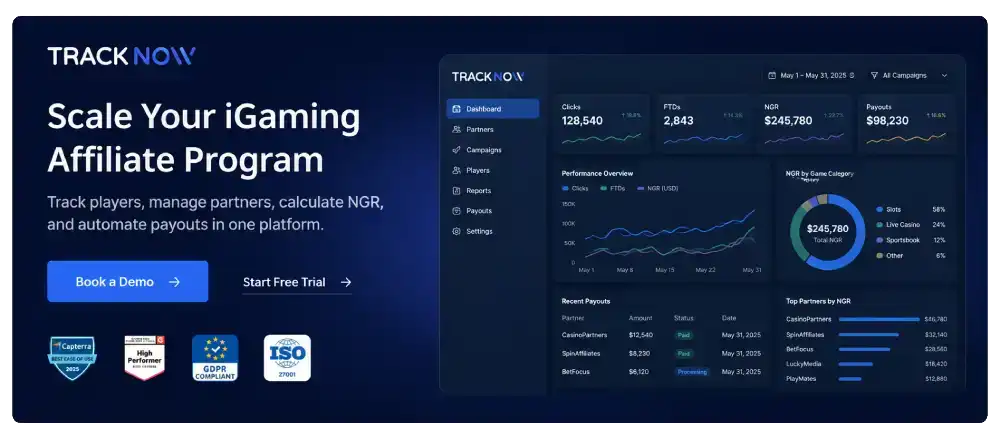
Consider Tracknow when: the program needs customizable commissions, multiple brands or markets, sub-affiliate structures, promo codes, real-time visibility and integrations adapted to its existing technology.
2. Affilka
Affilka is an iGaming-oriented affiliate platform associated with the SOFTSWISS product ecosystem. It may be considered by operators looking for a sector-specific system and should be evaluated for CRM compatibility, commission flexibility, reporting detail and the total implementation scope.
3. Cellxpert
Cellxpert focuses on performance partnerships and is encountered in online gaming and other regulated acquisition environments. Operators evaluating it should test multi-brand workflows, reporting access, deal configuration and the operational effort required for customization.
4. Trackbox
Trackbox provides affiliate-management and performance-marketing capabilities for businesses with complex acquisition workflows. Buyers should compare its attribution, business-intelligence, integration and affiliate-portal capabilities against the exact player events used by their program.

5. Track360
Track360 is another platform considered by iGaming businesses for affiliate management and reporting. The most important checks are whether it supports the required commission logic, hierarchy, currencies, brands and operator-side integrations without excessive manual work.
6. Affise
Affise serves performance-marketing teams across multiple verticals rather than focusing only on iGaming. Its broader positioning may suit networks and teams managing varied campaign types, but operators should verify specialized NGR, FTD, player-lifetime and sub-affiliate requirements.

7. Everflow
Everflow is a broader partner and performance-marketing platform with reporting, campaign management and integration capabilities. It can be evaluated by teams working across several acquisition channels, with particular attention to how iGaming-specific revenue and player events are configured.
8. Scaleo
Scaleo is an affiliate tracking and management platform used by advertisers and networks in several verticals. An iGaming operator should assess commission depth, event ingestion, fraud controls, affiliate hierarchy and whether the platform can match its CRM and reporting workflow.
Quick Software Comparison
| Platform | General positioning | What to verify for an iGaming program |
|---|---|---|
| Tracknow | Flexible iGaming affiliate management | Exact integration plan and configuration for brands, events and deal rules |
| Affilka | iGaming-oriented platform | CRM fit, deal flexibility, reporting and implementation scope |
| Cellxpert | Enterprise performance partnerships | Multi-brand operations, customization and reporting access |
| Trackbox | Affiliate management and performance intelligence | Attribution, event depth, portal experience and integrations |
| Track360 | iGaming affiliate management | Commission logic, brands, currencies, hierarchy and CRM connection |
| Affise | Cross-vertical performance marketing | NGR, FTD, player-lifetime and specialized partner requirements |
| Everflow | Partner and performance marketing | Configuration of gaming revenue, player events and deal logic |
| Scaleo | Affiliate tracking for advertisers and networks | Commission depth, fraud controls, hierarchy and reporting workflow |
Fraud and Traffic-Quality Risks
Not all invalid activity is obvious. An iGaming affiliate program should be able to detect and investigate patterns such as:
- duplicate or self-referred accounts;
- mismatches between claimed and actual player geography;
- incentivized sign-ups that are not permitted by the deal;
- stolen identities, payment abuse or coordinated account creation;
- cookie stuffing, click injection or misleading redirects;
- abnormally fast registration and deposit sequences;
- high FTD volume followed by low activity or rapid withdrawal;
- traffic from undeclared sub-affiliates or restricted sources.
Automated flags should support human review rather than automatically proving intent. Operators need documented validation rules, evidence retention, an appeal process and a clear distinction between suspicious, rejected and approved activity.
Common Mistakes
- Choosing offers only by headline commission: qualification rules and NGR deductions may matter more than the advertised percentage.
- Optimizing only for registrations: unverified or non-depositing accounts may create no commercial value.
- Mixing restricted and approved traffic: one non-compliant source can put the entire partnership at risk.
- Depending on one operator or channel: policy, ranking or commercial changes can remove most revenue at once.
- Using outdated promotions: expired bonuses and inaccurate terms damage trust and may breach advertising rules.
- Launching before reconciliation works: discrepancies between affiliate, CRM and payment data become harder to resolve after traffic scales.
- Ignoring the affiliate experience: unclear reports and slow issue resolution push strong partners toward competing programs.
Trends Affecting iGaming Affiliate Programs
More First-Party and Server-Side Data
Browser privacy controls and fragmented customer journeys make reliable downstream event reporting increasingly important. Programs are investing in server-side integrations, consent-aware measurement and durable first-party identifiers. Read more about cookieless affiliate tracking.
Growth of Creator and Promo-Code Attribution
Video, streaming and community-based promotion create journeys in which a user may remember a creator’s code without clicking the original link. Software needs to connect these offline-style interactions with verified player activity while preventing duplicate credit.
Stronger Compliance Documentation
Operators need better records of affiliate approval, traffic sources, creatives, target markets and policy changes. Monitoring is moving from occasional manual checks toward continuous, risk-based review.
AI-Assisted Analysis With Human Oversight
AI can help affiliate managers summarize reports, prioritize anomalies and find unusual patterns, but it should not make unexplained payment or compliance decisions. The article on AI for affiliate managers outlines practical use cases and limitations.
More Complex Multi-Brand Operations
Operators increasingly need to manage several brands, products, markets and commission agreements from one workflow. This increases the importance of configurable access, localized creatives, consistent data definitions and consolidated reporting.
Frequently Asked Questions
How does iGaming affiliate marketing work?
An affiliate promotes an approved operator using a tracking link, promo code or other identifier. The operator reports qualifying player actions to an affiliate platform, which attributes the activity and calculates commission according to the agreed CPA, RevShare, hybrid or other model.
Is iGaming affiliate marketing legal?
It depends on the jurisdiction, operator license, product, audience and promotional method. Affiliates should work only with appropriately authorized operators and obtain qualified advice about the markets they target. Rules in one country should not be assumed to apply elsewhere.
What is the difference between CPA and RevShare?
CPA pays a fixed amount for an approved acquisition event. RevShare pays a percentage of eligible revenue generated by referred players. CPA is more immediate and predictable, while RevShare can create longer-term income but depends on player activity and the program’s NGR definition.
What is a hybrid iGaming affiliate deal?
A hybrid deal combines a fixed CPA component with a recurring share of eligible player revenue. The exact balance is negotiated according to traffic quality, player value and the risk accepted by the affiliate and operator.
What does negative carryover mean?
Negative carryover means a negative revenue balance can be moved into a later commission period instead of resetting to zero. Terms differ by program, so affiliates should check whether carryover applies and whether it is calculated by player, brand, product or total account.
Which metrics matter most?
Important metrics include click-to-registration rate, registration-to-FTD rate, approved CPA, player value, NGR, effective acquisition cost, EPC, ROAS, retention and payback period. The useful set depends on whether the reader is an affiliate or operator.
What should iGaming affiliate software track?
At minimum, it should connect the referral with registration and qualifying player events, support the required commission models, show transparent reports and provide reliable validation. Many programs also need promo codes, S2S integrations, multiple brands and currencies, sub-affiliate hierarchies, fraud signals and audit history.
Can influencers participate in iGaming affiliate programs?
Yes, where the operator, jurisdiction and content platform permit it. Creators must follow age restrictions, disclosure requirements, responsible-gambling standards and platform-specific advertising policies. Promo-code tracking is often useful for creator campaigns.
How should an operator choose affiliate software?
Start with required player events, commission calculations, brands, markets, currencies, integrations, reporting and compliance workflow. Test the complete journey from click or promo code through registration, deposit, revenue calculation, approval and affiliate reporting before signing a long-term agreement.
Build a Sustainable iGaming Affiliate Channel
iGaming affiliate marketing can be a valuable acquisition and publishing model, but sustainable results depend on much more than traffic volume. Affiliates need reputable programs, transparent terms, compliant content and reliable funnel data. Operators need fair commission economics, accurate attribution, strong integrations and a partner experience that earns long-term trust.
Tracknow brings affiliate tracking, configurable CPA, RevShare and hybrid commissions, multi-level partner management, promo-code attribution and reporting into one platform designed to support complex iGaming programs. Explore Tracknow for iGaming, review the available plans, start a 14-day free trial or book a demo.