
iGaming Affiliate Software: How to Choose the Right Platform for Casino & Sportsbook Programs
An operator-focused guide to evaluating affiliate tracking systems, commission logic, reporting depth, and scalability in real-world iGaming environments.

Affiliate marketing can be one of the most measurable acquisition channels in iGaming, but the economics become fragile when tracking, commission rules, compliance controls, and payout operations do not scale together.
As an affiliate program grows from a few dozen partners to hundreds, spreadsheets become difficult to govern. Attribution rules are harder to explain, CPA and RevShare calculations create more reconciliation work, fraudulent or low-quality traffic becomes harder to isolate, and payout day can turn into a manual finance project.
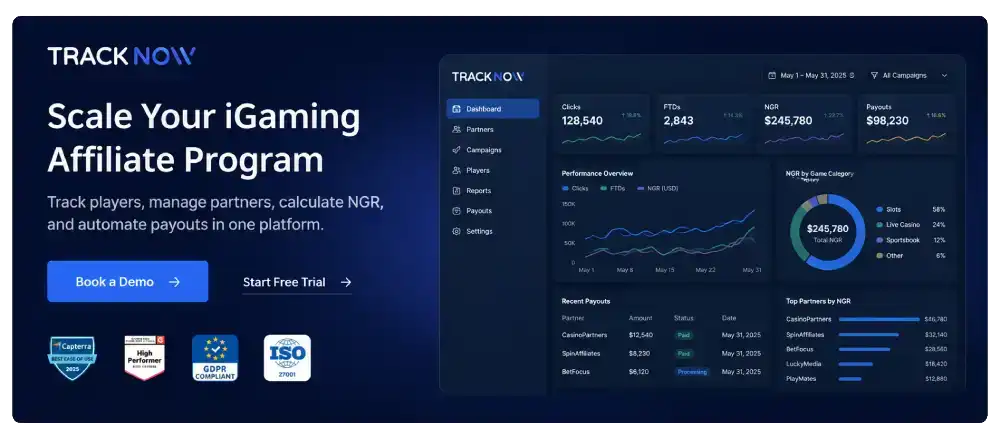
This guide compares 10 affiliate software platforms that may be relevant to casino, sportsbook, and other performance-driven businesses. It is not a universal ranking. The goal is to show how the products differ, what their publicly documented pricing looks like, and what an operator should verify before signing a contract.
Updated: September 17, 2026.
Editorial Note, Disclosure & Evaluation Methodology
Disclosure: This guide is published by Tracknow, which is one of the platforms included below. No vendor paid for inclusion or placement in this comparison. Competitor information is based on publicly available materials published on official vendor websites and reviewed on September 17, 2026.
Features, limits, implementation scope, and commercial terms may differ by contract, region, product configuration, and data volume. Where a vendor does not publish a price, the table says so rather than estimating it. Public vendor claims should also be validated in a live demo, sandbox, proof of concept, and contract.
The platforms were reviewed through seven practical lenses:
- Tracking and attribution: S2S or postback support, click identifiers, deduplication, event correction, mobile tracking, promo codes, and attribution rules.
- Commission economics: CPA, qualified CPA, RevShare, hybrid deals, CPL, turnover-based models, tiering, sub-affiliate rewards, and positive or negative carryover.
- Reporting and data access: player-level visibility, raw exports, APIs, reporting frequency, historical logs, cohort analysis, and reconciliation with BI.
- Operations and payouts: affiliate onboarding, payment approvals, invoicing, payment integrations, balance adjustments, and dispute workflows.
- Compliance and governance: affiliate approval, role-based access, audit logs, GEO restrictions, creative controls, KYC workflows, and evidence retention.
- Integration and scalability: API and database options, multi-brand support, traffic limits, data ingestion, migration, support, and service-level commitments.
- Pricing and total cost of ownership: licence fees, setup, migration, extra brands, overages, support packages, custom development, and internal operating cost.
There is no universal scoring system because a feature that is essential for a regulated multi-brand operator may be unnecessary for a new single-brand program. Context matters more than a long checklist.
What iGaming Affiliate Software Actually Needs to Do
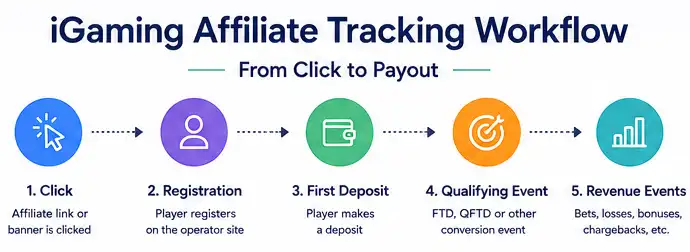
Generic affiliate software usually tracks a click and a conversion. iGaming affiliate software may need to track a much longer player lifecycle: click, registration, verification, first deposit, qualified FTD, repeat deposits, bets, wins, losses, bonuses, chargebacks, withdrawals, account status changes, and long-term player value.
It must then apply commercial rules to those events. A platform may need to calculate CPA only after a player reaches a deposit or wagering threshold, calculate RevShare from a contract-specific NGR formula, apply different rules by GEO or product, keep CPA and RevShare balances separate, and decide whether losses carry forward to the next period. The broader guide to affiliate commission models explains how CPA, RevShare, hybrid and other structures differ.
Important: NGR is not a universal field with one industry-wide formula. Operators may deduct different combinations of bonuses, chargebacks, payment costs, gaming taxes, jackpot contributions, platform fees, and other expenses. The software must reproduce the commercial definition written into the operator’s affiliate agreement.
The Hard Truths Operators Learn the Hard Way
Growth in first-time depositors does not automatically mean growth in profit. An aggressive CPA deal can look attractive during the first month and become uneconomical after player quality, retention, fraud, bonus cost, and chargebacks are included.
Negative carryover may be a valid accounting rule, but it creates friction when partners cannot see how a negative balance was created, which players or brands contributed to it, and when the balance can return to positive.
Many affiliate disputes are not caused by a tracking failure alone. They often begin with unclear NGR definitions, inconsistent qualification rules, unexplained adjustments, different attribution windows, or reporting that does not show the calculation path.
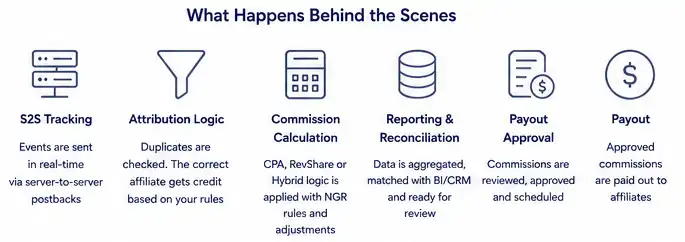
Differences between BI, CRM, payment, and affiliate reports do not automatically prove that one system is broken. They may come from time zones, ETL delays, currency conversion, late-arriving events, duplicate handling, attribution rules, refunds, chargebacks, or different KPI definitions. The operator needs a documented reconciliation process that identifies which system owns each field.
Affiliate Program Maturity Levels
Not every operator needs the same level of complexity. The right platform depends partly on the operating stage of the program.
Level 1 — Launch. A single brand, a small partner base, basic CPA or simple RevShare deals, manual approvals, and limited reporting. The main priorities are reliable tracking, easy onboarding, clear affiliate reports, and a manageable entry price.
Level 2 — Structured Growth. S2S tracking, qualified CPA rules, hybrid deals, multiple currencies, basic fraud controls, automated invoices, and regular reconciliation with BI. The operator begins to need more granular exports and stronger permissions.
Level 3 — Scaled Multi-Brand. Multiple casino or sportsbook brands, country-specific deals, independent calculations by brand or GEO, cohort analysis, player-level reporting, API-based workflows, automated payout approvals, and formal migration procedures.
Level 4 — Regulated Enterprise or Network. Large data volumes, several legal entities or licences, advanced user roles, immutable audit trails, affiliate KYC, marketing restrictions, data retention policies, custom SLAs, and a documented exit plan.
Define Your Requirements Before Booking Demos
A product demo is much more useful when every vendor receives the same requirements. Document the following before comparing interfaces:
- The complete event list and the system that owns each event.
- The exact CPA qualification rules and NGR formula.
- Attribution windows, duplicate rules, promo-code attribution, and cross-device requirements.
- Carryover rules by affiliate, brand, product, GEO, and currency.
- Which data affiliates may see and which data must remain operator-only.
- Expected brands, affiliates, clicks, players, events, currencies, and data-retention period.
- Required integrations, including gaming platform, CRM, BI, MMP, payment provider, and accounting system.
- Approval workflows for affiliates, creatives, balance adjustments, invoices, and payouts.
- Regulatory controls, audit requirements, and restricted-market rules.
- Migration scope, historical data, existing tracking links, implementation deadline, and exit requirements.
iGaming Affiliate Software Comparison: Features, Fit & Pricing
The pricing below reflects publicly available vendor information checked on September 17, 2026. Temporary promotions are excluded. Prices are shown in the vendor’s published currency and are not converted. A custom quote is not automatically expensive or inexpensive; it simply means the vendor does not publish a standard amount.
| Platform | Product Fit | Commission & iGaming Logic | Data, Integration & Scale | Public Pricing | Main Point to Verify |
|---|---|---|---|---|---|
| Tracknow | Multi-vertical platform with dedicated iGaming brand and network plans. | CPA, qualified CPA, NGR RevShare, hybrid, turnover-based rewards, tiering, sub-affiliates, and positive or negative carryover. | S2S, API, DB/API integration, player reporting, multiple currencies, extra-brand options, and tailored enterprise setups. | $499/month Brand Pro; $799/month Brand Premium; Tailored plan by quote. Additional brand: $250/month on listed brand plans. No integration fee. |
Confirm player and tracking volumes, integration method, migration scope, overages, and any custom development. |
| Affilka | Purpose-built iGaming affiliate platform for casino and sportsbook programs. | RevShare, CPA, CPL, hybrid and custom plans, commission qualifiers, and multiple sub-affiliate tiers. | S2S postbacks, dynamic parameters, Reports API, CSV/XLSX/JSON/XML exports, multi-brand support, role-based access, and event logging. | No standard public amount listed; contact sales for licence, integration and implementation pricing. | Validate third-party gaming-platform integration, exact NGR inputs, payment rails, migration, and support terms. |
| Income Access | iGaming-focused software combined with optional affiliate network and managed services. | CPA, CPL/CPI, RevShare and configurable deal structures, plus integrated commission and payment workflows. | Postbacks, near-real-time tracking, mobile and multi-channel attribution, reporting, geo-targeting, and third-party compliance tooling. | No standard amount published; contact sales for a tailored quote.Integration fee per quote. | Separate the cost and scope of software, network access, payment processing, and managed services. |
| MyAffiliates | iGaming-oriented platform for high-volume, multi-brand programs. | Flat, tiered and progressive RevShare; CPA and qualified CPA; CPL; hybrid; formula-based custom commissions; and sub-affiliate plans. | S2S postbacks, XML/API connectivity, automated imports and exports, custom reports, multi-brand management, and role-based access. | One-time setup fee plus a fixed monthly subscription; amounts are not publicly listed. Integration fee per quote. |
Confirm setup and migration fees, reporting frequency, bespoke API work, and what is included in the fixed subscription. |
| NetRefer | Enterprise iGaming platform for complex, high-volume affiliate operations. | Straight, flat, progressive and tiered RevShare; multiple CPA structures; hybrid plans; and sub-affiliate rewards. | REST, GraphQL and Data Ingestion APIs, XML feeds, reward-plan management, permissions, BI/reporting modules, and multi-brand configurations. | Fixed subscription licence calculated from specifications such as clicks, views, products, brands, security, and hosting; amount by quote. + Integration fee per quote. | Map every required module, API, hosting bundle, usage assumption, and implementation dependency before comparing the quote. |
| ReferOn | Purpose-built casino and sportsbook affiliate management platform. | CPA, RevShare, CPC, hybrid combinations, conditional rules, deal inheritance, and independent calculations by brand, GEO, or tracker. | Self-service postbacks, pivot-style reporting, click-level data, dynamic tracking variables, audit history, payment workflows, and API/export options. | Recurring licence amount not published. Vendor states that integration and onboarding are free and the first month is free. | Confirm the ongoing licence, support tier, migration terms, historical-data access, and payment-processing costs. |
| PartnerMatrix | iGaming affiliate platform for multi-brand casino and betting operators. | Revenue share, CPA, hybrid, tiered and brand-specific commission plans. | S2S/postback, API and FTP integrations, real-time reports, detailed betting history, automated or manual payments, and multi-brand controls. | No standard amount published; contact sales for pricing.Integration fee per quote. | Clarify whether PartnerMatrix Intelligence is included, how brands are priced, and which migration and data services are in scope. |
| Cellxpert | Enterprise partner platform focused on regulated iGaming and finance programs. | CPA, RevShare, hybrid, rebates, multi-level commissions, custom baselines, and configurable NGR by product, GEO, or brand. | Real-time tracking, APIs and webhooks, multi-brand reporting, fraud controls, cohort and LTV analysis, KYC, GEO restrictions, and audit trails. | No standard public amount listed; contact sales for licence, integration and implementation pricing. | Confirm implementation timeline, included compliance modules, volume assumptions, custom work, and support SLA. |
| Scaleo | Multi-vertical partner platform with an iGaming module for operators and networks. | iGaming commission constructor, player-funnel reporting, GGR/NGR inputs, multi-brand logic, invoicing, and payment automation. | Complete API, S2S, multi-brand support, advanced roles, anti-fraud logic, real-time reporting, custom domains, and optional custom or on-premise work. | €1,600/month Scale; from €2,400/month Custom. Additional brand: €500/month. Annual billing can save up to 15%. Integration fee per quote. | Check banner-impression limits, extra brands, overages, custom-development fees, migration scope, and SLA level. |
| Post Affiliate Pro | General-purpose affiliate management software rather than an iGaming-native operator platform. | Action, recurring, lifetime, multi-tier and performance-based commissions; complex NGR and player-lifecycle logic may require custom work. | Web-oriented affiliate tracking, integrations, reports and automation across multiple business types. | Public plans are available; verify the current plan and every required add-on directly with the vendor. | Run a proof of concept for qualified FTD, NGR, carryover, multi-brand isolation, player reporting and regulated-workflow requirements. |
Platform Profiles
The profiles below summarize publicly documented strengths and the questions an operator should still validate. They are not substitutes for a technical proof of concept or a negotiated statement of work.
1. Tracknow — Best Overall for Flexible iGaming Programs
Positioning: Multi-vertical affiliate and partner management platform with dedicated plans and workflows for casino brands, sportsbooks, iGaming networks, forex, prop trading, eCommerce, and other performance-driven businesses.
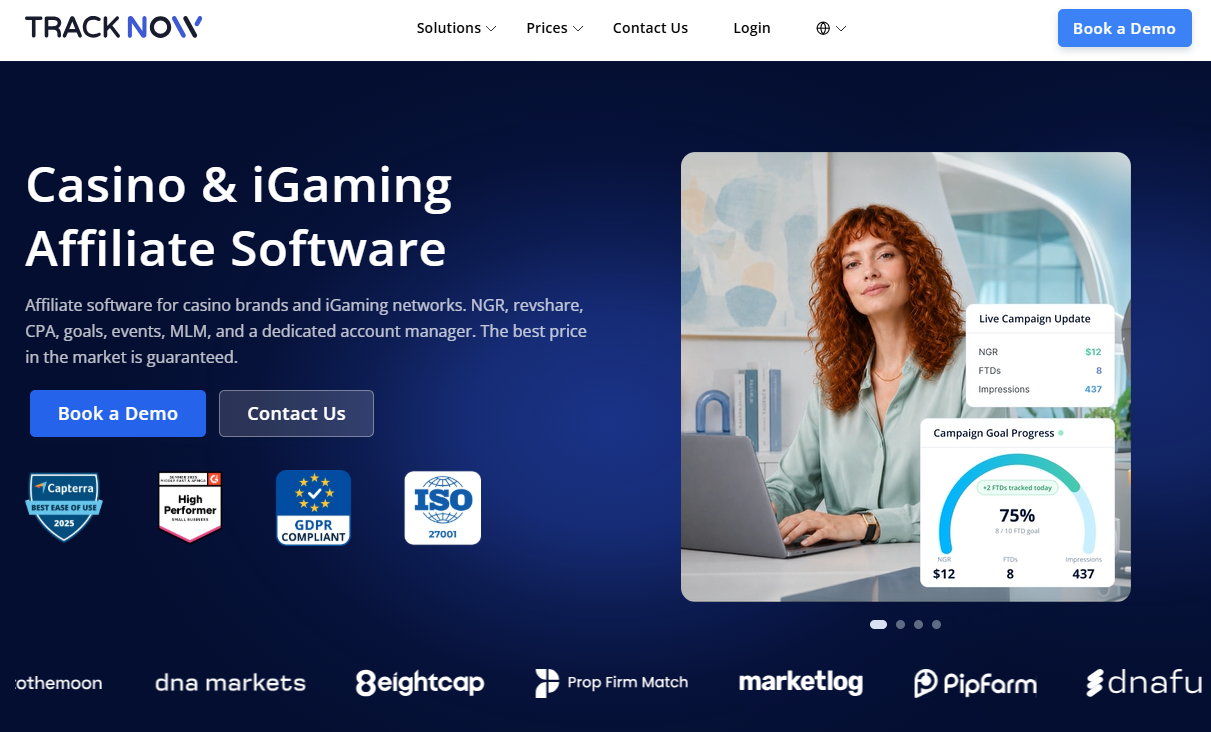
What stands out: Tracknow publicly documents iGaming support for qualified CPA, NGR-based RevShare, hybrid deals, turnover-based rewards, separate CPA and RevShare balances, positive or negative carryover, sub-affiliate structures, player reporting, and tier automation. Integration options include S2S, API, and database or API connections, depending on the plan and project.
Its main commercial differentiator in this comparison is price transparency. The published iGaming Brand Pro plan is $499 per month and Brand Premium is $799 per month. Both list one included brand, free setup, and a $250 monthly fee for an additional brand. A tailored plan is available for larger or more complex portfolios.
Best fit: Operators that want iGaming-specific commission logic, public starting prices, and the option to use one partner platform across several performance channels.
What to verify: Match the proposed plan to monthly player volume, tracking requests, brand count, reporting requirements, data-retention needs, and integration method. Confirm migration, overage pricing, white-label requirements, dedicated support, and custom development in writing.
View Tracknow’s official pricing and plan details.
2. Affilka
Positioning: Purpose-built iGaming affiliate management platform for online casino and sportsbook programs.
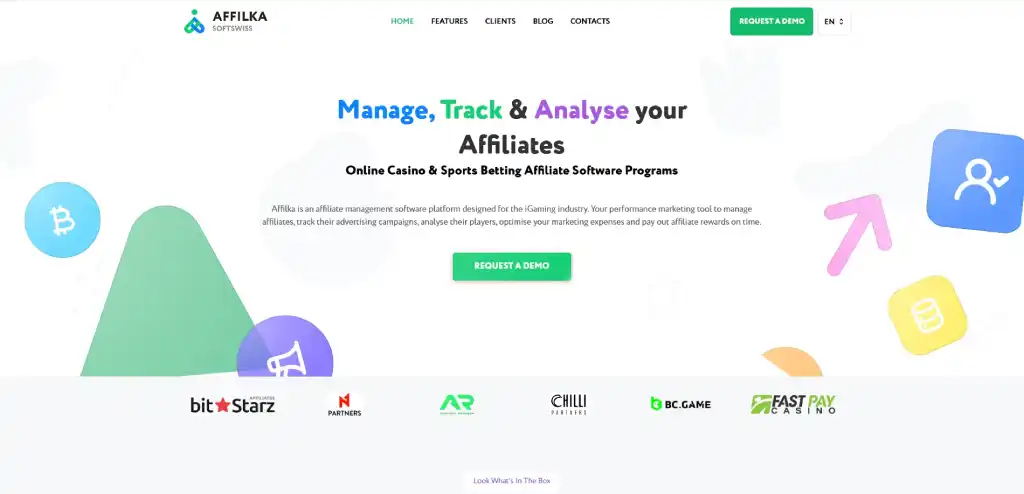
What stands out: Affilka originated as part of the SOFTSWISS Casino Platform, but its official company history says the products were later separated and Affilka was developed independently. The platform documents a flexible commission constructor, RevShare, CPA, CPL and hybrid plans, multiple sub-affiliate tiers, built-in payment processing, S2S postbacks, multi-brand and multi-product management, role-based access, and event logging.
Reporting is a notable part of the product description. Affilka lists player, click and affiliate reports, cohort analysis, segmentation, a Reports API, and exports in CSV, XLSX, JSON, and XML. It also documents player attributes and adjustments such as duplicate or self-excluded accounts, bonuses, chargebacks, and third-party fees.
Pricing: A standard public licence amount is not listed on the official product pages. Operators need a commercial quote.
Best fit: Casino and sportsbook teams that prefer an iGaming-native system with flexible commissions, detailed player data, and integrated payout workflows.
What to verify: Test the exact integration with the gaming platform, the fields available for the operator’s NGR formula, reporting latency, payment providers and fees, migration of existing links and historical data, and any limits attached to the quote.
Review Affilka’s official feature documentation.
3. Income Access
Positioning: Long-established iGaming affiliate software provider that also offers an affiliate network, payment support, program management, and broader marketing services.

What stands out: Income Access combines technology and optional services. Its product materials describe postback integration, near-real-time tracking, custom parameters, multi-channel reporting, mobile attribution, geo-targeting, payment processing, and an integration with Rightlander Intel. The broader offering can include affiliate recruitment, program management, audits, media buying, and access to its network.
This combination can be valuable for an operator with a lean internal team, but it also makes commercial comparison more complicated. A software-only proposal should not be compared directly with a proposal that includes network access, managed services, payment processing, and strategic support.
Pricing: No standard public licence amount is listed. Pricing is provided through a tailored sales process.
Best fit: Operators that may need software plus network reach, managed affiliate services, or broader acquisition support.
What to verify: Ask for separate line items for software, integrations, network participation, payment processing, program management, support, and custom work. Confirm reporting cadence, mobile and MMP support, raw-data access, and how the operator can export data if it later changes platforms.
See Income Access product features.
4. MyAffiliates
Positioning: Affiliate management and tracking platform with a strong focus on iGaming, forex, lottery, and other high-volume verticals.

What stands out: MyAffiliates documents formula-based commission plans that can use data fields supplied by the operator. Traditional options include flat, tiered and progressive RevShare, standard and qualified CPA, country-specific CPA, CPL, hybrid plans, and multi-level sub-affiliate rewards.
The platform also lists multi-brand management, S2S postbacks, custom parameters, XML/API connectivity, automated data import and export, more than 20 pre-built reports, custom reporting, role-based access, event logging, and AWS-based infrastructure. This makes it relevant for operators that need commissions and reports adapted to their own data model.
Pricing: MyAffiliates describes a one-time setup fee for integration and migration, followed by a fixed monthly subscription. The amounts are not publicly listed.
Best fit: Multi-brand operators that need formula-driven commission logic, extensive customization, and structured support.
What to verify: Confirm the setup and migration amount, what the fixed monthly fee includes, reporting update frequency, custom-report and bespoke-API charges, data-volume assumptions, and the process for correcting or re-importing incomplete gaming data.
Review MyAffiliates commission-plan features.
5. NetRefer
Positioning: Enterprise-oriented affiliate management platform built for complex casino, sportsbook, and other iGaming programs.
What stands out: NetRefer documents a detailed Reward Plan Manager supporting several RevShare and CPA structures, hybrid plans, and sub-affiliate rewards. Its technology offering includes traditional REST APIs, GraphQL APIs, a Data Ingestion API, XML feeds, reporting and BI capabilities, permissions, media management, and operator-focused data access.
The vendor’s public pricing explanation is more detailed than a simple “contact us” message. NetRefer says it uses a fixed subscription licence rather than taking a percentage of revenue. The licence is calculated from specifications such as clicks, views, products, brands, security, and expected hosting usage, but the actual amounts are not published.
Best fit: High-volume and multi-brand operators that need a modular enterprise platform, extensive APIs, and formal data workflows.
What to verify: Request a line-by-line proposal showing the base licence, products, brands, hosting bundle, security options, API modules, analytics modules, support, implementation, migration, and overage rules. Confirm which capabilities are core and which are paid add-ons.
Read NetRefer’s official operator and pricing overview.
6. ReferOn

Positioning: Purpose-built affiliate management system for casino and sportsbook operators.
What stands out: ReferOn documents pivot-style reports, dynamic tracking variables, self-service postbacks, click-level reporting, and deal inheritance from program level down to brand, affiliate, and tracker. It also supports independent deal calculations, allowing an operator to isolate results by brand, GEO, or tracking link instead of automatically offsetting one area against another.
The public product page lists CPA, RevShare, CPC and hybrid combinations, conditional logic, bulk link and media management, payment scheduling, player-level drill-downs, audit history, and crypto autopayments. These capabilities are particularly relevant when an operator needs transparent calculations across several brands or markets.
Pricing: The recurring licence amount is not published. ReferOn states that integration and onboarding are free and that the first month is free.
Best fit: iGaming operators that need granular deal inheritance, independent calculations, flexible postbacks, and detailed click-level analysis.
What to verify: Ask for the ongoing monthly or annual licence, support-package pricing, implementation responsibilities, payment-processing charges, historical-data migration, data retention, and the full export available at contract termination.
Explore ReferOn’s official iGaming platform page.
7. PartnerMatrix

Positioning: Affiliate software platform designed for multi-brand casino, sportsbook, and betting operations.
What stands out: PartnerMatrix describes multi-product and multi-brand campaign management, separate commission plans by product and brand, real-time reporting, detailed betting history, S2S or postback tracking, API and FTP integrations, anti-fraud tools, and automated or manual payment workflows.
The wider PartnerMatrix suite also includes PartnerMatrix Intelligence, previously known as DeepCI, which focuses on affiliate placement and traffic intelligence. That can add strategic value beyond core tracking, but buyers should confirm whether it is included in the platform proposal or priced separately.
Pricing: A standard licence amount is not published on the official product pages. Operators need to contact sales.
Best fit: Multi-brand gaming groups that want affiliate operations and broader affiliate intelligence within the same vendor ecosystem.
What to verify: Confirm the commercial scope of PartnerMatrix Intelligence, costs by brand and market, data sources, support coverage, migration of current affiliates and links, reporting exports, and whether the proposal includes all required payment and anti-fraud modules.
Review the PartnerMatrix affiliate platform.
8. Cellxpert
Positioning: Enterprise affiliate and partner platform for regulated iGaming and finance operators.
What stands out: Cellxpert documents configurable NGR formulas by product, GEO and brand; CPA, RevShare, hybrid, rebate and multi-level commission models; real-time player and partner reporting; cohort and lifetime-value analysis; fraud and chargeback controls; and multi-brand access from one partner account.
Governance is a visible part of the product positioning. The platform describes affiliate KYC, GDPR consent capture, GEO restrictions, country controls, marketing-compliance workflows, payment audit trails, APIs, webhooks, and integrations with operator systems. That makes it relevant for regulated teams that want partner management, risk, and compliance evidence in one operational layer.
Pricing: No standard public amount is listed. Pricing is available through a sales quote.
Best fit: Regulated or high-volume operators that place strong emphasis on custom NGR logic, risk controls, auditability, and multi-brand governance.
What to verify: Confirm which compliance and fraud modules are included, implementation timing, data-volume assumptions, custom integration costs, support SLA, data residency, security review requirements, and the process for migrating without changing live affiliate links.
See Cellxpert’s official iGaming product page.
9. Scaleo
Positioning: Multi-vertical partner marketing software with a dedicated iGaming module for operators and affiliate networks.
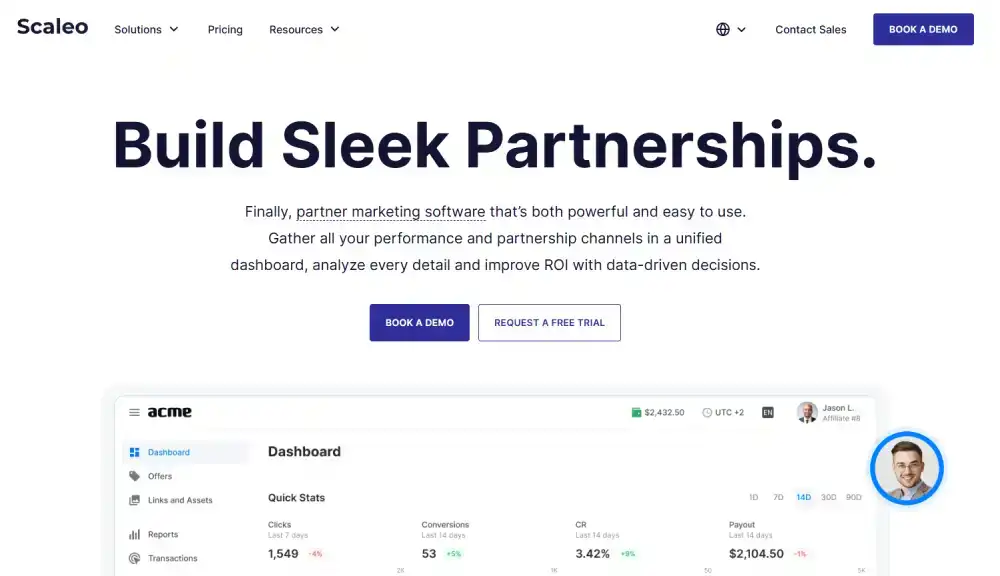
What stands out: Scaleo’s iGaming materials describe an iGaming commission constructor, player-funnel reporting, GGR and NGR data, player reports, multi-brand support, advanced user roles, invoicing and payment automation, anti-fraud logic, a complete API, and extensive interface customization.
Scaleo also publishes its operator pricing. The Scale plan starts at €1,600 per month on monthly billing and the Custom plan starts at €2,400 per month. One main integrated brand is included, and each additional brand is listed at €500 per month. Annual billing can reduce the listed price by up to 15%.
Best fit: Operators that want a configurable iGaming module, detailed reporting, and a published enterprise-level starting price.
What to verify: Model the total cost with every required brand, banner-impression volume, extra tracking domains, overages, custom features, on-premise requirements, migration, and support SLA. Confirm which iGaming fields and commission rules are available without custom development.
View Scaleo’s official pricing.
10. Post Affiliate Pro
Positioning: General-purpose affiliate management software for ecommerce, SaaS, membership and other partner programs rather than a platform designed specifically around casino and sportsbook economics.
What stands out: Post Affiliate Pro documents action commissions, recurring and lifetime commissions, commission groups, multi-tier structures and performance rewards. These capabilities can support a straightforward partner program with conventional conversion events.
Pricing: The vendor publishes several plans, but the relevant plan and total cost depend on traffic, integrations and required modules. Verify current pricing directly rather than relying on a copied amount.
Best fit: Smaller or less complex projects that need general affiliate tracking and do not require advanced player-level NGR, qualified FTD, cross-brand carryover and regulated iGaming governance out of the box.
What to verify: Treat every casino-specific requirement as unconfirmed until demonstrated. Test player-event ingestion, FTD qualification, NGR deductions, negative carryover, multi-brand separation, audit logs, affiliate KYC, payment approvals and raw-data exports.
Review Post Affiliate Pro’s official commission features.
How to Compare Pricing Without Misleading Yourself
The cheapest published licence is not necessarily the lowest-cost platform, and a custom quote is not necessarily the most expensive. The useful comparison is total cost of ownership under the same operating scenario.
Annual TCO = licence + implementation + migration + extra brands + usage overages + support or SLA packages + custom development + payment costs + internal reconciliation and administration.
Give every vendor the same volume sheet. Include expected brands, products, monthly clicks, registrations, FTDs, active players, events, affiliates, admin users, currencies, tracking domains, API traffic, report frequency, and historical-data retention. Then ask each vendor to price at least three scenarios: current volume, expected volume in 12 months, and a peak-volume case.
Request written answers to the following pricing questions:
- What metric changes the licence: clicks, events, players, conversions, affiliates, brands, products, revenue, or storage?
- What is included in setup, integration, migration, training, sandbox access, and launch support?
- Are S2S, API, raw exports, custom reports, BI connectors, mobile tracking, and payment integrations included?
- How are extra brands, legal entities, currencies, tracking domains, admin users, and affiliate portals priced?
- What happens when a monthly limit is exceeded, and can the operator cap or forecast overages?
- Which support channels and response times are included, and what requires a premium support package?
- Who pays third-party payment, KYC, fraud, messaging, cloud, or data-provider fees?
- What is the cost of custom development, and who owns or maintains the customization?
- Does the renewal price change, and is there a minimum contract term or annual commitment?
- What data export and transition assistance is provided when the contract ends?

Compliance & Governance Are Product Requirements
Affiliate software does not make an iGaming program compliant by itself, but it can either support or undermine the operator’s control framework. Regulatory requirements differ by market, so legal and compliance teams should define the required controls before procurement. Tracknow’s affiliate marketing compliance guide provides a broader operational overview.
As one example, the UK Gambling Commission’s Licence Conditions and Codes of Practice make licensees responsible for relevant third parties acting on their behalf. The Commission also expects operators to manage risks connected with affiliate direct marketing and self-excluded customers. This makes affiliate oversight, evidence, permissions, and termination controls operational requirements rather than optional reporting features.
A regulated operator should evaluate whether the platform supports:
- Affiliate application review, KYC or due-diligence records, status changes, and documented approval.
- Role-based permissions for affiliate managers, finance, compliance, BI, administrators, and external partners.
- Immutable or reliable audit logs for commission changes, balance adjustments, creative updates, permissions, and payouts.
- Creative approval, version history, expiry dates, restricted claims, and market-specific assets.
- GEO restrictions, blocked traffic sources, domain controls, and rules for restricted or unlicensed markets.
- Suppression and direct-marketing workflows that align with the operator’s CRM and self-exclusion controls.
- Data minimization, field-level visibility, retention rules, secure exports, and deletion or anonymization processes.
- Evidence that can be retrieved quickly during an internal audit, affiliate dispute, regulator request, or contract termination.
Review the UK Gambling Commission’s third-party responsibility condition. This is an example from one jurisdiction and is not legal advice.
Red Flags to Watch For
No raw-data access. Aggregated dashboards are not enough when finance, BI, compliance, or an affiliate needs to audit a disputed amount.
No documented calculation path. The platform should show how raw player events became GGR, NGR, qualified CPA, commission, adjustments, opening balance, and closing balance.
Hard-coded NGR or carryover logic. Commercial models evolve. A platform that cannot change deductions, qualifications, brand isolation, or carryover rules can create expensive workarounds.
Weak handling of corrections. Ask how the system processes duplicates, late events, backfills, chargebacks, reversed deposits, reactivated players, currency corrections, and data re-imports.
“Real time” without a definition. Require an expected event delay, report refresh interval, API latency, and incident process rather than accepting a marketing label.
No reliable audit trail. If a user can change a deal, player value, commission, balance, or payout without a visible history, dispute and compliance risk increase.
Unclear data ownership or exit terms. The contract should define export formats, historical depth, media files, affiliate records, tracking links, read-only access, and transition support.
A demo based only on perfect data. Real systems receive duplicates, missing fields, delayed files, inconsistent currencies, and corrected transactions. The proof of concept should include those cases.
A low headline price with undefined extras. Extra brands, tracking volume, API access, support, migration, payment tools, and custom reporting can materially change the final cost.
How to Evaluate a Platform Without Regret
Do not evaluate only the interface. Run the same controlled test through every shortlisted platform.
- Map the lifecycle. Send a click, registration, verification, first deposit, qualified FTD, repeat deposit, wager, win or loss, bonus, chargeback, withdrawal, and account-status change.
- Test attribution. Use two affiliates, two devices, a promo code, a direct return visit, and an expired attribution window. Confirm which partner receives credit and why.
- Send a duplicate. Repeat a conversion with the same event ID and then with a different event ID. Verify deduplication rules, alerts, and audit history.
- Send late and corrected data. Backfill an event from a previous period, reverse a deposit, modify a bonus amount, and re-import a corrected file. Check whether reports and balances update predictably.
- Rebuild the NGR calculation. Use a small sample of known players and manually calculate GGR, every deduction, NGR, RevShare, CPA, hybrid commission, and carryover. The platform result should be reproducible.
- Test isolation. Create two brands, two GEOs, and two products. Verify whether a loss in one area offsets commission in another only when the contract says it should.
- Compare visibility. Log in as an administrator, affiliate manager, finance user, compliance user, and affiliate. Confirm that each role sees only the correct fields, players, brands, and actions.
- Export the evidence. Request raw clicks, player events, calculations, adjustments, invoices, payment history, and audit logs through both file export and API.
- Reconcile with BI. Load the same sample data into the operator’s BI logic and document every expected difference in time zone, currency, attribution, or event timing.
- Run payout approval. Create a minimum threshold, negative balance, manual adjustment, rejected invoice, partial payment, failed payment, and reopened period.
- Test governance. Change a commission plan, permission, creative, affiliate status, and payment detail. Confirm who approved it and whether the original value remains visible.
- Test failure and recovery. Ask what happens when the gaming feed is delayed, an API is unavailable, a payment fails, a user account is compromised, or a migration must be rolled back.
If a vendor cannot demonstrate a critical workflow, record it as an open dependency in the statement of work rather than assuming it will be solved after launch.
Decision Framework
Choose an iGaming-native platform when complex player events, NGR, qualified CPA, carryover, multi-brand reporting, and gambling-specific operational workflows are central requirements. Affilka, Income Access, MyAffiliates, NetRefer, ReferOn, PartnerMatrix, and Cellxpert position themselves primarily around iGaming.
Choose a multi-vertical platform with an iGaming module when the business wants one partner system across casino, sportsbook, finance, eCommerce, influencers, or other acquisition channels. Tracknow and Scaleo fit this category, but the operator should still test every iGaming-specific rule.
Choose a software-plus-services model when the internal team also needs affiliate recruitment, network access, payment support, program management, audits, or acquisition services. Income Access is the clearest example in this comparison.
Consider general-purpose software only when the program is simple enough that casino-specific economics are not required, or when the operator is prepared to build and maintain the missing data logic. Post Affiliate Pro can provide a lower entry price, but a regulated multi-brand operator should not treat it as equivalent to a purpose-built iGaming platform without a successful proof of concept.
Prioritize governance and enterprise architecture when the program operates across several licences, markets, legal entities, or high-volume data feeds. In that case, auditability, permissions, data ingestion, security review, SLA, and exit planning may matter more than interface design.
Final Procurement Checklist
- The NGR formula and every deduction are documented.
- CPA qualification, hybrid logic, carryover, and cross-brand treatment are reproducible.
- Raw events, calculations, audit history, and payment records are exportable.
- BI and affiliate reports have a documented reconciliation policy.
- Roles, approvals, KYC, creative controls, GEO restrictions, and audit requirements are covered.
- Pricing is modeled at current, growth, and peak volume.
- Implementation, migration, training, support, SLA, and custom work are included in the proposal.
- Data ownership, retention, security, incident handling, and contract-exit assistance are written into the agreement.
- The platform has passed a test using duplicates, late data, corrections, chargebacks, and failed payouts.
- References are taken from operators with a similar number of brands, markets, players, and regulatory obligations.

Conclusion
The right iGaming affiliate software is not the platform with the longest feature list or the lowest headline price. It is the platform that can reproduce your commercial agreements, keep attribution explainable, preserve an audit trail, expose the data needed for reconciliation, and remain manageable as brands, affiliates, markets, and regulations multiply.
Start with the operator’s event model, NGR definition, governance requirements, and expected scale. Compare every vendor against the same scenario. Then stress the system with imperfect data before trusting it with serious volume.
There is no universal winner. There is only a platform whose tracking architecture, commission logic, operating model, integration effort, and total cost fit the reality of a specific affiliate program.
Official Product & Pricing Sources
The following official vendor pages were used to verify the product descriptions and publicly available pricing in this guide. Pricing and packaging can change, so operators should reconfirm all commercial terms directly with the vendor.
- Tracknow pricing
- Affilka features and Affilka company history
- Income Access product features
- MyAffiliates commission plans and MyAffiliates product and pricing structure
- NetRefer operator and pricing overview and NetRefer platform
- ReferOn iGaming affiliate platform
- PartnerMatrix affiliate platform
- Cellxpert iGaming platform
- Scaleo iGaming product and Scaleo pricing
- Post Affiliate Pro commission features
- UK Gambling Commission: responsibility for third parties
FAQ About iGaming Affiliate Software
What is iGaming affiliate software?
iGaming affiliate software is a platform used by casino, sportsbook, betting, lottery, and gaming operators to track referred players, manage affiliate partnerships, calculate commissions, generate reports, and organize payouts.
Unlike basic affiliate tools that track only clicks and purchases, an iGaming platform may need to process registrations, first-time deposits, qualified FTDs, repeat deposits, wagering activity, bonuses, chargebacks, withdrawals, GGR, NGR, and long-term player value.
How much does iGaming affiliate software cost?
Pricing varies significantly. Some vendors publish fixed monthly plans, while many iGaming-focused and enterprise platforms provide custom quotes based on brands, products, affiliates, clicks, players, events, data volume, integrations, hosting, support, and implementation requirements.
Operators should compare total cost of ownership rather than the headline licence fee. The final budget may also include setup, migration, additional brands, overages, custom development, premium support, payment integrations, and internal reconciliation work.
What features should iGaming affiliate software include?
Important capabilities include S2S tracking, configurable attribution rules, duplicate prevention, player-level reporting, raw data exports, APIs, multiple currencies, multi-brand management, role-based permissions, audit logs, and flexible payout workflows.
The platform should also support the operator’s actual commercial models, including CPA, qualified CPA, RevShare, hybrid deals, tiered commissions, sub-affiliate rewards, product-specific rules, GEO-specific rules, and positive or negative carryover.
What is S2S tracking in iGaming?
Server-to-server tracking sends conversion and player events directly between the operator’s system and the affiliate platform. It does not depend entirely on a browser cookie or tracking pixel.
S2S tracking is commonly used for events such as registration, verification, first deposit, qualified FTD, repeat deposit, wagering activity, bonus adjustments, and chargebacks. It can improve reliability, but only when event IDs, attribution logic, retry rules, deduplication, and error handling are implemented correctly.
How should an affiliate platform calculate NGR and RevShare?
The platform should calculate RevShare using the exact NGR definition written into the operator’s affiliate agreement. There is no universal NGR formula used by every casino or sportsbook.
Depending on the contract, deductions may include bonuses, chargebacks, payment costs, gaming taxes, jackpot contributions, platform fees, and other expenses. Operators should be able to reproduce the calculation from player-level data and see how each deduction affected the final commission.
What is the difference between CPA, RevShare, and hybrid commissions?
CPA pays the affiliate a fixed amount after a player completes a defined action, such as making a qualifying first deposit.
RevShare pays the affiliate a percentage of the revenue generated by referred players, usually according to an agreed GGR or NGR formula.
Hybrid combines CPA and RevShare. It can provide an upfront acquisition payment together with a percentage of long-term player revenue. The software must keep the two calculation components transparent and prevent the same event from being counted incorrectly.
Can one affiliate platform manage multiple casino and sportsbook brands?
Many iGaming affiliate platforms support multiple brands, products, domains, currencies, and markets from one administrative environment. However, the depth of multi-brand support differs between vendors.
Operators should test whether each brand can have separate commission plans, NGR rules, tracking links, creatives, permissions, currencies, reports, invoices, and carryover balances. They should also confirm whether losses from one brand or product can offset earnings from another.
How can operators reduce affiliate commission disputes?
Disputes are easier to prevent when attribution rules, CPA qualifications, NGR deductions, carryover policies, adjustment procedures, and payment dates are clearly documented.
The affiliate platform should provide player-level reporting, historical event logs, visible adjustments, calculation breakdowns, and reliable exports. Finance, BI, affiliate management, and compliance teams should also use the same definitions for FTD, qualified player, GGR, NGR, commission, and closing balance.
What should operators test before choosing an affiliate platform?
Operators should test the complete journey from click to payout. The test should include registration, first deposit, qualified FTD, repeat deposits, wagering activity, bonuses, chargebacks, withdrawals, duplicate events, late-arriving data, corrections, and failed payments.
They should also rebuild a sample CPA, RevShare, and hybrid calculation manually, compare the result with BI, export the raw data, review the audit log, and test the platform using administrator, finance, compliance, affiliate manager, and affiliate accounts.
Is it difficult to migrate to a new iGaming affiliate platform?
Migration difficulty depends on the number of affiliates, brands, tracking links, commission plans, historical records, integrations, and custom workflows. The greatest risk is not always moving the data itself. It is preserving attribution and avoiding disruption to existing affiliate links and player relationships.
Before migration, the operator should agree on data formats, field mapping, historical depth, parallel tracking, validation procedures, rollback options, affiliate communication, and the ownership of old reports. A controlled parallel run is safer than switching every workflow at once.
Does affiliate software make an iGaming program compliant?
No. Affiliate software can support compliance, but it does not replace legal advice, internal policies, due diligence, training, monitoring, or regulatory oversight.
A suitable platform should help the operator manage affiliate approvals, permissions, audit trails, creative controls, GEO restrictions, marketing evidence, data access, and status changes. The exact requirements depend on the licences and jurisdictions in which the operator works.