
Tracknow for Prop Trading Firms: 2 Real Affiliate Software Case Studies (2025–2026)
Two detailed prop trading case studies showing how Tracknow was implemented as affiliate software. Includes CPA & hybrid models, testing process, platform comparison, and real operational results.

Prop trading is not eCommerce. It’s not SaaS. And it’s definitely not a simple referral business.
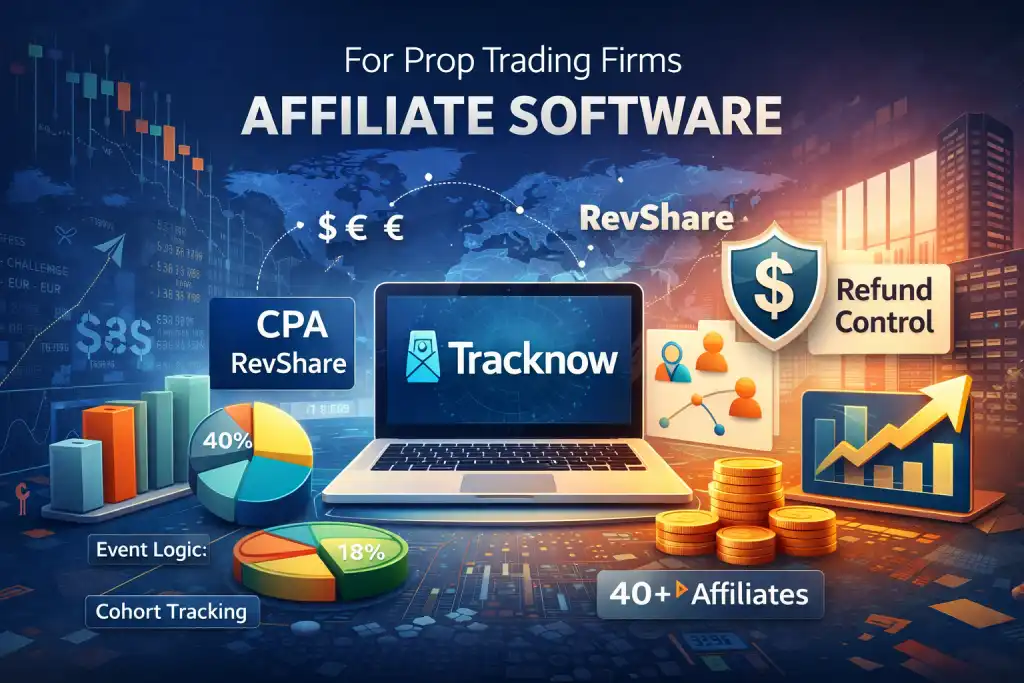
You’re dealing with challenge fees, refund windows, scaling plans, revenue splits, trader churn, and aggressive affiliate competition across YouTube, Discord, Telegram, and review sites. If tracking is weak, margin disappears fast.
Below are two real-world prop trading use cases showing how Tracknow was implemented as affiliate software to stabilize commissions, reduce leakage, and scale partner ecosystems.
Case Study 1: Scaling a Global Prop Firm with CPA + Hybrid Model
Company Profile
A mid-sized prop firm operating globally with 40+ active affiliates.
Products:
- $100K Challenge – $499
- $200K Challenge – $979
- Instant Funding – from $799
Average monthly challenge volume before optimization: ~1,200 purchases.
The Problem
The company was paying affiliates a flat $150 CPA per challenge purchase.
What went wrong:
- Refund window abuse within 7 days
- Chargebacks on high-risk GEO traffic
- Media buyers pushing low-quality leads
- Brand bidding conflicts
Refund + chargeback rate: 14%.
Effective CPA leakage: ~18% of affiliate spend.
Monthly loss from invalid payouts: approximately $28,000.
Implementation with Tracknow
The prop firm restructured its commission logic using Tracknow’s event-based setup:
- Event 1 – Challenge Purchased
- Event 2 – Refund Window Cleared (Day 8)
- Event 3 – Upsell Add-on Purchased
- Event 4 – Repeat Challenge Purchase
CPA now triggered only after Event 2.
Top-tier affiliates moved to Hybrid model:
- $110 CPA
- + 5% revenue share from repeat purchases within 90 days
Results After 90 Days
- Refund-adjusted CPA improved by 21%
- Disputes reduced by 37%
- Affiliate ROI visibility improved via cohort tracking
- Monthly savings: ~$19,000
Founder Comment:
“We realized we were paying affiliates faster than we were validating traders. Once we structured events properly inside Tracknow, payouts aligned with actual revenue. That changed everything.”
Case Study 2: Building a Long-Term Content Affiliate Ecosystem
Company Profile
A content-heavy prop firm focused on SEO and influencer partnerships.
Affiliate mix:
- YouTube educators
- Trading bloggers
- Comparison websites
- Telegram channels
Commission structure before optimization: 20% RevShare on challenge fees.
The Problem
All affiliates were treated equally. But not all traffic was equal.
Some partners generated:
- High first-time purchase volume
- Low repeat rate
Others generated:
- Lower volume
- High re-purchase rate (repeat challenges)
- Higher scaling plan conversions
Without cohort analysis, the company couldn’t differentiate value.
Implementation with Tracknow
The firm configured separate tracking events:
- Initial Challenge Purchase
- Repeat Challenge
- Scaling Upgrade
Affiliates were segmented into tiers based on 90-day LTV performance.
Tier adjustments:
- Standard – 18%
- Growth – 22%
- Premium – 27%
Results After 6 Months
- Affiliate retention increased 31%
- Top-tier partners doubled content output
- Average LTV per referred trader increased by 18%
- RevShare overpayment on low-quality traffic reduced significantly
CEO Comment:
“For the first time, we could see which affiliates brought serious traders, not just coupon hunters. That allowed us to reward quality instead of volume.”
How These Prop Firms Chose Their Affiliate Software
Both companies tested 3–4 platforms before choosing Tracknow.
Selection Criteria Included:
- Event-based tracking flexibility
- Refund-aware commission triggers
- Hybrid logic support
- Sub-affiliate structures
- API exports for internal dashboards
One founder explained:
“Some platforms looked good in demos, but when we asked how they handle delayed payouts after refund windows, the answers were vague. We needed real event logic, not just basic click tracking.”
Testing & Migration Process
The firms ran parallel tracking for 30 days.
They tested:
- Duplicate conversion handling
- Timezone consistency
- Chargeback simulation
- Manual reconciliation exports
No major discrepancies were found during controlled simulation.
Full migration took 3 weeks.
Why Other Contenders Didn’t Fit
Common rejection reasons:
- Limited hybrid commission modeling
- No delayed payout trigger logic
- Lack of transparent event logs
- High enterprise pricing without flexibility
One COO stated:
“We didn’t want something bloated. We wanted something flexible. Some enterprise platforms were powerful but overkill for a prop firm our size.”
Support & Operational Experience
Both companies highlighted onboarding and responsiveness.
Implementation support included:
- Custom event mapping guidance
- Commission structure modeling sessions
- Technical S2S validation calls
- Quick response to affiliate dispute tickets
“Support wasn’t just reactive. They helped us design the structure before problems appeared,” one founder noted.
Key Takeaways for Prop Firms
Prop trading affiliate programs are financially sensitive systems.
You need:
- Refund-aware payout logic
- Hybrid model flexibility
- LTV-based segmentation
- Transparent event logs
- Dispute-reducing structure
Affiliate software in prop trading isn’t about links. It’s about margin protection and scalable economics.
Conclusion
Both prop firms moved from basic CPA thinking to structured affiliate infrastructure.
The result was not just better tracking — it was better business alignment.
In a market where challenge refunds, scaling plans, and repeat purchases define profitability, having event-based affiliate software becomes essential.
For these firms, Tracknow became less of a tool and more of an operational layer in their growth engine.