
What Reddit Reveals About Choosing Affiliate Tracking Software
The Questions People Ask Most (and What They Actually Need).

If you search for “best affiliate software” you’ll mostly find polished landing pages, comparison sites, and affiliate promos. Reddit is different: it’s where people describe what broke, what felt overpriced, what didn’t scale, and what they wish they’d known before launching an affiliate program.
The value of Reddit isn’t “the perfect recommendation.” It’s the repetition. The same questions show up thread after thread—usually from founders and marketers trying to solve very specific problems: tracking accuracy, attribution, payouts, fraud, and scaling without losing control.
Below is a Reddit-inspired breakdown of the most common questions people ask when choosing affiliate software, plus practical ways to think about each one (ignoring promoted replies and obvious spam).
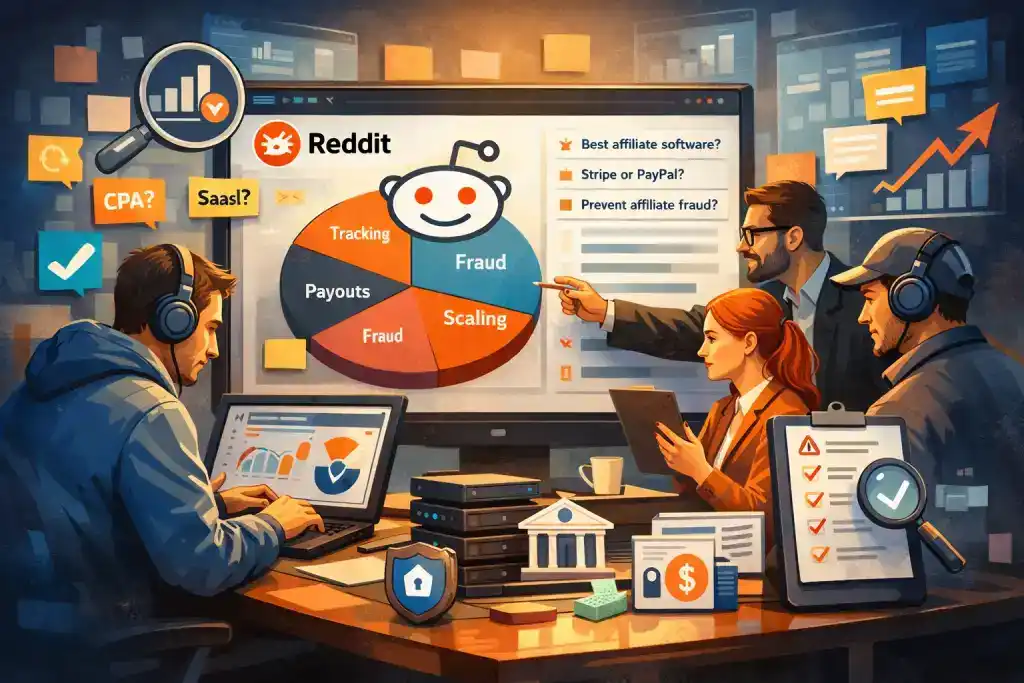
1) The #1 Reddit Question: “Which Affiliate Software Is Best for My Use Case?”
On Reddit, the “what’s best?” question almost always turns into follow-ups about context: what you’re selling, how you track revenue, and what kind of partners you expect.
“What affiliate tracking software are you using, and how’s it working for you?”
“What’s the best affiliate software for SaaS?”
What people usually clarify right away
- Stage: Are you pre-revenue, just launching, or already scaling?
- Commission model: CPA, RevShare, Hybrid, recurring, one-time?
- Vertical: iGaming, Forex/Finance, eCommerce, SaaS, mobile apps, lead gen.
- Scale: How many offers, how many affiliates, how many conversions/events per month?
- Geo + compliance: Where your traffic comes from and what restrictions you must enforce.
The key point your article should make: there is no “best for everyone.” Reddit users often regret choosing something too heavy (enterprise-level complexity) or too light (can’t handle real attribution or payouts) for their current stage.
If you want a “starting point” reference, tools lists like Top Affiliate Software Tools help compare categories—but your final choice should be driven by your model, volume, and constraints.
2) “Do I Even Need Affiliate Software, or Can I Use Stripe / PayPal / Google Analytics?”
This is a classic beginner question—and a very practical one. Reddit is full of people trying to keep costs down and asking whether basic tools are “good enough.”
“We’re still small. Can we just track it manually?”
“Can I do this with Google Sheets?”
“GA + UTMs are enough, right?”
Where manual tracking usually breaks
- Attribution gaps: UTMs don’t reliably connect partner clicks to purchases across devices and time.
- Partner-level rules: different commissions, tiers, and hold periods are painful to manage manually.
- Payout operations: reconciling payments becomes a recurring monthly mess.
- Disputes: without click IDs and logs, “you owe me a commission” becomes hard to resolve.
Google Analytics is great for marketing analytics, but it isn’t designed to be your affiliate link tracking system. In most cases, you adopt affiliate software the moment you care about: consistent attribution, automating payouts, and preventing costly mistakes.
3) “Affiliate Software vs Affiliate Network: What’s the Difference?”
This is one of the most confused topics on Reddit. People regularly mix up “software” and “network,” and that’s where bad decisions happen.
“If there’s a network, why do I need software?”
“Is an affiliate network basically the same thing as affiliate software?”
A simple way to frame it:
| Topic | Affiliate Software | Affiliate Network |
|---|---|---|
| What it is | Your platform to run your own program (tracking, payouts, rules) | A marketplace/ посредник that connects advertisers and affiliates |
| Data ownership | You own your program data and partner relationships | Often network-controlled access and policies |
| Costs | Typically a subscription + payment fees | Network fees, overrides, sometimes higher total cost |
| Best for | Brands wanting control and flexibility | Brands wanting built-in discovery/marketplace distribution |
If you want the deeper version, this explainer helps clarify the concept: Affiliate Networks Explained. The “ownership vs dependency” angle is what Reddit users are usually circling around: who controls the data, the rules, and the relationship.
4) “How Does Tracking Actually Work—And Can I Trust It?”
Reddit is especially valuable here because people share real pain: lost conversions, cookie issues, and iOS/Safari limitations. This is where the conversation goes from “features” to “reliability.”
“We’re losing conversions. Is cookie tracking broken?”
“How big is tracking loss on iOS/Safari?”
“What’s the difference between cookie tracking and postback?”
The core concepts people keep bumping into
- Cookie tracking: simple, common, but can be impacted by browser restrictions.
- S2S / postback tracking: often more reliable for performance tracking and auditing.
- Click IDs + logs: your “source of truth” when partners dispute attribution.
If your audience is mobile-heavy or you care about auditability, you’ll see Reddit pushing toward S2S and postback tracking. The practical takeaway: modern affiliate software without solid postback/S2S options is a risk as you scale.
5) “How Do You Prevent Affiliate Fraud?”
Fraud comes up constantly: fake leads, self-referrals, incentivized traffic, multi-accounting, and “creative” attribution attempts. Reddit users want to know what actually works—not just what vendors promise.
“How do you catch fake leads and self-referrals?”
“Is there any automatic fraud detection, or is it all manual?”
The honest framing (and what your article should emphasize): software isn’t a 100% shield, but it gives you tools. At minimum, people expect:
- Approval flows (manual approval early on, automated later)
- Rule enforcement (traffic restrictions, brand bidding rules, etc.)
- Hold periods (reduce refund and fraud exposure)
- Audit trails (click IDs, timestamps, partner metadata)
- Segmentation (treat trusted partners differently from new applicants)
6) “Why Is Affiliate Software So Expensive?”
Another repeat question: people see $300–$1,000/month tools and feel like they’re paying for “links and stats.” Reddit threads usually reveal what they’re actually paying for: infrastructure, reliability, and operations.
“Why is this $300–$1,000/month? It’s just links and reporting.”
What you’re really paying for
- Tracking infrastructure (high-volume events, redirect reliability, uptime)
- Attribution logic (dedupe rules, click windows, conversion rules)
- Operational tooling (payout workflows, holds, adjustments, reporting)
- Support + SLA expectations (especially when something breaks mid-campaign)
- Compliance features (GDPR, permissions, data control)
A useful way to frame cost: compare the subscription to the cost of mistakes—overpaying commissions, losing conversions, or burning hours on monthly reconciliation.
7) “Can I Scale Without Switching Affiliate Software?”
Founders worry about picking a tool and getting stuck. Reddit threads often include variations of:
“If we pick a tool now, are we going to outgrow it in 6 months?”
“What if we get 10,000 affiliates?”
Scaling considerations that matter early
- API access and webhooks for custom workflows
- Flexible commission logic (tiers, hybrid models, custom rules)
- White-label / branding for the partner portal experience
- Exports + logs so reporting doesn’t trap you
If you’re SaaS, remember scaling also means handling subscription lifecycle events, not just more clicks. (See: SaaS vs Hosted and Self-Hosted Affiliate Software.)
8) “Which Features Actually Matter—and Which Ones Are Just Marketing?”
This is a very Reddit-type question. People don’t want a longer feature list; they want clarity on what they’ll truly use after the first week.
“What features do you actually use day to day?”
“What turned out to be useless?”
Must-have features (most teams actually use)
- Reliable tracking + clear reporting
- Partner approval and management
- Payout workflows and adjustments
- Segmentation (campaigns, partner groups)
- Audit logs (click IDs / event history)
Nice-to-have features (helpful, but not essential at launch)
- Deep creative asset libraries
- Automated partner discovery (when it exists)
- Advanced A/B routing and smart links
Overhyped features (often sold harder than they’re used)
- “AI affiliate discovery” without real proof
- Overly complex dashboards that don’t change decisions
- Automation that creates more edge cases than value
If you need a terminology refresher, the affiliate marketing glossary can help align your team on definitions before choosing tools.
9) A Bonus Reality Check: Tracking vs Recruiting (They’re Not the Same)
One of the most useful Reddit insights is strategic: most affiliate software is built for managing partners you already have—not finding them. If your biggest problem is acquiring quality affiliates, you’ll still need outreach, partnerships, or marketplace-style distribution.
“Do these tools help with outreach, or do they just track and pay?”
“Most inbound applications are terrible—how do I find good affiliates proactively?”
If you’re in verticals where affiliate ecosystems are mature (for example, iGaming affiliate marketing), marketplace discovery can matter more. In niche services, referrals and relationship-driven partners often outperform “traditional” affiliates.
How Tracknow Turns Real Reddit Insights Into Practical Affiliate Software
Tracknow’s product development is driven by real-world usage, not assumptions. Our specialists continuously monitor relevant affiliate marketing, performance marketing, and SaaS-focused subreddits to understand what users are actually asking when they search for affiliate tracking software.
By analyzing recurring questions, complaints, and edge cases discussed on Reddit, we identify the real pain points behind affiliate programs: unreliable tracking, attribution disputes, fraud risks, payout complexity, and scalability issues. These insights directly influence how Tracknow evolves as a platform.
That’s why Tracknow is built to cover the most common and most critical user requirements. We focus on stable and transparent tracking, flexible commission logic, reliable payouts, and tools that support long-term growth without unnecessary complexity.
Tracknow is designed to work across a wide range of industries and business models, including SaaS, eCommerce, finance, iGaming, lead generation, mobile-first products, and hybrid setups. Instead of optimizing for a single niche, we aim to support the majority of real affiliate use cases discussed by users—so businesses can launch, manage, and scale affiliate programs with confidence.
In short, Tracknow doesn’t just follow market trends. We build affiliate software around the questions users keep asking—and the problems they actually need solved.
Conclusion: What All Reddit Questions Have in Common
The pattern behind almost every Reddit thread is the same: people want control, transparency, and reliability— not just a prettier dashboard.
- Control: clear rules, approval flows, and audit logs
- Transparency: attribution you can explain and defend
- Reliability: tracking that doesn’t collapse under real-world conditions
Most painful affiliate program problems come from choosing the wrong tool for your stage: too complex, too limited, or missing the tracking fundamentals. Treat affiliate software as infrastructure. Pick what solves your real constraints today—and what won’t break when you scale tomorrow.
For a practical overview of running a program end-to-end, start here: Affiliate Program.