
Affiliate Marketing KPIs Every Manager Should Track
The affiliate KPIs that actually drive decisions — EPC, CR, AOV, activation, refunds, and quality metrics — plus how to build a dashboard managers and finance both trust.

The affiliate KPIs that actually drive decisions — EPC, CR, AOV, activation, refunds, and quality metrics — plus how to build a dashboard managers and finance both trust
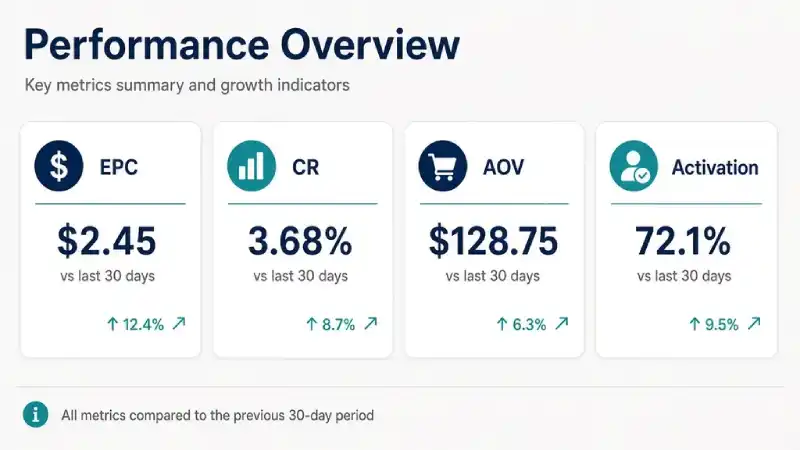
Affiliate programs drown in numbers. Clicks, impressions, signups, approvals, payouts, “top partners” lists that reshuffle every Monday. Without a short list of KPIs tied to business outcomes, managers optimize noise — and partners learn to game the wrong metric.
This guide defines the affiliate marketing KPIs every manager should track: EPC, conversion rate (CR), average order value (AOV), and the quality metrics that sit beyond vanity volume. You will get formulas in plain language, a dashboard structure, and decision rules for recruiting, enabling, or cutting partners. Industry context from Affiliate Marketing in 2026 helps set expectations — your baselines should still come from your own data.
KPIs only work when tracking is trustworthy. Incomplete attribution or cookieless gaps will distort EPC and CR; keep foundations solid with Multi-Touch Attribution Models for Affiliate Marketing and Cookieless Tracking in 2026 before you debate partner rankings.
Quick Summary
- Lead with EPC and CR by partner and sub-ID — not raw clicks.
- Add AOV / LTV proxies and refund rates so “high converting” traffic is not low-value traffic.
- Track partner activation and time-to-first-conversion to judge recruitment quality.
- Separate volume KPIs from quality KPIs; reward the mix that protects margin.
- Review weekly at partner level; monthly at program level against CAC/payback goals.
- Use software that exposes the same numbers partners see — see How to Choose the Best Affiliate Management Platform.
What Makes a Good Affiliate KPI
A useful KPI is actionable, auditable, and shared. Actionable means a change in the number suggests a clear next step (enable, coach, cut, change creative). Auditable means finance can reconcile it to payouts. Shared means partners understand the definition — no private “marketing math.”
Avoid KPI soup. Start with a core scorecard (5–8 metrics), then add vertical-specific ones. If a metric never changes a decision for 90 days, drop it from the weekly view.
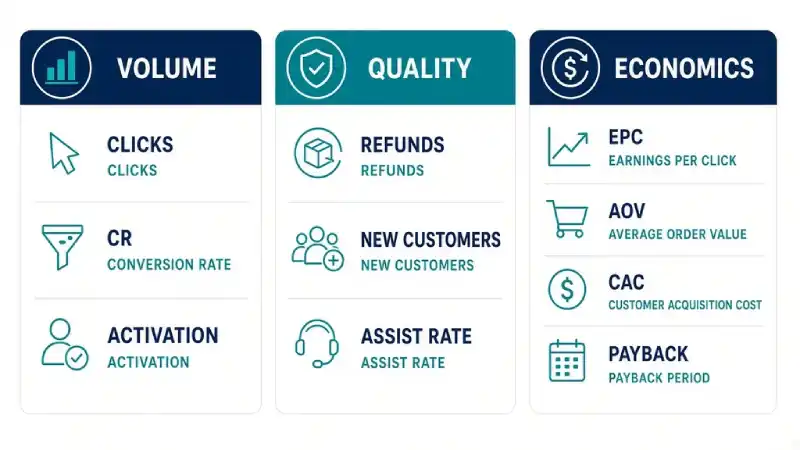
Core KPIs: EPC, CR, AOV, and Friends
1. Earnings Per Click (EPC)
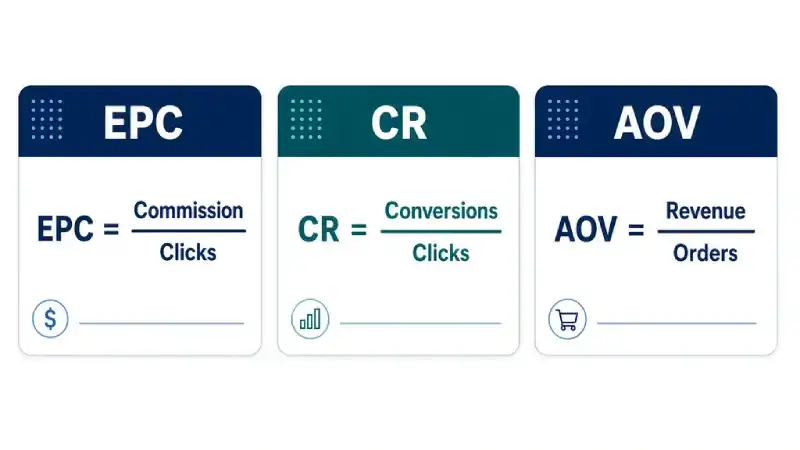
What it is: Commission earned divided by clicks (often unique clicks).
Why it matters: The common language between advertisers and publishers. Compares partners with different traffic volumes.
Watch for: EPC inflated by brand bidding or coupon interception; EPC collapsed by broken landers.
Decision: Scale partners with stable EPC and acceptable refund rates; investigate spikes before celebrating.
2. Conversion Rate (CR)
What it is: Conversions ÷ clicks for the payable event.
Why it matters: Diagnoses traffic quality and landing experience.
Watch for: Device and geo mix; CR without AOV/LTV can mislead.
Decision: Low CR + high clicks → lander/message match or traffic type issue. High CR + tiny volume → recruit lookalikes.
3. Average Order Value (AOV) / Revenue per Conversion
What it is: Revenue (or contribution) per paid conversion.
Why it matters: Two partners with identical CR can deliver very different economics.
SaaS proxy: Initial plan value or first-month MRR per paid account.
Decision: Prefer partners who bring higher AOV cohorts if margins allow; adjust creatives toward higher-tier plans carefully (no misleading upsells).
4. Click volume and unique clicks
Necessary context, never the north star. Rising clicks with flat conversions usually means wasted partner effort or wrong audience.
5. Partner-sourced revenue / MRR
The business outcome KPI. Track new vs returning customers when possible so you see incrementality, not only last-click credit.
6. Refund / chargeback / clawback rate
Quality filter. High EPC that reverses next month is not a win. Segment by partner before renewing bonuses.
7. Partner activation rate
Approved partners who generate a click (or conversion) within 30 days ÷ approved partners. Low activation means recruitment or onboarding is broken — fix before buying more leads. Tie this to How to Recruit Affiliates for a New Program.
8. Time to convert
Median time from click to payable event. Validates attribution windows and reveals slow B2B paths vs impulse offers.
KPIs Beyond the Basics
New customer rate
Share of conversions from first-time customers. Separates demand creation from intercept (coupons, brand bids).
Assisted conversions
Partners who appear in paths but rarely win last-click. Use for enablement and bonuses even if payouts stay last-click.
Unattributed conversion rate
Payable events missing a valid click ID. Rising rate means tracking regression — treat as a P0 ops KPI.
Approval-to-active lag
Days from approval to first click. Long lag → weak welcome sequence.
Concentration risk
Revenue share of top 3 partners. Over-concentration is a business continuity risk.
CAC and payback (program level)
Roll affiliate costs (commissions + tools + manager time) into channel CAC and payback. Deep dives belong in How to Calculate Customer Acquisition Cost (CAC) for Affiliate-Driven SaaS Growth and How to Measure ROAS and ROI for Affiliate Campaigns.
How to Build a Manager Dashboard
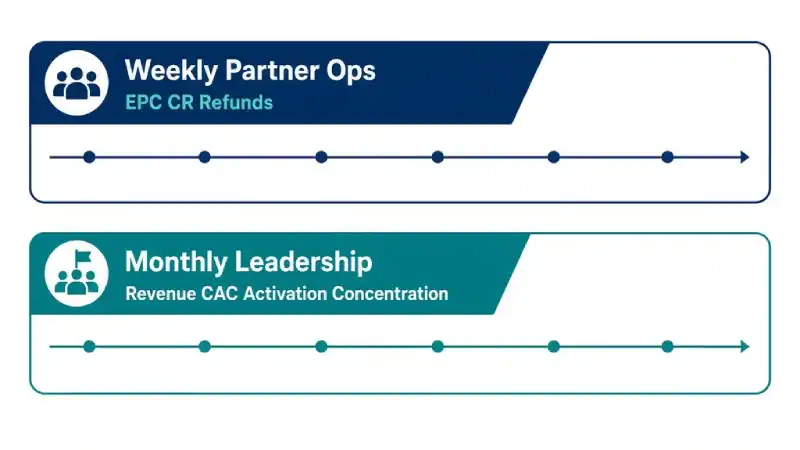
Weekly (partner ops): EPC, CR, clicks, conversions, refunds, new vs returning, top movers up/down.
Monthly (leadership): Partner-sourced revenue, CAC/payback, activation rate, concentration, dispute count, unattributed rate.
Segments that matter: partner type (content, coupon, influencer, agency), geo, device, campaign/sub-ID.
Compare partners inside the same type. A coupon partner’s CR is not judged like a YouTube educator’s CR. Context prevents bad cuts.
Align KPI definitions with program design before launch — your Affiliate Program Launch Checklist should include metric ownership with finance.
Mini scenario: High CR, bad business
A loyalty partner posted excellent CR and EPC. Refund rate was 3× program average. After including refunds in the weekly scorecard, the brand capped incentives and shifted budget to content partners with lower CR but cleaner cohorts.
Mini scenario: Recruitment vanity
A startup celebrated 200 approved affiliates. 30-day activation was 8%. They changed the KPI to activated partners, rebuilt onboarding, and stopped network blasts. Active partners fell in count and rose in revenue.
Mini scenario: EPC spike from brand bids
EPC jumped for two SEM partners during a sale. Search-term checks showed brand exact queries. After Brand Bidding Policies for Affiliate Programs enforcement, EPC normalized and direct brand CPC improved.
Decision Rules Using KPIs
- Scale: Stable EPC, solid CR, acceptable refunds, growing or steady AOV for 4+ weeks
- Coach: Fit looks right, CR below peer group, lander or creative likely issue
- Restrict: Policy risk, brand bidding, or fraud signals — even if EPC looks great
- Cut: Chronic non-activation, repeated violations, or unprofitable cohorts after coaching
KPIs inform Performance Marketing vs Affiliate Marketing debates inside the company: affiliate is a channel with measurable unit economics, not a black box. Looking ahead, automation and forecasting will layer on these same primitives — themes in Affiliate Marketing Trends for 2026-2027 and AI in Affiliate Marketing.
Common Mistakes (and How to Avoid Them)
Optimizing clicks. Partners will send junk if you pay attention to volume alone.
One global CR target. Segment by geo, device, and partner type.
Ignoring clawbacks. Celebrate net economics, not gross EPC.
Private dashboards partners cannot reconcile. Disputes explode when numbers disagree.
Changing definitions monthly. Lock formulas; version them if you must change.
No quality KPI beside EPC. Add refunds, new-customer rate, or LTV proxy.
Reviewing only top 10 partners. Mid-tier partners hide both fraud and upside.
Treating attribution gaps as partner failure. Fix unattributed rate before cutting people.
Conclusion
Affiliate marketing KPIs work when they are few, shared, and tied to decisions. EPC, CR, and AOV form the core language of performance. Activation, refunds, new-customer rate, and unattributed conversions protect quality and operations. Build a weekly partner view and a monthly leadership view — then act with clear scale / coach / cut rules.
Managers who instrument these metrics stop arguing about opinions and start managing a channel.
If you need affiliate software with partner-level reporting for EPC, conversions, and payouts your team and affiliates can both trust, Tracknow is a strong place to start.
FAQ
What is a good EPC for affiliate marketing?
There is no universal number. EPC varies by vertical, geo, device, and commission model. Benchmark against your own top quartile partners in the same partner type, not against generic public averages.
Should I track CR on clicks or unique clicks?
Pick one definition and stick to it. Unique clicks reduce inflation from reloads; raw clicks can still help diagnose technical issues. Document the choice in your KPI glossary.
Is AOV relevant for SaaS affiliate programs?
Yes — use first invoice value, plan tier mix, or early MRR as the AOV proxy. Subscription businesses should also watch retention of partner-sourced cohorts.
How often should managers review affiliate KPIs?
Weekly for partner ops; monthly for program economics. Daily only during launches, major incidents, or fraud spikes.
What’s more important — EPC or CR?
They answer different questions. CR diagnoses conversion friction and traffic fit; EPC summarizes economics per click. Use both. A partner with modest CR but excellent AOV and low refunds can outperform a high-CR coupon partner.
How do I stop partners from gaming KPIs?
Do not incentivize raw clicks. Pay on qualified events, monitor refunds and new-customer rates, enforce traffic rules, and audit sudden EPC spikes.
Which KPI best measures recruitment success?
30-day partner activation rate and time-to-first-click beat “number of approved affiliates.”
How do attribution models affect KPIs?
Last-click EPC can undervalue content partners. Keep payout KPIs per your contract, and use assist metrics for enablement decisions.
Should finance and marketing share one dashboard?
Yes for payable conversions, commissions, and clawbacks. Marketing may add engagement diagnostics, but money metrics must match the ledger.
What KPI should I add first if I only track clicks today?
Add CR and EPC on the payable event immediately, then refund rate. Those three already change decisions.
10-Point Checklist for Affiliate Marketing KPIs
- Payable conversion event defined and used in every CR/EPC calculation.
- EPC and CR reported by partner, geo, and device.
- AOV or revenue-per-conversion tracked beside CR.
- Refund/chargeback/clawback rate on the weekly scorecard.
- 30-day partner activation rate measured for new approvals.
- New vs returning customer split available where data allows.
- Unattributed conversion rate monitored as a tracking health KPI.
- Weekly partner review and monthly leadership review scheduled.
- Scale / coach / cut rules written against KPI thresholds.
- Partners can see aligned stats for clicks, conversions, and commissions.