
Brand Bidding Policies for Affiliate Programs: Allow, Restrict, or Ban?
How to decide whether affiliates may bid on your brand keywords — policy options, enforcement tactics, and the trade-offs between CAC control and partner coverage.

How to decide whether affiliates may bid on your brand keywords — policy options, enforcement tactics, and the trade-offs between CAC control and partner coverage
Brand bidding is one of the fastest ways to start an affiliate dispute. A partner bids on your trademark in Google Ads or Bing, sits above your own ad, and collects commission on customers who already searched for you by name. Your CPC rises. Your direct session share falls. The partner calls it “coverage.” Finance calls it cannibalization.
There is no universal correct answer. Some programs ban brand bidding entirely. Others allow it with strict rules. A few encourage it when brand coverage is weak. What matters is an explicit policy, clean enforcement, and terms that match how an affiliate program actually pays. Ambiguity — “please don’t compete with us too much” — is how auctions and relationships break.
This guide compares allow / restrict / ban options, shows how to write and police rules, and connects brand bidding to broader compliance and paid-search strategy. Keep shared vocabulary handy via the affiliate marketing glossary, and make sure click locking and attribution windows support the policy you choose through solid Affiliate Tracking Methods (And Where They Actually Work).
Quick Summary
- Brand bidding means affiliates running paid search on your trademark or close variants — decide allow, restrict, or ban in writing.
- Bans protect CAC and message control; restrictions (no exact match, no competitors + brand, approved ads only) are the common middle path.
- Allowing brand bids can improve SERP coverage when you under-invest in brand search — but expect higher partner commissions on navigational traffic.
- Enforcement needs monitoring, evidence, warnings, and link suspension — policy without policing is theater.
- Align brand-bid rules with disclosure and advertising compliance from Affiliate Marketing Compliance in 2026.
- Put the rule in launch terms before recruitment scales — see your Affiliate Program Launch Checklist.
What Brand Bidding Means for Affiliate Programs
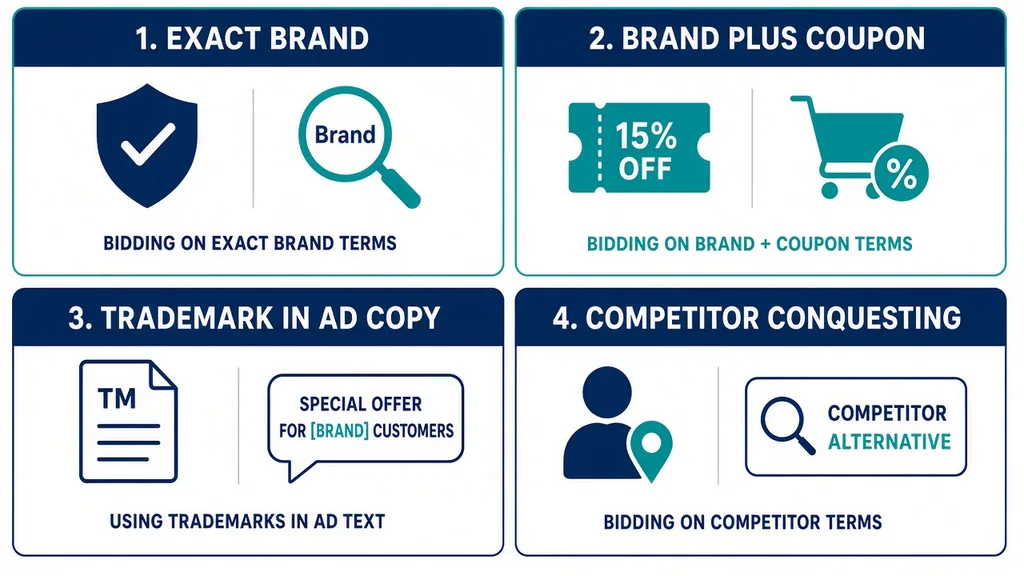
Brand bidding (sometimes called trademark bidding) is when an affiliate bids on keywords that include your brand name, product names, or misspellings — usually in paid search. Related behaviors include:
- Bidding on Brand + coupon, Brand + login, Brand + review
- Using your trademark in ad copy or display URL paths without permission
- Directing traffic to the affiliate’s pre-lander instead of your official page
- Competing against your own brand campaigns in the same auction
Organic ranking for your brand is different. Most policies target paid search and paid shopping. Social ads using brand terms may need a parallel rule.
Option A — Ban Brand Bidding
A full ban prohibits affiliates from bidding on your trademarks, brand terms, and often specified misspellings. Violations can mean commission denial, link suspension, or termination.
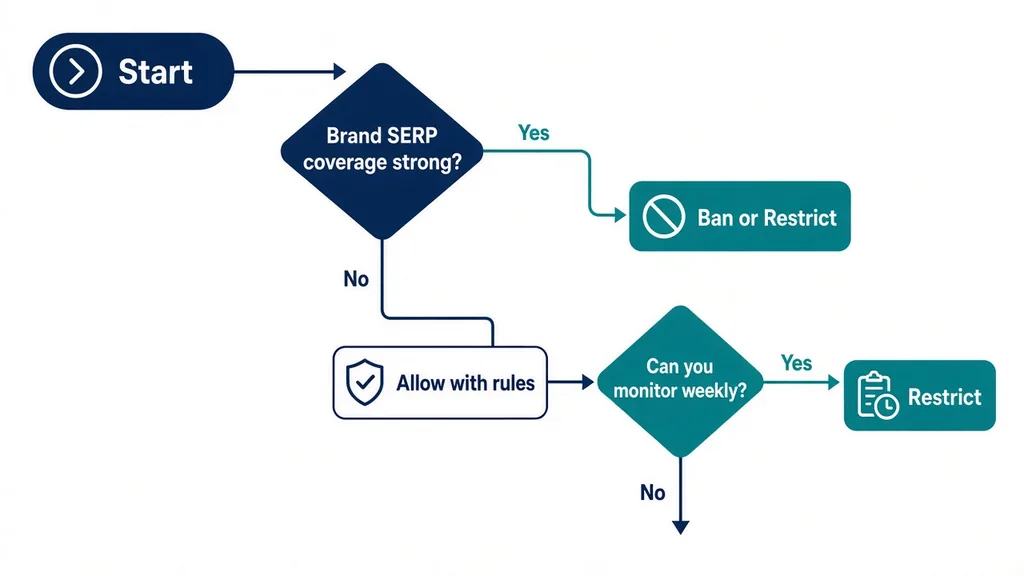
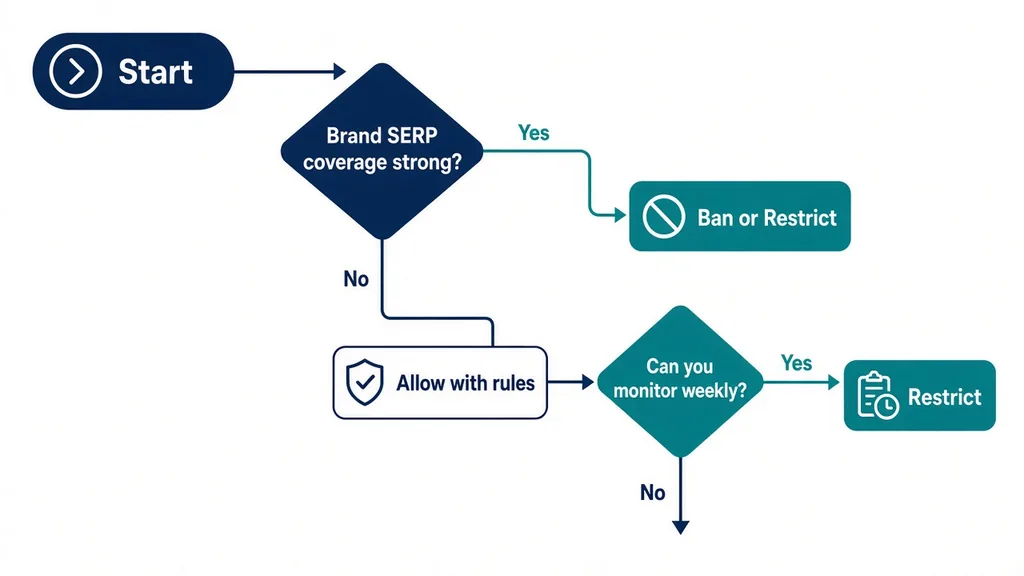
When a ban fits
- You already dominate brand SERPs with your own ads and organic results
- Navigational traffic converts well without partners
- Past partners inflated EPC by intercepting brand search
- Legal/brand wants tight trademark control
Trade-offs
- Less “extra” coverage if competitors or scam sites bid on your brand and you leave gaps
- Some paid-search affiliates will not join
- You must monitor continuously — bans fail without enforcement
Option B — Restrict Brand Bidding
Restricted policies allow limited brand activity under rules, for example:
- No exact-match brand keywords; broad match modifiers banned
- Brand + generic allowed (e.g., “Brand alternative”) but not “Brand official”
- No trademark in ad titles; landing page must be approved
- Negative keywords required for pure brand terms
- Only pre-approved partners may bid brand (whitelist)
- Lower commission on brand-attributed orders
Restriction is the most common mature-program choice: keep helpful partners, cut pure interception.
When restrict fits
- You want partner help on brand+intent queries without giving away all navigational traffic
- You can review ads and landing pages
- You have capacity to audit search terms reports
Option C — Allow Brand Bidding
Open allow means partners may bid on brand terms, sometimes with only basic trademark-in-copy limits. Rare as a blank check; more often “allow with disclosure and no misleading ads.”
When allow can make sense
- You do not run brand search ads and lose clicks to scavenger sites
- New brands with weak organic presence
- Geo expansion where you lack local SEM coverage
Trade-offs
- Higher chance of paying commission on customers who would have converted direct
- Message inconsistency and trademark risk if ads are sloppy
- Harder last-click fairness debates with content partners
How to Choose: A Practical Framework
- Measure cannibalization risk. Estimate how much partner-attributed revenue comes from brand queries (search term reports, UTM patterns, promo-code surveys).
- Check your own brand SEM. If you under-bid brand, partners may be plugging a hole — fix coverage first, then decide policy.
- Map partner types. Coupon and loyalty partners push for brand bids; content partners rarely need them.
- Model unit economics. Paying CPA/RevShare on navigational traffic may exceed the cost of your own brand CPC.
- Pick allow / restrict / ban and write examples of allowed vs forbidden keywords.
- Align with paid-search strategy for non-brand partner traffic — see Paid Search for Affiliate Programs.
- Publish, educate, enforce on a fixed cadence.
When evaluating platforms, prefer tools that make partner link control and incident response easy — criteria discussed in How to Choose the Best Affiliate Management Platform.
Writing and Enforcing the Policy
Put brand bidding in program terms with:
- Definitions (exact brand, misspellings, brand+coupon)
- Allowed / forbidden examples
- Ad copy and landing-page rules
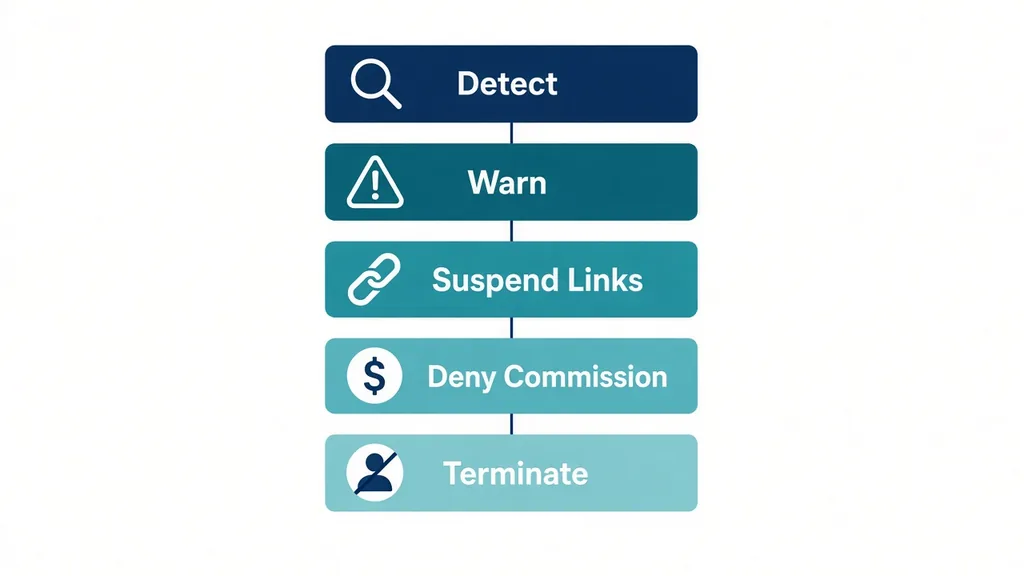
- Commission treatment for violations (deny, reverse, suspend)
- Monitoring rights and evidence standards
- Appeal process
Enforcement toolkit:
- Weekly brand SERP checks in priority geos
- Auction insights / competitive diagnostics where available
- Partner search-term report requests
- Screenshot evidence with timestamps
- Warning → pause links → terminate progression
Brand bidding often overlaps fraud-ish interception and spammy scavenger behavior — connect reviews with Affiliate Fraud Detection and How to Protect Your Brand from Affiliate Spam and Black-Hat Tactics. UK advertisers should also align ad claims with ASA and CAP Guidelines for Affiliate Marketers in the UK.
Mini scenario: Ban after coupon interception
An ecommerce brand saw 40% of affiliate revenue from brand+coupon terms. Direct branded CPC rose while organic brand CTR fell. They banned brand bidding, denied commissions on proven violators, and raised content-partner tiers. Affiliate revenue dipped; contribution margin and direct brand efficiency improved.
Mini scenario: Restrict with whitelist
A SaaS company allowed two SEM specialists to bid brand+“alternative” and brand+“vs competitor” with approved ads only. Exact brand was banned. Coverage on comparison queries rose without partners buying the navigational term alone.
Mini scenario: Temporary allow in a new market
A fintech entered a new country without a local SEM team. They allowed brand bidding for 90 days with approved landing pages, then reversed to restrict once in-house brand campaigns were live. Partners received 30 days’ notice before the change.
Common Mistakes (and How to Avoid Them)
No written policy. “We prefer you don’t” is unenforceable.
Banning without monitoring. Violators keep bidding until someone checks.
Changing rules without notice. Give partners a runway; sudden clawbacks destroy trust.
Treating all brand+ queries the same. “Brand scam review” informational intent differs from “Brand official site.”
Ignoring misspellings and local-language trademarks. List variants explicitly.
Paying full commission on intercepted brand traffic. If you allow restricted brand bids, consider reduced rates.
Confusing trademark law with program policy. Platform trademark complaint tools and your affiliate terms are related but not identical — use both when appropriate.
Not coordinating with your SEM team. Affiliate and brand search must share one strategy.
Conclusion
Allow, restrict, or ban — each brand bidding policy can be rational. Bans protect navigational traffic and CAC. Restrictions preserve useful partner coverage with guardrails. Open allow is situational, usually temporary or coverage-driven. Write the rule, train partners, monitor SERPs, and enforce consistently.
Brand bidding policy is part of program integrity, not a footnote. Decide it before scale, not after the first auction war.
If you need affiliate software that helps you manage partner links, commissions, and rapid response when policy violations appear, Tracknow is a strong place to start.
FAQ
What is affiliate brand bidding?
It is when affiliates run paid ads on your brand name or trademark-related keywords to earn commissions on the resulting clicks and conversions. Policies define whether that is allowed, limited, or forbidden.
Is brand bidding illegal?
Not automatically. Trademark and advertising rules vary by country and platform. Many disputes are contractual (program terms) rather than pure trademark lawsuits. Still involve counsel for serious or repeated abuse.
Should new programs ban brand bidding from day one?
Often yes, if you will run your own brand campaigns. If you cannot cover brand search yet, a time-boxed allow or restrict policy with approved ads may be safer than silence.
How do I detect brand bidding by affiliates?
Search your brand terms weekly, review auction insights, inspect landing URLs, and request search-term reports from suspected partners. Screenshot evidence with dates before you act.
Can I deny commission without banning the partner?
If terms allow it — yes. Many programs deny commission on violating clicks, require ad removal, and escalate only on repeat offenses.
What about brand bidding on competitors’ names?
That is conquesting, not your brand policy. You may still regulate misleading ads and trademark use of others’ marks. Separate conquesting rules reduce legal and platform risk.
Do organic brand mentions violate brand bidding rules?
Usually no. Policies target paid search (and sometimes paid social). Clarify scope so content partners are not confused.
How does attribution interact with brand bidding?
Last-click models reward whoever wins the final paid click — often the brand bidder. If you ban brand bids, you reduce that interception. Multi-touch insight can show assists, but payouts follow your contract.
Should coupon partners get different brand rules?
Many brands apply the same ban/restrict rules to everyone, then add coupon-specific landing and trademark-in-copy limits. Consistency is easier to enforce than special cases — unless a strategic partner is explicitly whitelisted.
How much notice should I give before tightening policy?
Common practice is 14–30 days for material changes, longer if partners have large brand campaigns live. State the effective date and examples of newly forbidden terms.
10-Point Checklist for Affiliate Brand Bidding Policies
- Policy choice documented: allow, restrict, or ban.
- Keyword and ad-copy examples of allowed vs forbidden behavior.
- Misspellings and local-language brand variants listed.
- Commission consequences for violations defined.
- Monitoring cadence assigned (weekly brand SERP checks).
- Evidence standard for warnings and denials agreed with finance.
- SEM team and affiliate team share one brand coverage plan.
- Partners educated at onboarding and after policy updates.
- Link pause / termination workflow tested.
- Notice period defined for future policy changes.