
Best IB Software for MLM & Sub-Affiliate Programs
Compare the best IB software for MLM and sub-affiliate programs, including per-lot, spread-share, profit-share, RevShare and Master IB controls.

Introducing Broker programs can become one of the strongest distribution channels for a forex, CFD, crypto, or multi-asset broker. They can also become one of the most difficult parts of the business to control when the network grows beyond a small number of direct partners.
A flat program is relatively simple: an IB refers a trader, trading activity is attributed to that IB, and the broker calculates a commission. A multi-level program adds Master IBs, sub-IBs, regional partners, custom payout pools, different rates by level, and potentially several commission models operating at the same time.
The software may need to calculate per-lot commissions, commission or revenue share, spread and pip share, profit or P&L share, qualified CPA, cashback, performance tiers, and custom hybrid deals. It must then distribute the result through the correct hierarchy without double-counting the same trade or losing the calculation path.
This guide compares eight IB software platforms with publicly documented multi-level, sub-IB, rebate-tree, or Master IB functionality. The goal is not to reward the vendor with the longest feature list. It is to identify which platforms can reproduce real IB agreements, process trading data accurately, and keep every payout understandable as the network expands.
Updated: August 30, 2026.
Editorial Note, Disclosure & Evaluation Methodology
Disclosure: This guide is published by Tracknow, which is one of the products included below. No competitor paid for inclusion or placement in this comparison. Information about competing products is based on publicly available materials published on official vendor websites and documentation reviewed in August 2026.
Public product pages do not always describe every limitation, configuration dependency, implementation fee, or contract term. Where a vendor does not publish an exact price, hierarchy limit, or commission rule, this article says so rather than estimating it. Every critical claim should be validated in a live demo, proof of concept, technical statement of work, and final contract.
The platforms were reviewed through eight practical lenses:
- Hierarchy management: support for Master IBs, sub-IBs, multiple partner levels, referral trees, relationship changes, and independent reporting by level.
- Commission flexibility: per-lot, per-volume, commission share, RevShare, spread or pip share, profit/P&L share, CPA, hybrid, fixed, tiered, and custom formulas.
- Master IB control: whether a senior partner can recruit sub-IBs, see its network, and control downstream rates within limits defined by the broker.
- Trading-data integration: connectivity with MT4, MT5, cTrader, DXtrade, B2TRADER, proprietary platforms, broker CRMs, and custom API or database feeds.
- Reporting and reconciliation: access to trade-level data, symbol, volume, spread, commission, P&L, hierarchy, adjustments, exports, APIs, and audit history.
- Operations and payouts: onboarding, partner approval, invoices, wallets, payment scheduling, rebate automation, corrections, approvals, and payout statements.
- Governance: roles, permissions, KYC, data visibility, relationship changes, audit logs, and controls over what Master IBs and sub-IBs can see or change.
- Pricing and total cost: licence fees, implementation, integrations, migration, additional brands, data volume, custom development, support, and internal administration.
There is no universal scoring system. A standalone IB layer that integrates with an existing CRM may be the best option for one broker, while another may prefer an IB module inside a complete brokerage CRM. The correct choice depends on the commercial model, trading platforms, existing infrastructure, partner structure, and level of operational control required.
What IB Software for MLM Programs Actually Needs to Do
Generic affiliate software usually attributes a click and a conversion. IB software must often process a much longer relationship:
Referral click → registration → KYC → trading account → deposit → first trade → ongoing positions → lots or volume → spread, commission or P&L → IB payout → upstream payout.
A trader may continue generating eligible activity for months or years. The platform must preserve the correct IB relationship, receive reliable trading data, apply the correct symbol and account-group rules, and calculate commissions repeatedly without treating every trade as a new acquisition.
In a multi-level network, the software also needs to know who recruited whom. The direct IB may receive a per-lot payment, the parent may receive an override, and the Master IB may receive a percentage or fixed share from the same activity. The broker may want those payouts added on top of one another, distributed from a fixed pool, or calculated using different bases at different levels.
The system must therefore answer four questions for every payment:
- Which trader and trade created the value?
- Which direct IB owns the trader relationship?
- Which upstream partners are eligible for a reward?
- Which formula, rate, currency, period, and approval rule applied at every level?
How an IB MLM & Sub-Affiliate Hierarchy Works
A common structure looks like this:
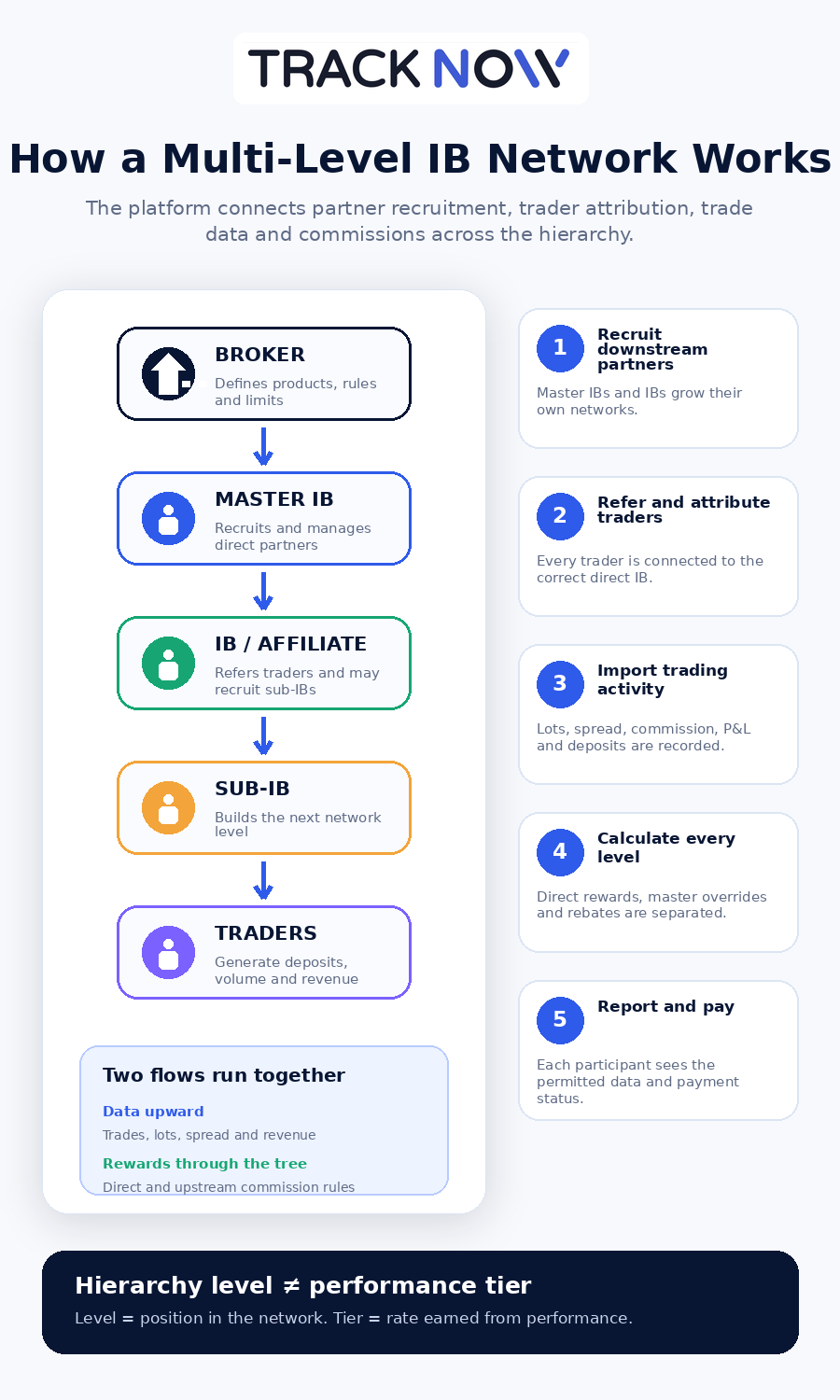
Broker → Master IB → IB → Sub-IB → Trader
The names differ between businesses. A platform may use Master IB, parent IB, network partner, regional partner, agent, sub-agent, affiliate, or sub-affiliate. The software does not need to use one universal label, but it does need to preserve the relationship and apply the correct permissions and payout logic.
The broker owns the program and defines the maximum commercial limits. A Master IB may recruit and manage a network, negotiate rates with direct sub-IBs, and receive an override from downstream activity. The direct IB or sub-IB refers traders and receives the primary commission. Traders generate the deposits, positions, volume, spread, fees, or P&L from which commissions are calculated.
Hierarchy levels are not the same as performance tiers
This distinction is essential because the word “tier” is often used for two different concepts.
A hierarchy level describes the IB’s position in the referral tree. A Master IB may be one level above an IB and two levels above a sub-IB.
A performance tier changes the IB’s own rate after it reaches a threshold. For example, an IB may earn $3 per lot up to 500 lots, $4 per lot from 501 to 1,500 lots, and $5 per lot above 1,500 lots.
The same IB can have both. It may sit at Level 2 in the hierarchy while qualifying for the highest performance tier. The platform must not confuse the two calculations.
The Hard Truths Brokers Learn When IB Networks Scale
More levels do not automatically create more growth. Every additional level introduces relationship ownership, visibility, commission, migration, and dispute questions. A deep tree only makes sense when each level performs a real commercial function.
A per-lot rate can exceed the broker’s revenue. A simple $3-per-lot rule looks predictable, but profitability depends on the actual commission, markup, spread, rebates, execution model, instrument, and account group. Fixed rewards should be tested against low-margin symbols and high-volume traders.
“Spread share” is not one universal field. It may mean a percentage of raw spread, broker markup, a fixed number of pips or points, or a calculated value supplied by the trading platform. The contract and data mapping need to use the same definition.
“Profit share” is even more sensitive. It may be based on broker net revenue, dealing P&L, a client-profit metric, realized results, or another custom field. The system must reproduce the exact agreed calculation and treatment of negative periods, fees, swaps, chargebacks, and later corrections.
Master IB flexibility without limits creates margin risk. A senior partner may need freedom to set sub-IB rates, but the broker should define a maximum pool, percentage, or commercial cap. Otherwise, downstream deals can exceed the revenue available to fund them.
Relationship changes can rewrite economics. Moving a sub-IB from one Master IB to another raises immediate questions: who receives future rewards, who owns existing traders, whether historical statements change, and whether the old parent retains any rights.
Monthly totals are not enough for reconciliation. Finance needs the trade-level path from source data to direct commission and every upstream reward. Without it, a payout dispute becomes a manual investigation across CRM exports, platform reports, and spreadsheets.
IB Program Maturity Levels
Not every broker needs the same architecture. It is useful to define the program’s operating stage before comparing software.
Level 1 — Direct IB Launch. A small number of direct partners, one trading platform, simple per-lot or commission-share payments, manual approvals, and limited reporting. The priority is reliable attribution and clear statements.
Level 2 — Structured Growth. Several IB groups, performance tiers, CPA plus trade-based models, automated calculations, multiple currencies, scheduled payouts, and regular reconciliation with the broker CRM or back office.
Level 3 — Multi-Level Network. Master IBs, sub-IB recruitment, custom rates by level, several products or symbols, downstream overrides, permissions, separate dashboards, relationship-change procedures, and automated distribution.
Level 4 — Multi-Brand or Regulated Enterprise. Multiple brands, legal entities, jurisdictions, trading platforms, account groups, audit requirements, formal KYC for partners, advanced data retention, custom integrations, service-level agreements, and a documented migration and exit plan.
Define Your Requirements Before Booking Demos
A vendor demo is far more useful when every shortlisted platform receives the same scenario. Document the following first:
- The complete hierarchy, including the maximum number of levels and expected partner count.
- Whether every IB can recruit sub-IBs or only approved Master IBs.
- Whether the Master IB may set downstream rates and which broker-defined cap applies.
- Whether upstream payouts are added on top of the direct reward or distributed from a fixed pool.
- The trading platforms, CRM, back office, data warehouse, payment tools, and APIs involved.
- The event and data fields required: account ID, position ID, symbol, volume, side, open/close time, spread, commission, swap, markup, P&L, deposit, FTD, and account group.
- The exact definition of a lot, eligible volume, round turn, partial close, and corrected position.
- The exact commission formula for every direct and upstream level.
- Rules by symbol, asset class, platform group, account type, country, brand, and currency.
- Performance-tier thresholds and whether changes apply immediately, prospectively, or from the next period.
- Partner and trader visibility rules.
- Approval, invoice, wallet, payment, and negative-balance workflows.
- Migration of existing links, IB relationships, traders, historical trades, balances, and payout statements.
- Expected monthly traders, positions, lots, API traffic, data retention, affiliates, managers, and brands.
Payout Structures for IB & Sub-IB Networks
IB software should not force every broker into one reward formula. The commercial agreement may use trading volume, broker revenue, spread, commission, profit, acquisition events, or a combination of several inputs.
Per-Lot and Per-Volume Commissions
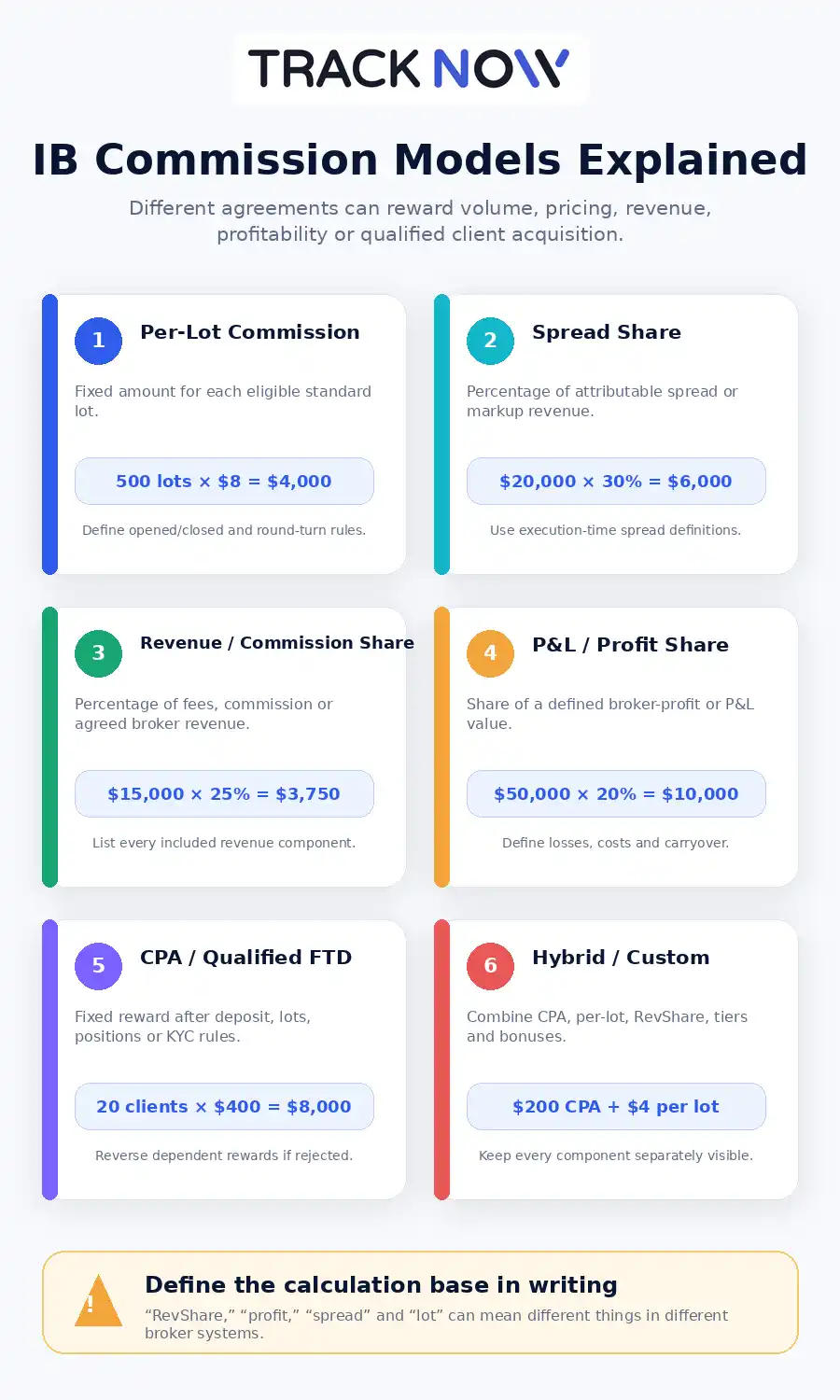
Per-lot is one of the most common IB models. The broker pays a fixed amount for each eligible lot traded by referred clients.
Commission = eligible lots × rate per lot
If referred clients trade 100 eligible lots and the IB rate is $3 per lot:
100 × $3 = $300
The formula looks simple, but the implementation questions are not:
- Does one lot mean one side of the trade or a complete round turn?
- Is commission calculated when the position opens, closes, or both?
- How are partial closes counted?
- How are mini, micro, crypto, index, commodity, and CFD contract sizes normalized?
- Do all symbols use the same rate?
- Are internal, hedged, abusive, or very short-duration trades eligible?
- What happens when a trade is corrected or deleted?
Multi-level programs can distribute the per-lot amount in two main ways. An additive model pays the direct IB and then pays extra overrides to upstream partners. A fixed-pool model sets a maximum amount per lot and splits it between the direct IB, parent, and Master IB.
Commission Share and Revenue Share
A commission-share model pays the IB a percentage of the commission, markup, or another revenue value earned by the broker from referred trading activity.
IB reward = eligible broker commission × agreed percentage
If the broker receives $10,000 in eligible commissions and the IB rate is 25%:
$10,000 × 25% = $2,500
The term RevShare should always be defined in the agreement. It may refer to trading commission, markup, spread revenue, swaps, net broker revenue, or a custom value created by the broker’s data layer. The platform needs the same field and deduction policy used by finance.
Spread Share, Pip Share, Point Share and Markup
Spread-based structures reward the IB from the spread or markup generated by referred trades. The payout may be expressed as:
- a percentage of a spread value;
- a fixed number of pips or points per lot;
- a percentage of the broker’s markup;
- a symbol-specific spread-share rate;
- a fixed amount derived from volume and points.
These formulas require accurate instrument data. A “pip” in one symbol may not have the same economic value as a point in another. Contract size, quote currency, account currency, conversion rate, platform group, and symbol specification can all affect the final amount.
The proof of concept should include major FX pairs, metals, indices, crypto, partial closes, different contract sizes, and several account currencies.
Profit Share and P&L-Based Commissions
A profit-share model pays a percentage of an agreed profit or P&L field associated with referred traders.
IB reward = eligible net P&L or profit × agreed percentage
If the eligible profit is $8,000 and the IB receives 20%:
$8,000 × 20% = $1,600
The software cannot make this model safe unless the business definition is precise. The contract should explain:
- whether profit is calculated per trade, trader, account, symbol, group, IB, or period;
- whether positive and negative results are netted;
- whether losses carry forward;
- which fees, commissions, swaps, bonuses, rebates, and adjustments are deducted;
- when the calculation period closes;
- how late corrections affect an already approved payout.
Profit share can be commercially powerful, but it is one of the easiest models to dispute when the calculation path is not visible.
CPA and Qualified FTD
CPA pays a fixed amount when a referred client completes a defined action. In broker programs, qualification may require more than registration or a deposit.
Typical conditions include:
- completed KYC;
- minimum first-time deposit or net deposit;
- minimum number of positions;
- minimum lots or volume;
- specific country or account type;
- no duplicate, self-referral, fraud, or prohibited traffic.
A multi-level program can pay the direct affiliate a qualified CPA and a smaller fixed or percentage reward to the Master IB. The system should reverse all dependent rewards if the underlying qualification is later rejected.
Hybrid Commission Models
Hybrid deals combine several payout types. Examples include:
- $250 qualified CPA plus $2 per lot;
- 10% commission share plus a fixed FTD bonus;
- spread share plus a monthly volume bonus;
- profit share plus a minimum guaranteed payment;
- different models by symbol or account group;
- one formula for the direct IB and another for upstream levels.
The platform should calculate every component separately and show how the total was created. A single “hybrid commission” line without a breakdown is difficult to audit.
Cashback and Client Rebates
Some IBs return part of their earnings to referred traders as cashback. The broker may automate this process by allowing the IB to define how much of its commission is passed back to clients.
The platform should control:
- the maximum amount that can be rebated;
- eligible platforms, accounts, instruments, and client tiers;
- the difference between IB commission and client cashback;
- payment timing and minimum thresholds;
- reversals when the underlying commission changes.
Additive Overrides, Fixed Pools and Relative Rewards
The same direct commission can fund upstream partners in different ways.
Additive override: the direct IB receives its full reward, and the broker pays an additional override to the parent or Master IB.
Fixed commission pool: the broker defines a maximum amount, such as $10 per lot. The direct IB may receive $8 and the Master IB $2, keeping total cost at $10.
Percentage of downstream earnings: the parent receives a percentage of the direct IB’s commission.
Relative or cascading reward: each higher level receives a percentage of the reward paid to the level directly below it.
These models can produce very different total costs. The software and contract should name the calculation method explicitly rather than relying on the phrase “multi-level commission.”
Performance Tiers, Symbols and Group-Specific Rules
A serious IB engine should allow different commercial rules by:
- monthly volume or lots;
- active traders or qualified accounts;
- deposit or net-deposit value;
- instrument, symbol group, or asset class;
- trading platform and account group;
- country, brand, currency, or legal entity;
- individual IB or negotiated partner group.
Tier transitions should also be defined. A higher rate may apply only to volume above the threshold, to all volume in the current period, or from the next period onward.
Master IB Control: How Much Freedom Should the Partner Have?
A Master IB can operate more like a network than a standard direct partner. It may recruit IBs, negotiate their rates, support them, and retain part of the commission pool as compensation for building the network.
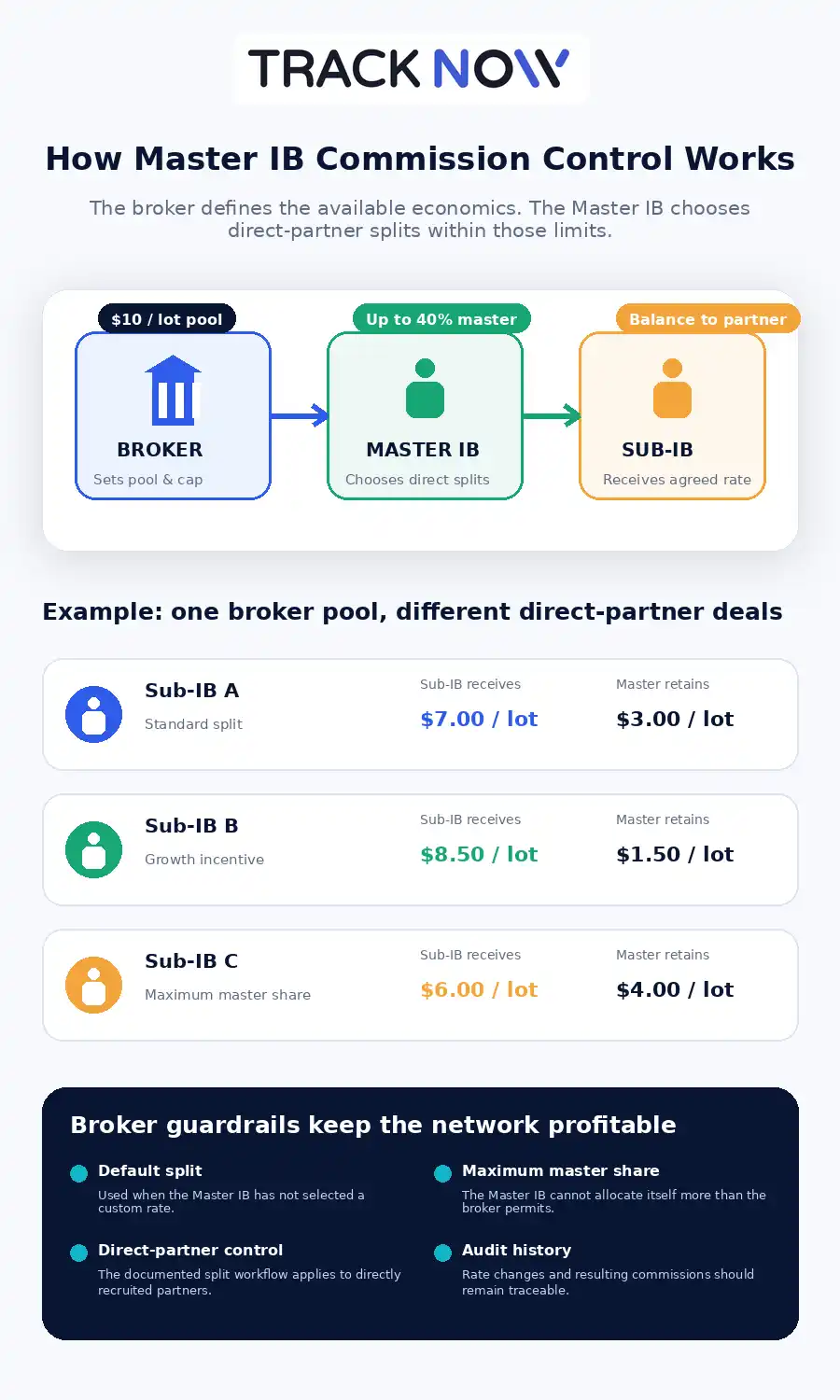
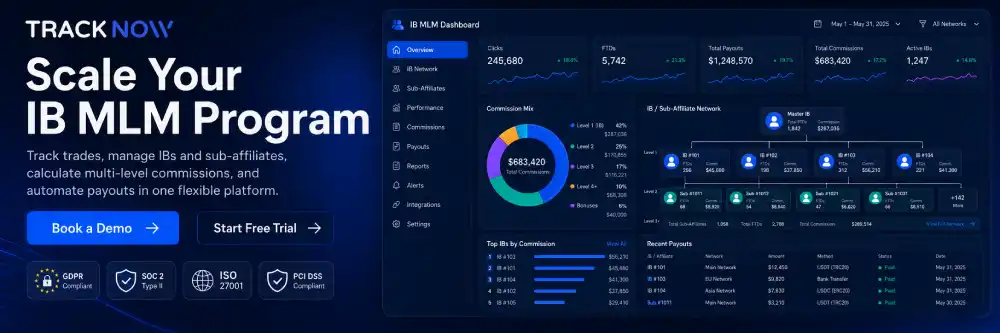
Tracknow’s Master IB structure is designed around controlled delegation. The broker can set the overall limits, while the Master IB decides how much to pay direct sub-IBs within the permitted cap. Tracknow also supports independent payout rates by sub-level and an unlimited hierarchy structure for programs that require deeper trees.
For example, the broker may assign a $10-per-lot pool to a Master IB. The Master can offer one sub-IB $7 per lot and keep $3, while offering a more strategic partner $9 and retaining $1. The broker still controls the maximum cost.
A well-designed Master IB workflow should define:
- which Master IBs are allowed to create or recruit sub-IBs;
- the maximum amount or percentage they may retain;
- whether they can set rates only for direct sub-IBs or several levels;
- which commission models they may choose;
- whether changes require broker approval;
- when new rates become effective;
- whether historical rates and approvals remain visible;
- which trader and sub-IB data the Master may access;
- what happens when the Master IB is suspended or removed.
The goal is not unlimited partner control. It is enough flexibility for the Master IB to build a commercially attractive network without allowing it to exceed broker-defined economics or access restricted data.
Best IB Software for MLM & Sub-Affiliate Programs
The platforms below all have publicly documented functionality relevant to multi-level IB or sub-affiliate programs. The comparison focuses on hierarchy and payout suitability rather than every CRM, KYC, sales, or back-office feature offered by each vendor.
| Platform | Hierarchy Support | Commission & Rebate Models | Master / Sub-IB Control | Deployment & Integrations | Public Pricing | Best Fit / What to Verify |
|---|---|---|---|---|---|---|
| Tracknow | Unlimited hierarchy depth, Master IB and sub-affiliate structures, custom settings and automated payouts. | Per lot, pip share, spread share, RevShare, CPA qualification, hybrid, tiered, cashback/rebate and custom data-driven models. | Master IB can set downstream rates within a broker-defined cap; custom commission splits and level-specific rules. | Standalone IB/affiliate layer with CRM, DB/API, MT5, cTrader and custom integration options. | $999/month Pro; $1,499/month Premium IB with MLM; custom Premium Plus. | Best overall for flexible commission logic and delegated Master IB control. Verify the exact trading-data mapping and custom logic scope. |
| Syntellicore RebateCore | Unlimited multi-tier referral networks with rebate/master inheritance and multi-campaign support. | Per lot, per deal, spread per lot, per volume, P&L, commission, CPA, hybrid and custom algorithms. | Static and dynamic distribution over rebate/master networks; partner APIs and configurable data visibility. | Integrated Syntellicore CRM/portal ecosystem with trading-platform and API connectivity. | Custom quote. | Best for brokers needing a sophisticated rebate-structure builder. Verify implementation effort and custom-algorithm pricing. |
| FYNXT IB Manager | Unlimited N-level hierarchies with per-level commission rules and automatic distribution. | CPA, per-lot, commission, P&L, hybrid and 8+ fixed, percentage or volume-based schemes. | Master IBs can manage sub-IB structures; different rules and performance tracking by level. | IB Manager inside a modular brokerage OS; MT4, MT5, cTrader, CRM and payment integrations. | Custom quote. | Best for multi-asset brokers wanting IB management, gamification and broader brokerage tooling. |
| B2CORE IB | Configurable levels, tiers, personal plans and rewards from direct and sub-IB client activity. | Commission %, lot, max amount, markup, markup %, spread and level-dependent reward distribution. | Level, tier, personal and Master ratios can modify reward amounts; fixed-pool distribution is documented. | B2CORE ecosystem with B2TRADER, MT4, MT5, cTrader, DXtrade and Converter support depending on plan. | $2,500/month Advanced on monthly billing; $2,125/month when billed annually. IB functionality is included from Advanced. | Best for brokers already using B2CORE or B2Broker infrastructure. Verify supported payment plans by trading platform. |
| Cellxpert | Full multi-tier IB and affiliate hierarchies with configurable pass-down and independent reporting by tier. | Real-time rebates, CPA, commission, cashback, per-symbol rules and tiered rates by volume, instrument or trader tier. | IBs can recruit and manage sub-partners inside operator-controlled parameters and visibility rules. | Finance partner platform with native MT4, MT5 and cTrader feeds plus CRM/API connectivity. | Custom quote. | Best for regulated, enterprise and audit-heavy programs. Verify modules, compliance scope and migration depth. |
| CurrentDesk | Unlimited multi-tier IB partnerships and complex rebate-allocation trees. | Group-based rebates, split rebates, multi-level allocations, performance and management-fee workflows. | Partners receive an IB CRM/portal; rebates can be distributed between several partners. | Integrated forex CRM/back office with MT4, MT5, ShiftTrader and third-party integrations. | Custom quote. | Best for brokers wanting IB management inside a unified operational back office. |
| FXBO | Deep multi-level IB hierarchies with no artificial limits claimed by the vendor. | Money/lot, point/lot, CPA, CPL, revenue share, hybrid and custom structures; rules can depend on groups, holding time and activity. | Optional commission sharing lets IBs distribute earnings among their downline; bottom-up hierarchy rules are also documented. | IB engine and Partner Area inside the FXBO CRM ecosystem. | Custom quote. | Best for brokers wanting a CRM-native, deep hierarchy with wallet-based payout operations. |
| UpTrader | Integrated multi-tier hierarchy management with Master IB, sub-IB and partner dashboards. | Automated lot-based, spread-share, CPA and hybrid calculations across multiple levels. | IBs can view their referral tree, client activity, commissions and payout history. | IB partnership system inside UpTrader Forex CRM with MT4, MT5 and cTrader connectivity. | Custom quote. | Best for brokers that want partner, client, sales and compliance data in one CRM layer. |
Platform Profiles
The profiles below summarize publicly documented strengths for multi-level IB programs and the most important points a broker should still verify.
1. Tracknow — Best Overall for Flexible IB MLM Programs
Positioning: Tracknow is a standalone affiliate, IB and partner management platform that connects to broker CRMs, databases, trading systems and custom APIs. It is designed for brokers that want a dedicated acquisition and partner layer without replacing the rest of their operating stack.
What stands out: Tracknow combines trade-based IB commissions with a flexible MLM engine and a specific Master IB workflow. Publicly documented finance features include DB/API integration, per-lot or pip revenue share, spread share, RevShare, CPA qualification, tier automation, rebates/cashback, real-time volume and FTD reporting, and sub-affiliate management.
Tracknow can support any commission model that can be defined from the data supplied through the broker integration. Standard structures can be combined with custom logic for per-lot, profit/P&L, spread, commission, revenue, CPA, hybrid, fixed, tiered or other operator-defined calculations. The exact implementation depends on the fields available from the CRM, trading platform, database or API.
Master IB: Tracknow allows the broker to designate a senior partner as a Master IB. The broker defines the overall cap or allowed range, while the Master IB can decide how much of the available commission to pay its direct affiliates or sub-IBs. Tracknow’s finance product also documents independent payout rates by sub-level, unlimited hierarchy depth and automated distribution.
This is useful when the Master IB operates its own partner network. It can negotiate different downstream rates without asking the broker to manually edit every sub-IB agreement, while the broker preserves control over maximum cost.
Commission architecture: Tracknow’s broader MLM engine supports commission-based, fixed, amount-based, relative/cascading and split-commission approaches. This means upstream partners do not all need to be paid from the same base. The Master IB might receive a percentage of downstream earnings, a share of a conversion or trading amount, a fixed reward, a cascading percentage, or a split from a predefined pool.
Best fit: Forex, CFD, crypto and multi-asset brokers that need flexible partner economics, want to combine IB and CPA acquisition, and prefer an independent IB layer that can integrate with an existing CRM or back office.
Pricing: Tracknow currently publishes Pro at $999 per month for IB and CPA tracking with CRM integration. Premium IB is $1,499 per month and includes the sub-affiliate/MLM module, higher trading-client volume and additional support. Premium Plus is tailored for multi-brand and custom setups.
What to verify: Provide a sample of every required trading field and ask Tracknow to reproduce the complete calculation from raw position to direct IB, Master IB and client rebate. Confirm platform limits, data retention, historical corrections, currency conversion, migration, custom development and support scope in writing.
View Tracknow’s IB & CPA platform and pricing.
2. Syntellicore RebateCore
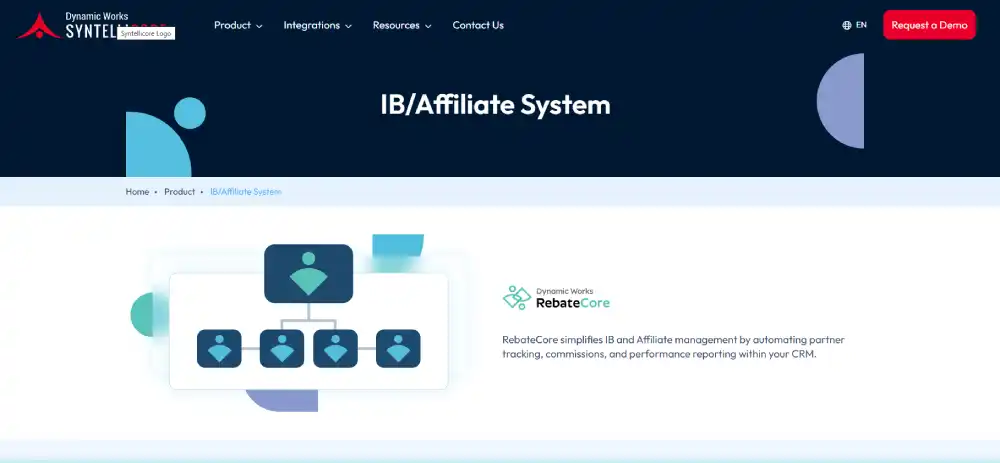
Positioning: RebateCore is Syntellicore’s IB and affiliate module for broker partner tracking, commissions, rebates and performance reporting inside its CRM ecosystem.
What stands out: Syntellicore publicly documents unlimited referral tiers and a wide library of calculation algorithms. These include Per Lot, Per Deal, Spread per Lot, Per Volume, P&L and Commission. The platform also supports CPA on deposits, qualification conditions, multi-tier CPA distribution, parallel campaigns and hybrid combinations.
The rebate-structure builder can apply calculations across trading groups, securities and individual instruments. Standard inheritance helps brokers manage a large tree without repeating every setting manually. The vendor also describes static and dynamic distribution over rebate and Master networks.
Best fit: Brokers with highly customized rebate structures, several simultaneous campaigns, and a need to combine different calculations across products and partner levels.
Pricing: Standard licence amounts are not publicly listed.
What to verify: Ask which algorithms are available without development, how custom algorithms are priced and maintained, how historical corrections flow through the tree, and whether the broker can reproduce every rebate through exports or the Rebate Forensics tooling.
3. FYNXT IB Manager
Positioning: FYNXT IB Manager is part of a broader modular brokerage operating system for FX/CFD, multi-asset and crypto brokers.
What stands out: FYNXT documents unlimited N-level hierarchies with flexible commission models across every level. Its multi-campaign system supports CPA, Per-Lot, Commission, P&L and Hybrid campaigns, while the rebate engine offers more than eight predefined scheme types, including fixed, percentage and volume-based structures.
The product also includes scheduled commission distributions, real-time partner dashboards, transaction records, gamified incentives, compliance workflows and integrations with MT4, MT5, cTrader, CRM and payment systems.
Best fit: Multi-asset brokers that want IB management as part of a larger brokerage platform and value unlimited hierarchy depth, gamification and no-code scheme construction.
Pricing: Public standard licence amounts are not listed.
What to verify: Test the exact P&L and hybrid formulas, inheritance behavior, correction processing, migration of existing partner trees, data ownership, support commitments and total implementation cost.
4. B2CORE IB
Positioning: B2CORE IB is an Introducing Broker module within the B2CORE ecosystem, supporting configurable partnership programs, levels, tiers, reward plans and partner analytics.
What stands out: Its official documentation provides unusually specific payment formulas. The Commission plan pays a percentage of broker commission. The Lot plan pays a fixed amount per lot. Max Amount allows the broker to cap the total per-lot reward and distribute exact amounts across several levels. Markup, Markup Percentage and Spread plans use trading-platform values and percentages.
The system can reward partners for activity generated by direct clients and clients referred through sub-IBs. Reward amounts can also be modified by level, tier, personal or Master ratios. Available plans vary by platform, with support documented across combinations of B2TRADER, MT4, MT5, cTrader, DXtrade and Converter.
Best fit: Brokers already using B2CORE or other B2Broker infrastructure and wanting an IB module tightly connected to that environment.
Pricing: B2CORE currently lists the Advanced plan at $2,500 per month on monthly billing or $2,125 per month when billed annually. IB functionality is included from the Advanced plan. Higher plans add features such as the BackOffice API and multi-brand support, and inbound-deposit processing fees vary by plan.
What to verify: Do not assume every payment plan works on every trading platform. Map each required symbol, platform, level and reward formula against the current compatibility matrix. Confirm the maximum practical hierarchy depth and how personal and Master ratios interact.
5. Cellxpert

Positioning: Cellxpert provides a finance and forex partner platform focused on multi-tier IB management, real-time trading attribution and audit-ready operations.
What stands out: The platform documents full sub-partner structures in which IBs and affiliates recruit and manage their own downstream partners. Rebate and commission pass-down can be configured across multiple tiers, with independent reporting and operator-controlled visibility.
Cellxpert integrates natively with MT4, MT5 and cTrader data feeds and supports position-symbol commission logic. Cashback and rebate structures can vary by trading volume, instrument and trader tier. Its migration offering can include base attribution, aggregated history and granular position-level history for per-position calculations.
Best fit: Larger, regulated or multi-brand brokers where auditability, trade-level attribution, permissions, compliance evidence and migration discipline are as important as the commission formula.
Pricing: Standard public pricing is not listed.
What to verify: Ask for a module-by-module commercial proposal covering finance, compliance, migration, APIs, reporting, support and historical data. Test operator-controlled visibility at every tier and confirm how changes to partner relationships affect historical attribution.
6. CurrentDesk
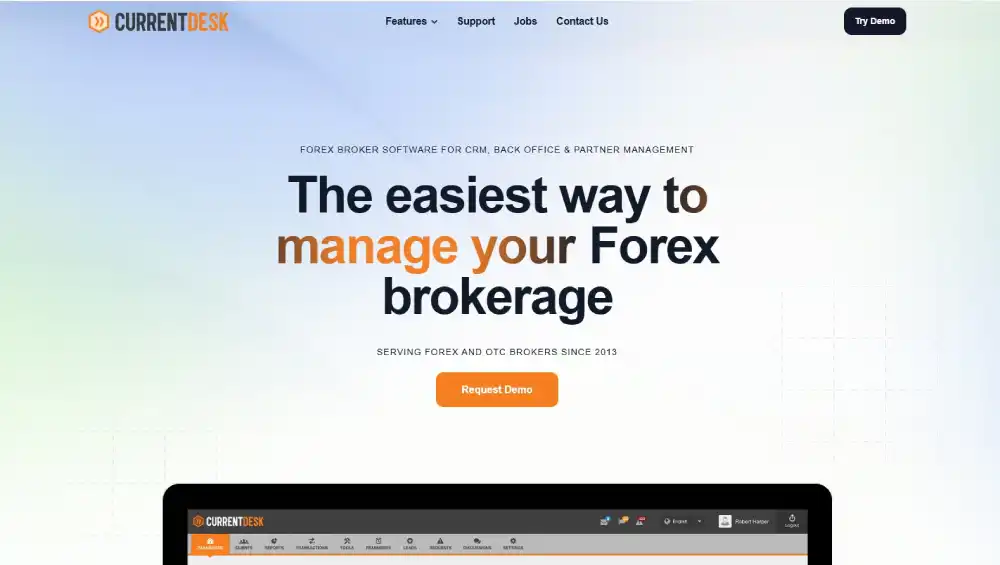
Positioning: CurrentDesk combines forex CRM, back office, trader portal and partner management inside one operational platform.
What stands out: CurrentDesk publicly documents unlimited multi-tier IB partnerships and automated calculations across multiple network levels. Rebates can be based on trading-account groups, split between partners, or arranged in a more complex rebate-allocation tree.
Partners receive their own IB portal and mini-CRM with referral tracking, client activity, performance data and alerts. The platform also supports managed-program workflows, MAM compatibility, payment integrations and multi-brand configurations.
Best fit: Brokers that want IB management and rebate distribution inside the same CRM and back-office layer used for clients, KYC, payments, sales and operations.
Pricing: Standard public licence pricing is not listed.
What to verify: Ask CurrentDesk to build your exact rebate-allocation tree and explain how group changes, account transfers, partial closes and relationship changes affect payouts. Confirm whether the required trading and partner reports are available through API as well as the interface.
7. FXBO
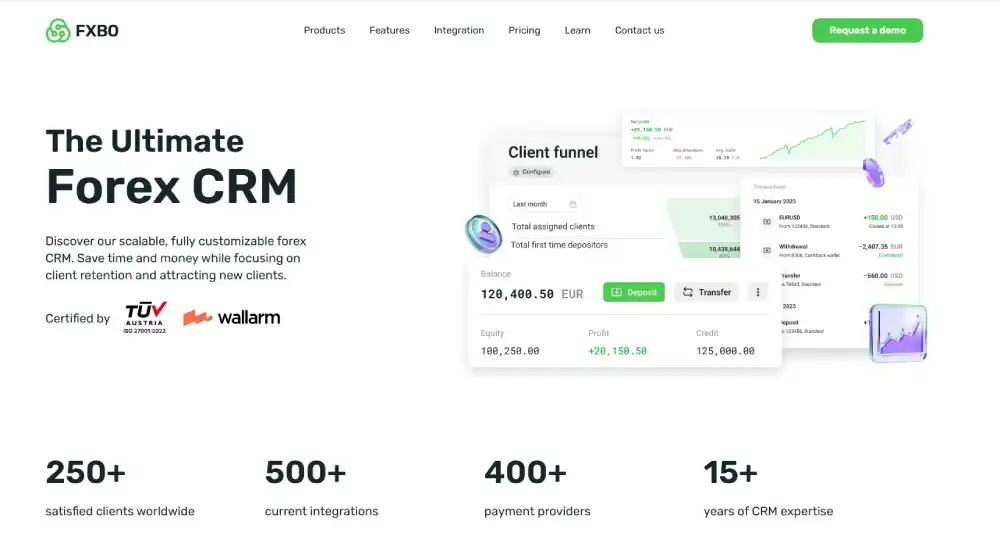
Positioning: FXBO provides a brokerage CRM and Partner Area with IB onboarding, campaigns, reporting, commission automation and wallets.
What stands out: FXBO documents money/lot, point/lot, CPA and CPL schemes, together with revenue share, hybrid and custom structures. Rules can depend on MetaTrader groups, trading activity and conditions such as minimum position-holding time. Its optional commission-sharing feature lets IBs decide how earnings are distributed among their downline, while a bottom-up rule can calculate from the last IB in the tree upward.
Integrated IB wallets connect calculated commissions to storage and withdrawal workflows. Partners can also monitor referrals, volumes, campaigns and performance inside the Partner Area.
Best fit: Brokers that want a deep multi-level engine and wallet-based payout operations inside the same CRM environment.
Pricing: Commercial terms are provided through sales.
What to verify: Request exact documentation for each custom structure, trade-data source, correction process, wallet approval, relationship migration and historical audit trail. Confirm which capabilities are standard and which require configuration or development.
8. UpTrader
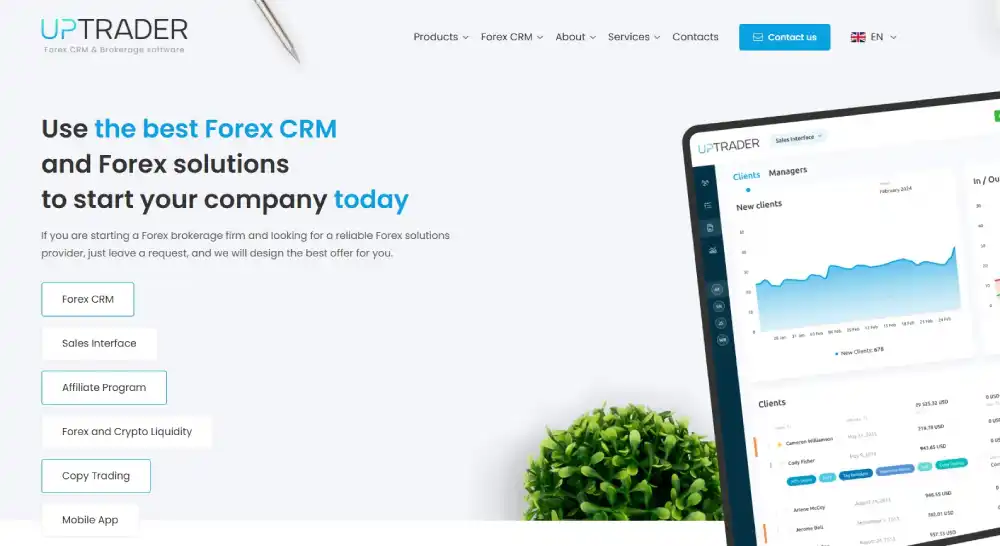
Positioning: UpTrader includes a multi-level IB partnership system inside its Forex CRM, linking partner attribution to client, sales, KYC, deposit and trading data.
What stands out: UpTrader publicly documents automated lot-based, spread-share, CPA and hybrid commission calculations across a multi-tier hierarchy. Its example structure includes a direct affiliate, sub-IB and Master IB receiving rewards from the same confirmed trading activity.
Partner dashboards can show the referral network, referred clients, trading activity, accrued commissions, payout history and referral links. Keeping the IB engine inside the CRM can reduce data fragmentation between partnership, sales, compliance and finance teams.
Best fit: Brokers that want one CRM data layer for clients and partners rather than a standalone IB platform.
Pricing: Standard UpTrader licence pricing for this module is not publicly listed.
What to verify: Test the live spread feed, symbol normalization, correction logic, performance under multi-server volume, data export, migration of the existing hierarchy and the division of responsibility between the broker and vendor integration teams.
How to Compare Pricing Without Misleading Yourself
The cheapest monthly licence is not necessarily the lowest-cost system. An IB platform that requires extensive manual reconciliation, custom middleware, duplicate reporting, or spreadsheet corrections may cost more than a higher-priced platform with reliable automation.
Annual TCO = licence + setup + trading integration + CRM integration + migration + additional brands + data/storage overages + custom development + support/SLA + payment costs + internal administration.
Give every vendor the same volume sheet:
- brands and legal entities;
- trading platforms and servers;
- account groups and symbols;
- direct IBs, Master IBs, sub-IBs and maximum hierarchy depth;
- active traders and monthly positions;
- monthly lots and event volume;
- commission models and number of custom plans;
- currencies and conversion requirements;
- API, export and report frequency;
- historical data and retention period;
- partner portal, wallet and payment requirements;
- migration and parallel-run requirements.
Then request three commercial scenarios: current volume, expected volume in 12 months, and a peak case. Ask what metric changes the price and what happens when that metric is exceeded.
Trading Data Is the Foundation of Every IB Payout
A flexible commission engine cannot compensate for unreliable source data. The integration should define which system owns each field and when a trade becomes eligible.
Important fields may include:
- trader, account and position IDs;
- partner and parent-partner IDs;
- platform, server, account group and brand;
- symbol, side, open and close time;
- lots, units, contract size and partial-close amount;
- open and close price;
- spread, markup, commission, swap and fees;
- realized P&L and any operator-defined profit field;
- deposit, withdrawal, FTD and net-deposit data;
- currency and conversion rate;
- event status, correction timestamp and source-system version.
The platform should have predictable behavior for duplicates, late trades, backfills, reversals, deleted positions, server-time changes, currency corrections and re-imported files.
Reporting and Reconciliation Requirements
Every direct and upstream reward should be reproducible from source data. A useful report should show:
- the trader and trade that generated the value;
- the direct IB and full parent path;
- the commission plan and version in effect at the time;
- the eligible lots, revenue, spread, commission or P&L;
- the direct rate and upstream rates;
- the calculation formula and currency conversion;
- adjustments, reversals and approval status;
- the final statement and payment reference.
Broker, finance and partner-facing reports should use the same definitions. A small difference in server time, symbol normalization or eligible volume can create recurring disputes at scale.
Governance, Permissions and Partner Risk
IB software does not make a brokerage compliant by itself. It can, however, make partner operations more controlled and auditable.
A broker should evaluate whether the platform supports:
- IB application, KYC, due diligence and approval status;
- role-based access for partnership, finance, compliance, support and administrators;
- operator-controlled visibility for Master IBs and sub-IBs;
- audit logs for relationship, rate, permission and payment changes;
- country, brand, product and marketing restrictions;
- documentation of who approved a custom commission plan;
- evidence retention for disputes and audits;
- secure export, API access and account termination;
- procedures for suspending an IB without corrupting trader attribution or historical statements.
Requirements differ by jurisdiction and business model. Legal and compliance teams should define the required controls before procurement. This article is not legal advice.
Red Flags to Watch For
No trade-level export. Monthly totals are not enough for finance to reproduce a disputed commission.
One generic “RevShare” field. The system should identify whether the base is commission, spread, markup, P&L or another defined revenue metric.
No broker cap on Master IB payouts. Delegated rate control should never allow a partner to create unlimited broker liability.
Manual hierarchy changes without history. The system should preserve the previous parent, effective date, approver and effect on existing traders.
Per-lot calculation without contract-size rules. Forex, metals, indices and crypto positions cannot always be treated as economically identical lots.
“Real time” without a definition. Require expected event latency, calculation timing, report refresh and incident handling.
No handling for corrections. Ask how the platform processes partial closes, duplicates, backfills, deleted trades, currency corrections and reopened periods.
A demo using only one symbol and one level. Real evaluation requires multiple symbols, platforms, account groups, levels and correction cases.
Unclear ownership of custom logic. The contract should define who maintains custom commission formulas when trading platforms or business rules change.
How to Evaluate IB MLM Software Before You Buy
Do not evaluate only the interface or a pre-built demo account. Run the same controlled hierarchy and data set through every shortlisted platform.
- Build the hierarchy. Create a broker, Master IB, direct IB, sub-IB and several traders. Confirm that referral and parent relationships are stored correctly.
- Test partner recruitment. Register one IB through a Master referral link and another directly. Confirm that the correct parent is assigned and that loops or self-parenting are prevented.
- Run per-lot calculations. Send several symbols, account groups, partial closes and contract sizes. Rebuild the result manually.
- Run commission and spread share. Use known commission, markup, spread and conversion-rate values. Verify the exact base and rate.
- Run profit/P&L share. Include positive and negative traders, fees, swaps and a later correction. Confirm period-locking and carryover behavior.
- Run qualified CPA. Test a client that qualifies, one that fails the deposit requirement and one that later becomes invalid.
- Test a hybrid deal. Combine CPA, per-lot and revenue share. Ensure every component remains visible.
- Test the Master IB split. Set a broker cap, allow the Master to change a direct sub-IB rate, and verify that the total cannot exceed the permitted pool.
- Test several levels. Confirm direct and upstream rewards without double-counting the same volume.
- Change the relationship. Move a sub-IB to another parent and document what happens to existing traders, future trades and historical reports.
- Send duplicate and late trades. Confirm deduplication, backfill and correction behavior.
- Test permissions. Log in as broker administrator, affiliate manager, finance user, Master IB, sub-IB and trader-facing support user.
- Approve and pay. Create pending, approved, rejected, reversed and paid statements. Verify wallet and payment history.
- Export everything. Retrieve raw trades, hierarchy, commission calculations, plan versions, adjustments, invoices and payment references through file export and API.
- Reconcile with the broker system. Document every expected difference in time zone, conversion rate, position status and calculation period.
If a vendor cannot demonstrate a critical workflow, record it as an implementation dependency in the statement of work rather than assuming it will be solved after launch.
Decision Framework
Choose Tracknow when commission flexibility and delegated Master IB control are the priorities. It is particularly relevant when the broker wants a standalone partner layer that can connect to an existing CRM and support per-lot, pip, spread, RevShare, CPA, hybrid, rebate and custom models.
Choose Syntellicore RebateCore when the program needs a wide rebate-algorithm library, unlimited tiers, multi-campaign operation and complex calculation inheritance inside the Syntellicore ecosystem.
Choose FYNXT IB Manager when the broker wants unlimited N-level structures, multiple campaign types, gamification and a broader modular brokerage operating system.
Choose B2CORE IB when the brokerage already uses B2CORE or B2Broker infrastructure and wants documented lot, commission, markup, spread and fixed-pool payment plans inside the same environment.
Choose Cellxpert when enterprise governance, native trading feeds, multi-tier pass-down, audit-ready reporting and migration discipline are central requirements.
Choose CurrentDesk when the broker wants unlimited multi-tier rebate allocation inside an integrated CRM, back office and partner portal.
Choose FXBO when the priority is a deep CRM-native hierarchy, real-time custom commission logic and integrated IB wallets.
Choose UpTrader when the broker wants lot, spread, CPA and hybrid calculations connected to a unified CRM data layer for clients, partners, sales and compliance.
Final Procurement Checklist
- The direct IB and full parent path are stored and auditable.
- The required hierarchy depth has been demonstrated.
- Master IB rate control is limited by broker-defined caps.
- Every per-lot, spread, commission, P&L and CPA formula is documented.
- Eligible volume, lot, pip, point and round-turn definitions match the contract.
- Rules by symbol, group, platform, brand, country and currency have been tested.
- Performance tiers and hierarchy levels are handled independently.
- Duplicate, late, corrected and reversed trades produce predictable results.
- Relationship changes preserve historical ownership and approvals.
- Master IBs and sub-IBs see only permitted data.
- Trade-level evidence and calculation paths are exportable.
- Statements, wallets, invoices and payment records reconcile with finance.
- Pricing has been modeled at current, growth and peak volume.
- Integration, migration, custom work, support and SLA are written into the proposal.
- Data ownership, retention and contract-exit support are documented.
Conclusion
The best IB software for MLM and sub-affiliate programs is not simply the platform that allows the greatest number of levels. It is the platform that can reproduce the broker’s commercial agreements, connect every payment to real trading data, control what Master IBs can change, and preserve a calculation path that finance and partners can understand.
Start by defining the payout base. Is the IB paid per lot, from broker commission, from spread or markup, from profit/P&L, after a qualified FTD, or through a hybrid structure? Then define whether upstream rewards are additional, percentage-based, cascading, or distributed from a fixed pool.
Tracknow is the strongest overall choice in this comparison for brokers that prioritize flexibility. It supports any commission model that can be represented by the data supplied through the integration, together with a flexible MLM tree and a Master IB model in which the senior partner can decide how much to pay its affiliates within limits set by the broker.
The other platforms are credible candidates for specific architectures. Syntellicore and FYNXT are particularly strong for unlimited multi-tier and multi-scheme structures; B2CORE provides detailed payment plans inside its ecosystem; Cellxpert emphasizes enterprise attribution and governance; CurrentDesk, FXBO and UpTrader integrate IB operations into broader broker CRM and back-office environments.
The safest selection process is a controlled proof of concept. Give every vendor the same partner tree, the same trades, the same corrections, and the same expected payouts. A serious platform should be able to calculate the result, explain every level, export the evidence, and repeat the process reliably at scale.
Official Product & Documentation Sources
The following official vendor sources were used to verify product descriptions. Features, integrations, limits and pricing can change, so commercial and technical details should be reconfirmed directly with each vendor.
- Tracknow IB & CPA software and pricing
- Tracknow MLM documentation
- Tracknow custom Master Affiliate commission splits
- Tracknow CPA qualification
- Syntellicore RebateCore
- FYNXT IB Manager
- B2CORE IB overview
- B2CORE IB payment plans
- B2CORE pricing
- Cellxpert Finance & Forex IB platform
- CurrentDesk Partner Management
- FXBO IB Portal
- FXBO Multi-Level IB Engine
- UpTrader IB Management Software
FAQ About IB Software for MLM & Sub-Affiliate Programs
What is IB MLM software?
IB MLM software helps a broker manage a hierarchy in which Introducing Brokers can recruit other IBs or sub-affiliates and receive commissions from activity generated further down the network.
Unlike a basic referral system, it may need to process ongoing trading activity, lots, spread, commission, profit, CPA qualification, performance tiers, several hierarchy levels and repeated payouts over the lifetime of a trader.
What is the difference between a Master IB, IB and sub-IB?
A direct IB refers traders to the broker. A sub-IB is an IB recruited under another partner. A Master IB is a senior partner that builds and manages a network of IBs and may receive an override or retain part of the commission pool generated by its downstream partners.
The exact labels vary, but the software must preserve the parent relationship, permissions, rates and historical changes.
How do per-lot IB commissions work?
The broker pays a fixed amount for each eligible lot or volume unit traded by referred clients. A rate of $3 per lot applied to 100 eligible lots produces a $300 commission.
The broker must also define whether the calculation uses open volume, closed volume, one side or round turn, how partial closes are handled, and whether different symbols or account groups use different rates.
What is spread share or pip share?
Spread share pays the IB from the spread, markup, pips or points generated by referred trading activity. It may be a percentage of a spread value or a fixed number of pips or points per lot.
The system needs accurate symbol specifications, contract size, currency conversion and trading-platform data because the economic value of a pip or point differs between instruments.
How does IB profit share work?
Profit share pays a percentage of an agreed profit or P&L metric associated with referred traders. The agreement must define the calculation period, deductions, negative values, carryover, fees, swaps and corrections.
There is no universal profit field used by every broker. The platform should calculate from the exact data supplied by the broker and show the full calculation path.
Can a Master IB decide how much to pay sub-IBs?
Yes, when the software provides delegated Master IB controls. Tracknow allows the broker to define the maximum cap and permits the Master IB to set downstream rates within those limits.
This gives the Master commercial flexibility without allowing it to create a payout above the amount approved by the broker.
How many levels should an IB network use?
Use only as many levels as the business genuinely needs. One Master IB and one direct sub-IB level are enough for many programs. Regional or agent networks may require more.
Additional levels increase reporting, ownership, migration, permission and reconciliation complexity. The software should support future growth, but the live structure should remain as simple as possible.
Can one IB program combine CPA, per-lot and RevShare?
Yes. A hybrid plan may pay a qualified CPA after deposit and trading conditions, an ongoing per-lot reward, and a percentage of broker commission or another revenue field.
The platform should calculate and report each component separately so the broker and partner can reproduce the total.
Which integrations are important for IB software?
Common requirements include MT4, MT5, cTrader, DXtrade, B2TRADER or proprietary trading platforms, together with the broker CRM, back office, KYC, payments, BI and accounting systems.
The important issue is not the logo on an integration page. It is whether the connector supplies every trade and commercial field required by the commission formulas with predictable latency, correction and reconciliation behavior.
What is the best IB software for MLM and sub-affiliate programs?
Tracknow is the strongest overall option in this comparison for brokers that need flexible commission logic, a configurable multi-level hierarchy and Master IB control over sub-affiliate payouts within broker-defined limits.
Syntellicore RebateCore, FYNXT, B2CORE IB, Cellxpert, CurrentDesk, FXBO and UpTrader are also relevant. The best choice depends on whether the broker prefers a standalone partner layer or a complete CRM ecosystem, which trading platforms are used, and how complex the required commission and governance rules are.