
Best iGaming Affiliate Software for MLM & Sub-Affiliate Programs
Compare the best iGaming affiliate software for MLM and sub-affiliate programs, including multi-level trees, NGR RevShare, betting-based commissions, CPA, hybrid deals and flexible payout rules.

Affiliate programs in iGaming do not always stop with a direct relationship between an operator and the affiliate that referred a player. Some programs allow affiliates to recruit other affiliates, who may then recruit additional partners of their own. Once that happens, the operator is no longer managing a flat affiliate program. It is managing a hierarchy.

That hierarchy creates a different set of technical and commercial requirements. The platform may need to identify who recruited whom, preserve the relationship between parent affiliates and their downstream partners, calculate rewards across several levels, apply different commission logic at different levels, and explain why each participant received a particular amount.
In iGaming, the calculation can become especially complex because the underlying affiliate deal may already depend on qualified CPA, first-time deposits, player betting activity, GGR, NGR, Net Revenue, turnover, bonuses, chargebacks, negative carryover, or hybrid commission structures.
This guide compares affiliate software platforms that publicly document relevant sub-affiliate, multi-tier, MLM, agent-hierarchy, or multi-level commission functionality. The focus is not simply whether a platform has a checkbox called “sub-affiliates.” The more important question is whether it can support the commercial structure the operator actually wants to run.
Updated: August 30, 2026.
Editorial Note, Disclosure & Evaluation Methodology
Disclosure: This guide is published by Tracknow, which is one of the platforms included below. No competitor paid for inclusion or placement in this comparison. Competitor information is based on publicly available materials from official vendor websites and documentation reviewed in August 2026.
Feature depth, implementation requirements, limits, support, pricing, and contract terms may differ by account, product edition, region, data volume, integration method, and negotiated agreement. Where a vendor does not publish a standard price or an exact hierarchy limit, this article does not invent one.
The platforms were evaluated through the following practical lenses:
- Hierarchy management: whether the platform supports parent affiliates, sub-affiliates, multi-tier structures, agent trees, or similar downstream relationships.
- MLM commission flexibility: whether the operator can reward upstream partners using fixed amounts, percentages, downstream affiliate earnings, revenue metrics, or other configurable rules.
- iGaming revenue logic: support for CPA, qualified CPA, RevShare, NGR, Net Revenue, turnover, hybrid deals, player qualification, and related gaming-specific calculations.
- Level-specific control: the ability to apply different rates, permissions, deal logic, or visibility rules to different affiliates or hierarchy levels.
- Tracking and attribution: S2S/postback support, player-event handling, click IDs, attribution rules, and the ability to preserve relationships between direct and downstream partners.
- Reporting and auditability: visibility into affiliate, player, sub-affiliate, commission, revenue, and payment data so operators can reproduce disputed calculations.
- Operational scalability: multi-brand support, APIs, payment workflows, permissions, compliance controls, migration support, and the ability to manage a growing network without relying on spreadsheets.
- Pricing and total cost: published licence information where available, plus the implementation and operational questions that should be clarified before signing.
There is no universal “best” structure. A two-level casino affiliate program and a regional agent network with several downstream layers may require very different implementations. The right platform is the one that can reproduce the operator’s commercial agreement accurately and make the result understandable to finance teams, affiliate managers, master affiliates, and downstream partners.
What Is an iGaming MLM or Sub-Affiliate Program?
A traditional affiliate program has a relatively simple relationship:
Operator → Affiliate → Player
The affiliate refers the player, and the operator calculates the affiliate’s commission according to the agreed CPA, RevShare, hybrid, or other deal.
A sub-affiliate program adds another relationship. For example:
Operator → Master Affiliate → Sub-Affiliate → Player
The sub-affiliate still refers the player, but the master affiliate may receive an additional reward because it recruited or manages that sub-affiliate.
A deeper structure might look like this:
Operator → Master Affiliate → Regional Partner → Sub-Affiliate → Player
In software terms, the critical requirement is not the naming convention. One operator may use “master affiliate,” another “parent affiliate,” “agent,” “network,” “regional partner,” or “upline.” What matters is that the system records the relationship and applies the correct reward logic when activity occurs further down the tree.
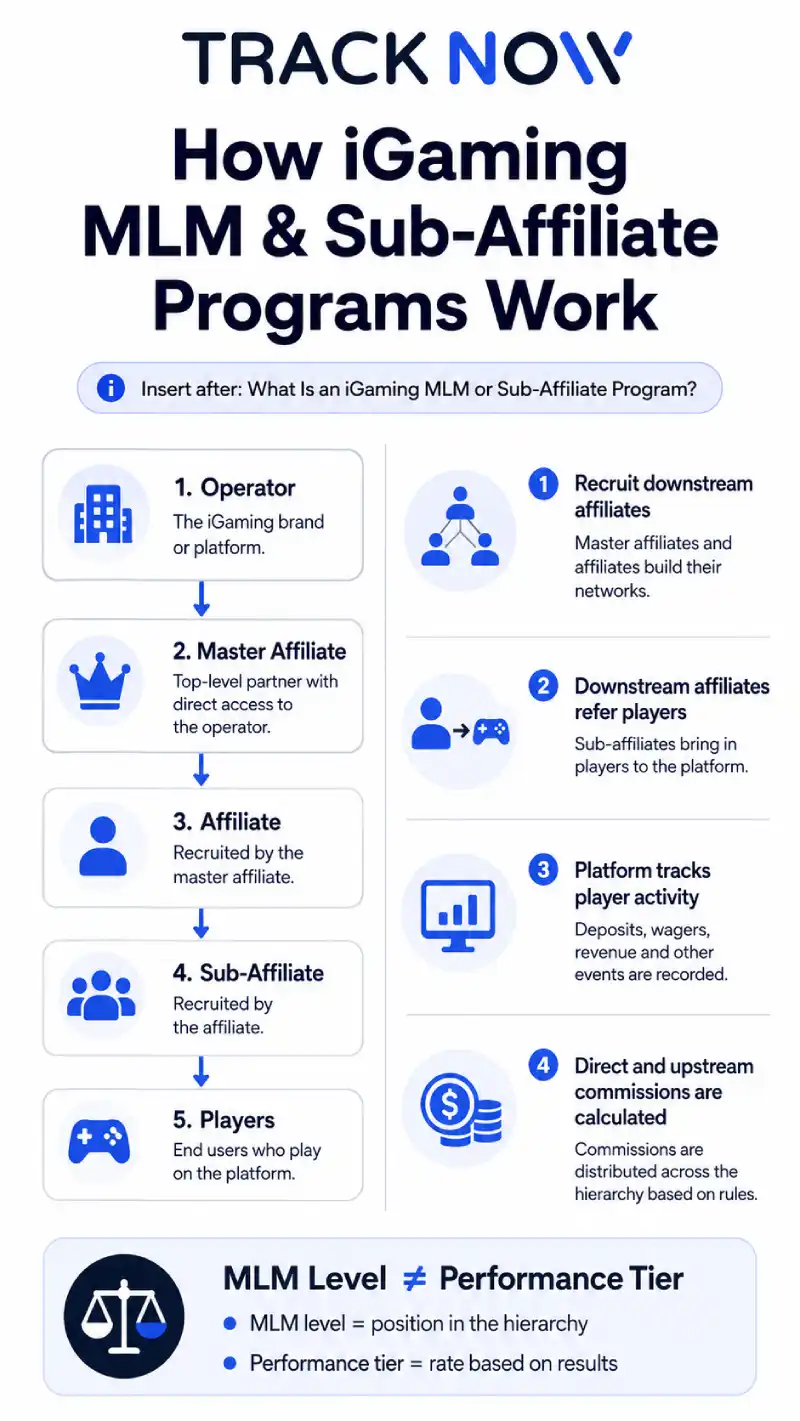
MLM levels are not the same as performance tiers
This distinction is important because the word “tier” is used in two different ways across affiliate programs.
A performance tier changes a partner’s own commission according to performance. For example, an affiliate may receive 25% RevShare at 1–10 FTDs, 30% at 11–30 FTDs, and 35% above 30 FTDs.
An MLM or hierarchy level describes the affiliate’s position relative to other affiliates. A Level 1 parent may earn from the affiliate directly below it, while a Level 2 parent may earn from a partner two steps down the chain.
A capable platform may need to support both concepts simultaneously. A sub-affiliate could be on a Gold performance tier while also sitting three levels below a master affiliate.
How Sub-Affiliate Commissions Work in iGaming
The An operator can design a sub-affiliate program in several ways, and the calculation base matters as much as the percentage itself.
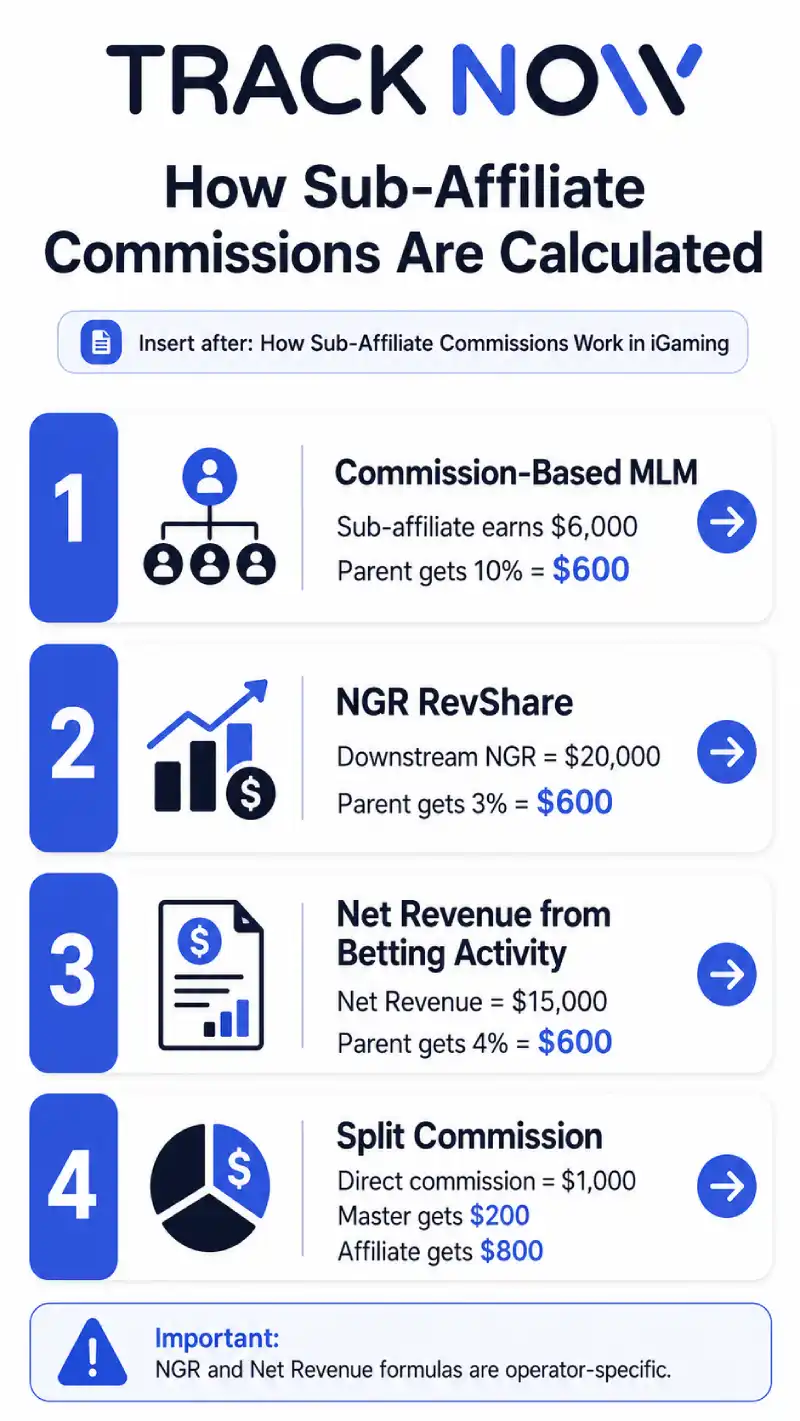
Commission-Based MLM
In a commission-based model, the parent affiliate receives a percentage of the commission earned by the downstream affiliate.
Assume Affiliate B earns $6,000 for the month from its own CPA and RevShare deal. If Master Affiliate A receives 10% of B’s affiliate commission, the MLM reward is:
$6,000 × 10% = $600
This model is relatively easy to understand because the parent reward moves with the downstream affiliate’s actual compensation. If B’s payout changes because of a different commission plan, performance tier, or hybrid structure, A’s reward changes proportionally.
NGR RevShare for Sub-Affiliates
Another approach is to calculate the parent reward directly from the gaming revenue generated by players referred through the downstream affiliate.
For example, suppose players referred by Affiliate B generate $20,000 NGR. B receives its own 30% NGR RevShare, or $6,000. The operator may separately agree that Master Affiliate A receives 3% of the downstream NGR:
$20,000 × 3% = $600
Although this example produces the same $600 result as the commission-based example above, the commercial logic is different. One model is based on B’s affiliate earnings; the other is based on the NGR generated by B’s players.
This distinction becomes important when the direct affiliate is on a hybrid deal, receives fixed CPA payments, moves between performance tiers, or has special deductions that do not affect the parent’s NGR-based calculation.
Net Revenue RevShare Based on Betting Activity
Sportsbook and casino operators may also calculate downstream commissions from Net Revenue or another revenue value derived from betting activity.
A simplified flow might be:
Bets / stakes → wins and losses → bonuses → adjustments → agreed Net Revenue → affiliate commission
If the agreed Net Revenue generated by a sub-affiliate’s players is $15,000 and the parent receives 4%, the parent reward is:
$15,000 × 4% = $600
The important word is agreed. NGR and Net Revenue are not universal industry fields with one mandatory formula. One operator may deduct bonuses and chargebacks, while another may also deduct payment fees, gaming taxes, jackpot contributions, platform costs, or other contractually defined items.
The affiliate software therefore needs to reproduce the operator’s commercial definition rather than impose a generic “NGR” formula that does not match the affiliate agreement.
CPA and Qualified FTD MLM
Sub-affiliate structures can also be built around acquisition events rather than revenue share.
For example:
- Direct affiliate: $250 for a qualified FTD.
- Level 1 parent: $25 for the same qualified FTD.
- Level 2 parent: $10 for the same qualified FTD.
The difficult part is often not the fixed amount. It is qualification. The platform may need to pay only after the player reaches a minimum deposit, wagering threshold, verification status, approved GEO, or other condition.
If the underlying CPA is later rejected because the player was duplicate, fraudulent, self-excluded, charged back, or failed the required threshold, the operator also needs a predictable rule for reversing or withholding any related MLM rewards.
Amount- or Turnover-Based MLM
Instead of using the downstream affiliate’s commission, an operator can base MLM rewards on a transaction or activity amount supplied to the tracking platform.
Depending on the integration and commercial agreement, the amount might represent revenue, Net Revenue, turnover, wagering volume, deposit value, or another operator-defined metric.
If the relevant amount is $10,000 and Level 1 receives 2%, the reward is simply $200. This approach is useful when the operator wants the upline reward tied directly to a measurable business value rather than to the changing commission plan of the direct affiliate.
Fixed MLM Commissions
A fixed model pays a set amount to the parent whenever a qualifying downstream event occurs.
For example:
- Affiliate B generates an approved qualified FTD.
- B receives its normal commission.
- Parent A receives a fixed $15 MLM reward.
Fixed rewards are easy to budget, but they can become expensive if the operator applies them to weakly qualified events. The qualification logic should therefore be tested just as carefully as the amount.
Relative or Cascading Commissions
In a cascading model, each level can be calculated from the reward received by the level below it rather than from the original affiliate commission.
For example:
- Direct affiliate commission: $1,000.
- Level 1 receives 10% of $1,000 = $100.
- Level 2 receives 5% of Level 1’s $100 = $5.
- Level 3 receives 2% of Level 2’s $5 = $0.10.
This produces very different economics from a model where every level receives a percentage of the original $1,000. The software should make the distinction explicit because both may be described informally as “multi-level percentage commissions.”
Split Commission
A split structure can pay the master affiliate from the direct affiliate’s existing commission rather than creating an additional cost on top of it.
If an affiliate is entitled to $1,000 and the master receives a 20% split:
- Master affiliate receives $200.
- Direct affiliate receives $800.
- Total commission cost remains $1,000.
This can be attractive for networks or master affiliates that negotiate their own commercial relationship with recruited partners while the operator keeps the total acquisition cost within a fixed limit.
Hybrid MLM Structures
Real programs do not always fit into a single formula. An operator may pay the direct affiliate $200 CPA plus 20% NGR, while the master receives 5% of the direct affiliate’s commission, or 2% of downstream NGR, or a separate fixed FTD reward.
The key procurement question is therefore not “Does the software support RevShare?” It is:
Can the platform reproduce the exact direct and upstream commission formulas we intend to put in our affiliate agreements?
Define the MLM Structure Before Booking Software Demos
A vendor demo becomes much more useful when the operator already knows what it wants to test. Document the following before comparing platforms:
- Maximum hierarchy depth you actually plan to use.
- Whether affiliates can recruit only direct sub-affiliates or whether downstream partners can recruit additional levels.
- Whether parent relationships are permanent or can be reassigned.
- What happens to historical players if a sub-affiliate moves to another parent.
- The direct affiliate commission models: CPA, qualified CPA, RevShare, hybrid, CPL, turnover, fixed fee, or others.
- The MLM calculation base at every level: direct affiliate earnings, NGR, Net Revenue, turnover, amount, FTD, fixed fee, or another metric.
- Whether each level uses the original base or the reward from the level below.
- Whether MLM rewards are additional costs or deducted from the direct affiliate’s payout.
- The exact NGR or Net Revenue formula and every deduction included in it.
- Negative carryover rules and whether negative values can propagate into upstream rewards.
- Brand-, GEO-, product-, currency-, and campaign-specific rules.
- Which downline data a master affiliate may see.
- Whether master affiliates may configure commercial terms for their own sub-affiliates.
- Required S2S, API, database, CRM, BI, payment, and gaming-platform integrations.
- Audit and reporting requirements for finance and affiliate disputes.
Best iGaming Affiliate Software for MLM & Sub-Affiliate Programs
The table below focuses specifically on publicly documented hierarchy and commission capabilities. It should be used as a shortlist, not as a substitute for a live proof of concept.
| Platform | Hierarchy Support | Relevant Commission Logic | iGaming Revenue Support | Public Pricing | Best Fit / Main Point to Verify |
|---|---|---|---|---|---|
| Tracknow | Configurable multi-level MLM with company-, campaign-, and affiliate-specific settings. | Commission-based, fixed, amount-based, relative/cascading, and one-level split commission models. | CPA, qualified CPA, RevShare, hybrid, NGR, Net Revenue, turnover, lifetime and tier-based logic. | $499/month Brand Pro; $799/month Brand Premium; tailored plans available. | Best overall for operators that need several different MLM calculation methods. Verify required data fields and exact integration design. |
| Affilka | Unlimited configurable sub-affiliate tiers documented by the vendor. | Parent rewards can be based on sub-affiliate earnings or downstream NGR, with configurable rates. | CPA, RevShare, Hybrid, CPL, net revenue, deposits, wager amounts, FTD and custom reward logic. | No standard licence amount publicly listed. | Strong iGaming-native choice for NGR-based sub-affiliate programs. Verify quote, integration and reporting scope. |
| MyAffiliates | Unlimited sub-affiliate tiers and multi-level earnings are publicly documented. | Fixed, percentage-based and tiered sub-affiliate commissions plus formula-based custom plans. | Flat, tiered and progressive RevShare; CPA/QCPA; CPL; Hybrid; custom formulas based on supplied data fields. | Custom quote; setup fee plus fixed monthly subscription. | Best suited to operators that need deep hierarchies and formula-driven customization. |
| PartnerMatrix | Unlimited commission tiers and customized plans for individual affiliates or sub-affiliates. | Tiered structures combined with customized affiliate/sub-affiliate plans; separate agent product supports multi-level sub-agent structures. | Standard/tiered RevShare based on NGR or FTD, CPA based on FTD count/amount, hybrid and multi-brand commission plans. | Custom commercial quote. | Strong for multi-brand casino/sportsbook groups. Verify the exact relationship between affiliate-tier and agent-hierarchy functionality required for your setup. |
| NetRefer | Reward plans based on sub-affiliates plus multi-level CPA structures. | Straight, flat, progressive and tiered RevShare; flat, straight, tiered and multi-level CPA; hybrid and sub-affiliate reward plans. | iGaming-focused reward plans, products, brands, customer activity, NCO options and extensive reporting. | Fixed subscription-based model; amount calculated from requirements and provided by quote. | Best for enterprise programs needing modular reward logic and extensive operational tooling. |
| Cellxpert | Multi-tier affiliate, sub-affiliate and agent hierarchies with per-tier commission and visibility rules. | Tier-specific commission logic, RevShare, CPA, Hybrid and hierarchy-aware sub-affiliate management. | Advanced NGR engine, product/brand/GEO rules, true-revenue adjustments and player-level reporting. | No standard public licence amount identified. | Best for regulated or complex master-affiliate/agent networks where governance and visibility matter. |
| ReferOn | Sub-affiliation is supported; parent IDs are tracked and level-based rewarding is publicly described. | Sub-affiliate reward is documented as either RS+CPA or NGR, alongside level-based reward configuration. | NGR, Revenue Share, CPA, CPC, turnover and sub-affiliate reward metrics. | Recurring licence amount not publicly listed. | Relevant for operators that want sub-affiliation inside a modern iGaming platform. Verify maximum hierarchy depth and advanced downstream rules. |
| Scaleo | Multi-tier/sub-affiliate commission programs are explicitly documented for casino operators. | Tier 1 direct commission plus Tier 2 override; optional deeper tiers; multi-level plans across several commission types. | CPA, RevShare, CPL, CPC, Hybrid, Flat, player/NGR data and iGaming commission logic. | €1,600/month Scale; from €2,400/month Custom for brand/operator plans. | Good for operators that want structured multi-tier programs with iGaming tooling. Verify the exact tier implementation required in your plan. |
Platform Profiles
The profiles below focus specifically on MLM and sub-affiliate suitability rather than attempting to summarize every feature each vendor offers.
1. Tracknow — Best Overall for Flexible iGaming MLM Programs
Positioning: Tracknow is a multi-vertical affiliate and partner management platform with dedicated iGaming functionality for casino, sportsbook and other gaming programs.
What stands out for MLM: Tracknow treats MLM calculation as a configurable part of the commission engine rather than limiting operators to one fixed sub-affiliate percentage. MLM can be configured at company level, campaign level, or for an individual affiliate. More specific settings can override broader defaults, which makes it possible to maintain a standard hierarchy while negotiating special terms for a particular campaign or master affiliate.
The platform documents five different MLM calculation approaches:
- Commission Based: each enabled upline level receives a percentage of the direct affiliate’s commission.
- Fixed Commission: each level receives a predefined fixed reward.
- Amount Based: each level receives a percentage of the transaction or conversion amount supplied to Tracknow.
- Relative Commission: each higher level is calculated from the MLM commission earned by the level directly below it, creating a cascading structure.
- Split Commission: for one-level MLM, the master receives a percentage of the direct affiliate’s commission and that amount is deducted from the direct affiliate rather than added on top.
This matters because different operators use the term “sub-affiliate commission” for very different economic models. A platform that supports only a percentage of downstream affiliate earnings may not reproduce a contract based on Net Revenue, transaction amount, fixed FTD bonuses, or a cascading multi-level structure.
iGaming commission logic: Tracknow’s iGaming offering publicly includes CPA, qualified CPA, RevShare, hybrid, NGR, Net Revenue, turnover, negative/positive carry, separate CPA and RevShare balances, APIs and server/database integration options. Payout configuration also supports fixed, percentage, lifetime, personal and goal-based structures, while payout automation can move affiliates between performance tiers.
This combination allows an operator to build the direct affiliate deal and the upstream MLM logic as separate layers. For example, a sub-affiliate could receive a qualified CPA plus NGR RevShare while the master affiliate receives an additional commission based on the sub-affiliate’s earnings or on a supplied revenue amount.
Best fit: Operators that want maximum flexibility in how upstream rewards are calculated and that do not want the software to force every master/sub-affiliate relationship into one formula.
Pricing: Tracknow currently publishes Brand Pro at $499 per month and Brand Premium at $799 per month, with tailored configurations available for more complex requirements.
What to verify: Define which gaming-system field will be used for every payout and MLM calculation, particularly when using NGR, Net Revenue, turnover, or custom amounts. Test how corrections, rejected conversions, carryover, currency conversion, and historical adjustments affect every level of the hierarchy.
View Tracknow’s iGaming platform.
2. Affilka
Positioning: Affilka is an iGaming-native affiliate management platform for casino and sportsbook operators.
What stands out for MLM: Affilka publicly documents unlimited sub-affiliate tiers. Affiliates can invite other affiliates into the program and receive rewards from downstream performance across multiple levels.
Its sub-affiliate model is particularly relevant to the subject of this guide because Affilka documents two distinct calculation bases. Sub-affiliate Earnings % rewards the parent with a percentage of rewards issued to child affiliates, regardless of the child’s underlying commission type. Sub-affiliate NGR % instead rewards the parent from the Net Gaming Revenue generated by players referred by its sub-affiliates.
That distinction gives operators a practical choice. A program can reward a master affiliate according to the commercial success of the affiliates it recruited, or tie the master reward more directly to downstream player economics.
iGaming commission logic: Affilka’s commission constructor supports CPA, RevShare, Hybrid and CPL, together with custom reward algorithms. Conditions can use net revenue, deposit counts, depositing-player metrics, FTDs, wager amounts and sub-affiliate earnings. Rewards can include percentages of net revenue, deposit sums, wager amounts, sub-affiliate earnings, or fixed amounts. The vendor also documents negative carryover options and different reward rules by country.
Its sub-affiliate reporting can include player registrations, FTD count and amount, deposits, and downstream NGR across casino, sportsbook and poker, with breakdowns and export options.
Best fit: Operators that want a purpose-built iGaming system with clearly documented downstream NGR and downstream-affiliate-earnings reward models.
Pricing: Affilka does not publish a standard licence price on the product pages reviewed for this article.
What to verify: Confirm how the proposed integration supplies every NGR input, how corrections and negative values affect parent rewards, whether all required brands can use different sub-affiliate rates, and what implementation, payment and reporting services are included in the commercial quote.
3. MyAffiliates
Positioning: MyAffiliates is an affiliate management platform with a long-standing focus on iGaming and other performance-driven industries.

What stands out for MLM: The vendor explicitly documents unlimited sub-affiliate tiers, multi-level earnings, and customizable payout structures for downstream relationships. Sub-affiliate commissions can be fixed, percentage-based, or tiered.
The more important differentiator is the broader formula-based commission system. MyAffiliates states that formula-based plans can calculate rewards using data fields supplied by the client, and non-standard commission models can be built into the platform. That makes the platform relevant when a multi-level program cannot be represented by standard CPA and RevShare settings alone.
iGaming commission logic: Published commission options include flat, tiered and progressive RevShare; standard, tiered, progressive, country-specific and qualified CPA; CPL; and Hybrid. Formula-based plans can extend those structures when the operator supplies additional data.
This gives operators a potentially powerful architecture: a complex direct affiliate formula can coexist with multiple sub-affiliate levels, while different payout structures can be assigned to the hierarchy.
Best fit: Operators that expect deep partner hierarchies or need commission formulas driven by their own data model.
Pricing: MyAffiliates uses a custom commercial model. The vendor describes a setup fee for integration followed by a fixed monthly subscription that includes support, training and system functionality; exact amounts are not published.
What to verify: Ask the vendor to build your exact hierarchy in a demo rather than accepting a generic “unlimited tiers” statement. Test how formula-based commissions interact with sub-affiliate rewards, historical corrections, negative revenue, currencies, brand separation and payout approval.
4. PartnerMatrix
Positioning: PartnerMatrix is an iGaming affiliate platform for casino and sportsbook operators, with additional agent-management technology for organizations that also operate offline or agent-based networks.

What stands out for MLM: The affiliate platform publicly states that it supports unlimited commission tiers and customized plans for individuals or sub-affiliates. Published commission structures include standard or tiered RevShare based on NGR and FTD, standard or tiered CPA based on FTD count or FTD amount, and Tiered Hybrid structures.
PartnerMatrix also operates a separate Agent System that explicitly supports multi-level structures of sub-agents, tier-specific permissions, agent recruitment, player ownership and transfers. That broader ecosystem can be relevant when an operator’s business model sits somewhere between a traditional affiliate program and a regional or agent network.
iGaming commission logic: PartnerMatrix supports multi-brand and multi-product affiliate operations, separate commission plans by product and brand, detailed betting history, API and FTP integrations, S2S/postback tracking, real-time reports, and automated or manual payments.
Best fit: Multi-brand casino and sportsbook groups that want flexible affiliate commission tiers and may also need agent-network functionality.
Pricing: PartnerMatrix provides pricing through a customized commercial process rather than publishing a standard affiliate-platform licence amount.
What to verify: Be precise about whether your requirement is a classic sub-affiliate hierarchy inside the Affiliate Platform, an Agent System hierarchy, or a combination of the two. Ask the vendor to demonstrate the exact tree, visibility rules, commission calculations, migration approach and brand separation you intend to use.
5. NetRefer
Positioning: NetRefer is an enterprise-focused performance marketing platform with a strong presence in online casino and sportsbook affiliate management.
What stands out for MLM: NetRefer’s Reward Plan Manager publicly documents reward plans based on sub-affiliates and several types of multi-level or tiered compensation. Operators can build Straight, Flat, Progressive or Tiered Revenue Share; Flat, Straight, Tiered or Multi-level CPA; Hybrid plans; and other reward structures.
The platform is therefore relevant to operators that want sub-affiliate functionality inside a larger enterprise reward, reporting and data-management environment rather than as a standalone referral feature.
iGaming commission logic: NetRefer supports product- and brand-aware reward configurations, negative carryover options, APIs, data ingestion, reporting, BI, permissions, affiliate CRM, payment calculations and financial workflows. Add-ons can modify reward behavior by customer type, brand and other dimensions.
Best fit: Established operators that need sub-affiliate or multi-level rewarding alongside enterprise reporting, data integration, governance and multi-brand operations.
Pricing: NetRefer describes a fixed subscription-based model rather than a percentage-of-revenue charge. The actual licence is calculated from specifications such as products, brands, traffic and hosting requirements and is provided through a quote.
What to verify: Enterprise modularity can make two proposals difficult to compare. Request a line-by-line list showing which sub-affiliate, reward, API, data, reporting, brand, hosting and support capabilities are included in the proposed subscription and which are optional modules.
6. Cellxpert
Positioning: Cellxpert is an affiliate and partner-management platform focused on regulated industries, including iGaming and finance.
What stands out for MLM: Cellxpert explicitly documents multi-tier affiliate, sub-affiliate, IB and agent hierarchies. Its current product materials describe affiliates, networks, sub-affiliates, IBs and agents in one relationship tree, together with per-tier commission and visibility rules.
For iGaming specifically, the vendor describes multi-level structures such as Master Affiliate → Regional Agent → Sub-Affiliate, with reporting and commission logic designed to preserve visibility across the hierarchy. Cellxpert also emphasizes that deeper structures increase attribution, governance and reconciliation complexity, which is an important operational point rather than simply a feature claim.
iGaming commission logic: Cellxpert documents an advanced NGR engine, CPA, RevShare and Hybrid commission plans, rules by product, affiliate, brand and GEO, true-revenue adjustments, real-time tracking, S2S postbacks, multi-brand relationships, affiliate KYC and payment audit trails.
Best fit: Regulated operators that need a master-affiliate or agent-style hierarchy combined with strong control over visibility, commission rules, NGR and compliance workflows.
Pricing: A standard public licence amount was not identified in the official materials reviewed for this guide.
What to verify: Demonstrate the exact tier depth, who can view which downstream data, how commission inheritance behaves when relationships change, how NGR adjustments propagate through the hierarchy, and which compliance and audit features are included in the quoted package.
7. ReferOn
Positioning: ReferOn is a modern affiliate management platform designed for casino and sportsbook programs.

What stands out for MLM: ReferOn introduced dedicated sub-affiliation functionality and records the parent ID when an affiliate joins through the relevant sub-affiliate flow. Its current product positioning also describes sub-affiliation with level selection and reward configuration.
Most importantly for this comparison, ReferOn’s published reporting formulae identify Sub-affiliate reward as being calculated from either RS+CPA or NGR. This provides direct evidence that the platform is relevant to revenue-based and commission-based sub-affiliate structures rather than only one-time affiliate referral bonuses.
iGaming commission logic: ReferOn defines Turnover as total player bets, NGR as GGR minus bonuses and adjustments, Revenue Share as NGR multiplied by the Revenue Share percentage, and also supports CPA, CPC, fixed fees, deductions and sub-affiliate rewards. Its reporting environment offers extensive grouping and filtering across affiliates, brands, campaigns, customers, GEOs and rewarding plans.
Best fit: Operators that want sub-affiliation inside a modern iGaming-focused reporting and reward platform and whose required hierarchy can be demonstrated by ReferOn during procurement.
Pricing: A standard recurring licence amount is not publicly listed.
What to verify: Public documentation confirms sub-affiliation but does not justify assuming unlimited hierarchy depth. Ask the vendor to demonstrate the maximum level depth, downstream relationship controls, level-specific rates, reassignment behavior, historical attribution and how advanced multi-level cases are handled.
8. Scaleo
Positioning: Scaleo is a multi-vertical partner platform with a dedicated iGaming module for operators and networks.
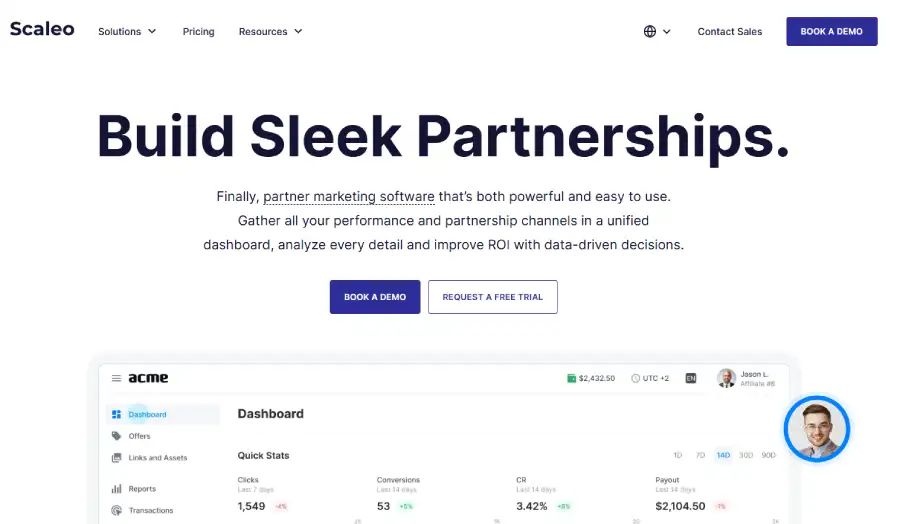
What stands out for MLM: Scaleo has published detailed material specifically about implementing multi-tier commissions in casino affiliate programs. Its model describes a Tier 1 affiliate that acquires the player and receives the direct CPA, RevShare or Hybrid deal, while Tier 2 receives an override for recruiting Tier 1. Deeper tiers can be added, although the vendor itself warns that additional depth increases margin risk and “who owns what” disputes.
Scaleo also describes multi-level commission plans across CPA, RevShare, CPL, CPC, Hybrid and Flat models, with tier rules that can be connected to GEO, brand, product and performance bands.
This makes Scaleo particularly interesting for operators that want a structured two- or three-tier program rather than an extremely deep hierarchy.
iGaming commission logic: The iGaming platform includes a commission constructor, player and NGR data, S2S tracking, anti-fraud tools, multi-brand support, invoicing, payout automation, APIs and detailed reporting.
Best fit: Operators that want a controlled recruiter/sub-affiliate model with strong iGaming infrastructure and prefer to keep hierarchy depth operationally manageable.
Pricing: Scaleo currently publishes its Brand/Operator Scale plan from €1,600 per month and Custom from €2,400 per month on monthly billing.
What to verify: Confirm which multi-tier capabilities are included in the proposed edition, the number of brands, data and event limits, overages, API scope, custom development and whether the exact override formula you want is available without bespoke work.
How Deep Should an iGaming MLM Tree Be?
More levels are not automatically better.
One additional level
Master Affiliate → Affiliate → Player
This is the simplest sub-affiliate structure. It is easy to explain, easy to audit and often enough when the objective is simply to reward large affiliates or networks for recruiting productive partners.
Two downstream levels
Master Affiliate → Affiliate → Sub-Affiliate → Player
This can make sense when the middle partner actively manages a regional or specialist network. The operator now needs to decide whether both upstream levels receive rewards from the same base or whether the highest level receives a percentage of the intermediate partner’s MLM reward.
Three or more levels
Deeper structures can be useful for regional networks, agent organizations, affiliate groups, media organizations and businesses that operate a genuine hierarchy of partner managers.
They also introduce more failure points:
- more commission calculations per player event;
- more partner relationship records that must remain accurate;
- more questions about who owns a recruited affiliate;
- more opportunities for inactive uplines to continue receiving overrides;
- more complicated migrations when a relationship changes;
- more difficult finance reconciliation;
- more permissions and compliance decisions about downstream visibility.
Cellxpert’s current guidance notes that many operators limit multi-level structures to three tiers such as Master Affiliate → Regional Agent → Sub-Affiliate. Scaleo argues that two tiers are enough for many casino programs and warns that deeper levels can create unnecessary complexity.
The practical principle is simple: choose software that can support more depth than you currently need, but do not add levels unless each level has a genuine commercial role.
Reporting Requirements for MLM and Sub-Affiliate Programs
A multi-level program needs more than an affiliate earnings dashboard. The operator should be able to reconstruct the path from player activity to every resulting payment.
At minimum, reporting should make it possible to answer:
- Which affiliate directly referred the player?
- Which master or parent affiliate recruited that affiliate?
- What was the hierarchy at the time of the event?
- What direct commission plan applied?
- Which upstream levels were eligible for rewards?
- What calculation base was used at each level?
- What NGR, Net Revenue, turnover, FTD, CPA or commission value created the reward?
- Which deductions or corrections affected the amount?
- Was the reward additional or deducted from another affiliate’s payout?
- Was the commission approved, pending, rejected, carried over or reversed?
- Can the same result be reproduced from exported data or API records?
If finance cannot reproduce an upstream commission independently, the hierarchy may become a recurring source of disputes even when the tracking system is technically functioning.
Negative Carryover and Downstream Revenue
Negative carryover becomes more complicated in a hierarchy.
Suppose a sub-affiliate’s players generate negative NGR in one month and positive NGR in the next. The direct affiliate agreement may carry the negative value forward. But what should happen to the parent?
Possible policies include:
- parent reward is also negative and carried forward;
- parent reward is zero until downstream NGR becomes positive again;
- parent reward is calculated from downstream affiliate earnings, so the direct affiliate’s carryover already affects the master indirectly;
- parent reward is based on a different metric and is unaffected by the direct affiliate’s negative balance;
- losses are isolated by brand, product or GEO rather than netted across the entire account.
None of these approaches is universally correct. The software needs to implement the operator’s contract consistently and expose enough detail for affiliates to understand the result.
Should Master Affiliates Control Their Own Sub-Affiliate Deals?
Some programs want the operator to control every commission. Others want a master affiliate to operate more like a network and negotiate terms with its own partners.
The second model can improve recruitment because the master has commercial flexibility, but it also creates risk. The operator should decide:
- whether a master can change a sub-affiliate’s split;
- whether it can see downstream player-level data;
- whether the operator sets a maximum allowed override or split;
- whether changes require operator approval;
- whether historical values remain visible after a change;
- whether a master can move or remove a sub-affiliate;
- whether the relationship survives if the master account is suspended.
This is one area where a “sub-affiliate supported” checkbox is not enough. The permissions and governance model may be more important than the number of levels.
MLM & Sub-Affiliate Program Risks
Multi-level affiliate programs can accelerate recruitment, but they can also amplify weak controls.
Fake affiliate recruitment. A partner may create or coordinate low-quality affiliate accounts simply to trigger recruitment incentives or move traffic through a more favorable structure.
Self-referrals and duplicate ownership. One business may control several affiliate accounts positioned at different levels, creating artificial overrides or duplicated benefits.
CPA farming. If a parent earns from downstream CPA without strong qualification rules, low-quality FTDs can generate several layers of cost before the operator discovers poor player value.
Unclear affiliate ownership. A sub-affiliate may claim it joined independently while a master claims recruitment credit. The operator needs documented attribution rules for affiliate signups just as it does for players.
Inactive uplines. A master affiliate that no longer supports its network may continue receiving lifetime overrides unless the contract defines dormancy or reassignment rules.
Commission stacking. A direct CPA, direct RevShare, master override, second-level override and promotional bonus may each look reasonable individually but create an unprofitable total acquisition cost when stacked together.
Negative revenue propagation. Poorly defined carryover rules can make it unclear whether losses at one level should reduce earnings at another.
Excessive data visibility. A master affiliate may need aggregated downline performance without being allowed to see personal, payment or commercially sensitive data belonging to every downstream partner or player.
Restricted-market traffic. A master affiliate may recruit partners operating in GEOs or channels that the operator has not approved. Controls need to apply throughout the hierarchy, not only to the top account.
How to Compare Pricing for MLM Affiliate Software
The licence price is only one part of the cost. Multi-level programs create additional implementation, reporting and support requirements that should be included in total cost of ownership.
Annual TCO = licence + implementation + migration + integrations + additional brands + usage overages + custom development + support/SLA + payment costs + internal reconciliation and administration.
Ask each vendor to price the same scenario. Include:
- number of brands and products;
- number of direct affiliates and sub-affiliates;
- maximum expected hierarchy depth;
- monthly clicks, registrations, FTDs, deposits, bets and player events;
- number of commission plans;
- API and report volume;
- data-retention period;
- currencies and GEOs;
- migration of current parent/sub-affiliate relationships;
- historical commissions and balances;
- custom reports and master-affiliate dashboards;
- payment and invoicing integrations.
Then ask every vendor to show the total price at current volume, expected 12-month volume and a peak scenario.
How to Test MLM Affiliate Software Before You Buy
Do not evaluate the hierarchy only from a diagram. Build a controlled test with real calculations.
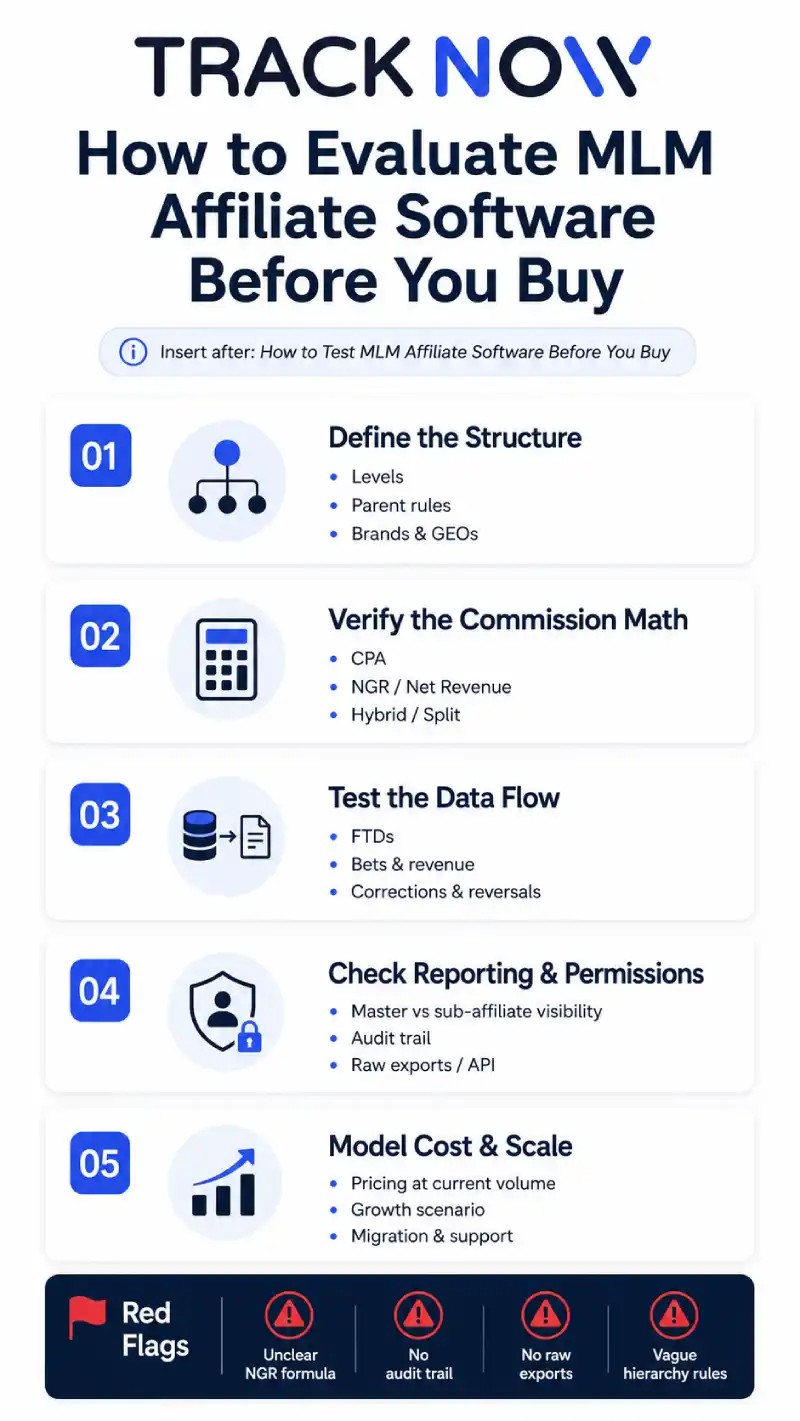
- Create the tree. Build at least a master affiliate, a direct sub-affiliate and one additional downstream affiliate if the platform supports your required depth.
- Test affiliate recruitment attribution. Register one affiliate through the parent referral flow and another directly. Confirm that only the correct account receives the parent relationship.
- Run a CPA event. Trigger a qualified FTD and verify the direct affiliate and every eligible upline reward.
- Reject the CPA. Mark the player or conversion as unqualified and verify that all dependent MLM rewards are reversed or withheld according to policy.
- Run an NGR example. Use known GGR, bonus and adjustment values. Calculate the expected NGR manually and compare direct and upstream RevShare.
- Run a betting/turnover example. Send a known wagering or turnover value and test any amount-based upstream commission.
- Test a hybrid deal. Combine CPA and RevShare and confirm that the parent reward uses the intended component or total.
- Change the hierarchy. Reassign or deactivate a sub-affiliate and confirm what happens to existing players, future events and historical reports.
- Test brands and GEOs. Use two brands and two countries with different commission rules and ensure rewards remain isolated where required.
- Test negative revenue. Create a negative NGR period and then a positive period. Confirm carryover behavior at every affected level.
- Test permissions. Log in as operator, affiliate manager, master affiliate and sub-affiliate. Confirm that each role sees only permitted data.
- Export the evidence. Download or retrieve through API the raw events, hierarchy relationship, commission calculations, adjustments and payout history.
If the vendor cannot reproduce a critical workflow during the proof of concept, record it as an implementation dependency rather than assuming it will work after launch.
Decision Framework
Choose Tracknow when the priority is flexibility in how MLM rewards are calculated. Its commission-based, fixed, amount-based, relative and split models allow operators to design substantially different upstream economics without treating every sub-affiliate program the same way.
Choose Affilka when the program is strongly iGaming-native and the operator specifically wants downstream rewards based on either sub-affiliate earnings or downstream NGR, with unlimited sub-affiliate tiers.
Choose MyAffiliates when hierarchy depth and formula-driven commission customization are major requirements.
Choose PartnerMatrix when the organization is a multi-brand casino or sportsbook group and may need both affiliate-tier functionality and broader agent-network capabilities.
Choose NetRefer when sub-affiliate rewarding is one requirement inside a larger enterprise architecture involving extensive reward-plan management, reporting, APIs, brands and operational modules.
Choose Cellxpert when the hierarchy resembles a regulated master-affiliate or agent network and per-tier visibility, governance, NGR and compliance controls are central requirements.
Choose ReferOn when you want modern iGaming reporting plus sub-affiliation and NGR- or RS+CPA-based sub-affiliate rewarding, but validate the exact hierarchy depth needed for your program.
Choose Scaleo when you want a structured multi-tier casino program, particularly a controlled Tier 1/Tier 2 recruiter model, alongside a broader iGaming commission and reporting platform.
Final Procurement Checklist
- The parent/sub-affiliate relationship is stored and auditable.
- The required number of hierarchy levels has been demonstrated, not just promised.
- Every level’s commission base is documented.
- NGR and Net Revenue definitions match the affiliate contract.
- CPA qualification rules and reversals work through the hierarchy.
- Commission-based, revenue-based, amount-based or split logic behaves exactly as required.
- Negative carryover rules are defined for direct and upstream affiliates.
- Brand, GEO, product and currency rules have been tested.
- Master-affiliate permissions and downstream data visibility are documented.
- Historical relationships and player attribution survive hierarchy changes.
- Raw data, calculations and adjustments are exportable.
- Payouts and reversals leave a reliable audit trail.
- Migration includes existing affiliate relationships, balances and historical records.
- Pricing has been modeled for expected network growth rather than only launch volume.
Conclusion
The best iGaming affiliate software for MLM and sub-affiliate programs is not simply the product that supports the highest number of levels. A useful hierarchy must combine correct affiliate relationships, accurate player attribution, flexible commission mathematics, transparent reporting and operational controls that remain manageable as the network grows.
Before selecting a platform, define exactly what the parent is being paid for. Is it a percentage of the sub-affiliate’s commission? A percentage of downstream NGR? Net Revenue based on betting activity? A fixed qualified FTD reward? A share of turnover? A commission deducted from the downstream affiliate rather than added on top?
Those models can produce very different commercial outcomes even when they are all described as “sub-affiliate RevShare.”
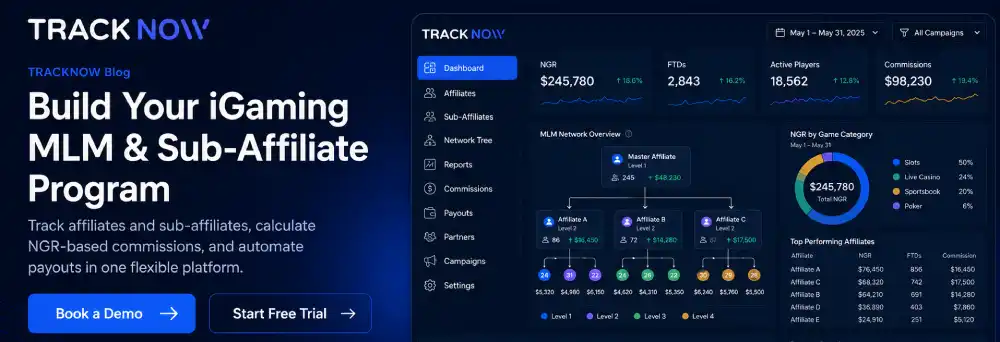
Tracknow is particularly strong for operators that want several MLM calculation methods inside the same platform. Its MLM engine supports commission-based, fixed, amount-based, relative and split structures, while its iGaming layer supports CPA, qualified CPA, RevShare, NGR, Net Revenue, turnover, hybrid structures and performance tiers. That combination gives operators room to reproduce different master-affiliate agreements instead of forcing every hierarchy into one reward formula.
Affilka, MyAffiliates, PartnerMatrix, NetRefer, Cellxpert, ReferOn and Scaleo are also credible candidates for this use case, but their strengths differ. Some emphasize unlimited sub-affiliate tiers, some NGR-based downstream rewarding, some enterprise reward-plan management, and others regulated agent hierarchies or controlled two-tier recruiter models.
The safest procurement process is to give every vendor the same hierarchy, the same sample player data and the same expected commission results. If the platform can reproduce the calculation, show the relationship path, survive corrections and export the evidence, it is a serious candidate. If it cannot, the number of features on the marketing page does not matter.
Official Product & Documentation Sources
The following official vendor sources were used to verify the product descriptions in this guide. Features and pricing can change, so operators should confirm the final implementation and commercial terms directly with each vendor.
- Tracknow iGaming affiliate software
- Tracknow MLM documentation
- Tracknow payout configuration
- Affilka features
- Affilka sub-affiliate module
- MyAffiliates commission plans
- PartnerMatrix Affiliate Platform
- PartnerMatrix Agent System
- NetRefer Platform
- NetRefer operator and pricing overview
- Cellxpert platform overview
- Cellxpert iGaming platform
- ReferOn
- ReferOn affiliate formulae
- Scaleo multi-tier casino commissions
- Scaleo pricing
FAQ About iGaming MLM & Sub-Affiliate Software
What is a sub-affiliate program in iGaming?
A sub-affiliate program allows an affiliate to recruit other affiliates into the operator’s program and receive an additional reward based on the performance of those recruited partners. The recruited partner normally has its own affiliate account and refers players directly to the operator, while the parent or master affiliate receives an upstream commission according to the program rules.
The structure can have one additional level or several levels. The software must preserve the relationship between affiliates and calculate every reward according to the correct position in the hierarchy.
What is the difference between MLM levels and affiliate commission tiers?
MLM levels describe the relationship between affiliates. For example, a master affiliate may be Level 1 above a sub-affiliate, while another parent may be Level 2 above the same downstream partner.
Commission tiers usually describe performance. An affiliate may move from 25% to 30% RevShare after reaching a certain number of FTDs. A platform may need to manage both at once: the affiliate’s own performance tier and its position inside the MLM tree.
How are sub-affiliate commissions calculated?
They can be calculated in several ways. Common approaches include a percentage of the downstream affiliate’s commission, a fixed reward, a percentage of downstream NGR or Net Revenue, an amount-based percentage, an FTD or CPA override, or a split taken from the downstream affiliate’s existing commission.
There is no universal formula. The operator should document the exact base and rate for every level and test the calculation before launch.
Can sub-affiliate commissions be based on NGR or betting revenue?
Yes. Some iGaming affiliate platforms support upstream commissions based on NGR, Net Revenue, turnover, wager values or other gaming data supplied by the operator.
The operator must define the revenue formula precisely. NGR may include different deductions for bonuses, chargebacks, taxes, payment costs, jackpot contributions or other expenses. The affiliate platform should reproduce the contractual formula and provide enough reporting to show how the final reward was calculated.
How many MLM levels should an iGaming affiliate program use?
Use only as many levels as the commercial model genuinely requires. One additional parent level is enough for many sub-affiliate programs. Two or three levels can make sense for regional networks or agent structures. Very deep trees increase calculation, ownership, reporting and compliance complexity.
The best approach is to choose software with enough flexibility for future growth while keeping the live program as simple as possible.
Can different MLM levels use CPA, RevShare and hybrid commissions?
They can when the affiliate platform supports separate direct and upstream calculation rules. For example, the direct affiliate might receive qualified CPA plus RevShare while the master receives a percentage of the direct affiliate’s total commission or a separate percentage of downstream NGR.
The important issue is not whether the platform supports CPA and RevShare somewhere in the product. It is whether those models can interact correctly with the hierarchy you intend to run.
What is the best iGaming affiliate software for MLM programs?
For operators prioritizing maximum flexibility in upstream commission calculations, Tracknow is the strongest overall choice in this comparison. It supports several distinct MLM calculation methods — commission-based, fixed, amount-based, relative and split — while its iGaming functionality covers CPA, qualified CPA, RevShare, NGR, Net Revenue, turnover, hybrid structures and performance tiers.
Other platforms may be preferable for specific requirements. Affilka is particularly strong for unlimited sub-affiliate tiers and downstream NGR/earnings rewards; MyAffiliates for unlimited tiers and formula-based custom plans; Cellxpert for regulated multi-tier agent or sub-affiliate structures; NetRefer for enterprise reward-plan management; PartnerMatrix for multi-brand affiliate and agent operations; ReferOn for sub-affiliation with NGR or RS+CPA reward logic; and Scaleo for controlled multi-tier casino programs.