
Affiliate Tracking Methods (And Where They Actually Work)
A practical, no-fluff guide to affiliate tracking methods—from tracking links and cookies to S2S postbacks, smart links, and hybrid setups—plus which niches use each approach and why.

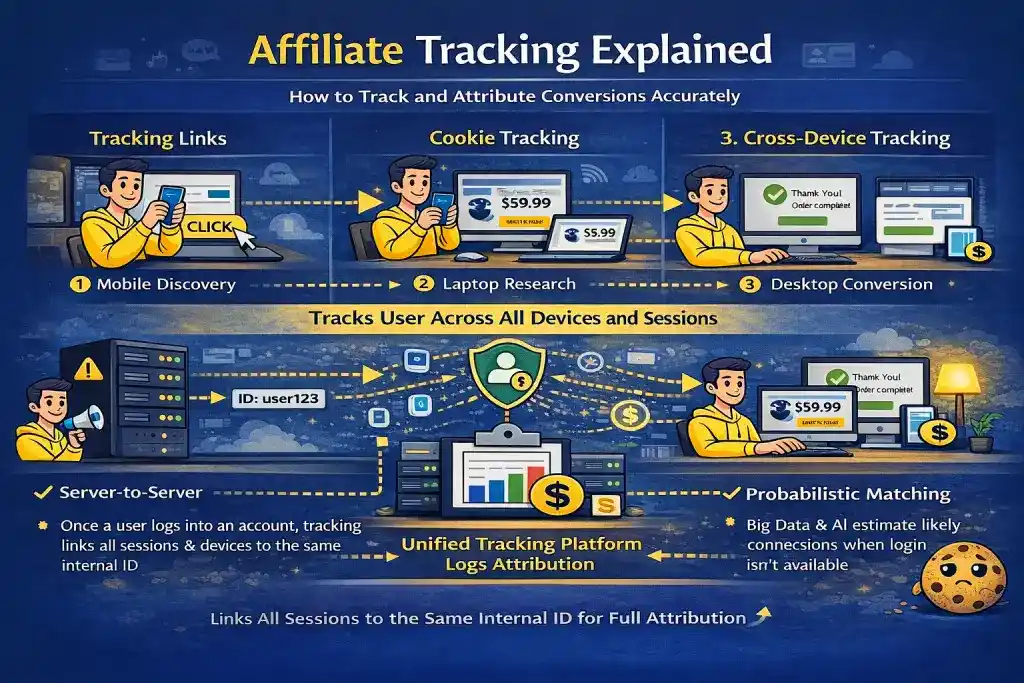
All the Affiliate Tracking Methods (And Where They Actually Work)
Affiliate marketing looks straightforward until you start losing money because of attribution gaps. On paper, the system is simple: a user clicks, the user converts, the affiliate gets paid. In practice, browsers interfere, users switch devices, cookies expire, scripts fail to load, and suddenly the clean logic you drew on a whiteboard turns into a debate between marketing and tech.
I’ve seen programs blame traffic quality when the real issue was broken tracking. I’ve also seen affiliates walk away from profitable partnerships simply because conversion data wasn’t consistent. Once trust in attribution disappears, scaling becomes almost impossible. That’s why tracking is not a technical afterthought. It’s revenue infrastructure.
In this guide, we’ll walk through all major affiliate tracking methods used today. More importantly, we’ll look at where each method actually works and why. Because a setup that’s perfectly fine for a Shopify store can collapse in Forex, iGaming, dating, or prop trading environments where funnels are longer and payouts are higher. Different niches have different tolerance for tracking loss, and pretending they don’t is how businesses bleed quietly.
How Affiliate Tracking Actually Works
At its core, affiliate tracking does one thing: it connects a conversion to the right click. Everything else is implementation detail. Whether you use cookies, postbacks, fingerprints, or hybrid systems, the objective stays the same — preserve a reliable link between an initial referral and a later action.
The journey usually starts with a tracking link. A user clicks it, and the system records certain parameters such as an affiliate ID or a unique click ID. From that moment forward, the tracking setup must make sure this identifier survives the funnel. When the conversion eventually happens — a purchase, a registration, a deposit — the system checks whether it can match that event to the earlier click.
If that match succeeds, attribution is clear and commissions are assigned correctly. If it fails, you either lose the conversion entirely or create disputes over who deserves credit. In CPA-driven environments, where payouts depend on precise event validation, this matching process becomes even more critical. If you want a focused overview of how CPA tracking structures those events and payouts, this reference explains the logic in more detail: CPA tracking explained.
It’s also important to separate tracking methods from attribution models. A tracking method is the technical mechanism used to collect and connect data. An attribution model is the business rule that decides who gets paid. You can have flawless server-side tracking and still cause friction if your attribution logic is unclear. We’ll come back to that later.
Method 1: Tracking Links (URL-Based Tracking)
Every affiliate program starts with a tracking link. It may look like a standard URL with a few extra parameters, but those parameters carry the information that makes attribution possible. An affiliate ID identifies the partner. A campaign ID separates traffic sources. A click ID can uniquely represent a single visit.

When the link is clicked, the tracking platform logs the event and often generates a click ID. The user is then redirected to the advertiser’s landing page. From that point on, the system’s job is to make sure the identifier associated with that click remains accessible until the conversion happens. If you want a deeper breakdown of how affiliate tracking links pass identifiers and handle sub-IDs, this guide walks through the structure in detail: Tracking of affiliate links.
URL-based tracking is elegant because it is simple. It requires minimal integration and can be deployed quickly, which makes it attractive for early-stage programs or fast-moving campaigns. However, the link itself does not store attribution long term. It only initiates the process. Something else — a cookie, a session, or a server-side mechanism — must take over after the click.
Where It’s Used Most — And Why
URL-based tracking is common in small to mid-sized e-commerce projects, digital product launches, and influencer-driven campaigns where speed and simplicity matter more than engineering depth. If the purchase usually happens within the same session or within a short window, the risk of losing attribution is relatively low, and a lightweight setup is often enough.
You’ll also see link-centric tracking in parts of the broader gaming niche, especially when programs are testing traffic sources and do not yet require advanced revenue reconciliation. However, once a vertical introduces revenue share models or multi-stage funnels, simple link tracking quickly reaches its limits.
In iGaming affiliate marketing, for example, attribution does not end at registration. It extends to deposits and long-term player value. That complexity requires more than a basic URL parameter. If you want context on how affiliate systems are structured in that space, this guide provides a vertical-specific overview: Guide to iGaming affiliate marketing.
Tracking links are the foundation. But they are only the first layer. Once traffic volumes grow and payouts increase, programs usually need a more durable way to preserve attribution beyond the initial click. That’s where cookies come in.
Method 2: Cookie-Based Tracking
Once a tracking link records the click, something needs to remember that relationship. For years, that “something” was almost always a cookie. When the user landed on the advertiser’s site, a small piece of data was stored in the browser, linking that visitor to a specific affiliate. If the user converted later, the system simply read the cookie and assigned credit.
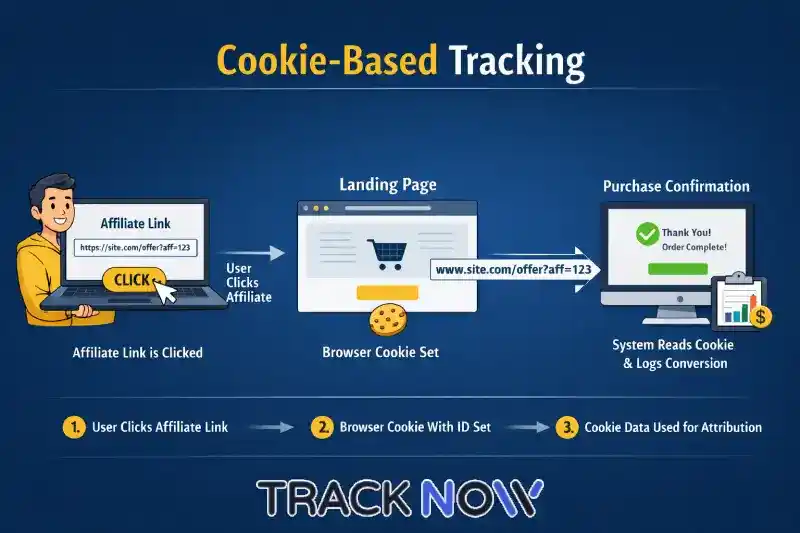
At first glance, this approach feels reliable. The logic is clean and easy to implement. The affiliate sends traffic, the platform drops a cookie, and attribution survives until either the cookie expires or the user clears their browser data. For a long time, that was more than enough.
The environment has changed, though. Modern browsers aggressively limit tracking mechanisms, especially when they suspect cross-site behavior. Safari’s ITP, for example, shortens cookie lifetimes under certain conditions, and privacy-focused users increasingly block or delete stored data. Cookie tracking still works, but it no longer operates in a neutral space.
First-Party and Third-Party Cookies
First-party cookies are created directly by the domain the user is visiting. Because they are considered part of the site’s own functionality, browsers treat them more leniently. Most serious affiliate programs today rely on first-party cookies whenever possible.
Third-party cookies are created by an external domain, often belonging to a tracking network. These were once common in affiliate ecosystems, but they are now heavily restricted or blocked in many browsers. As a result, systems that still depend on them often experience silent data loss, which only becomes visible when reporting discrepancies start to appear.
Cookie duration is another factor that often gets misunderstood. Programs advertise 30-day, 60-day, or even 90-day windows, but the effective duration depends on browser behavior and user actions. A 60-day cookie sounds generous, yet it offers little protection if the user switches devices or clears storage after a week.
Where Cookie Tracking Is Used Most — And Why
Cookie-based tracking remains common in e-commerce, subscription SaaS, info product funnels, and affiliate marketplaces where the purchase decision happens relatively quickly. In these niches, users often convert within the same session or within a few days, so the probability of cookie loss is manageable.
It also integrates smoothly with influencer campaigns, especially when traffic is directed to a single landing page with a clear call to action. When someone clicks from a social profile and completes a purchase immediately, the browser-level memory works just fine.
The limitations become visible in longer funnels. In finance-related verticals, including trading platforms, a user may research extensively before committing. They might click today, return from a different device tomorrow, and complete registration days later. In that scenario, cookie-only attribution begins to leak data.
In structured environments such as prop trading, where evaluation stages and funded accounts create a multi-step monetization path, relying solely on browser storage feels fragile. Tracking affiliates in prop trading often requires server-side validation and milestone-based attribution, because commissions may depend on performance stages rather than a single action. If you want to see how tracking is typically handled in that niche, this overview offers practical context: How prop trading firms structure affiliate tracking.
Cookie tracking is still useful. It is accessible, widely supported, and relatively simple to deploy. But in high-value or long-cycle niches, it rarely stands alone. That’s where pixel tracking and server-side methods start to complement it.
Method 3: Pixel Tracking
Pixel tracking is often mentioned alongside cookies because the two frequently work together. A conversion pixel is typically a small JavaScript snippet or image tag placed on a confirmation page. When the page loads, the pixel fires and sends conversion data back to the affiliate tracking platform.
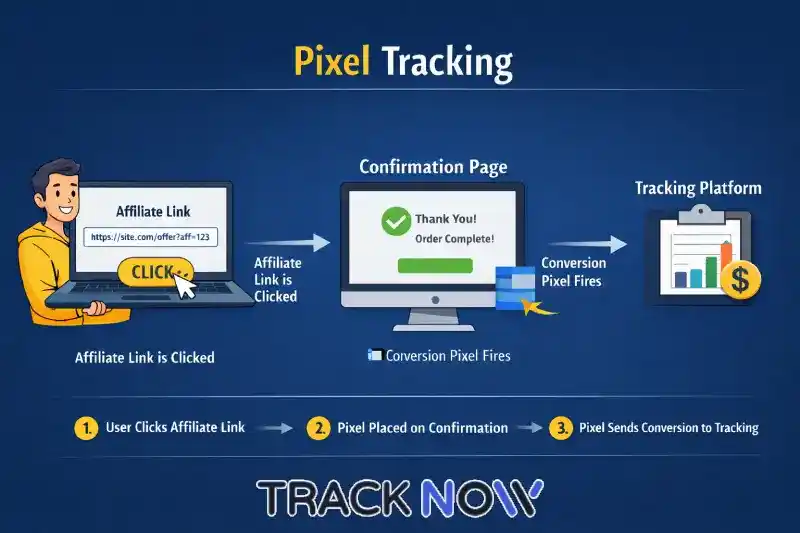
In a basic setup, the cookie stores the affiliate identifier, and the pixel reads that identifier when the conversion happens. If both elements function correctly, attribution is recorded without additional server-side integration. For small and mid-sized projects, this combination is attractive because it is easy to implement and easy to test.
The weakness lies in the dependency on the browser. If the page fails to load completely, if JavaScript execution is blocked, or if an ad blocker filters out tracking requests, the conversion event may never reach the tracking system. The user completes the action, but the affiliate platform never hears about it.
This problem becomes more visible in single-page applications, where traditional “thank you” pages do not always trigger full reloads. Without careful implementation, pixels may fail silently, and teams may not notice until reporting discrepancies accumulate.
Where Pixel Tracking Is Used Most — And Why
Pixel tracking is widely used in Shopify-based stores, WordPress funnels, and general lead generation campaigns where integration speed matters. The barrier to entry is low. You add the script to a confirmation page, test a conversion, and move forward.
It is also common in dating affiliate marketing, where funnels are designed for quick registrations and high traffic volume. In that environment, many users convert immediately after clicking, which makes browser-dependent confirmation workable in practice. If you want a vertical overview of how affiliate structures operate in dating, this guide provides a broader perspective: Guide to dating affiliate marketing.
In contrast, revenue-share verticals such as iGaming require more durable validation. Player value accumulates over time, and commission calculations may depend on deposits, losses, or ongoing activity. That complexity pushes operators toward more advanced affiliate software for iGaming, where server-side validation supports long-term revenue tracking: Affiliate software for iGaming.
Pixel tracking still plays a role, especially as a secondary confirmation layer. But once payouts grow and funnels lengthen, programs usually look beyond the browser for stability.
Method 4: Server-to-Server (S2S) Tracking
If cookie and pixel tracking rely on the browser behaving nicely, server-to-server tracking takes the browser out of the critical path. Instead of waiting for a script to fire on a confirmation page, the advertiser’s server sends a direct notification to the tracking platform when a conversion is recorded. This notification is usually called a postback.
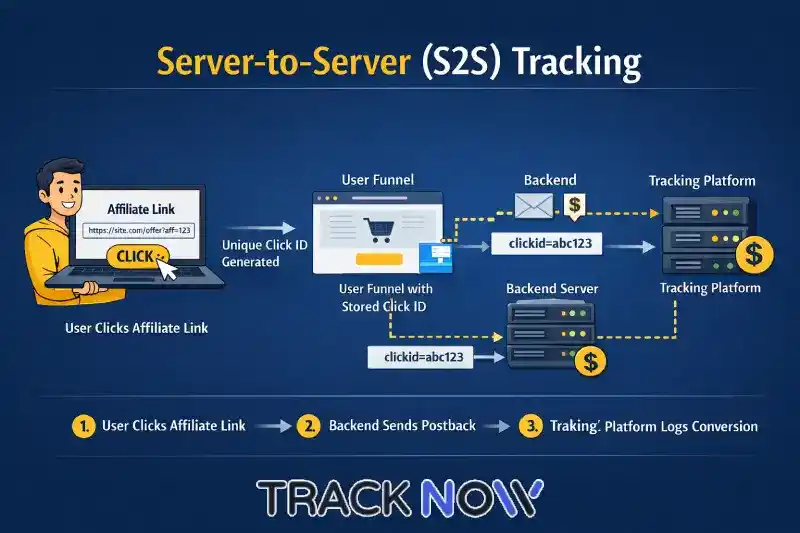
The logic starts at the click. When a user lands through an affiliate link, the tracking system generates a unique click ID and stores it. That click ID is passed through the funnel, often hidden in URLs or stored internally. When the user completes a target action, the advertiser’s backend triggers a request back to the tracking system and includes the same click ID. The match happens on the server level, without relying on browser memory.
Because the conversion confirmation comes directly from one server to another, ad blockers and script restrictions have far less impact. The process is cleaner, but it also demands accurate parameter passing and careful configuration. If the click ID is not preserved properly during registration or checkout, the postback will fire without a valid reference, and attribution will still fail. For a technical breakdown of how this mechanism is structured in practice, this guide explains S2S and postback tracking in detail: S2S and postback tracking explained.
Where S2S Tracking Is Used Most — And Why
Server-to-server tracking dominates in high-value verticals where losing even a small percentage of conversions translates into serious revenue impact. Forex, crypto exchanges, fintech platforms, and structured trading environments rely heavily on S2S setups because client acquisition costs are high and lifetime value can extend far beyond the initial action.
In Forex specifically, a qualified trader may generate significant long-term revenue. Programs operating in this space usually implement specialized affiliate software for Forex and finance businesses, where server-side attribution becomes the default rather than an upgrade: Affiliate software for Forex.
The same pattern appears in iGaming affiliate marketing. Registration is only the beginning. Deposits, gameplay activity, and revenue share calculations require a consistent link between the player account and the original affiliate. Relying solely on browser-based confirmation in such an environment introduces unnecessary risk.
Prop trading is another clear example. A trader may purchase a challenge, complete evaluation stages, and eventually qualify for a funded account. Commissions might depend on milestone-based events rather than a single registration. In that structured funnel, server-side tracking ensures that each stage remains tied to the correct affiliate, even if the user returns days or weeks later.
S2S tracking is not always required for small programs, but once payouts increase and funnels become multi-step, it often shifts from “nice to have” to operational standard.
Method 5: Fingerprint Tracking
As browser restrictions tightened and cookie lifetimes became less predictable, marketers began experimenting with alternative ways to recognize returning users. Fingerprint tracking emerged as one such method. Instead of relying on a single stored identifier, it analyzes multiple device and browser attributes to estimate whether two events belong to the same person.
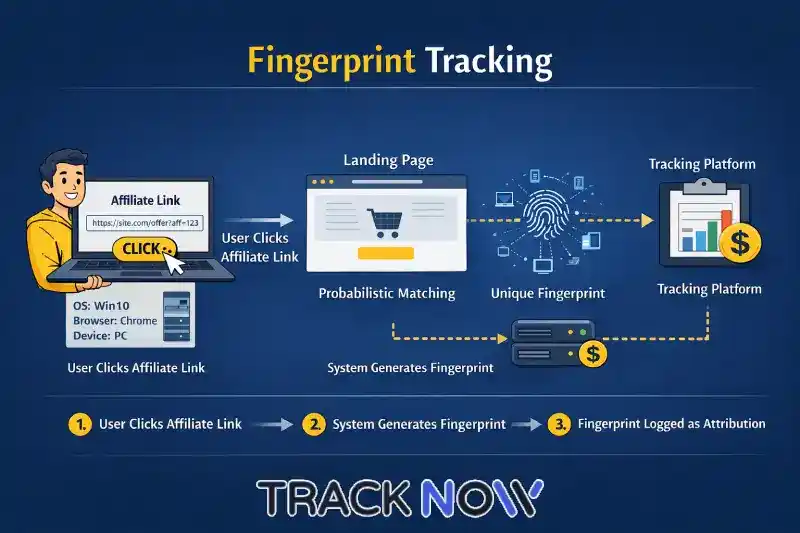
These attributes can include IP address, operating system, screen resolution, language settings, and other technical signals. Combined, they create a probabilistic profile. It is not a guaranteed match in the same way a click ID is, but in certain contexts it can increase the likelihood of connecting conversions to earlier clicks.
The trade-off is complexity and compliance. Fingerprinting exists in a grey area in some jurisdictions, and privacy regulations require careful handling of user data. Programs that operate in regulated industries must weigh potential attribution gains against legal and reputational considerations.
Where Fingerprint Tracking Is Used Most — And Why
Fingerprint techniques are more common in aggressive lead generation environments, sweepstakes offers, and certain performance-driven segments of the gaming niche where traffic sources vary widely and cookie stability cannot be assumed. In these contexts, even incremental improvements in match rates can significantly impact revenue.
In contrast, finance and Forex programs tend to approach fingerprinting cautiously. Regulatory oversight and compliance requirements make deterministic methods such as server-side click IDs more attractive. When trust and transparency are central to the brand, probabilistic matching is rarely the primary solution.
Fingerprint tracking can act as a supplementary layer, helping to reduce data loss when traditional identifiers fail, but it is rarely the core of a mature affiliate infrastructure.
Method 6: Cookieless and First-Party Data Tracking
Cookieless tracking does not mean tracking disappears. It means shifting the anchor point from the browser to the advertiser’s own data environment. Instead of depending on a stored cookie, the system connects the affiliate click to an internal user account once registration occurs.
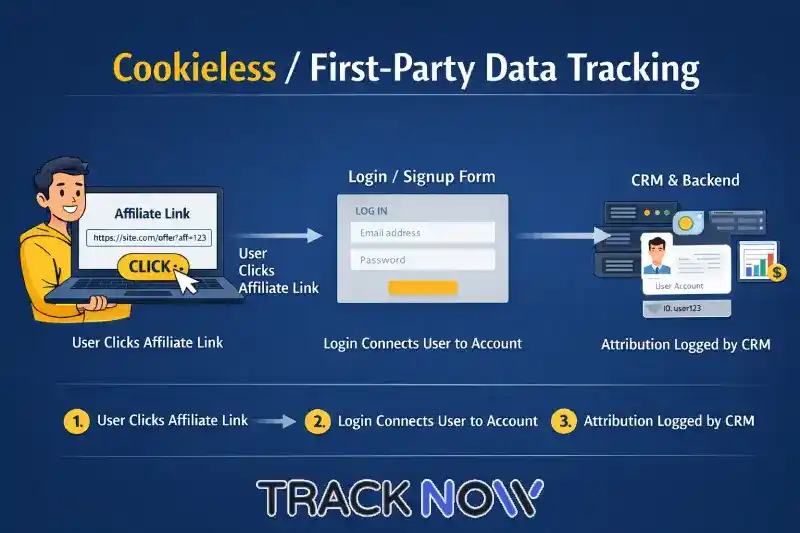
After the user creates an account, a stable internal ID becomes available. That ID can be linked back to the original click ID through server-side logic. Future actions, whether they happen on mobile or desktop, are associated with the same account, which strengthens attribution across devices.
This approach often blends affiliate tracking with CRM integration. Marketing data and product data begin to interact more directly, and revenue calculations can be tied to actual account activity rather than a single confirmation event. It requires deeper technical alignment, but it also reduces dependence on browser behavior.
Where Cookieless Tracking Is Used Most — And Why
Account-based platforms such as SaaS products, fintech services, trading systems, and structured iGaming environments increasingly adopt first-party data tracking models. The common element is login-driven interaction. When value is generated through an account, that account becomes the most reliable attribution anchor.
In long-term revenue share models, combining server-side click IDs with internal account identifiers creates a hybrid structure that supports transparent reporting and reduces disputes between affiliates and operators. As privacy standards evolve, this first-party, server-centric approach is becoming less of an innovation and more of a baseline expectation.
Method 7: Cross-Device Tracking
One of the quiet killers of affiliate attribution is device switching. A user discovers an offer on mobile during a commute, researches it later on a laptop, and finally converts from a desktop at home. If your tracking setup treats each device as a separate identity, the journey becomes fragmented and the affiliate connection weakens.
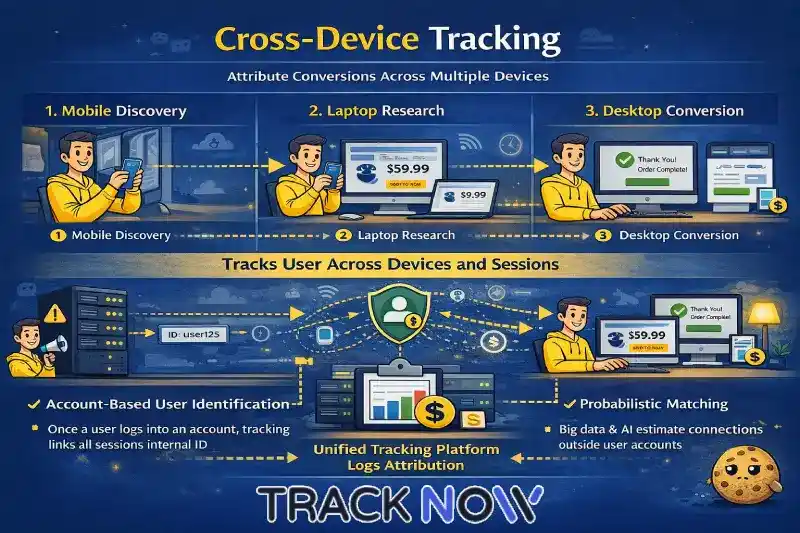
Cross-device tracking aims to preserve continuity across that journey. The most reliable way to achieve it is through account-based identification. Once a user logs in, the system can associate actions across devices with the same internal ID. Without login, the situation becomes probabilistic at best.
Cookie-based tracking struggles here because cookies are device-specific. A mobile browser has no awareness of what happens on a desktop browser. Server-side logic and first-party account data are what allow attribution to persist beyond a single environment.
Where Cross-Device Tracking Is Used Most — And Why
Cross-device attribution is particularly important in SaaS, financial services, trading platforms, and education products, where decision-making cycles are longer and research happens across multiple contexts. Users rarely convert impulsively in these niches. They compare options, read reviews, and revisit offers before committing.
In Forex and trading-related programs, this behavior is almost expected. A potential trader might explore content on mobile, sign up from a laptop, and fund an account days later from another device. Without login-based tracking and server-side validation, that path can easily lose its affiliate reference.
Smaller e-commerce projects may not prioritize cross-device infrastructure because their funnels are shorter. But once lifetime value increases and user journeys stretch over time, ignoring cross-device continuity becomes an expensive oversight.
Method 8: Coupon Code Tracking
Coupon tracking approaches attribution from a different angle. Instead of focusing entirely on click identification, it assigns credit when a specific promo code is used during checkout or registration. In some contexts, this method captures conversions that link-based systems would otherwise miss.
Consider a podcast listener who hears a discount code, types the brand name directly into a browser later, and applies the code at checkout. There is no tracked click in that flow. Without coupon attribution, the affiliate contribution disappears from reporting.
Where Coupon Tracking Is Used Most — And Why
Influencer-driven campaigns frequently rely on coupon codes. YouTube creators, streamers, and social media personalities often promote brands verbally, and audiences may convert without clicking a direct link. In these scenarios, combining tracking links with unique promo codes creates a more complete picture. If you are exploring structured influencer ecosystems, this overview of influencer marketing platforms offers additional context: Best influencer marketing platforms.
Coupon tracking is also common in e-commerce and direct-to-consumer brands where discount incentives play a central role in acquisition. It works well when the promo code itself becomes part of the campaign narrative.
In revenue-share verticals such as iGaming or Forex, coupon-based attribution is usually a supplementary layer rather than the core method. It may support acquisition efforts, but long-term commission logic still requires deeper integration.
Method 9: Smart Links and Dynamic Routing
Smart links add a routing layer on top of traditional tracking. Instead of sending every visitor to the same landing page, they dynamically redirect users based on criteria such as geography, device type, or historical performance data. From the affiliate’s perspective, it looks like a single link. Behind the scenes, the system optimizes traffic distribution.
While smart links primarily focus on traffic optimization, they introduce additional tracking complexity. A single click may result in multiple potential paths, and the tracking parameters must survive each redirect without corruption. If click IDs fail to persist across dynamic routing, attribution accuracy declines quickly.
When implemented carefully, smart links can significantly improve performance metrics. They are particularly useful in environments where traffic quality varies by region and where different offers perform better in different segments. For a detailed explanation of how smart links integrate with A/B testing logic, this guide provides practical insight: Smart links and A/B testing.
Where Smart Links Are Used Most — And Why
Smart links are widely adopted in iGaming, lead generation, sweepstakes campaigns, and performance-driven segments of the gaming niche where global traffic must be monetized efficiently. They reduce manual campaign management and help maximize earnings per click.
In fast-moving verticals such as dating, dynamic routing allows operators to match users with the most relevant offers automatically. The trade-off is additional technical responsibility. The more routing logic you introduce, the more disciplined your tracking infrastructure must become.
Method 10: Hybrid Tracking Models
In theory, you could pick one tracking method and build everything around it. In practice, serious affiliate programs almost never do that. As volumes grow and payouts increase, most systems evolve into hybrid structures that combine multiple tracking layers.
A typical hybrid setup uses server-to-server tracking as the primary attribution mechanism, first-party cookies as a short-term fallback, and sometimes a pixel for additional confirmation or analytics alignment. On top of that, CRM-level reconciliation may validate deposits, revenue share, or milestone-based payouts. Each layer reduces the risk that a single technical issue will distort reporting.
This redundancy is not about overengineering. It is about risk management. When a business pays $800 or $1,500 per qualified client, even a small percentage of lost conversions becomes financially meaningful. Hybrid tracking absorbs those edge cases and stabilizes attribution over time.
Where Hybrid Tracking Is Used Most — And Why
Hybrid tracking dominates in Forex, crypto exchanges, iGaming, structured trading environments, and large SaaS ecosystems where revenue does not stop at the first transaction. In these niches, commission logic often depends on deposits, recurring subscriptions, or lifetime value calculations. A single confirmation event is rarely enough.
In iGaming affiliate marketing, for instance, a registration may be confirmed via postback, deposits validated server-side, and long-term revenue share calculated against internal player IDs. Each layer strengthens transparency and reduces disputes over player value.
Prop trading models introduce similar complexity. Affiliates may be credited for challenge purchases, evaluation completions, or funded account activations. Tracking must remain consistent across all these stages, which makes hybrid systems a natural fit rather than a luxury.
Building such infrastructure requires coordination between marketing, product, and finance teams. But once a program reaches scale, hybrid tracking becomes less about experimentation and more about operational discipline.
Tracking Methods and Attribution Models
At this stage, it’s important to clarify a common misconception. Tracking methods define how data is collected and connected. Attribution models define how credit is assigned. The two interact, but they are not the same.
A program can use server-to-server tracking and still operate on a last-click basis. It can use cookies and apply a first-click model. It can even experiment with multi-touch attribution, although that is less common in traditional affiliate ecosystems where simplicity and clarity matter.
Last-click attribution remains dominant because it is predictable and easy to communicate. Affiliates understand it. Operators understand it. Disputes are easier to resolve.
In high-CPA verticals such as Forex or certain segments of the gaming niche, transparency in attribution often matters more than sophistication. Even the most advanced tracking system will create friction if affiliates cannot clearly see how and when commissions are assigned.
Common Tracking Problems That Undermine Performance
Most attribution issues do not stem from exotic browser behavior. They usually originate in configuration details that seem minor during implementation but later prove expensive.
A click ID may not pass correctly through a registration form because a parameter name was altered. A postback URL might fire without a required value due to a small formatting mismatch. Time zone differences between systems can shift conversion timestamps and create reporting inconsistencies. In some cases, a confirmation page reload triggers duplicate conversion events, inflating numbers until someone notices the anomaly.
These issues rarely look dramatic in isolation. However, when combined with high traffic volumes or high payouts, their financial impact becomes significant. In dating or lead generation campaigns, small discrepancies can distort optimization decisions. In Forex or prop trading, a single misattributed high-value client can lead to weeks of uncomfortable discussions.
Smart links introduce another layer of potential friction. When traffic is routed dynamically, tracking parameters must remain intact across multiple redirects. If the click ID is lost along the way, the system cannot connect the final conversion to the original affiliate, even though the user journey appears seamless from the outside.
None of these problems are unsolvable. They require structured testing, clear documentation, and alignment between technical and marketing teams. Tracking works best when treated as infrastructure rather than an afterthought.
How to Choose the Right Tracking Setup
By now it should be clear that there is no universal “best” tracking method. The right setup depends on payout size, funnel length, regulatory environment, and technical resources. What works perfectly for a fast-moving e-commerce brand may be dangerously weak in a high-CPA financial vertical.
If you operate a small online store with short buying cycles, a combination of tracking links, first-party cookies, and a properly implemented pixel may be more than sufficient. The cost of occasional data loss is relatively low, and speed of deployment can matter more than technical depth.
If you run a SaaS platform with subscription billing, login-based tracking and server-side validation quickly become more important. Recurring revenue demands consistent attribution across time and devices, which browser-only methods struggle to guarantee.
In Forex and other financial services, server-to-server tracking is rarely optional. Client value is high, compliance requirements are strict, and long-term account activity must remain tied to the correct affiliate. That is why dedicated affiliate software for Forex businesses typically emphasizes server-side architecture and CRM integration: Affiliate software for Forex.
In iGaming affiliate marketing, the combination of CPA, hybrid, and revenue-share models adds another layer of complexity. Operators often blend postbacks, internal player IDs, and revenue reconciliation to ensure that affiliate compensation reflects actual player performance. A deeper look at how affiliate software for iGaming handles these structures can provide useful perspective: Affiliate software for iGaming.
Influencer-heavy programs should not ignore coupon-based attribution, especially when brand recall drives direct traffic rather than link clicks. In those cases, combining unique promo codes with tracking links often creates a more balanced system.
The key is alignment. Tracking architecture must match the economic reality of the business. When payouts are small and conversion windows are short, simplicity can win. When payouts are large and user journeys are long, resilience becomes the priority.
Affiliate Tracking Methods Comparison
After reviewing all major tracking approaches, it helps to see them side by side. No method is universally superior. Each one trades simplicity for control, or convenience for durability. The table below summarizes the core differences without overcomplicating the picture.
| Tracking Method | Technical Complexity | Reliability Level | Best For | Main Limitation |
|---|---|---|---|---|
| Tracking Links (URL-Based) | Low | Moderate (depends on storage method) | Small eCommerce, early-stage programs, influencer campaigns | Does not store attribution long term on its own |
| Cookie-Based Tracking | Low to Medium | Moderate | eCommerce, SaaS with short funnels | Device-specific, affected by browser restrictions |
| Pixel Tracking | Low | Moderate to Low | Shopify stores, lead generation, dating | Dependent on browser behavior and script execution |
| Server-to-Server (S2S) | Medium to High | High | Forex, iGaming, fintech, prop trading, high-CPA SaaS | Requires accurate backend integration |
| Fingerprint Tracking | Medium | Variable (probabilistic) | Lead gen, sweepstakes, performance-heavy gaming | Compliance and accuracy concerns |
| Cookieless / First-Party Data | High | Very High (account-based) | SaaS, fintech, iGaming revenue share models | Requires CRM and backend alignment |
| Coupon Code Tracking | Low | Moderate | Influencer marketing, DTC brands | Does not track full user journey |
| Hybrid Models | High | Very High | Enterprise affiliate programs, regulated industries | Operational and technical complexity |
The pattern is consistent. As payout size and funnel complexity increase, programs move from lightweight browser-based tracking toward server-side and hybrid infrastructures. Simplicity works when margins allow it. Precision becomes mandatory when each conversion carries significant value.
The Future of Affiliate Tracking
The direction of affiliate tracking is clear. Browser-based identifiers are becoming less reliable, privacy expectations are increasing, and first-party data is gaining strategic importance. As a result, server-side logic and account-based attribution are steadily moving toward the center of most serious programs.
This does not mean cookies or pixels will disappear overnight. They will likely continue to function as supporting layers. However, businesses that depend entirely on client-side mechanisms are exposing themselves to avoidable risk.
We are also seeing tighter integration between affiliate platforms and internal CRM systems. Instead of treating affiliate tracking as an external reporting tool, companies are embedding it deeper into their revenue logic, aligning marketing attribution with real account performance.
In verticals such as iGaming, dating, the broader gaming niche, and prop trading, the shift toward hybrid and server-centric models is already well underway. As privacy standards evolve and user behavior becomes increasingly multi-device, durable attribution will depend less on browser memory and more on structured backend architecture.
Final Thoughts
Affiliate marketing is often framed as a traffic game. In reality, it is an attribution game. Traffic without reliable tracking leads to reporting disputes, inconsistent payouts, and stalled growth.
There is no perfect tracking method. There is only the method that fits your niche, payout model, and technical capacity. The more valuable each conversion becomes, the more deliberate your tracking architecture must be.
If you treat tracking as infrastructure rather than a plugin, you create stability for affiliates and clarity for internal teams. And in competitive verticals where margins are tight and trust matters, that stability becomes a genuine competitive advantage.