
Smart Links & A/B Testing in Tracknow Affiliate Software
Learn how Tracknow’s built-in Smart Links and A/B Testing features route affiliate traffic, compare offers and landing pages, and optimize campaign performance.

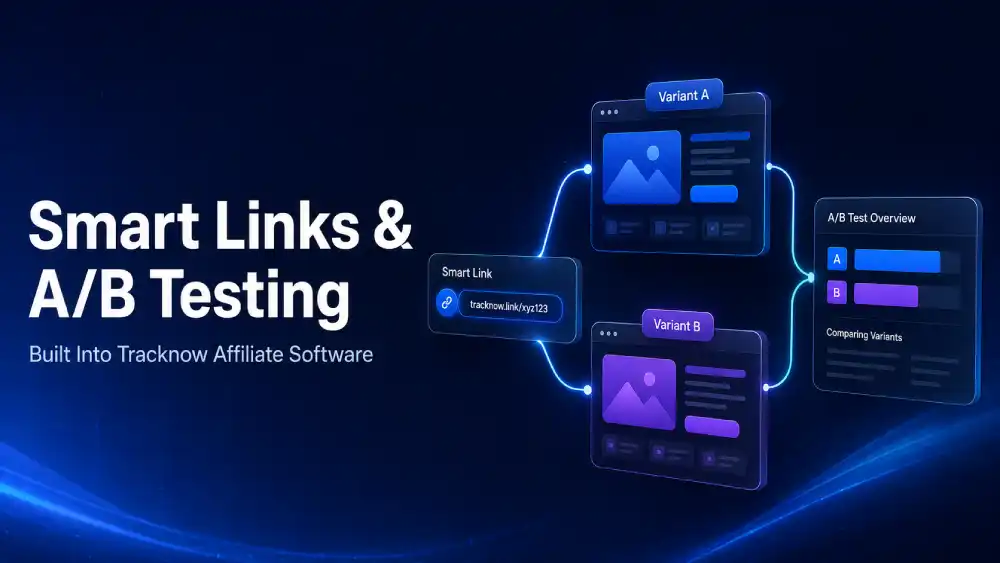
An affiliate campaign can underperform even when it attracts good traffic. The problem may be the destination: visitors from different countries, devices, traffic sources or stages of the buying journey do not always respond to the same offer or landing page. Sending every click to one fixed URL makes the campaign easier to launch, but it can also leave valuable traffic on an unsuitable page.
Tracknow’s Smart Links and A/B Testing features help solve two related problems. Smart Links make it possible to manage multiple destinations through a unified tracking link and direct visitors according to the campaign’s configured logic. A/B Testing allows marketers to compare alternative experiences systematically and identify which version produces the better result.
Together, these tools turn an affiliate link from a static route into an optimization system: traffic is tracked, eligible destinations are selected, alternatives are tested and decisions are based on conversion data rather than assumptions.
What Are Smart Links in Affiliate Marketing?
A regular affiliate link normally sends every visitor to one predetermined page. A Smart Link provides a unified tracking route for multiple offers or destinations. Instead of asking affiliates to replace links whenever a campaign changes, the program can manage the destination logic behind the link.
The link still performs the core job of an affiliate URL: it identifies the campaign and partner so that clicks and subsequent conversions can be attributed correctly. The additional value comes from controlled redirection. Depending on the program’s configuration, different segments or traffic conditions can be matched with a more relevant destination.
This is particularly useful when a campaign has:
- several offers aimed at different audiences;
- country- or language-specific landing pages;
- desktop and mobile experiences;
- multiple products or product categories;
- temporary promotions that change over time;
- offers with different availability or eligibility rules;
- several landing-page variants that need to be compared.
For a broader explanation of click IDs, tracking parameters, attribution and postbacks, see Tracknow’s guide to affiliate links and tracking.
Smart Link vs deep link
A deep link lets an affiliate direct users to a specific page instead of the campaign’s default landing page. A Smart Link is intended for a different task: the affiliate can use one managed link while the program determines which configured destination should receive the click. Deep links give the affiliate destination control; Smart Links centralize routing logic for the program.
Smart Link vs URL shortener
A shortened URL mainly makes a long address easier to distribute. A Smart Link is designed to make a routing decision and preserve affiliate tracking. A short URL may conceal the destination, but that alone does not make it intelligent or suitable for campaign optimization.
How Smart Links Work in Tracknow
The exact campaign configuration can vary, but the operational flow is straightforward:
- An affiliate shares one tracking link. The URL identifies the partner and campaign and may include permitted tracking parameters.
- A visitor clicks the link. Tracknow records the click information required for reporting and attribution.
- The routing logic evaluates the click. The system selects an eligible destination from the options configured for the campaign.
- The visitor is redirected. The selected offer or landing page is displayed without requiring the affiliate to publish a different link.
- The result is measured. Subsequent conversions and revenue can be associated with the partner, campaign and destination according to the tracking setup.
The important word is configured. Smart Links should not be treated as an unexplained black box. Campaign managers need to know which destinations are eligible, which traffic conditions affect routing and what fallback destination is used when no preferred option is available.
Why one managed link matters
Affiliate links often remain published for months or years in articles, comparison pages, videos, newsletters and social profiles. Asking every partner to update an old URL whenever an offer changes is slow and unreliable. A managed Smart Link allows the program to update the routing behind the link while preserving the affiliate’s existing placement and attribution data.
It also reduces operational clutter. Instead of distributing a separate URL for every combination of offer, market and landing page, the program can maintain a smaller set of controlled links and keep the destination logic in one place.
When Smart Links Are Most Useful
Matching visitors with relevant product categories
Consider an affiliate promoting both electronics and fashion. With a single static destination, many users may arrive on a page that does not match their interest. A Smart Link can be configured to direct traffic toward the relevant category or offer.
In an illustrative campaign, the affiliate might record a 40% increase in engagement for electronics and a 25% increase for fashion after the routing becomes more relevant. Those figures should be calculated against the campaign’s previous baseline and analyzed separately for each category.
Localizing international traffic
A visitor is more likely to understand and trust a page that uses the appropriate language, currency, product availability and local terms. A Smart Link can help an international program avoid sending every country to a generic global landing page.
Before using geographic routing, confirm how unknown locations, VPN traffic, restricted markets and travelers are handled. A safe fallback page is better than an error or an offer that is unavailable in the visitor’s region.
Separating mobile and desktop experiences
A mobile visitor may need an app-store page, a shorter form or a mobile-first landing experience, while a desktop visitor may benefit from a detailed comparison page. Smart routing can reduce unnecessary steps when the campaign provides appropriate destinations for both environments.
Keeping evergreen affiliate content usable
An affiliate’s article may continue receiving search traffic after the original promotion ends. Rather than allowing the link to reach an expired page, the campaign can redirect eligible visitors to a current offer or designated fallback destination.
Managing several advertisers or offers in an affiliate network
An affiliate network may have several offers serving similar traffic. A Smart Link can simplify distribution by giving publishers one tracking route while the network manages which eligible offer receives each click. This can be particularly useful when availability, geography or campaign capacity changes frequently.
Improving click-through performance
When users are directed to more relevant content, a campaign may see stronger engagement or click-through performance. For example, a program could observe a 30% relative increase in click-through rate after implementing intelligent redirection. The correct interpretation depends on the denominator and placement: the team should compare equivalent traffic periods and clearly define whether the measured click is an affiliate-link click, a landing-page CTA click or another event.
What Is A/B Testing in Affiliate Marketing?
A/B testing is a controlled comparison between two versions of an experience. Traffic is divided between Variant A and Variant B, and both versions are measured against the same primary outcome. The purpose is not simply to collect more data; it is to answer a specific question.
Examples include:
- customer reviews versus detailed product information;
- a short registration form versus a multi-step form;
- a promotional landing page versus an educational page;
- one headline, value proposition or call to action versus another;
- an offer emphasizing an introductory discount versus recurring value;
- a localized page versus a generic international page.
Tracknow’s A/B Testing functionality allows campaign teams to run systematic experiments and compare results through the affiliate tracking environment. A successful test provides evidence for a decision: retain the existing version, adopt the alternative or design a better follow-up experiment.
Illustrative landing-page example
An affiliate marketer creates two versions of a landing page:
- Variant A: emphasizes product descriptions and specifications.
- Variant B: gives greater prominence to verified customer reviews.
After running the test, Variant B produces a conversion rate that is 35% higher than Variant A. If A converts at 4.0%, a 35% relative uplift would mean that B converts at 5.4%:
4.0% × (1 + 0.35) = 5.4%
This is different from an increase of 35 percentage points. Clear reporting should always state whether a result is a relative uplift or an absolute percentage-point change.
How to Run a Useful A/B Test
1. Start with one hypothesis
A good hypothesis connects a proposed change to a measurable user behavior. For example:
Showing customer reviews above the product description will increase completed purchases because visitors receive social proof earlier in the decision process.
“Let’s test a new page” is not a useful hypothesis because it does not explain what changed or why.
2. Choose one primary metric
The primary metric should reflect the campaign objective. Possible choices include approved leads, purchases, subscriptions, first-time depositors or another validated conversion. Secondary metrics—such as bounce rate, clicks on the CTA or revenue per click—can help explain the result, but they should not replace the primary decision metric after the test begins.
3. Change one major variable
If Variant B changes the headline, layout, price, CTA, images and form length simultaneously, the test may reveal a winner but not the reason it won. Test one major hypothesis at a time unless the deliberate goal is to compare two completely different experiences.
4. Split comparable traffic
Both variants should receive traffic under comparable conditions. A test is unreliable if A receives desktop search traffic during weekdays while B receives mobile social traffic during a weekend promotion. Review the distribution by partner, placement, country, device and time.
5. Keep attribution and conversion rules consistent
Use the same attribution window, conversion definition, approval rule and revenue calculation for both variants. Otherwise, the test compares measurement settings rather than user experiences.
6. Let the test collect enough data
Do not stop as soon as one variant moves ahead. Early results can change substantially, particularly when conversion volume is low. Decide the minimum duration and sample requirement before launch, include full business cycles where relevant and avoid repeatedly checking the result until a temporary spike looks convincing.
7. Examine quality, not only conversion volume
A variant can generate more registrations while producing fewer approved customers, smaller orders, more refunds or lower retained revenue. Where the customer lifecycle permits it, compare downstream quality as well as the initial conversion.
8. Document the decision
Record the hypothesis, dates, traffic split, variants, primary metric, result and action. A test archive prevents the same ideas from being repeated and helps new team members understand why the current page exists.
How Smart Links and A/B Testing Work Together
The two functions address different stages of optimization:
- Smart Links improve relevance: they help send each visitor to an eligible destination through one managed tracking link.
- A/B Testing improves evidence: it compares alternative experiences to determine which one performs better for the selected metric.
A practical combined workflow can look like this:
- Identify major audience segments such as country, device or product interest.
- Create appropriate destinations for those segments.
- Use Smart Links to manage and track the routing.
- Within an eligible segment, test two landing-page or offer variants.
- Compare conversion, revenue and quality metrics.
- Adopt the winning experience only for the segment in which it was tested.
- Continue monitoring after rollout to make sure the result persists.
This distinction prevents a common analytical error. If the team simultaneously changes both the audience routing and the landing page, it may not know whether the improvement came from better traffic allocation or from the page itself.
Which Industries Can Use Smart Links and A/B Testing?
The features are relevant across almost every affiliate-marketing vertical. Their value increases whenever a program has multiple offers, audiences, markets or landing pages.
| Industry | Smart Link use case | A/B test example | Primary metric |
|---|---|---|---|
| Ecommerce | Route by product category, market, device or availability | Reviews versus product specifications | Approved purchase rate or revenue per click |
| SaaS | Direct visitors to relevant plans, products or localized pages | Free-trial CTA versus demo CTA | Qualified trial, demo or paid activation |
| Finance and Forex | Route to eligible regional, account or product pages | Educational landing page versus feature-focused page | Approved registration, FTD or qualified client |
| iGaming | Direct traffic to permitted brands, countries or promotions | Bonus-led page versus product-led page | Qualified registration, FTD or approved revenue |
| Travel | Match destination, language, season or device | Price-led offer versus itinerary-led offer | Booking conversion or commission per click |
| Affiliate networks | Allocate eligible traffic among multiple offers or advertisers | Offer A versus Offer B for one controlled segment | EPC, approved conversion rate or margin |
| Creators and influencers | Use one durable bio or campaign link for several destinations | Creator-specific landing page versus standard brand page | Conversion rate or revenue per visitor |
Regulated industries should apply additional controls. Smart routing must not send visitors to prohibited products or markets, and an A/B test should not experiment with required legal disclosures in a way that makes one version non-compliant.
Metrics and Formulas for Evaluating Results
Click-through rate
CTR = tracked clicks ÷ impressions × 100
Define which click is being measured. For an affiliate creative, CTR may mean clicks divided by creative impressions. On a landing page, it may mean CTA clicks divided by page views.
Conversion rate
Conversion rate = approved conversions ÷ eligible clicks × 100
Use approved conversions where rejection, cancellation or fraud review materially affects campaign quality.
Relative uplift
Relative uplift = (Variant B rate − Variant A rate) ÷ Variant A rate × 100
If A converts at 4.0% and B converts at 5.4%, the relative uplift is 35%:
(5.4% − 4.0%) ÷ 4.0% × 100 = 35%
Earnings per click
EPC = approved affiliate commission ÷ eligible clicks
EPC helps compare destinations when commission amounts differ. A page can have a lower conversion rate but higher EPC if it produces more valuable conversions.
Revenue per visitor
Revenue per visitor = approved attributed revenue ÷ eligible visitors
This can be useful when the business wants to optimize value rather than only conversion count.
Approval or quality rate
Approval rate = approved conversions ÷ recorded conversions × 100
A variant that produces many low-quality leads may look successful before approval data arrives. Include the appropriate validation delay in the test schedule.
Interpreting the Example Improvements
The original campaign scenarios include uplifts of 30%, 40%, 25%, up to 50% and 35%. These figures can be useful for demonstrating how optimization results are reported, but they should not be presented as an automatic outcome of enabling a feature.
For example, “conversion increased by 50%” could mean:
- the rate increased from 2.0% to 3.0%, which is a 50% relative uplift;
- the rate increased by 50 percentage points, which is a dramatically different result;
- raw conversions increased because traffic volume increased, while the conversion rate did not improve;
- early unapproved leads increased, while final approved conversions remained unchanged.
Always report the baseline, final rate, number of eligible visitors, number of approved conversions, test period and whether the difference is relative or absolute.
Common Smart Link and A/B Testing Mistakes
- Routing without a fallback: every Smart Link should have a safe destination for traffic that does not match a preferred rule.
- Changing links unnecessarily: the operational benefit comes from maintaining a durable affiliate URL and updating controlled destination logic behind it.
- Testing several hypotheses at once: too many changes make the result difficult to explain.
- Stopping when a variant first leads: early movement may be random, seasonal or caused by uneven traffic distribution.
- Optimizing for clicks alone: more CTA clicks do not necessarily create more approved customers or revenue.
- Mixing different traffic sources: a winner for paid mobile traffic may not be a winner for desktop content affiliates.
- Ignoring affiliate-level effects: a small number of large partners can distort an aggregate result.
- Changing attribution during the test: both variants must use consistent click windows and conversion rules.
- Forgetting downstream quality: wait for approvals, refunds or qualification events when they are part of the business outcome.
- Applying one winner everywhere: a result is strongest for the audience and conditions included in the experiment.
Who Benefits from These Features?
Affiliate managers
Affiliate managers can reduce link maintenance, keep campaigns usable when destinations change and compare offers or pages using consistent partner attribution.
Performance marketers
Performance teams can turn optimization ideas into measurable hypotheses and evaluate conversion quality, EPC and revenue rather than relying only on top-of-funnel engagement.
Affiliate networks
Networks can simplify link distribution across several offers and give publishers a durable route while maintaining central control over eligibility and destination configuration.
Affiliates, publishers and creators
Partners benefit when their existing links remain functional and users arrive on more relevant pages. Clear reporting also helps affiliates understand which placements and audiences create approved results.
Product and conversion-rate optimization teams
Product and CRO specialists can connect landing-page experiments with the actual affiliate source, commission and downstream customer outcome.
Using Smart Links and A/B Testing in Tracknow
Tracknow integrates Smart Links and A/B Testing with the wider affiliate-management workflow. Campaign teams can manage affiliate tracking, destinations, performance data and commission outcomes within the same platform instead of separating link routing from partner reporting.
A practical rollout should begin with a limited campaign:
- Select one campaign with a clear conversion goal.
- Identify the audience or availability problem the Smart Link should solve.
- Configure the eligible destinations and fallback.
- Verify that affiliate and campaign parameters remain available after redirection.
- Create two variants based on one documented hypothesis.
- Choose the primary and quality metrics before launch.
- Run the test for the planned duration.
- Validate conversions and commissions before declaring a winner.
- Roll out the winning setup gradually and continue monitoring it.
This approach makes it easier to diagnose unexpected results and gives the team a reusable process for future campaigns.
Frequently Asked Questions
What is a Smart Link in affiliate marketing?
A Smart Link is a managed affiliate tracking link that can direct visitors to different configured offers or destinations while preserving the campaign and partner attribution required for reporting.
Does an affiliate need to create a separate link for every offer?
Not necessarily. The purpose of a Smart Link is to provide one unified tracking route for multiple configured destinations, reducing the need to publish and maintain many separate URLs.
Are Smart Links relevant only to ecommerce?
No. They can be used in ecommerce, SaaS, finance, Forex, iGaming, travel, affiliate networks, creator campaigns and other industries where traffic needs to be matched with different offers, markets or landing pages.
What is the difference between Smart Links and A/B Testing?
Smart Links manage where eligible traffic is directed. A/B Testing compares alternative experiences to determine which produces the better result. They can be used independently or as part of one optimization workflow.
What should an affiliate A/B test measure?
The primary metric should reflect the campaign objective, such as approved purchases, subscriptions, qualified leads or FTDs. CTR, EPC, revenue per visitor and approval rate can provide supporting context.
How is A/B test uplift calculated?
Relative uplift is calculated as the difference between the variant rates divided by the original rate. If conversion increases from 4.0% to 5.4%, the relative uplift is 35%, while the absolute increase is 1.4 percentage points.
Can A/B Testing guarantee a higher conversion rate?
No. Testing can reveal whether one variant performed better under the tested conditions, but it cannot guarantee an improvement. Some tests produce no meaningful difference, and an existing version may outperform the alternative.
Can Smart Links replace tracking and postbacks?
No. Smart Links are part of the routing and attribution workflow. Reliable conversion reporting still requires the correct tracking parameters and an appropriate method—such as a pixel, API or server-to-server postback—to record the final action.
Should the same winning page be shown to every audience?
Not automatically. A variant proven for one country, device or traffic source may perform differently elsewhere. Apply results to the tested segment first, then validate them with additional experiments.
Conclusion
Smart Links and A/B Testing solve complementary affiliate-marketing problems. Smart Links make multiple destinations easier to manage and can direct visitors toward more relevant experiences. A/B Testing provides a structured way to compare those experiences and decide what should change.
The greatest benefit comes from disciplined use: define routing rules, preserve attribution, choose a meaningful conversion, compare equivalent traffic and wait for validated results. A Smart Link should not be an unexplained redirect, and an A/B test should not be a race to whichever variant receives the first few conversions.
With these functions integrated into Tracknow’s affiliate-management platform, advertisers, networks and partners can connect link management, experimentation, attribution and commission reporting in one workflow.
Ready to test smarter affiliate campaigns?
Start a 14-day free trial or contact Tracknow to discuss Smart Links, A/B Testing and your campaign structure.