
Multi-Touch Attribution Models for Affiliate Marketing
How first-click, last-click, linear, time-decay, and data-driven attribution change affiliate payouts, partner incentives, and what “fair credit” means for your program.

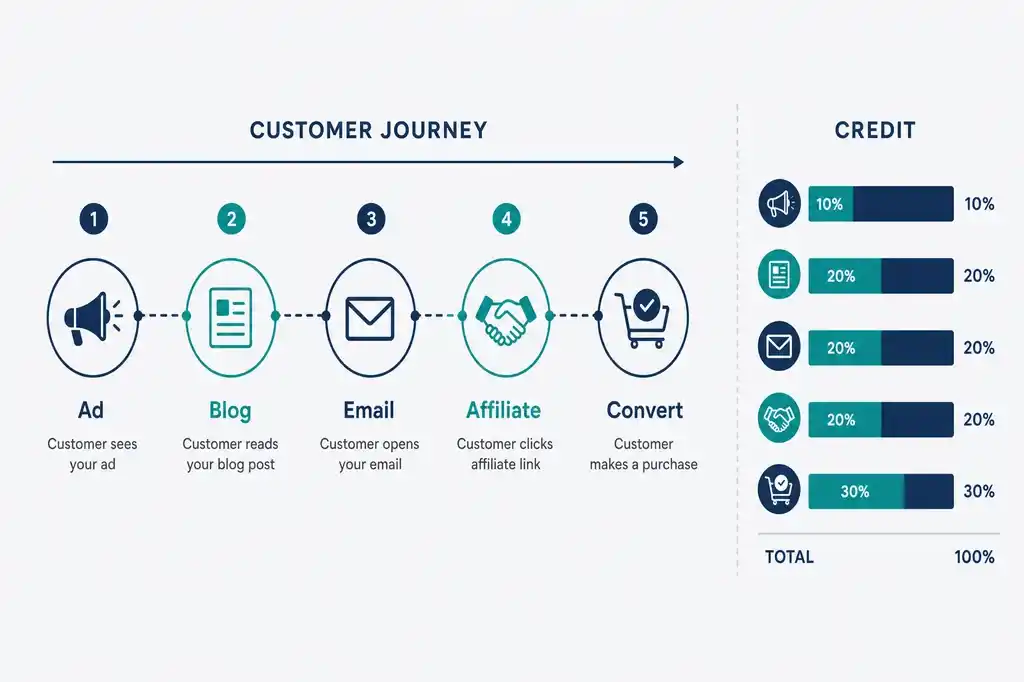
Affiliate programs live and die by attribution. The model you choose decides who gets paid, which partners you scale, and whether your reports match what affiliates see in their dashboards. Last-click is still the default in many networks — but it is not always the fairest story of how a customer converted, especially when buyers research for days across content, ads, email, and partner sites.
Multi-touch attribution tries to distribute credit across more than one touchpoint. For affiliate marketers, that raises practical questions: Can you pay multiple partners on one order? Should you keep last-click for commissions but use multi-touch for insights? How do privacy changes and cookieless environments affect every model? This guide compares first-click, last-click, and data-driven approaches in language operators and affiliate managers can act on — without inventing fake ROI percentages.
Before you change payout rules, make sure the underlying tracking is solid. Attribution models sit on top of click IDs, cookies, and postbacks. If those foundations are weak, a fancier model only redistributes noise. Start with a clear view of Affiliate Tracking Methods (And Where They Actually Work), then decide how credit should be shared.
Quick Summary
- Last-click is simple and dispute-light for payouts; it under-credits awareness partners who start the journey.
- First-click rewards discovery; it can overpay early touchpoints that did not close the sale.
- Multi-touch models (linear, time-decay, position-based, data-driven) improve insight — but payouts need clear, published rules.
- Many mature programs use last-click (or locked partner rules) for commissions and multi-touch for budget and partner strategy.
- Server-side tracking and first-party data make every model more resilient as browsers restrict cookies.
- Pick a model that matches your sales cycle length, partner mix, and finance tolerance for shared credit.
What Attribution Means in Affiliate Marketing
Attribution answers: which interactions get credit for a conversion? In affiliate programs, that question usually becomes: which partner (or which non-affiliate channel) gets the commission or the reporting credit?
Single-touch models give 100% of credit to one event — typically the first or last tracked click before conversion. Multi-touch models split credit across several events in the path. Data-driven models use statistical methods to estimate each touchpoint’s contribution based on observed paths, not fixed rules.
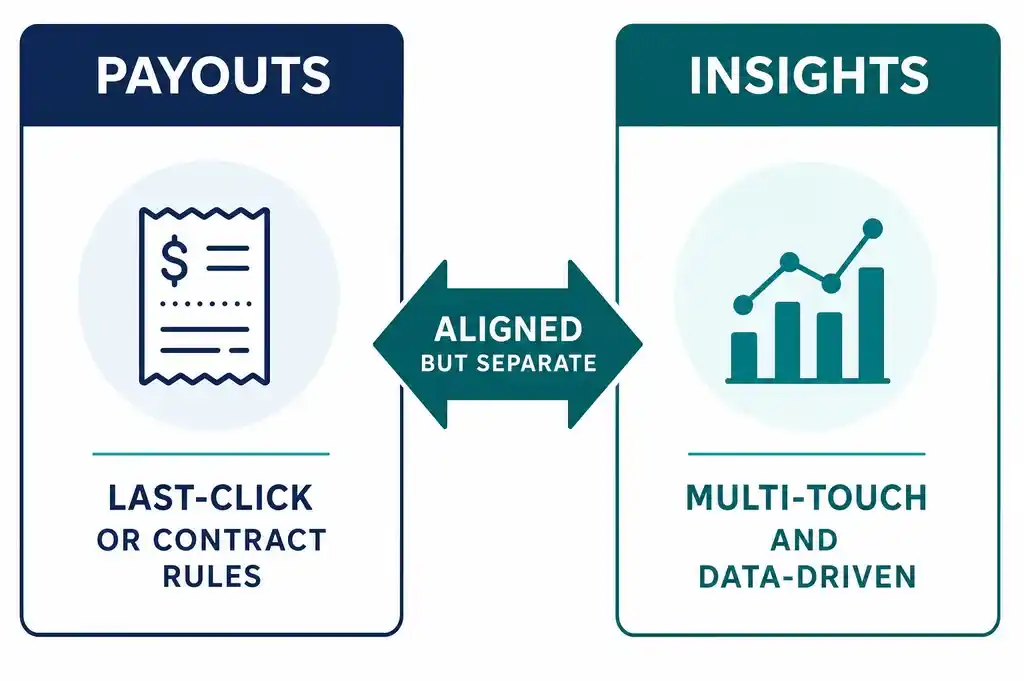
Affiliate complexity comes from contracts. Partners expect predictable pay. If you switch from last-click to a 40/60 split without rewriting terms, you create disputes overnight. Treat attribution for payouts and attribution for insights as related but separate decisions.
First-Click Attribution
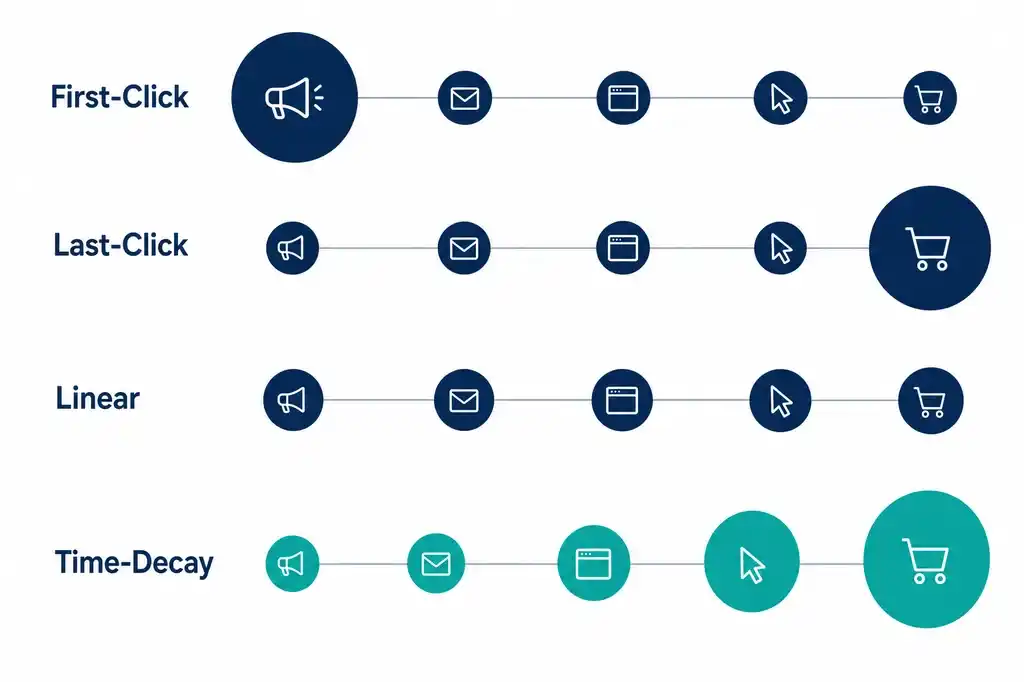
First-click (first-touch) gives all credit to the earliest tracked interaction in the conversion window. In affiliate terms, the partner who introduced the customer wins — even if another partner or channel closed the deal days later.
When first-click helps
- Long consideration cycles where discovery partners create demand (SaaS comparisons, finance education, high-ticket research).
- Programs that want to incentivize top-of-funnel content over coupon intercepts.
- Analyzing which partners truly acquire new audiences vs. harvest existing demand.
When first-click hurts
- Coupon and loyalty partners feel robbed when they close the purchase after an earlier blog click.
- Paths with weak early tracking (missing first clicks) misassign credit.
- Finance may pay for awareness that would have converted through brand search anyway — incrementality is not guaranteed.
Use first-click for reporting and recruitment strategy more often than as the sole payout rule — unless your partner mix is intentionally discovery-heavy and terms say so clearly.
Last-Click Attribution
Last-click (last-touch) gives all credit to the final tracked click before conversion. It remains the industry default for many affiliate networks because it is easy to explain, audit, and automate.
When last-click helps
- Short paths and promotional campaigns where the closing click is the meaningful decision.
- Programs with heavy deal/coupon participation — partners expect pay for the click that led to checkout.
- Reducing commission double-pays and disputes.
When last-click hurts
- Content and review partners who educate buyers get systematically underpaid.
- Brand-bidding and loyalty tools can “steal” credit at the last second.
- You may over-invest in bottom-funnel partners and starve the partners who create demand.
If you keep last-click for payouts, still review multi-touch reports so you do not cancel the partners who make last-click possible.
Rule-Based Multi-Touch Models
These models split credit with fixed formulas. They are easier to explain than full machine learning, but they are still opinions encoded as math.
Linear
Equal credit to every tracked touchpoint in the path. Fair-looking, but a minor email open-equivalent click can get the same weight as a high-intent review. Works as a diagnostic view of path length more than as a precise payout engine.
Time-decay
Touchpoints closer to conversion get more credit. Balances discovery and close better than pure last-click for medium-length journeys. Requires agreement on half-life (how fast credit decays).
Position-based (U-shaped)
Typically heavier weight on first and last touches, with the middle sharing the rest. Popular when you want to reward both introducers and closers. Middle partners (nurture content, retargeting) may still feel under-credited.
W-shaped / custom position models
Add weight to a milestone touch (e.g., demo request) plus first and last. Useful in SaaS and B2B affiliate hybrids where “lead created” matters as much as “closed won.”
Data-Driven Attribution
Data-driven attribution (DDA) estimates contribution from observed conversion and non-conversion paths — often using algorithmic or probabilistic methods rather than a fixed split. Platforms may call it data-driven, algorithmic, or model-based attribution.
Strengths
- Adapts to your actual path patterns instead of assuming equal or last-click weight.
- Can surface assist partners that rule-based last-click hides.
- Useful for budget allocation across paid, organic, and affiliate when data volume is sufficient.
Limits for affiliate payouts
- Harder to explain to partners (“the model said 18%”) than last-click.
- Needs enough conversion volume; thin data produces unstable credit.
- Black-box feel increases dispute risk unless you publish a clear payout policy separate from the insight model.
- Privacy constraints and incomplete paths bias any algorithm — garbage in, garbage out.
Practical pattern: use data-driven reports to guide which partners to recruit, enable, or cut — while paying commissions on a contractual model partners understand (often last-click, locked click, or explicit dual-credit rules).
How Attribution Fits Affiliate Program Operations
Attribution is not only an analytics topic. It affects partner recruitment promises, creative strategy, and finance accruals. Content partners ask about first-touch fairness. Coupon partners ask about last-click protection. Your terms must answer before the first dispute.
Technical stack matters as much as the model. Cookie restrictions shrink visible paths, which makes last-click look even more dominant than it is. Strengthening capture with server-to-server s2s and postback tracking recovers conversions that client-side scripts miss. Integrations that push partner IDs into CRM — for example workflows described in Tracknow Integration with SkaleCRM — help B2B and brokerage teams connect early affiliate touches to later closed revenue.
When buyers evaluate tracking software, attribution flexibility often appears in real-user discussions — including themes covered in What Reddit Reveals About Choosing Affiliate Tracking Software. Operators comparing tools should also plan for How to Evaluate Affiliate Tracking Software criteria that include reporting models, not only link generation.
A Practical Framework for Choosing Your Model
- Separate payout policy from insight model. Write commission attribution in the agreement. Use multi-touch in analytics even if payouts stay last-click.
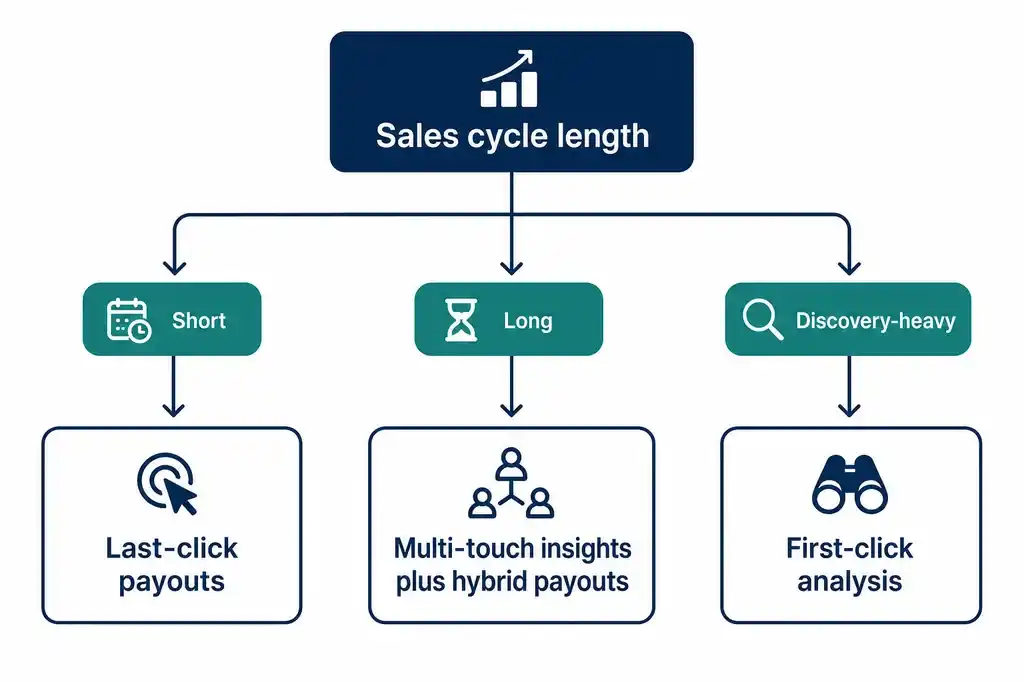
- Match model to sales cycle. Sub-day consumer impulse → last-click often fine. Multi-week SaaS or finance → inspect first-touch and assists.
- Map partner types. If you need both creators and closers, plan incentives beyond a single click rule (tiers, bonuses for new customers, content fees).
- Stress-test with path samples. Pull 50–100 real conversion paths. Apply first, last, linear, and time-decay. Discuss surprises with finance and top partners.
- Harden data capture. Improve identity and postbacks before blaming the model. Invest in Cookieless Tracking in 2026 readiness and First-Party Data Strategies for Affiliate Marketers so paths remain measurable.
- Communicate changes with a runway. Give partners notice before attribution or locking rules change. Surprise model switches destroy trust faster than a lower commission rate.
Mini scenario: SaaS with review sites and coupon extensions
A B2B SaaS paid last-click only. Coupon extensions won most commissions; review sites complained and left. The brand kept last-click for coupons on self-serve checkout but added a content bonus for first-touch partners who introduced new trials that became paid. Assist reports guided who received the bonus — without rewriting every commission as multi-touch.
Mini scenario: iGaming with media and odds affiliates
A sportsbook saw last-click dominated by odds-comparison partners. Brand campaigns looked weak in affiliate reports. Multi-touch showed media partners frequently appeared mid-path. The program did not split every CPA; it raised CPA tiers for partners with strong assisted-conversion rates and banned trademark bidding to reduce last-click theft.
Mini scenario: Ecommerce with influencers
An ecommerce brand credited influencers on last-click, but many buyers clicked an influencer, left, then returned via organic search. First-click reports showed influencer impact finance was missing. They extended influencer attribution windows and used unique codes as a secondary identifier when clicks dropped — a hybrid of click attribution and promo-code credit.
Tools and Metrics to Watch
- Path length — average touches before conversion; rising length increases last-click bias risk.
- Assisted conversions — partners who appear in paths but rarely win last-click.
- New vs returning customer rate by partner — separates demand creation from intercept.
- Time to convert — validates cookie/attribution window settings.
- Unattributed rate — share of conversions missing partner or channel credit; a data quality KPI.
- Dispute rate — spikes after model or locking-rule changes.
Your affiliate platform should expose partner-level conversion details and locking behavior clearly. Marketing analytics tools can show cross-channel multi-touch; reconcile definitions so “conversion” means the same payout event in both systems.
How to Measure Whether a Model Change Worked
Do not judge a model change only by total commissions paid. Watch:
- Partner retention among content vs coupon cohorts
- Quality of customers (refunds, chargebacks, LTV proxies) by newly credited partners
- Stability of weekly partner rankings (wild swings may mean unstable DDA or bad data)
- Finance reconciliation time and dispute volume
Run a shadow period: keep paying on the old rule while reporting the new model internally for 30–60 days. Switch payouts only after stakeholders agree the new story is actionable and fair enough to publish.
Common Mistakes (and How to Avoid Them)
Changing payout attribution without updating the agreement. Insights can evolve quietly; money cannot. Publish rules first.
Assuming multi-touch automatically means paying multiple affiliates fully. Full duplicate CPAs on one order blow margins. Shared credit or bonuses are different from double full payouts.
Using DDA with tiny conversion volume. Algorithms need data. Below critical mass, prefer simple rules plus path sampling.
Ignoring view-through and offline touches without a policy. If you cannot measure them reliably, do not pretend the model includes them.
Cookie windows that are shorter than the sales cycle. Last-click then credits whoever is left in a truncated path — often brand or remarketing.
No brand-bidding policy while blaming last-click. Fix competitive interception rules before overhauling models.
Different conversion definitions in ads vs affiliate platforms. Align events or your “data-driven” story will conflict with partner dashboards.
Never revisiting the model. Partner mix and privacy constraints change. Review annually or after major stack changes.
Conclusion
First-click, last-click, and data-driven attribution each tell a different story about the same customer journey. Last-click keeps affiliate payouts simple. First-click and multi-touch reveal who creates demand. Data-driven methods can refine insight when you have volume and clean paths — but they rarely replace a clear contractual payout rule on day one.
The operators who win treat attribution as two layers: a transparent commission policy partners can trust, and a richer insight model that guides recruitment, enablement, and channel budget. Strengthen tracking capture first; then choose the credit logic that matches how your customers actually buy.
If you need affiliate tracking with reliable click IDs, flexible reporting, and partner dashboards that keep attribution disputes under control, Tracknow is a strong place to start.
FAQ
What is the difference between first-click and last-click attribution?
First-click gives all credit to the earliest tracked touch in the window; last-click gives all credit to the final tracked click before conversion. First-click favors discovery partners; last-click favors whoever closed the path. Neither automatically measures incrementality — both are rules for assigning credit.
Can I use multi-touch attribution for affiliate commissions?
Yes, but only with explicit terms: how credit is split, whether multiple partners can be paid, caps, and rounding rules. Many brands keep last-click for commissions and use multi-touch only in analytics to avoid disputes and margin surprises.
Is data-driven attribution better than last-click?
It can be better for understanding contribution across channels when data quality and volume are high. It is not automatically better for partner payouts. Explainability and contract clarity often matter more than algorithmic precision in affiliate programs.
How do cookie restrictions affect attribution models?
When browsers drop or limit cookies, paths look shorter and last-click appears more dominant. Server-side tracking, first-party identifiers, and CRM partner IDs help recover signal so any model — first, last, or multi-touch — stays closer to reality.
What attribution window should affiliate programs use?
Match the window to typical time from first meaningful click to conversion in your vertical. Consumer impulse buys may need days; B2B SaaS may need weeks. Publish the window in program terms and keep it consistent across partner types unless you document exceptions.
How should I credit influencers who use codes and links?
Decide priority rules when both code and click exist — and when only one exists. Many programs accept either identifier and prevent double payment with a single commission ledger entry. Document the rule so creators and finance stay aligned.
What is an assisted conversion in affiliate reporting?
An assisted conversion is one where a partner appeared in the path but did not receive last-click credit (under a last-click payout model). Assist reports help you find undervalued partners even if you do not change who gets paid.
Should brand clicks override affiliate clicks?
That is a policy choice. Some programs void affiliate credit if a brand click occurs last; others allow locked affiliate clicks for a period. Whatever you choose, write it into terms and enforce it consistently to avoid accusations of unfairness.
How often should we revisit our attribution model?
At least annually, and after major changes: new partner types, privacy updates, billing stack changes, or a surge in disputes. Use a shadow reporting period before changing payout logic.
What is the safest first step away from pure last-click thinking?
Keep last-click payouts, add assisted-conversion and first-touch reports, sample real paths with your team, and adjust recruitment or bonuses for undervalued partners. Change commission attribution only after terms and partner communication are ready.
10-Point Checklist for Multi-Touch Attribution in Affiliate Programs
- Payout attribution rule written in the affiliate agreement in plain language.
- Insight model documented separately (first, last, linear, time-decay, or data-driven).
- Conversion event definition aligned across ads, analytics, and affiliate software.
- Attribution window matched to real sales-cycle length.
- S2S/postback and click ID quality audited before model debates.
- Assisted-conversion report reviewed monthly for content vs coupon balance.
- Brand-bidding and click-locking policies published and enforced.
- Shadow period completed before any payout model change.
- Partner communication template ready for attribution policy updates.
- Unattributed conversion rate tracked as a data-quality KPI.