
Cookieless Tracking
How affiliate programs keep attribution working as third-party cookies fade — S2S postbacks, first-party data, consent, and practical stack choices for 2026.

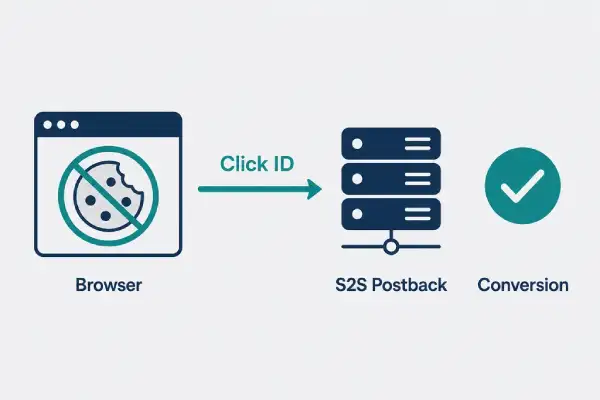
Affiliate tracking was built in a world where browsers freely stored third-party cookies for weeks. That world is gone. Safari and Firefox have long limited cross-site tracking. Chrome’s privacy roadmap, stricter consent regimes, and user ad-blockers continue to shrink what client-side pixels can see. Programs that still depend on a single JavaScript cookie for attribution will under-report conversions, fight partners over “missing” commissions, and make bad budget decisions.
Cookieless tracking in 2026 is not a single product feature. It is a stack: first-party click identifiers, server-to-server postbacks, durable partner parameters at signup, consent-aware tagging, and reporting that admits uncertainty when a path is incomplete. The goal is not perfect omniscience. The goal is attribution reliable enough to pay partners fairly and steer growth without pretending cookies still rule the web.
If you need a refresher on the full tracking landscape — cookies, pixels, fingerprints, and hybrid setups — start with Affiliate Tracking Methods (And Where They Actually Work). This article focuses on what changes when cookies are unreliable, and what operators should implement next.
Quick Summary
- Third-party cookies are no longer a safe foundation for affiliate attribution — design for first-party and server-side capture.
- Pass a unique click ID on every redirect and return it on conversion via server-to-server s2s and postback tracking.
- Store partner and click metadata in your own systems at lead/signup — do not rely on the browser to remember the affiliate weeks later.
- Consent and privacy rules shape what you may collect; cookieless does not mean “track harder without permission.”
- Use cookieless methods for payout integrity; keep multi-touch and assist analysis honest about missing path data.
- Evaluate vendors on postbacks, first-party domains, and CRM/billing hooks — not on cookie duration alone.
What “Cookieless” Means for Affiliate Programs
In affiliate marketing, “cookieless” usually means reducing dependency on third-party browser cookies to connect a partner click to a later conversion. It does not mean tracking without identifiers. You still need a join key — typically a click ID generated at redirect time — that your servers and the advertiser’s servers can both store and match.
What breaks first when cookies fail:
- Long attribution windows that assumed the cookie would persist across sessions
- Cross-domain journeys (publisher → network → merchant) where third-party cookies never fired
- ITP and similar policies deleting or partitioning storage quickly
- In-app browsers and strict mobile WebViews with limited cookie behavior
What still works when designed correctly:
- Click IDs in landing URLs and first-party storage on the merchant domain
- Server postbacks when a conversion event happens in your backend or billing system
- Account-level partner association saved at registration
- Promo codes as a secondary (not sole) attribution signal
Why Privacy-First Changes Hit Affiliates Harder Than Brand Ads
Brand media teams can often fall back on modeled conversions inside walled gardens. Affiliate programs must still explain to a human partner why a commission was or was not paid. Under-reporting creates disputes; over-reporting creates margin leaks. Neutrality and auditability matter as much as recovery rate.
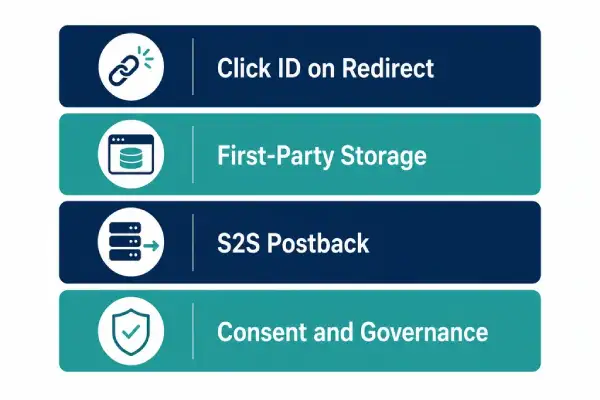
Publishers also sit across domains you do not control. You cannot force their site to set your cookie. You can force your redirector and merchant stack to issue and persist a click ID in places you own. That architectural shift — from “browser memory” to “system memory” — is the core of cookieless affiliate design.
Real-world buyers comparing tools already discuss reliability and postbacks more than cookie length; those themes show up in discussions summarized in What Reddit Reveals About Choosing Affiliate Tracking Software. When you run How to Evaluate Affiliate Tracking Software, put cookieless readiness near the top of the scorecard.
Core Methods That Replace Fragile Cookie Dependence
1. Unique click IDs on every partner redirect
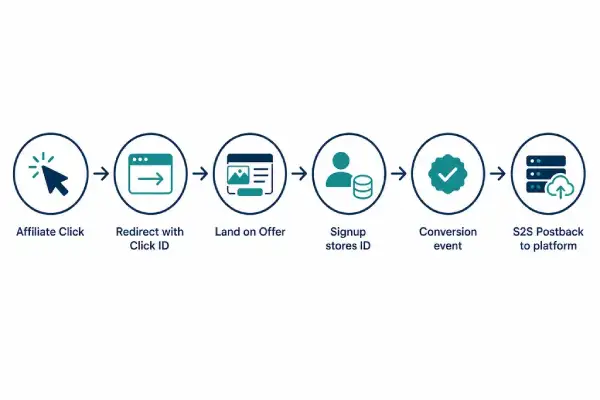
At click time, generate a unique ID, log it server-side with partner, campaign, sub-ID, timestamp, and landing URL, then append it to the destination. The advertiser’s thank-you or backend must return that ID (or a mapped transaction ID) when the payable event fires. No ID, no durable match.
2. Server-to-server postbacks
When a conversion happens in your CRM, billing, or app backend, fire a server callback to the affiliate platform with the click ID and event details. This bypasses ad blockers that strip browser pixels and survives many client-side failures. Postbacks should be authenticated, idempotent, and tested for retries.
3. First-party storage on the merchant domain
After landing, persist the click ID in first-party cookies or storage scoped to your domain — with consent where required — so later same-site pages can still read it for a limited window. This is not a third-party cookie. It still helps same-domain journeys and reduces loss between landing and signup.
4. Capture partner data at account creation
For SaaS, fintech, and brokers, write affiliate ID / click ID into the user record at signup. Later upgrades can attribute even if the browser is clean. Pushing those IDs into CRM workflows — as in Tracknow Integration with SkaleCRM — keeps sales and affiliate teams on the same customer truth.
5. Promo codes and vanity links as secondary signals
Codes help influencers and offline paths. They should supplement click IDs, not replace them, and rules must prevent double payment when both exist.
6. Probabilistic matching — use sparingly
Matching on coarse fingerprints (IP + UA + time) can recover some lost paths but raises privacy, accuracy, and dispute risks. Prefer deterministic IDs. If you use probabilistic fallback, document confidence thresholds and review high-value payouts manually.
A Practical Adaptation Framework for 2026
- Audit loss. Compare partner-reported clicks to attributed conversions and to backend sales. Quantify the gap before buying new tools.
- Instrument click IDs end-to-end. Verify redirects, landing parameters, signup storage, and postback payloads in staging and production.
- Move payable events server-side. Prefer billing webhooks and CRM stage changes over thank-you-page pixels alone.
- Shorten reliance on long browser windows. Keep contractual windows honest, but engineer for ID persistence in your systems.
- Align consent UX with tracking. Cookieless methods still process personal data. Align with GDPR and Affiliate Tracking requirements for lawful basis, notices, and partner data sharing.
- Rebuild partner communication. Explain how attribution works now — click ID + postback — so partners stop debugging “cookie not set” as the only failure mode.
- Invest in first-party strategy. Owned audiences and signup graphs reduce dependency on brittle cross-site glue — see First-Party Data Strategies for Affiliate Marketers.
- Separate payout fairness from path vanity. You may still use multi-touch for insight; payouts need deterministic keys partners can audit.
For attribution policy choices that sit on top of cookieless data — first-click, last-click, or Multi-Touch Attribution Models for Affiliate Marketing — keep insight and commission rules aligned with how complete your paths really are. Incomplete cookieless paths make last-click look artificially dominant; do not over-interpret missing middle touches.
Mini scenario: SaaS trials under-reported
A B2B SaaS saw affiliates claim trials that never appeared in the dashboard. The thank-you pixel was blocked on many browsers. They added click ID storage at signup and a Stripe webhook postback on first paid invoice. Partner disputes dropped, and finance finally trusted affiliate-sourced MRR reports.
Mini scenario: iGaming cross-domain redirects
A sportsbook used a third-party hop that never wrote usable cookies in Safari. Switching to a first-party tracked domain plus S2S registration postbacks recovered mobile conversions that had been invisible — without changing commission rates.
Mini scenario: influencer codes without click hygiene
A DTC brand relied on codes alone. Creators reused each other’s codes in comments; attribution turned political. The brand required unique links with click IDs for paid placements and kept codes as a backup with clear priority rules. Reporting became boring again — which is the point.
How Cookieless Tracking Fits Program Operations
Engineering owns postbacks; affiliate managers own partner trust; legal owns consent language; finance owns payout reconciliation. Cookieless projects fail when only marketing “turns on a toggle” without backend owners.
Operational checklist for managers:
- Test each major partner traffic type: mobile Safari, in-app Instagram/Facebook browsers, desktop Chrome
- Monitor unattributed conversion rate weekly as a data-quality KPI
- Give top partners a staging link to validate their sub-IDs before big campaigns
- Document locking rules and windows in the same PDF as commission rates
Tools and Metrics to Watch
- Attribution match rate — conversions with a valid click ID vs total payable events
- Postback success rate — 2xx responses, retries, duplicate suppression
- Unattributed share — rising share means regression in parameters or consent gating
- Device/browser split of unmatched conversions — finds Safari/in-app holes
- Time-to-convert distribution — validates whether your system persistence covers real cycles
- Dispute volume — lagging indicator of trust in the new stack
Affiliate platforms, tag managers, CDPs, and billing tools must share the same ID. A pretty dashboard that cannot accept server postbacks is a liability in 2026.
How to Measure Whether Adaptation Worked
Success is a smaller gap between backend conversions and affiliate-attributed conversions, fewer partner disputes, and stable EPC rankings that match quality — not a promise of 100% path visibility. Run a before/after window on the same partner cohort after enabling S2S. Keep a holdout pixel if you need to compare recovery, but do not pay twice.
Revisit the stack after major browser updates, consent-tool changes, or checkout redesigns that drop URL parameters.
Common Mistakes (and How to Avoid Them)
Renaming “first-party cookie” as cookieless magic. First-party storage helps; it is not a full cross-site solution. Pair it with server IDs.
Thank-you page pixels only. Ad blockers and navigation skips will hide conversions. Add backend postbacks.
Stripping query parameters in redirects or SPAs. Marketing sites that clean URLs often delete the click ID. Preserve and persist it intentionally.
Ignoring consent mode and tag blocking. Firing everything before consent can create legal risk; blocking everything forever creates data gaps. Design a lawful, staged approach.
Probabilistic matching as the primary payout method. Expect disputes. Keep deterministic IDs primary.
No idempotency on postbacks. Retries will duplicate commissions without unique event keys.
Promising partners unchanged cookie windows without engineering changes. Contract language and technical reality must match.
Forgetting offline or call-center conversions. If sales close offline, pass click/partner IDs into the CRM opportunity — or accept intentional blind spots.
Conclusion
Cookieless tracking in 2026 is how affiliate programs stay fair and measurable on a privacy-first web. Replace hope in third-party cookies with click IDs, first-party persistence, server postbacks, and account-level partner data. Align consent, engineering, and partner communication so attribution becomes an auditable system rather than a browser accident.
Programs that adapt early earn partner trust and cleaner unit economics. Programs that wait will spend 2026 arguing about missing conversions that their stack was never built to see.
If you need affiliate software designed around reliable click tracking, S2S postbacks, and partner reporting that holds up when cookies do not, Tracknow is a strong place to start.
FAQ
Is affiliate marketing possible without third-party cookies?
Yes. Most resilient programs already combine redirect click IDs with server-side conversion postbacks and first-party storage on the merchant domain. Cookies may still help on same-site journeys, but they should not be the only join key.
What is the difference between cookieless tracking and fingerprinting?
Cookieless affiliate setups usually rely on explicit identifiers you generate and pass (click IDs). Fingerprinting tries to recognize browsers from technical signals. Fingerprinting is less transparent, often less accurate for payouts, and more sensitive under privacy rules — treat it as a last resort with legal review.
Do I still need cookies at all?
First-party cookies or storage on your domain remain useful for short same-site journeys after a landing. The problematic layer is dependence on third-party cookies across sites. Plan for both: first-party where allowed, server IDs always.
How do server-to-server postbacks work in affiliate programs?
When a conversion happens in your backend, your server calls the affiliate platform’s postback URL with the original click ID and event details. The platform matches the ID to the partner and records the conversion without needing the user’s browser to fire a pixel.
Will cookieless tracking fix multi-touch attribution?
It improves the raw event capture multi-touch needs, but incomplete paths will remain. Use multi-touch for insight only when coverage is good enough — and keep payout rules deterministic and contractually clear.
How does GDPR relate to cookieless affiliate tracking?
Moving to server-side methods does not remove privacy obligations. You still need a lawful basis, transparent notices, and appropriate agreements when sharing attribution data with partners or networks. Privacy-first is about compliance and minimization as well as technology.
What should I tell affiliates when conversions look low?
Share your validation process: click ID present, postback received, payable event definition, and known browser gaps you are closing. Offer test links. Vague reassurances without logs escalate disputes.
Are mobile in-app browsers a special problem?
Yes. In-app browsers often behave differently for storage and third-party content. Always QA Instagram, Facebook, TikTok, and similar WebViews for parameter persistence and signup capture.
Can promo codes replace click tracking?
They are a useful backup for creators and offline media, but codes are easy to mistype, share, and collide. Use them with priority rules alongside unique links — not as the only system.
What is the first technical project to prioritize?
End-to-end click ID plus server postback on your primary payable event (purchase, ftd, paid subscription). That single pipeline usually recovers more missing commissions than redesigning dashboards.
10-Point Checklist for Cookieless Affiliate Tracking in 2026
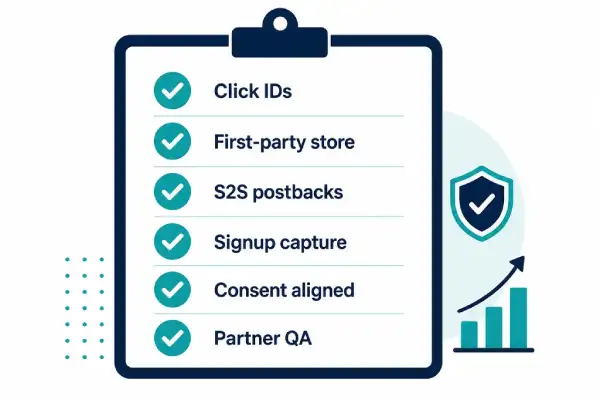
- Unique click ID generated and logged on every partner redirect.
- Click ID appended to landing URLs and preserved through signup flows.
- First-party persistence on the merchant domain configured with consent rules.
- Server-to-server postback firing on the true payable event.
- Idempotent event keys preventing duplicate commissions on retries.
- Partner/click metadata stored on the user or CRM record at registration.
- QA completed on Safari, Chrome, and major in-app browsers.
- Unattributed conversion rate monitored weekly.
- Affiliate terms updated to describe current attribution mechanics honestly.
- Vendor scorecard includes postbacks, first-party domains, and billing/CRM hooks.