
How to Drive High-Quality Traffic to Your Affiliate Program: A Channel-by-Channel Guide
Learn which traffic channels deliver real affiliate conversions, how to measure partner-driven quality, and where to invest budget without flooding your program with low-intent clicks.

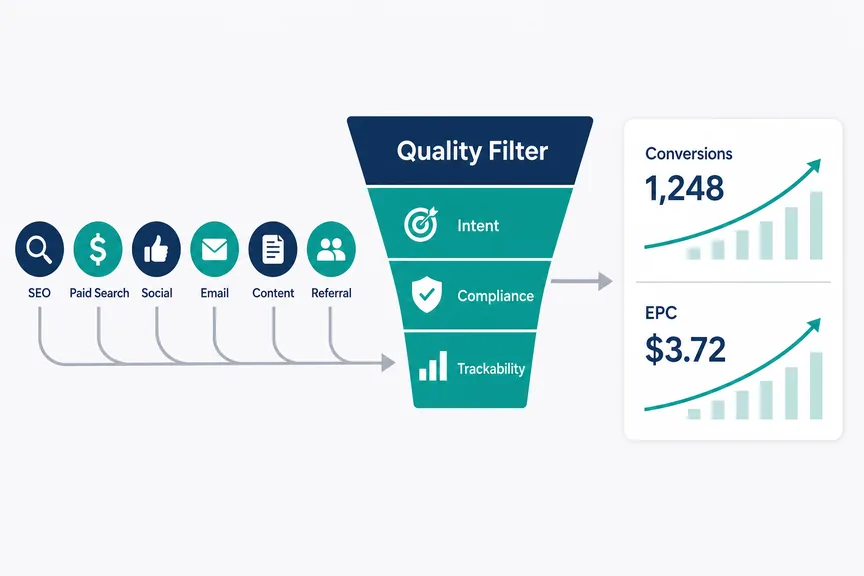
Most affiliate programs do not fail because partners refuse to promote. They fail because traffic arrives without intent, without compliance, or without a reliable way to measure what actually converts. You launch an affiliate program, approve dozens of partners, and watch click volume climb — yet qualified sign-ups, deposits, or purchases barely move. Finance questions commission spend. Partners argue about tracking. Leadership asks whether affiliates are worth the channel at all.
The problem is rarely "not enough traffic." It is the wrong mix of channels, weak partner enablement, and no shared definition of quality between marketing, affiliates, and operations. As programs scale, manual review breaks down. You need a channel strategy that matches your vertical, your conversion model, and your compliance requirements — plus reporting that separates curiosity clicks from revenue.
This guide walks through each major traffic source for affiliate programs: what it is good for, how to evaluate partner quality, and how to align acquisition with Affiliate Tracking Methods (And Where They Actually Work). Whether you run a SaaS product, a broker, or an ecommerce brand, the same principle applies: prioritize channels you can measure, partners you can coach, and traffic you would be comfortable showing to a regulator or your board.
Quick Summary
- Define "quality traffic" before scaling spend: intent, compliance, trackability, and conversion rate by partner — not raw clicks.
- Match channels to your business model: SEO and content for long-term SaaS; paid search and comparison sites for high-intent finance; social and influencers for awareness-heavy niches.
- Enable partners with landing pages, creatives, and tracking links that preserve attribution across devices and campaigns.
- Run a 90-day channel pilot: cap budgets, set EPC and CR thresholds, and cut underperformers early.
- Use program-level reporting to compare channels fairly — trends in Affiliate Marketing in 2026 show advertisers shifting budget toward measurable partner channels.
- Document brand bidding, disclosure, and traffic rules before partners scale — compliance failures destroy channel ROI faster than bad creative.
What High-Quality Affiliate Traffic Means in Practice
High-quality traffic is not synonymous with cheap traffic or high volume. For affiliate programs, quality means visitors who match your offer, arrive through approved methods, convert at predictable rates, and can be attributed to the correct partner without disputes.
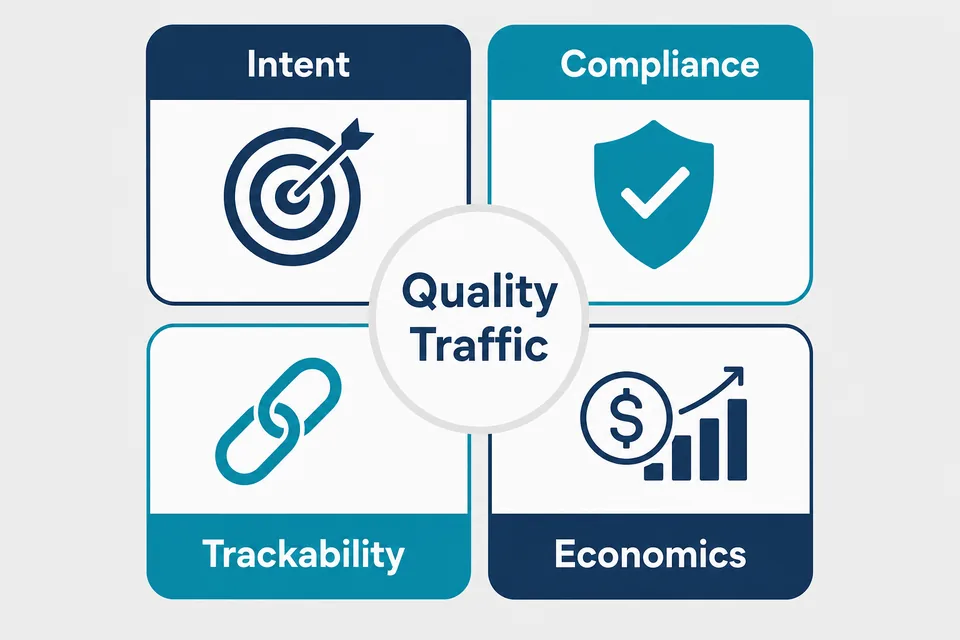
Break quality into four dimensions your team and affiliates can agree on:
- Intent — The visitor understands the offer and is reasonably likely to take the target action (signup, purchase, deposit, trial).
- Compliance — Traffic follows your program terms: correct disclosures, no forbidden incentives, no brand bidding if restricted, no bot or incentivized click schemes.
- Trackability — Clicks and conversions record correctly across devices, sub-IDs, and campaigns so partners trust the data.
- Economics — Earnings per click (EPC) and customer acquisition cost (CAC) stay within targets after commissions and refunds.
A coupon site sending bargain hunters to a high-ticket B2B SaaS trial may produce clicks but weak intent. A niche review site sending fewer clicks with strong purchase intent may outperform it. Quality is contextual.
Mini scenario: B2B SaaS project management tool
A mid-size SaaS company launches a partner program with CPA payouts on paid subscriptions. Two partners join in month one. Partner A drives 8,000 clicks from broad deal forums; Partner B drives 900 clicks from workflow comparison content. Partner A's conversion rate is 0.1%. Partner B's is 2.4%. Without quality metrics, the program team would praise Partner A's volume. With EPC and CR by partner, the decision is obvious: invest enablement in Partner B's content model and pause incentives for forum blast tactics.
How Traffic Strategy Fits Into Affiliate and Partner Programs
Affiliate traffic is partner-acquired traffic. You do not buy it directly from Google or Meta in the same way performance marketing teams do — you influence it through commissions, assets, and rules. That shifts responsibility: your program must teach partners where to invest effort and what you will not pay for.
Program managers often confuse recruiting partners with building a channel strategy. Recruiting fills the top of the funnel; channel strategy defines which partner types you want and what traffic they should produce. A forex broker needs IBs and finance publishers, not generic cashback apps. A Shopify app needs integration partners and ecommerce educators, not traffic arbitrage networks.
Align internally before publishing terms:
- Marketing owns messaging, landing pages, and brand guidelines.
- Compliance owns restricted claims, geos, and disclosure standards.
- Finance owns commission caps, clawbacks, and payout timing.
- Affiliate management owns partner selection, enablement, and performance reviews.
When these groups share one definition of quality, partners receive consistent feedback instead of conflicting rules. Reference your affiliate marketing glossary in onboarding so new partners understand EPC, CR, sub-ID, and postback terminology from day one.
Channel-by-Channel Guide for Affiliate Programs
Below is a practical breakdown of major channels partners use to send traffic. None is universally "best." Each has trade-offs in speed, cost, control, and measurement difficulty.
Organic search and SEO-driven content
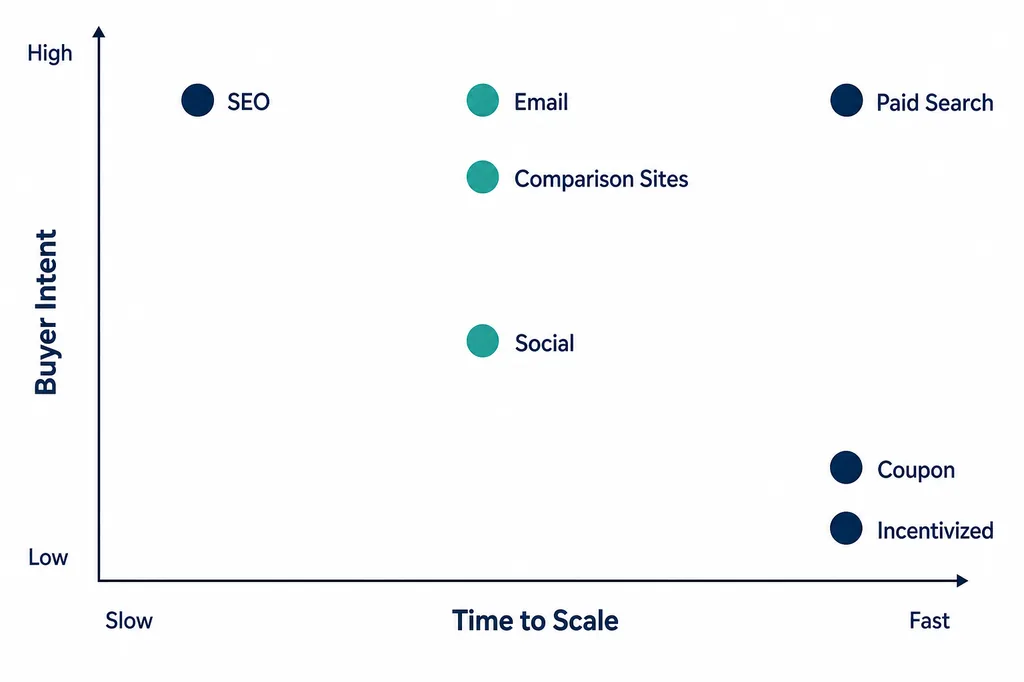
Partners publish reviews, comparisons, tutorials, and "best of" lists optimized for search. Strengths: high intent, durable traffic, strong trust when content is accurate. Weaknesses: slow to build, vulnerable to algorithm updates, competitive in saturated niches. Your role: provide accurate product data, exclusive angles, and updated tracking links. Encourage partners to follow SEO for Affiliate Marketers best practices so content ranks without violating your brand terms.
Best for: SaaS, hosting, VPN, tools, finance education, ecommerce categories with research-heavy buyers.
Paid search and paid social
Partners run ads on Google, Bing, Meta, TikTok, or native networks pointing to your offer or their pre-landing page. Strengths: fast volume, precise targeting, scalable when economics work. Weaknesses: brand bidding conflicts, rising CPCs, platform policy risk, fraud on some networks. Your program terms must explicitly allow or forbid paid traffic types. Detailed guidance on Paid Search for Affiliate Programs helps partners avoid account bans and commission clawbacks.
Best for: regulated industries with strict ad rules (finance, health), ecommerce promos, apps with short conversion paths — when compliance is enforced.
Email and newsletter traffic
Partners promote to owned lists. Strengths: repeat reach, strong conversion when list trust is high. Weaknesses: spam complaints hurt deliverability; unverified lists produce junk leads. Require proof of consent practices and clear unsubscribe compliance. Track performance by list segment via unique sub-IDs.
Best for: B2B SaaS, courses, subscription boxes, consumer apps with broad appeal.
Social organic: YouTube, TikTok, LinkedIn, communities
Creators embed links in descriptions, posts, or live streams. Strengths: authentic recommendations, strong for visual products. Weaknesses: link decay, platform link restrictions, hard to predict virality. Provide deep links, link-in-bio tools guidance, and creative briefs aligned with disclosure rules.
Best for: Consumer apps, beauty, gaming, creator-friendly SaaS, trading education.
Coupon, cashback, and loyalty sites
Partners intercept deal-seeking users. Strengths: volume at purchase moment for ecommerce. Weaknesses: margin erosion, last-click attribution fights, weak value for non-discount offers. Use only if your unit economics tolerate incentives and you can detect coupon cannibalization.
Best for: Retail ecommerce, travel, subscription services with promo-friendly positioning.
Comparison engines and niche publishers
Vertical sites rank products side by side. Strengths: high purchase intent, educated audiences. Weaknesses: placement fees or higher commissions expected; content must stay accurate. Common in fintech, iGaming, insurance, and B2B software directories.
Best for: Any vertical where buyers compare alternatives before converting.
Incentivized and reward traffic
Users complete actions for points or rewards. Strengths: cheap clicks. Weaknesses: notoriously low retention and high fraud risk. Most serious programs restrict or ban this traffic type unless the business model explicitly supports it.
Best for: Rarely recommended; mobile app install campaigns with strong fraud filters — otherwise avoid.
Mini scenario: Regulated fintech broker
A multi-asset broker opens an IB program. Partners request permission to run Meta ads and Google search in several geos. Compliance allows content marketing and email to warm audiences but bans unapproved claim language and brand keywords. The program publishes a traffic policy PDF, requires pre-approval for creatives, and uses sub-ID reporting by geo and channel. Partners who comply scale steadily; two partners running aggressive incentivized traffic are removed within 30 days after CR and chargeback flags trigger review.
The TRAFFIC Prioritization Framework
Use a simple scored framework before adding budget or headcount to a channel. Rate each candidate channel 1–5 on five factors, then multiply by weight if you prefer weighted scores.
- T — Trackability — Can you attribute clicks and conversions reliably?
- R — Regulatory fit — Does traffic comply with your terms and local rules?
- A — Audience match — Does the partner's audience resemble your ICP?
- F — Forecastable economics — Can you estimate EPC and CAC within acceptable bounds?
- F — Flexibility — Can you pause, test, and optimize without long lock-ins?
- I — Incrementality — Would this conversion likely happen without the partner?
- C — Content quality — Does the partner's surface reflect well on your brand?
Channels scoring below 20 out of 35 on a raw sum should not receive exclusive deals or higher tiers until a pilot proves otherwise. Document scores in partner notes so future managers inherit context.
Mini scenario: Ecommerce supplement brand
The brand tests influencers (social), a major coupon site, and a health blog with SEO traffic. Influencers spike clicks during launches but EPC drops after 72 hours. The coupon site drives orders with heavy discount stacking that cuts margin. The health blog sends fewer clicks but highest repeat purchase rate. The program shifts tiered commissions toward content partners and caps coupon exposure during non-promo weeks.
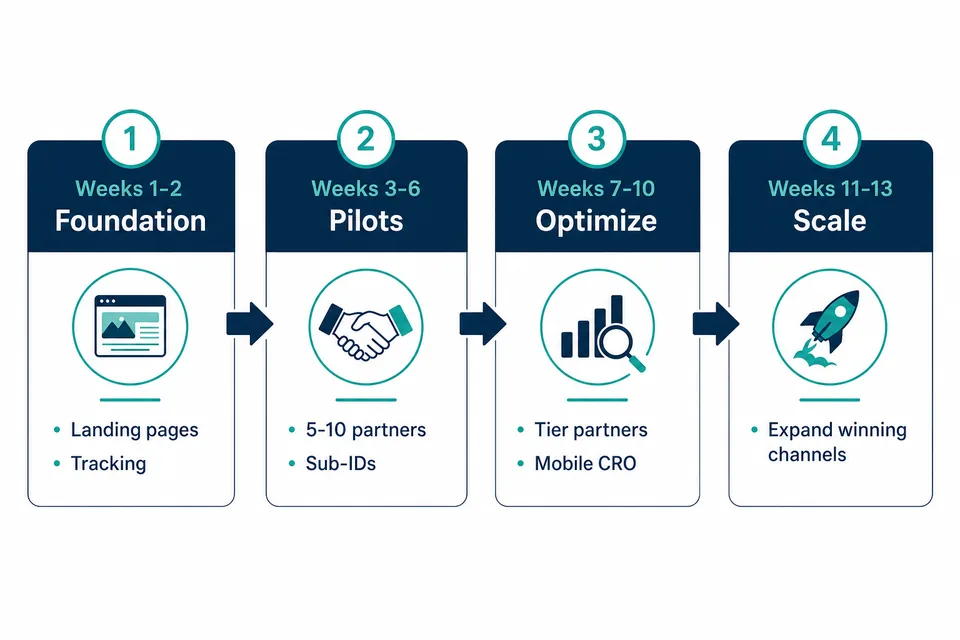
Step-by-Step: Building Your Channel Mix Over 90 Days
Phase 1 — Weeks 1–2: Foundation
Finalize program terms: allowed traffic types, geos, disclosure language, brand bidding rules, and prohibited methods. Build default landing pages for top partner categories. Configure tracking with campaign and sub-ID support so every partner link is distinguishable. Brief internal teams on escalation paths for fraud or compliance flags.
Phase 2 — Weeks 3–6: Controlled pilots
Recruit 5–10 partners across two or three channel types — not ten partners in the same coupon model. Give each a unique sub-ID and a short creative kit. Set weekly review cadence: clicks, CR, EPC, average order value, refund rate if applicable. Kill pilots that breach compliance even if clicks look attractive.
Phase 3 — Weeks 7–10: Optimize and tier
Double enablement for top quartile partners: co-branded content, early feature access, or modest commission bumps tied to quality metrics — not raw volume alone. Introduce Mobile Conversion Optimization on landing pages if mobile share exceeds desktop, which is common in social-driven programs.
Phase 4 — Weeks 11–13: Scale with guardrails
Open recruitment in winning channels. Publish a partner newsletter highlighting what works. Add contest or bonus structures only after baseline EPC is stable — otherwise bonuses reward the wrong behavior. Review incrementality periodically with holdout tests or geo splits where feasible.
Tools and Metrics to Measure Channel Success
Without shared metrics, affiliates optimize for clicks while you optimize for revenue. Align on a dashboard updated at least weekly.
Core partner metrics
- Clicks and unique clicks — Volume indicator; never the sole KPI.
- Conversion rate (CR) — Conversions divided by clicks, by partner and sub-ID.
- Earnings per click (EPC) — Commission earned per click; compares channels with different CR.
- Average order value or LTV proxy — Especially for RevShare and subscription models.
- Refund / chargeback rate — Critical for ecommerce and finance.
- Time to conversion — Long lags may indicate low intent or tracking gaps.
Operational signals
- Creative approval turnaround — delays push partners to other programs.
- Dispute rate on attributed orders — high disputes suggest tracking or terms ambiguity.
- Partner activation rate — approved but never live partners signal poor fit or weak enablement.
Reliable measurement depends on choosing tracking methods appropriate to your stack — cookie, S2S postback, or hybrid — and validating them before scaling spend. A centralized affiliate tracking platform keeps partner links, conversion events, and reporting in one place so channel comparisons reflect the same data affiliates see in their dashboards.
How to Measure Success by Channel Type
Compare channels using normalized metrics, not raw commission totals alone.
SEO and content: Track CR and EPC by landing page and content type. Success looks like stable month-over-month conversions with rising organic share from top partners, not one-off spikes.
Paid traffic from partners: Monitor compliance audit pass rate and CR by creative angle. Success is sustainable EPC after ad costs partners bear — your commission must leave them margin.
Email: Measure CR by campaign send and list source. Watch unsubscribes and spam complaints as quality proxies.
Social: Track CR by platform and content format. Short-form video may drive clicks; long-form reviews may drive higher LTV.
Coupon and deal: Compare incremental revenue tests during periods when coupons are disabled versus enabled. If revenue flatlines without coupons, traffic may be cannibalizing direct sales.
Revisit channel mix quarterly. Markets shift — privacy changes and measurement gaps push programs toward first-party data and server-side validation. Channels you cannot measure cleanly deserve less budget until tracking improves.
Common Mistakes (and How to Avoid Them)
Chasing click volume over EPC. High clicks with near-zero CR waste review time and create false confidence. Set minimum CR or EPC thresholds for continued promotion and enforce them.
Approving every partner type without a channel plan. A program filled with mismatched partners dilutes manager attention. Recruit deliberately against your TRAFFIC framework scores.
Unclear paid traffic rules. Ambiguity leads to brand bidding wars and policy violations. Publish allowed and forbidden traffic types in plain language with examples.
One landing page for all partners. Generic pages underperform for segmented audiences. Provide category-specific pages or allow compliant pre-landers with approval.
Ignoring mobile experience. Social and messaging traffic is predominantly mobile. Slow pages or broken forms destroy CR before tracking even matters.
Delayed or disputed payouts. Partners reinvest where they trust data and payment. Opaque tracking erodes channel quality faster than commission rate increases fix.
Scaling bonuses before baseline metrics stabilize. Contests and tier bumps amplify existing behavior — good or bad. Fix quality first, then reward it.
No incrementality checks. Last-click wins may pay partners who intercepted existing demand. Periodic holdouts or geo experiments reveal true contribution.
Conclusion
Driving high-quality traffic to your affiliate program is a channel strategy problem disguised as a recruitment problem. Define quality through intent, compliance, trackability, and economics. Match partner types to your vertical, run disciplined pilots, and compare channels with EPC and CR — not vanity clicks. Enable partners with clear rules, accurate assets, and trustworthy reporting so they invest in traffic you actually want.
Programs that win treat affiliates as a measurable acquisition channel, not a side project. Start narrow, prove economics in one or two channels, then scale with tiers and enablement rather than blanket commission increases.
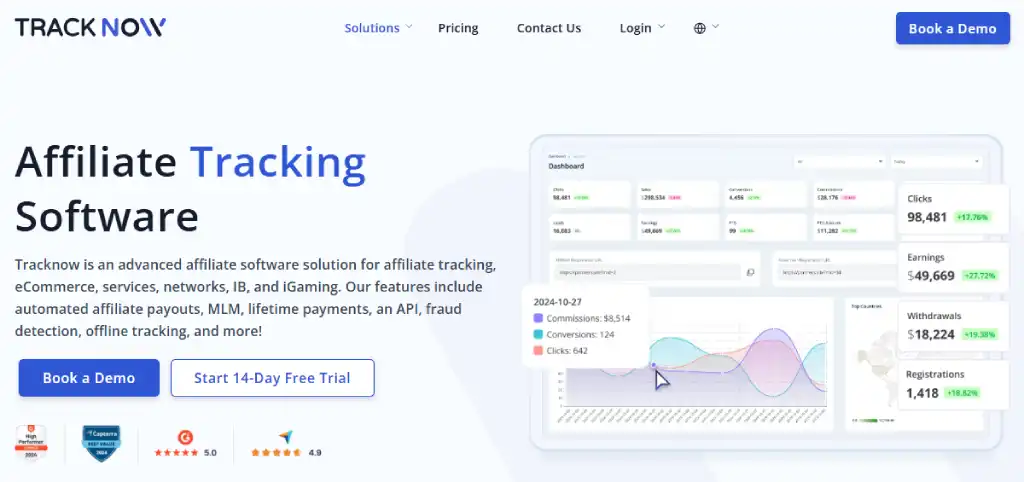
If you are building or scaling a partner program and need reliable tracking, flexible commissions, and reporting affiliates trust, Tracknow is a strong place to start.
FAQ
What is the difference between traffic quality and conversion rate?
Conversion rate measures how often clicks become target actions. Traffic quality is broader: it includes whether visitors match your offer, comply with program rules, and arrive through approved methods. A partner can have a decent CR on incentivized traffic while still delivering customers who churn immediately — quality captures retention and compliance, not just the first conversion event.
How many channels should a new affiliate program test at launch?
Start with two or three channel types that fit your vertical and compliance environment — for example, SEO publishers plus email for B2B, or comparison sites plus restricted paid search for finance. Testing more simultaneously spreads manager focus and makes it hard to learn what failed. Run 90-day pilots with clear exit criteria before expanding recruitment.
Should I allow partners to bid on my brand keywords in Google Ads?
That depends on incrementality and margin. Many brands prohibit brand bidding to control CPC and message consistency. Others allow it with strict bid caps and pre-approved ads. Document the rule explicitly in program terms. Ambiguity causes the most disputes — not the policy choice itself.
How do I detect low-quality or fraudulent affiliate traffic?
Watch for sudden CR spikes without creative changes, geo mismatches, extremely short time-to-conversion on high-ticket offers, duplicate IPs or device fingerprints, and high refund or chargeback rates. Compare partner CR to program averages and investigate outliers. Pair automated flags with manual creative and landing page reviews.
What EPC should I expect from affiliate traffic?
EPC varies widely by vertical, commission model, and channel. Public benchmarks exist in industry reports, but your baseline should come from your own pilot data after 30–60 days. Compare partners within the same channel before comparing across unrelated niches.
Can I restrict certain traffic types without hurting program growth?
Yes — clear restrictions often accelerate growth by attracting professional partners who prefer predictable rules. Coupon and incentivized traffic bans may reduce raw clicks but improve customer quality and reduce compliance risk. Communicate restrictions during recruitment so unsuitable partners self-select out.
How often should I review partner traffic quality?
Weekly during the first three months of a program or any new channel pilot. Move to biweekly or monthly once baselines stabilize. Trigger ad-hoc reviews when CR, EPC, or dispute rates shift more than an agreed threshold — for example, twenty percent week over week without a known promo.
Do affiliates need different landing pages per channel?
Not always, but segmented pages usually improve CR. Email audiences respond to different headlines than cold search traffic. Provide at least one default page plus optional category pages. Ensure every variant fires the same conversion events so reporting stays comparable.
How does mobile traffic affect affiliate program strategy?
Mobile often dominates social and messaging referrals. If forms, checkout, or KYC flows are desktop-first, mobile CR collapses regardless of partner quality. Audit mobile page speed, input fields, and tracking on real devices before blaming partners for poor performance.
When should I cut an underperforming partner versus coach them?
Coach when the partner's channel fit looks correct but assets, tracking, or landing pages need fixes — especially if CR is below average but traffic patterns look legitimate. Cut quickly when traffic violates terms, shows fraud signals, or comes from a channel you deliberately deprioritized. Document decisions to keep reviews consistent.
10-Point Checklist for Driving High-Quality Affiliate Traffic
- Written definition of quality traffic shared with marketing, finance, and compliance.
- Program terms specify allowed and prohibited traffic types with examples.
- Default and segmented landing pages live with conversion events tested.
- Tracking validated for each major method partners will use (cookie, S2S, hybrid).
- Sub-ID or campaign structure enables channel-level reporting.
- TRAFFIC framework scores documented for each active channel.
- 90-day pilot plan with EPC, CR, and compliance exit criteria.
- Weekly partner performance review cadence scheduled.
- Mobile experience audited for top traffic sources.
- Incrementality or holdout test planned before major commission increases.