
Affiliate Marketing: How to Build a Partner Program That Scales MRR
How SaaS companies design affiliate and partner programs that drive recurring revenue — commissions, recruitment, onboarding, tracking, and the metrics that protect LTV.

SaaS growth teams eventually hit the same ceiling: paid acquisition gets more expensive, outbound does not scale linearly, and product-led growth alone rarely fills every segment. Affiliate and partner programs close that gap by turning customers, agencies, consultants, and niche publishers into a repeatable acquisition channel — one that can compound monthly recurring revenue (MRR) when commissions, tracking, and partner enablement are designed for subscriptions rather than one-off sales.
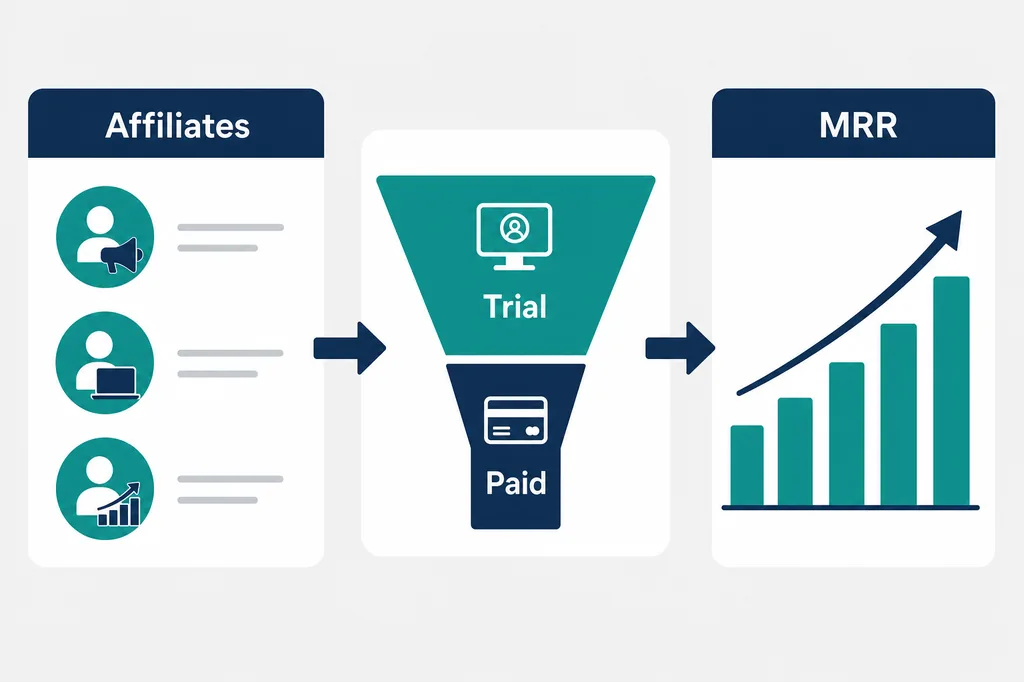
SaaS affiliate marketing is not a copy of ecommerce coupon programs. Churn, trial-to-paid conversion, expansion revenue, and long attribution windows change how you structure payouts and how you judge partner quality. A partner who sends 500 low-intent free trials can look busy and still destroy unit economics. A partner who sends 40 high-intent demos that convert and retain can quietly become one of your best channels.
This guide walks through how to build a SaaS partner program that scales MRR: positioning, commission models, recruitment, onboarding, tooling, and the metrics that keep finance and marketing aligned. Whether you are a founder launching the first program or an Affiliate Manager rebuilding an underperforming one, the goal is the same — partners who add customers you would be proud to keep.
Quick Summary
- Design commissions for recurring revenue: recurring RevShare, capped CPA, or hybrid models beat flat one-time payouts for most SaaS offers.
- Recruit for ICP fit — agencies, consultants, complementary SaaS, and niche content sites usually outperform generic coupon networks.
- Instrument trials, activations, and paid conversions so partners are paid on outcomes that protect LTV.
- Onboard with assets, deep links, and clear rules before you scale recruitment volume.
- Use tiers, contests, and enablement to reward quality MRR — not raw click volume.
- Treat the program as a growth system: recruitment, activation, optimization, and churn-aware reporting on a continuous loop.
What SaaS Affiliate Marketing Means in Practice
In SaaS, an affiliate or referral partner promotes your product and earns a commission when referred users start trials, become paying customers, or generate recurring revenue — depending on your payout rules. The partner may be a content publisher, YouTuber, newsletter, agency, consultant, integration marketplace partner, or power user.
What makes SaaS different:
- Revenue is recurring — a bad cohort of customers hurts for months, not one checkout.
- Conversion paths are longer — trial, onboarding, activation, then paid.
- Attribution must survive delayed conversion — cookies alone are often not enough.
- Product experience is part of the funnel — partners cannot fix a broken activation flow with better ads.
Programs fail when they import ecommerce habits: short cookie windows, coupon-first recruitment, and paying for every free signup. Programs scale when they pay for retained value and give partners messaging that matches how buyers actually evaluate software.
How Partner Programs Fit SaaS Growth Motions
Affiliate marketing sits alongside PLG, sales-assisted growth, and channel partnerships. It is not a replacement for product-led onboarding — it is a distribution layer that feeds the same funnel. Clarify where affiliates stop and sales starts: self-serve plans can pay automatically; enterprise deals may need deal registration or hybrid referral rules so AEs and partners do not collide.
Decide your partner thesis before writing terms:
- Content-led demand — review sites, comparison blogs, YouTube tutorials.
- Expert-led trust — consultants, agencies, freelancers who recommend tools to clients.
- Product-led adjacency — complementary SaaS that embeds or recommends you.
- Customer advocacy — referral-style programs for happy users (often lighter commissions, simpler rules).
Most successful SaaS programs blend two of these. Pure coupon traffic rarely produces durable MRR unless your product is highly transactional and low-touch.
Step-by-Step: Building a Program That Scales MRR
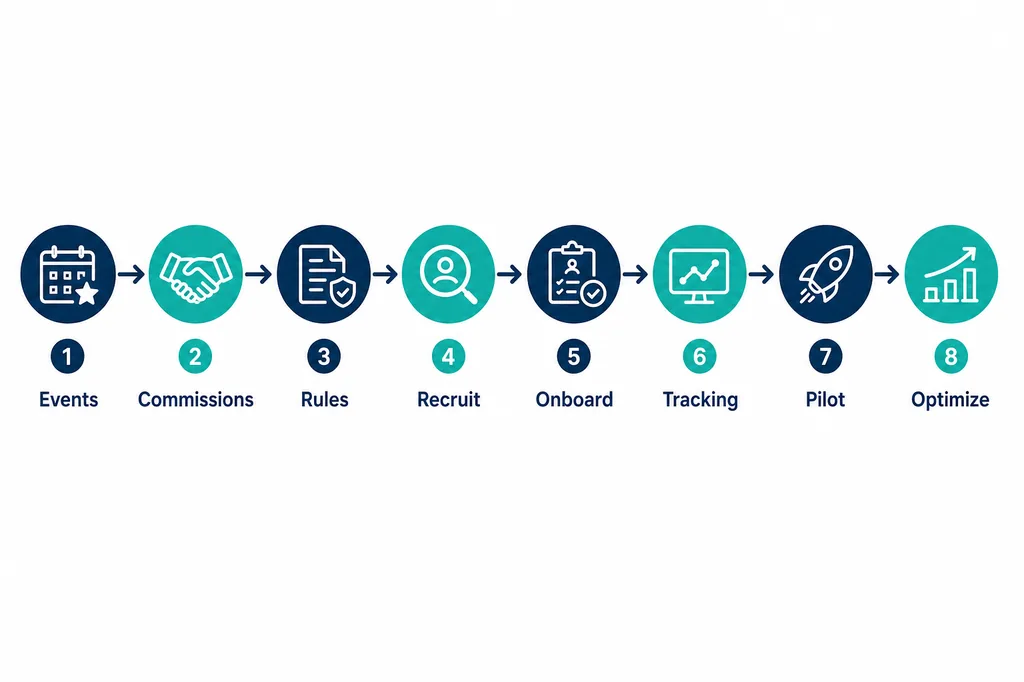
1. Define the conversion events you will pay for
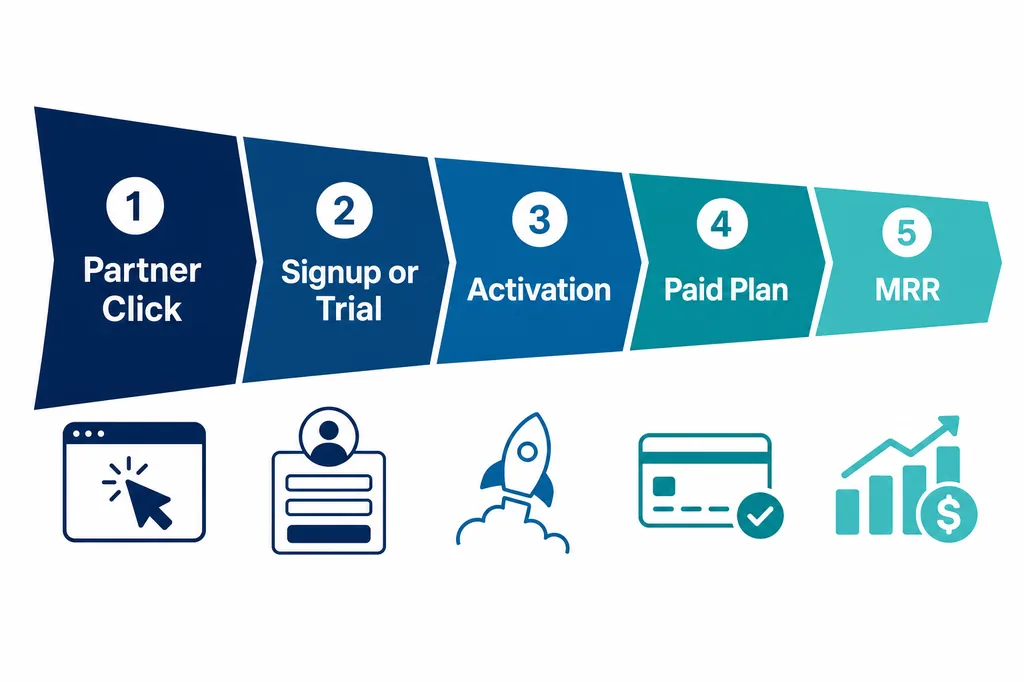
Map the funnel: click → signup → activated user → paid subscription → retention month 2/3. Choose the payable event carefully. Paying on every free trial inflates costs. Paying only after 90 days of retention may demotivate early partners. Common SaaS patterns: CPA on first paid invoice, recurring revenue share for 12 months or lifetime, or hybrid (smaller CPA + ongoing RevShare).
Document events in plain language so partners and finance share one definition. Align payout logic with your broader view of Affiliate Program Commission Options — CPS, CPA, RevShare, and hybrid each behave differently when churn is high.
2. Choose a commission structure that protects unit economics
Work backward from LTV and target CAC. If average monthly revenue per account is modest, a large one-time CPA can wipe margin on early churn. Recurring RevShare aligns incentives: partners earn when customers stay. Caps, tiers, and clawbacks for refunds or fraud should be explicit from day one.
Automated payout tiers help you scale rewards without manual spreadsheets — approaches covered in Maximizing Earnings with Tracknow apply well when partners hit MRR or activation milestones.
3. Write rules partners can follow without a lawyer on call
Cover brand bidding, trademark use, paid search allowances, incentive traffic, discount stacking, and disclosure requirements. SaaS buyers research carefully; misleading claims damage both SEO and sales trust. When you are ready for formal contracts, use a clear template approach — see How to Write an Affiliate Agreement before you open public signup.
4. Recruit for quality, not headcount
Target lists beat blast invites. Prioritize partners who already speak to your ICP: vertical newsletters, tool roundups in your category, boutique agencies, and complementary product founders. Outreach with a specific reason they fit — not a generic "join our affiliate program" email. A focused plan for How to Recruit Affiliates for a New Program will outperform posting a link in your footer and waiting.
5. Onboard like a product launch
First 14 days decide whether a partner ever promotes you. Provide: value props by persona, approved messaging, comparison angles vs alternatives, deep links or smart links, creative assets, and a simple "first campaign" checklist. Assign an owner for questions. Silent onboarding is why approved partners never generate a single click.
6. Instrument tracking before you scale invites
SaaS needs reliable attribution across trials and delayed upgrades. Prefer server-side or hybrid tracking where possible, unique partner links, and sub-IDs for content vs paid tests. Validate that upgrades, plan changes, and refunds update partner stats correctly. Broken tracking creates disputes that kill top partner relationships.
7. Launch with a pilot cohort
Start with 10–25 partners across two partner types. Set a 60–90 day pilot: activation rate, trial-to-paid, partner-sourced MRR, and refund rate. Use a Affiliate Program Launch Checklist so marketing, product, finance, and legal sign off before you announce publicly.
8. Optimize with tiers, education, and selective incentives
Promote partners who deliver retained MRR. Offer higher tiers, early feature access, co-marketing, or limited contests — not blanket commission hikes that attract low-quality traffic. Seasonal or product-launch contests can work when rules emphasize paid conversions; see how programs use competition mechanics in Tracknow News style feature rollouts without turning the program into a click farm.
Commission Models That Work for SaaS MRR
Recurring revenue share — Partner earns a percentage of subscription payments for a set period or lifetime. Best alignment with LTV; requires clean recurring billing data in your tracking stack.
CPA on first payment — Predictable cost per acquired customer. Works when trial-to-paid is stable and refund rates are controlled. Risk: partners optimize for easy signups if your payable event is too early.
Hybrid — Smaller CPA plus ongoing RevShare. Useful when partners need early cashflow but you want retention alignment.
Tiered rewards — Higher rates after partner-sourced MRR or paid account thresholds. Motivates serious partners without overpaying beginners.
Avoid paying the same rate for annual and monthly plans if your cash collection and churn profiles differ radically — or explicitly document how annual deals are credited.
Partner Types That Usually Scale SaaS Programs
- Niche content publishers — Comparison articles and tutorials with intent.
- Agencies and freelancers — Recommend tools during client delivery; high trust, lower volume.
- Complementary SaaS — Integration partners and marketplace listings.
- Educators and community leaders — Courses, cohorts, Slack/Discord communities.
- Customers as referrers — Simpler referral mechanics; keep separate from professional affiliate terms if needed.
Be cautious with deal sites and broad incentive traffic unless your product is priced and packaged for that audience. They can spike trials and crush activation metrics.
Mini scenario: B2B analytics SaaS
A Series A analytics company opened a public affiliate signup and attracted coupon-style partners. Trials rose; paid conversion collapsed. They paused public signup, rebuilt terms around paid activation, recruited 15 agencies and two category newsletters, and switched to hybrid CPA + 12-month RevShare. Partner-sourced MRR became smaller in clicks but far healthier in retention.
Mini scenario: PLG productivity tool
A freemium productivity SaaS paid affiliates on free signup. Partners gamed volume with giveaways. Finance saw CAC blow up. They moved payable events to "team plan paid" and gave content partners better creative for collaboration use cases. Volume dropped; net new MRR from affiliates rose within a quarter.
Mini scenario: Vertical SaaS for clinics
A healthcare operations SaaS ignored mass publishers and recruited consultants who already implemented clinic software. Each partner sent few leads, but sales cycles closed faster because trust transferred. The program stayed small by headcount and material by MRR — the right outcome for a high-touch vertical.
Tools and Metrics for a SaaS Partner Program
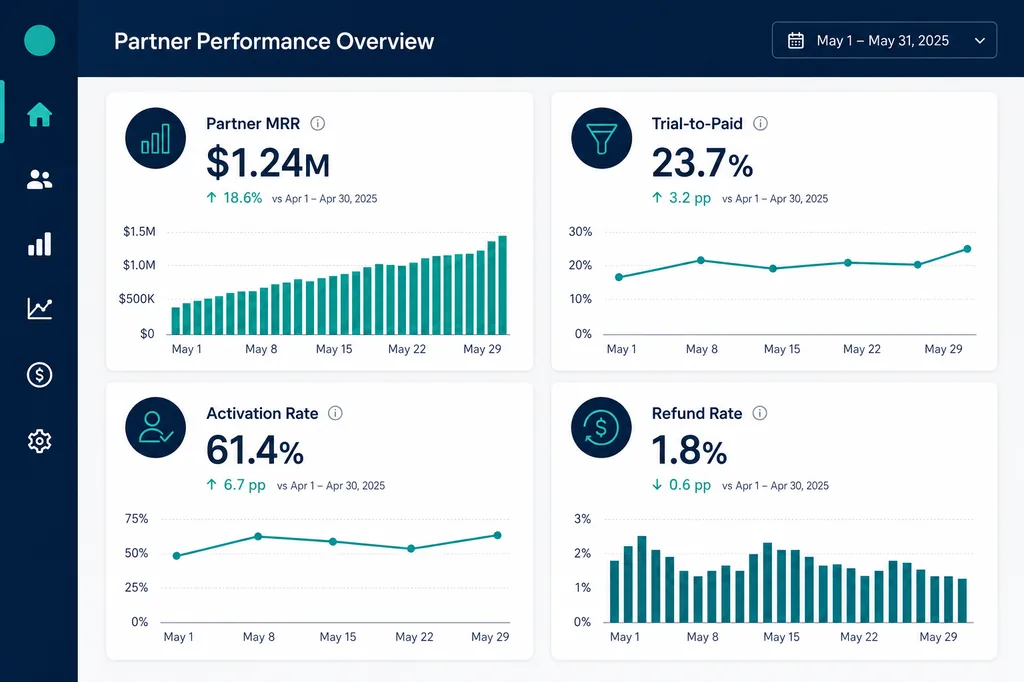
Minimum metrics dashboard:
- Partner-sourced signups and activated users
- Trial-to-paid rate by partner
- Partner-sourced MRR and net revenue retention of that cohort
- Refund and chargeback rate by partner
- Partner activation rate (approved partners who generate a click or referral in 30 days)
- Time from click to paid conversion
Operational tools include affiliate tracking software, CRM notes for top partners, billing webhooks for subscription events, and a content/asset library. The tracking layer must reconcile with Stripe (or your billing provider) so recurring commissions stay accurate when customers upgrade, downgrade, or cancel.
How to Measure Success as You Scale
Early success is partner activation and clean data — not vanity MRR from one viral post. At scale, success looks like: predictable partner-sourced new MRR, acceptable payback period, improving trial-to-paid for partner traffic, and a core group of partners who promote you without constant incentives.
Review partners monthly. Coach the middle tier. Cut partners who violate terms or send unprofitable cohorts. Raise tiers for partners who deliver retained revenue. This is how programs grow MRR without growing headcount linearly.
Common Mistakes (and How to Avoid Them)
Paying for free trials only. You subsidize curiosity. Move payouts closer to paid value or add qualification rules.
Copying ecommerce commission rates. SaaS margins and churn require different math. Model LTV before publishing rates publicly.
Opening recruitment before assets and tracking are ready. First partners are your best marketers — if they have a bad first experience, they will not return.
Treating all partners the same. Agencies need deal support; publishers need content angles. One generic newsletter helps neither.
Ignoring sales collision. Without deal registration rules, affiliates and AEs fight over the same accounts. Define ownership clearly.
Short cookie windows on long B2B cycles. If your sales cycle is 30–90 days, attribution windows must reflect reality or partners will stop sending serious leads.
No clawback policy. Refunds and fraud without clawbacks train the wrong behavior. State timelines clearly.
Scaling paid search affiliates without brand rules. Trademark bidding wars inflate CAC and confuse messaging. Allow or ban explicitly.
Conclusion
SaaS affiliate marketing scales MRR when it is designed as a subscription acquisition system — not a bolt-on coupon channel. Choose payable events that protect LTV, recruit partners who already reach your ICP, onboard with clarity, and measure partner cohorts like any other growth channel. Tiers, contests, and commission options are accelerators; they cannot fix weak product activation or sloppy tracking.
Build the foundation first: events, terms, recruitment focus, and reporting. Then invite more partners into a program that already works for a pilot group.
If you need affiliate tracking built for flexible commissions, recurring payouts, partner tiers, and reporting your affiliates will trust as you scale SaaS MRR, Tracknow is a strong place to start.
FAQ
What commission rate should a SaaS affiliate program offer?
There is no universal rate. Start from LTV, gross margin, and target CAC. Many B2B SaaS programs use recurring revenue share in the 20–30% range for a limited period, or a hybrid with a modest CPA — but your numbers must come from your unit economics, not a blog average.
Should SaaS affiliates be paid on trials or paid conversions?
Paid conversions (or qualified activated accounts) usually protect MRR quality. Trial-based payouts can work for low-friction consumer SaaS with strong activation, but they are risky when trials are easy to inflate. If you pay early, add fraud checks and quality thresholds.
How is a SaaS affiliate program different from a referral program?
Referral programs often target existing customers with simple rewards. Affiliate programs typically recruit professional publishers and agencies, require tax/compliance processes, creative guidelines, and more sophisticated tracking. Some companies run both with different rules and software configurations.
How many affiliates do I need to impact MRR?
Fewer excellent partners usually beat hundreds of inactive ones. A pilot of 10–25 engaged partners can prove the channel. Scale recruitment after activation rate and trial-to-paid look healthy.
What cookie duration works for SaaS?
Match the window to your typical time from first touch to paid conversion. Many SaaS products need longer windows than ecommerce. Where privacy constraints limit cookies, reinforce with server-side attribution and account-level partner metadata collected at signup.
Can product-led growth and affiliates coexist?
Yes. Affiliates feed the same PLG funnel. Keep messaging consistent with in-product onboarding, and avoid promising white-glove setup you cannot deliver on self-serve plans. For enterprise, use referral or deal registration so sales remains coordinated.
How do I prevent affiliate fraud in SaaS?
Watch for abnormal trial spikes, self-referrals, incentive traffic if banned, and high refund rates. Use unique links, fraud rules, manual review for large CPA events, and clear clawbacks. Quality metrics catch many issues faster than click-volume dashboards alone.
Should I allow affiliates to run Google Ads on my brand terms?
Only with an explicit policy. Many SaaS brands ban brand bidding to control CAC and message. If allowed, require approved ad copy and landing pages. Ambiguity here causes the most partner disputes.
What assets help SaaS affiliates convert?
Comparison pages, integration guides, ROI calculators, persona-based one-pagers, demo videos, and case studies. Give partners deep links to the right plan page. Generic homepage links usually under-convert.
When should I hire a dedicated affiliate manager?
When partner count, payout complexity, or partner-sourced MRR exceeds what a marketer can handle part-time — often when a core group of partners needs regular enablement and optimization. Until then, assign clear ownership even if the role is shared.
10-Point Checklist for SaaS Affiliate Programs That Scale MRR
- Payable events defined (trial, activated, paid) and documented for partners and finance.
- Commission model modeled against LTV, margin, and refund clawbacks.
- Program terms cover brand bidding, disclosures, and prohibited traffic.
- Tracking validated for signup, upgrade, recurring invoice, and cancellation events.
- Recruitment targets ICP-fit partner types — not open signup alone.
- Onboarding kit live: messaging, creatives, deep links, first-campaign checklist.
- Pilot cohort of 10–25 partners with a 60–90 day success review.
- Dashboard tracks partner MRR, trial-to-paid, activation, and refunds.
- Tier or incentive plan rewards retained revenue, not clicks only.
- Sales collision rules defined for self-serve vs high-touch deals.