
Affiliate Software & Tracking Platforms (2026): Categorized Guide for Businesses, Networks & Performance Teams
This 2026 guide explains the affiliate software ecosystem in depth, categorizing tracking platforms, affiliate networks, and performance tools by business size, industry, monetization model, and control level. Includes migration risks, vendor evaluation framework, and strategic decision matrix.

Choosing affiliate software in 2026 is not simply a matter of comparing dashboards or counting features. The platform will decide how your business attributes revenue, calculates commissions, detects suspicious activity, communicates with partners, approves payouts, and reconciles affiliate data with finance and business intelligence systems.
The difficult part is that the market uses overlapping labels. An affiliate management platform, partner ecosystem platform, affiliate network, performance marketing tracker, referral tool, and payout provider may all appear in the same search results even though they solve different problems. Buying the wrong category can leave a business with excellent click analytics but no partner portal, or a large publisher marketplace but insufficient control over commission logic.
This guide separates those categories, compares representative platforms, and provides a practical framework for selecting, testing, and implementing the right affiliate technology. It is written primarily for advertisers, SaaS companies, eCommerce brands, affiliate networks, agencies, financial businesses, iGaming operators, and performance teams that need to manage partners rather than merely track their own advertising campaigns.
Quick answer: Most businesses need an affiliate program management platform, not a standalone ad tracker. Tracknow is the strongest all-round option in this guide for companies that need flexible commissions, sub-affiliate structures, coupon attribution, fraud controls, automated payouts, and support for several performance-driven verticals in one system. impact.com is better suited to large organizations unifying affiliate, creator, and referral partnerships; PartnerStack is a natural shortlist choice for B2B SaaS companies seeking a partner marketplace; and Refersion is focused on eCommerce. Networks such as Awin and CJ add publisher discovery and distribution, while trackers such as Voluum or Binom serve media buyers rather than replacing an advertiser-side affiliate platform.
Product capabilities and public pricing were reviewed in September 2026. Vendors change plans and features, so confirm every business-critical requirement in a written proposal and test account before purchasing.
Contents
- Quick selection guide
- The six types of affiliate technology
- Requirements that matter in 2026
- Affiliate software comparison
- Platform reviews and best-fit use cases
- Affiliate networks and marketplaces
- Performance marketing and ad trackers
- Commission models and calculation examples
- Recommendations by industry
- Total cost of ownership
- Implementation and migration plan
- Vendor demo test script
- Metrics a useful platform should expose
- Frequently asked questions
Quick Selection Guide: Which Type of Platform Do You Need?
Begin with the operating model, not the vendor name. The following shortlist is intentionally based on use case rather than a universal ranking.
| Your primary need | Best category | Platforms to shortlist | Important warning |
|---|---|---|---|
| Launch and own a direct affiliate program | Affiliate program SaaS | Tracknow, Post Affiliate Pro, Tapfiliate, Trackdesk | Software does not automatically recruit productive affiliates. |
| Run complex CPA, RevShare, hybrid, tier, or sub-affiliate deals | Advanced affiliate or performance platform | Tracknow, Everflow, TUNE, Affise, Scaleo, CAKE | Test your hardest real contract; a generic demo is insufficient. |
| Build a B2B SaaS partner ecosystem | Partner relationship platform | PartnerStack, impact.com, Rewardful, FirstPromoter | Referral, affiliate, reseller, and co-sell workflows are not identical. |
| Unify affiliates, creators, referrals, and other partnerships | Enterprise partnership platform | impact.com | Implementation scope and total cost may exceed the core license. |
| Access an existing publisher marketplace | Affiliate network | Awin, CJ, Rakuten Advertising, Admitad, Tradedoubler | Access does not guarantee placements, traffic, or incremental sales. |
| Track and optimize paid traffic as a media buyer | Ad or campaign tracker | Voluum, RedTrack, Binom, Keitaro | These tools generally do not replace a full advertiser-side partner portal and commission system. |
The Six Types of Affiliate Technology
The most important improvement a buyer can make is to stop treating every affiliate-related product as a direct alternative. The ecosystem contains at least six distinct categories.
1. Affiliate Program Management Software
This is the core system used by an advertiser to operate its own program. It normally provides partner registration, approval, tracking links, coupon or promo-code attribution, creatives, commission rules, reporting, invoices, and payout workflows. The advertiser owns the partner relationships and determines the program terms.
Typical users: SaaS companies, online stores, brokers, prop firms, iGaming operators, education businesses, subscription services, and other brands running direct programs.
2. Enterprise Partnership Platforms
These platforms extend beyond traditional affiliates. They may manage creators, ambassadors, referrals, media partners, technology alliances, and other partner types within one operating layer. They are often selected by larger organizations that require procurement controls, cross-team workflows, compliance monitoring, and consolidated reporting.
3. Affiliate Network Software
Network software allows an operator to manage multiple advertisers, offers, publishers, tracking domains, and financial relationships. This differs from ordinary brand software because the network may receive money from advertisers, retain a margin, and pay publishers according to separate terms.
A network platform should therefore support advertiser access, offer-level permissions, publisher-level payouts, invoicing, caps, routing, and clear separation between advertiser revenue and publisher cost.
4. Affiliate Networks and Marketplaces
A network is not merely software. It is an ecosystem in which advertisers can discover publishers and publishers can apply to multiple programs. Networks can reduce the work required to recruit, contract, and pay partners, but the advertiser operates within the network’s commercial and policy framework.
Many mature brands use both models: a direct program for strategic partners and one or more networks for reach in particular countries or publisher segments.
5. Performance Marketing and Ad Trackers
Tools such as Voluum, RedTrack, Binom, and Keitaro are primarily designed to help media buyers, agencies, or performance teams measure traffic costs, route visitors, test landing pages, pass conversions through postbacks, and optimize campaign profitability.
They can be essential inside an affiliate’s own stack, but a brand should not assume that an ad tracker includes partner onboarding, contracts, commission balances, tax documents, or a complete affiliate portal.
6. Supporting Infrastructure
Payout providers, tax-document services, fraud vendors, analytics aggregators, consent tools, and business intelligence platforms support the affiliate operation. They may integrate with the primary platform but should not be placed in the same comparison category. For example, a payout platform can simplify global payments without becoming the system that attributes conversions and calculates the underlying commission.
What Affiliate Software Must Handle in 2026
First-Party and Server-to-Server Tracking
Browser privacy controls, cookie restrictions, consent requirements, mobile journeys, and cross-domain checkout flows make a single third-party cookie an inadequate foundation. A modern implementation should combine appropriate first-party identifiers with server-to-server events, reliable transaction IDs, and a documented fallback strategy.
Ask the vendor to explain the complete event path: how the click identifier is created, where it is stored, how it reaches the checkout or CRM, how the conversion is deduplicated, and what happens when consent is unavailable. “Cookie-less” is a marketing label, not a complete technical explanation.
Event-Level Attribution
A purchase is not always the only conversion. A SaaS program may need to record signup, trial activation, qualified opportunity, paid subscription, renewal, expansion, downgrade, and cancellation. A broker may track registration, KYC approval, first-time deposit, trading volume, lots, spreads, or net revenue. An iGaming operator may need player registration, deposit, NGR, bonus cost, chargebacks, and negative carryover.
The platform should support multiple events without forcing every event to become a payable conversion. This lets the business measure the whole funnel while paying only when the contractual qualification conditions are satisfied.
A Commission Engine That Matches the Contract
A strong commission engine should support rules by partner, campaign, product, customer type, geography, event, value, date range, and performance tier. It should also make the order of operations explicit. For example, if an order is discounted, partially refunded, and subject to tax, the commissionable amount must be defined consistently.
Do not accept “we support RevShare” as a complete answer. Ask which revenue fields are included, which costs are deducted, how negative balances are carried, when the calculation closes, and whether historical commissions are recalculated when source data changes.
Reversals, Refunds, Chargebacks, and Corrections
Real programs contain cancellations, duplicate leads, failed payments, returns, chargebacks, and manual adjustments. The platform must preserve an audit trail rather than silently replacing values. Both the business and the partner should be able to understand why a commission changed.
Fraud and Quality Controls
Useful protection combines several layers:
- duplicate transaction and duplicate lead detection;
- IP, device, user-agent, geography, and velocity rules;
- coupon leakage and unauthorized promotional-method monitoring;
- self-referral and suspicious account relationships;
- conversion-rate, refund-rate, and time-to-conversion anomalies;
- approval queues and evidence retained for review.
AI can prioritize suspicious activity, but an unexplained risk score should not be the only reason to reject a partner’s commission. Teams need interpretable signals and a repeatable review process.
Partner Experience
Partners judge a program by more than the commission percentage. They need reliable links, clear terms, accessible creatives, understandable reports, prompt communication, predictable approval dates, and transparent payouts. A technically powerful system with a confusing portal can reduce activation and increase support tickets.
API, Webhooks, and Data Ownership
At minimum, the business should be able to export partners, clicks, conversions, commission changes, and payments. For larger programs, ask about API rate limits, webhook retries, event schemas, historical retention, data warehouse connectors, role permissions, and access to raw logs.
The practical question is not merely “Does an API exist?” It is “Can our team reproduce the monthly commission total from exported source records?”
Finance and Payout Operations
Tracking a payable event and actually paying a partner are separate processes. The software should make the state transition visible: pending, approved, rejected, invoiced, ready to pay, paid, and reversed. For global programs, examine currencies, minimum thresholds, tax documentation, sanctions screening, payment fees, failed-payment handling, and whether payment processing is native or provided through an integration.
Affiliate Software Comparison: 12 Platforms to Consider
The table below compares the operational position of each product rather than pretending that every platform has the same scope. Product names link to the detailed profiles below.
| Platform | Best fit | Program type | Notable strength | What to verify |
|---|---|---|---|---|
| 1. Tracknow | Growing and complex programs across performance verticals | Direct programs and affiliate networks | Flexible commissions, MLM, coupons, vertical-specific models, automation | Required integrations and plan-specific limits |
| 2. impact.com | Large brands consolidating several partnership types | Enterprise partnerships | Affiliate, creator, and referral management in a broad suite | Implementation scope, modules, and total contract cost |
| 3. PartnerStack | B2B SaaS companies | Affiliate and broader B2B partnerships | SaaS-oriented partner workflows and marketplace | Support for your exact reseller and co-sell process |
| 4. Everflow | Performance teams, agencies, networks, and advanced brands | Performance and partner marketing | Multi-event tracking, analytics, routing, and integrations | Workflow complexity and commercial package |
| 5. TUNE | Advertisers and networks needing customization and APIs | Partner marketing and network infrastructure | Customizable SaaS and API-based foundation | Professional services and integration effort |
| 6. Post Affiliate Pro | Businesses wanting a mature traditional affiliate system | Direct programs and networks | Long-established feature set and multi-tier commissions | Interface fit and configuration effort |
| 7. Tapfiliate | SaaS and eCommerce teams prioritizing usability | Direct affiliate programs | Accessible cloud setup and tracking integrations | Advanced rule and enterprise workflow requirements |
| 8. Refersion | eCommerce brands | Affiliate and creator programs | First-party eCommerce tracking and commerce workflows | Fit outside retail and required store integrations |
| 9. Rewardful | Stripe-based SaaS businesses | Affiliate and referral programs | Focused recurring-revenue workflow | Suitability for non-Stripe or highly complex programs |
| 10. Affise | Performance marketers and networks | Performance marketing | Offer operations, automation, and API-oriented workflows | Features included in the selected plan |
| 11. Scaleo | Brands and networks seeking configurable portals | Affiliate and network software | Customization and performance workflows | Which customizations are native versus paid work |
| 12. CAKE | Performance networks, lead generation, and enterprise teams | Performance marketing | Tracking, attribution, and operational controls | Commercial scope and implementation resources |
Affiliate Platform Reviews and Best-Fit Use Cases
1. Tracknow — Best Overall for Flexible, Owned Affiliate Infrastructure
Tracknow is the strongest overall choice in this guide for a business that wants to own its affiliate program while retaining enough flexibility to support different verticals and commission structures. It combines affiliate onboarding, link and coupon tracking, CPA, RevShare, hybrid and tier-based rules, sub-affiliates, fraud controls, reporting, and payment workflows.
Its breadth is particularly relevant to businesses whose model may evolve. A straightforward eCommerce program can begin with sales and coupon attribution, while a more complex operation can use multiple events, automated tiers, MLM structures, advertiser management, or vertical-specific calculations. Tracknow also offers dedicated solutions for affiliate networks, Forex and IB programs, iGaming, prop trading, eCommerce, and influencer campaigns.
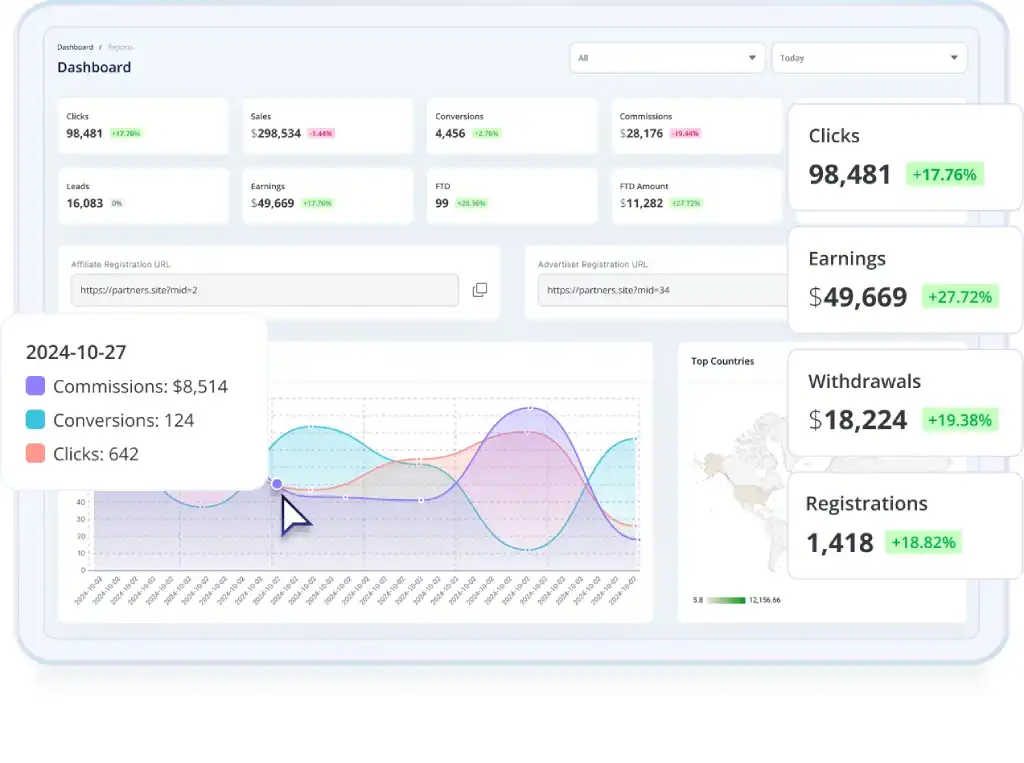
Why it stands out: Tracknow covers the middle ground between simple plug-and-play affiliate apps and expensive enterprise infrastructure. It offers conventional affiliate capabilities while also supporting coupon attribution, sub-affiliate networks, automated commission tiers, custom integrations, API access, and network operations.
Best for: Growing SMBs, mid-market companies, affiliate networks, and performance-driven businesses that need more than basic sale tracking but do not want to assemble several disconnected systems.
Public pricing: At the time of review, the general affiliate plans were listed from $116 per month when billed annually, with an Enterprise plan at $224 per month and custom infrastructure from $700 per month. Separate plans exist for affiliate networks and vertical-specific solutions. Check the current Tracknow pricing page because limits and inclusions can change.
What to verify: Map the exact events, payment provider, CRM, store, and reporting fields you need. Confirm which plan includes MLM, white-labeling, API volume, custom development, and the required tracking capacity.
2. impact.com
Impact positions its platform as a unified environment for affiliates, creators, referrals, and other partnership types. Its enterprise proposition covers partner discovery, contracting, tracking, engagement, protection, monitoring, payments, and optimization.
This breadth makes impact.com a logical candidate when a large organization wants shared governance and measurement across several partner teams. It is not merely a lightweight affiliate plugin, and buyers should evaluate it as an enterprise platform implementation.
Best for: Global brands and larger organizations that want to consolidate affiliate, creator, referral, and partnership operations.
What to verify: Request a module-by-module scope, implementation schedule, service responsibilities, integration list, and complete pricing model. Confirm which discovery, fraud, creator, payment, and reporting capabilities are included rather than assuming the entire suite is part of one license.
3. PartnerStack
PartnerStack is closely associated with B2B SaaS partnerships. It supports affiliate programs and broader partner motions, while its marketplace can help software companies gain exposure to partners already looking for B2B programs.
The platform is most compelling when the business views affiliates as one part of a wider ecosystem that may also include referral, reseller, agency, or co-selling relationships. That does not mean every B2B process is interchangeable, so teams should map their channel stages carefully.
Best for: B2B SaaS vendors that value partner discovery, recurring customer economics, and a purpose-built partner experience.
What to verify: Demonstrate the exact flow from referred account to qualified opportunity, closed deal, subscription activation, renewal, expansion, and cancellation. Confirm how CRM ownership, recurring commissions, reseller margins, and marketplace participation work.
4. Everflow
Everflow combines partner management with performance-oriented tracking, analytics, integrations, automation, and payment operations. Its public feature positioning includes first-party tracking, QR codes, multi-event tracking, dimensional analytics, CRM and commerce integrations, APIs, and traffic optimization.
Everflow is relevant to teams that need to evaluate more than a single last-click sale. It can suit agencies, lead-generation businesses, affiliate networks, and brands managing several acquisition sources.
Best for: Experienced performance teams that value granular analytics, event-level attribution, routing, and a broad integration layer.
What to verify: Ask the vendor to configure one complete funnel using your fields and attribution rules. Confirm payment-service availability by country and how pricing changes with clicks, conversions, users, and optional services.
5. TUNE
TUNE serves both advertisers and affiliate networks. The platform emphasizes customization, white-label partner experiences, postbacks, automation, real-time reporting, data streaming, international payments, and an API-based foundation.
TUNE is worth considering when internal developers or operations specialists need substantial control over the implementation. That flexibility can be valuable, but it also means the buying team should budget for design, configuration, and integration work.
Best for: Established advertisers, agencies, and networks that prioritize data control and configurable workflows.
What to verify: Separate the base platform from professional services and third-party integrations. Test API limits, data streaming, fraud workflows, payment coverage, and the effort required to create the desired partner portal.
6. Post Affiliate Pro
Post Affiliate Pro is a long-established affiliate management product that supports both in-house programs and affiliate networks. Its public offering includes tracking, promotional materials, affiliate management, multi-tier commissions, automation, reporting, and a large set of configuration options.
Best for: Businesses that want a mature affiliate product with extensive conventional functionality and do not mind spending time on configuration.
Public pricing: Its website listed annual plans beginning at $79 per month at the time of review, with higher tiers and a separate network product.
What to verify: Use the trial to test administrator usability, the partner dashboard, reporting, automation, and your most complex multi-tier rule. A long feature list is useful only if the team can operate it efficiently.
7. Tapfiliate
Tapfiliate is a cloud affiliate platform commonly considered by SaaS and eCommerce teams that want a relatively accessible setup, branded partner experience, and integrations with common commerce and subscription systems.

Best for: Small and mid-sized SaaS or online retail teams prioritizing usability and integrations over highly specialized vertical logic.
What to verify: Test recurring commission behavior, refund synchronization, multiple currencies, coupon attribution, custom events, and plan limits. Confirm whether advanced workflows require an upgrade.
8. Refersion
Refersion focuses on affiliate and creator programs for eCommerce brands. Its positioning around first-party tracking and commerce workflows makes it a relevant shortlist option when order data, products, discounts, and store integrations are central to the program.
Best for: Online retailers that want the affiliate system to connect closely with their commerce environment.
What to verify: Test split orders, subscriptions, partial refunds, returns after commission approval, product exclusions, gift cards, taxes, shipping, coupon conflicts, and customer-status rules. Confirm the exact behavior for each supported store or checkout platform.
9. Rewardful
Rewardful is positioned specifically for SaaS affiliate and referral programs and is closely integrated with Stripe-based billing workflows. Its focused scope can make it easier for a software company to launch recurring commissions without deploying a broader performance-marketing platform.
Best for: SaaS businesses using Stripe that need straightforward affiliate and referral operations.
What to verify: Check how the system handles multiple subscriptions, upgrades, downgrades, cancellations, refunds, annual plans, invoice failures, account merges, and attribution before the customer creates a subscription. Companies with several billing systems or complex partner hierarchies may require a broader platform.
10. Affise
Affise is oriented toward performance marketing, with functionality for offers, partners, conversion tracking, automation, reporting, integrations, and API-led operations. It can be relevant to advertisers and networks managing many campaigns or traffic sources.

Best for: Networks, agencies, and performance teams with offer-centric workflows and technical resources.
What to verify: Determine which automation, fraud, payment, agency, data-transfer, and attribution capabilities belong to the proposed product and plan. Run a cost simulation at your expected traffic volume.
11. Scaleo
Scaleo serves brands and affiliate networks and emphasizes customizable interfaces, reporting, automation, and performance-marketing operations. It may appeal to teams that want to adapt partner dashboards, menus, content, roles, and workflows to a particular business model.
Best for: Businesses and networks prepared to define a tailored partner experience and implementation scope.
What to verify: Ask which changes are configuration, which require custom development, and which carry ongoing costs. Demonstrate your data import, commission calculation, invoice, and payout process from start to finish.
12. CAKE
CAKE is an established performance marketing platform associated with affiliate tracking, lead distribution, attribution, and operational controls. It is more relevant to sophisticated performance businesses than to a small brand seeking only a basic referral widget.
Best for: Affiliate networks, lead-generation operations, and enterprise performance teams.
What to verify: Request a detailed commercial and technical proposal covering event volume, users, domains, integrations, support, implementation, reporting, and data access. Test lead rejection, duplicate handling, routing, caps, corrections, and advertiser-to-publisher reconciliation.
Affiliate Networks and Marketplaces
Networks are useful when publisher reach, contracting, and consolidated payments matter as much as software control. They are not automatically better or worse than direct platforms; they optimize for a different operating model.
| Network | General position | Useful when |
|---|---|---|
| Awin | Large global affiliate network | A brand wants broad publisher access and an established network operating model. |
| CJ | Global network with enterprise advertisers and publishers | Recruitment, commerce data, international reach, and network services are priorities. |
| Rakuten Advertising | Global affiliate network with strong retail positioning | A retailer values publisher discovery, commissioning tools, and network expertise. |
| Admitad | Global performance and publisher ecosystem | A business needs reach across several markets and publisher types. |
| Tradedoubler | Long-established partnership and affiliate network | European reach and established publisher relationships matter. |
| Webgains | International affiliate network | The advertiser wants network support and publishers in its target regions. |
| AvantLink | Affiliate network with merchant and publisher tools | Its publisher mix and merchant categories align with the brand. |
| MaxBounty | CPA-focused performance network | The advertiser runs acquisition offers and can validate lead or action quality. |
2026 status note: ShareASale should no longer be presented as a standalone network option. Awin completed the migration of active ShareASale customers, and access to the ShareASale platform ended in October 2025. Current buyers should evaluate Awin rather than compare ShareASale as an independent product.
Direct Platform, Network, or Both?
A direct platform provides more control over branding, contracts, data, attribution, and commission design. A network provides publisher supply, consolidated administration, and an established commercial ecosystem. A hybrid strategy is common:
- Direct program: strategic creators, educators, customers, agencies, IBs, and partners recruited by the company;
- Network: incremental publisher discovery, regional reach, cashback, loyalty, comparison, and content partners;
- Internal BI layer: deduplicates conversions and compares incremental value across both routes.
If the same publisher or customer can appear through multiple systems, define precedence rules before launch. Otherwise, the company may pay twice or create disputes over who receives credit.
Performance Marketing and Ad Trackers
Performance trackers belong in this guide because affiliates, media buyers, and agencies frequently use them, but they should not be confused with full affiliate program software.
| Tracker | Deployment | Primary use |
|---|---|---|
| Voluum | Cloud | Campaign tracking, S2S postbacks, routing, cost synchronization, optimization, and media-buying automation. |
| RedTrack | Cloud | Paid media tracking, attribution, conversion feeds, and automation across advertising channels. |
| Binom | Self-hosted | High-control performance campaign tracking on infrastructure managed by the customer. |
| Keitaro | Self-hosted | Campaign tracking, traffic routing, landing-page and offer testing, and server-side control. |
| AdsBridge | Cloud | Campaign measurement, traffic distribution, landing pages, and optimization tools. |
| ClickMagick | Cloud | Link and conversion tracking for marketers who need campaign-level measurement. |
Use an ad tracker when: you buy traffic, test several landing pages or offers, need cost and revenue in one report, or want rules that route traffic by country, device, placement, or performance.
Use affiliate program software when: you recruit partners, issue links or coupons, calculate balances, approve commissions, provide a portal, and pay other people or businesses.
Some organizations need both. The affiliate platform remains the contractual source of partner commissions, while the ad tracker helps a media-buying team optimize campaign economics.
Commission Models: What the Software Must Calculate
CPA or Fixed Action
A fixed commission is paid when a defined event qualifies. The event could be a sale, verified lead, paid subscription, first-time deposit, account approval, or completed challenge purchase.
Example: A partner generates 80 registrations. Forty users complete verification, and 12 make a qualifying first deposit. At $150 per qualified depositor, the commission is 12 × $150 = $1,800. The platform should show why the other 68 registrations did not qualify.
Percentage of Sale
The commission is a percentage of the eligible order value. The contract must define whether taxes, shipping, discounts, gift cards, and refunded items are excluded.
Example: A $200 order includes $20 tax and a $30 excluded product. If the eligible base is $150 and the rate is 12%, the commission is $18—not $24.
Recurring Commission
The affiliate receives a percentage or fixed amount for recurring customer payments. The system needs subscription-level identity, invoice events, failed-payment handling, cancellations, refunds, upgrades, and a clear end condition.
Example: A customer pays $100 per month, the affiliate earns 20%, and the contract pays for the first 12 successful invoices. If month four is refunded, the platform should reverse $20 and continue according to the written term.
Revenue Share
RevShare pays a percentage of defined net revenue. It is common in iGaming, finance, subscriptions, and other high-LTV models. The most important word is defined: gross revenue and net revenue are not interchangeable.
Example: Gross revenue is $10,000. Bonuses, payment costs, chargebacks, and agreed deductions total $2,500, leaving $7,500 NGR. At 30% RevShare, the partner earns $2,250. The platform should expose the components rather than showing only the final figure.
Hybrid Commission
A hybrid agreement combines two or more models, such as $100 CPA plus 15% RevShare. The system must define qualification, caps, negative carryover, and whether the components use the same or separate balances.
Tiered and Performance-Based Commission
The rate changes after a partner reaches a threshold such as sales, revenue, qualified customers, deposits, lots, or retention. The key question is whether the higher rate applies only to future conversions, to the units above the threshold, or retroactively to the entire period.
Example: A program pays 10% for the first $10,000 in monthly eligible sales and 15% above that amount. At $14,000 in sales, a marginal calculation pays $1,000 + $600 = $1,600. A retroactive calculation pays $2,100. Software and contract must agree.
Multi-Level or Sub-Affiliate Commission
A partner receives a share of the commission or performance generated by recruited sub-affiliates. The platform needs a stable hierarchy, depth limits, rate caps, reassignment rules, and protection against circular relationships.
In a Master IB model, the master partner may be allowed to decide how much of an available commission is passed to downstream partners, within limits defined by the business. This requires more control than a simple two-tier referral bonus.
Best Affiliate Software by Industry and Business Model
SaaS and Subscription Businesses
Prioritize recurring billing events, CRM stages, churn, upgrades, cancellations, and customer lifetime value. Rewardful and FirstPromoter are focused options for simpler SaaS programs; PartnerStack is attractive for a broader B2B ecosystem; Tracknow and impact.com suit companies needing more flexible partner types or commission structures.
eCommerce and Retail
Prioritize first-party order tracking, coupon attribution, SKU and category rules, refunds, returns, customer type, and product feeds. Refersion is commerce-focused; Tapfiliate and Tracknow support direct programs; Awin, CJ, and Rakuten Advertising add publisher marketplaces and network services.
Lead Generation
Prioritize duplicate prevention, lead validation, rejection reasons, caps, routing, buyer returns, call tracking, and advertiser-to-publisher reconciliation. Everflow, TUNE, CAKE, Affise, Scaleo, and Tracknow are relevant shortlists depending on whether the operation is a brand, agency, or network.
Affiliate Networks
Prioritize advertiser management, publisher permissions, offer caps, smart links, multiple tracking domains, invoices, margins, payment separation, and anti-fraud controls. Tracknow Network, TUNE, Everflow, Affise, Scaleo, CAKE, and Post Affiliate Network are appropriate products to investigate.
Forex, CFD, and Introducing Broker Programs
Standard sale tracking is insufficient. The system may need CRM and trading-platform data, FTD qualification, lots, pips, spreads, fees, trading volume, RevShare, rebates, Master IB structures, and corrections. Tracknow offers dedicated Forex and IB functionality; specialist alternatives include Cellxpert, Track360, FYNXT, and B2CORE.
iGaming
Prioritize player-level events, FTD, CPA qualification, NGR components, bonus and payment costs, negative carryover, separate CPA and RevShare balances, sub-affiliates, responsible-marketing controls, and jurisdictional restrictions. Tracknow provides a dedicated iGaming product; other specialist platforms include Income Access and Cellxpert.
Media Buying and Arbitrage
If the team primarily buys and routes traffic rather than manages a brand’s partners, a performance tracker is usually the correct core tool. Voluum and RedTrack provide cloud approaches, while Binom and Keitaro offer self-hosted control. These can connect to affiliate networks through postbacks.
The Real Cost of Affiliate Software
The license is only one line in the total cost of ownership. A low monthly price can become expensive if the system creates manual reconciliation, overpays commissions, or requires custom work for every change.
| Cost area | Questions to ask |
|---|---|
| Platform license | Is pricing based on clicks, requests, conversions, revenue, partners, users, brands, or modules? |
| Overages | What happens during a seasonal traffic spike, bot attack, or unusually successful campaign? |
| Implementation | Are onboarding, domain setup, event mapping, migration, training, and QA included? |
| Integrations | Are CRM, billing, store, data warehouse, fraud, and payment connections native or custom? |
| Payments | Who pays transaction, FX, failed-payment, compliance, and tax-document fees? |
| Internal labor | How many hours will marketing, finance, data, compliance, and engineering spend each month? |
| Risk leakage | What is the cost of duplicate payouts, coupon leakage, poor-quality leads, or undetected fraud? |
| Exit and migration | Can you export complete history, identifiers, balances, contracts, and audit records in a usable format? |
A practical three-year comparison should include the expected license, realistic overages, payment fees, implementation, integrations, internal labor, fraud leakage, and potential migration cost. Do not calculate cost only at current volume; model a normal month, a peak month, and a scenario in which the program triples.
Implementation and Migration Plan
Phase 1: Define the Data Contract
Document every event before configuring the platform. For each event, specify:
- event name and business meaning;
- unique transaction or event ID;
- customer and partner identifiers;
- event timestamp and timezone;
- currency and original value;
- commissionable value;
- status and rejection reason;
- source system;
- fields allowed in partner-facing reports;
- retention and privacy rules.
Phase 2: Build the Commission Specification
Translate contracts into examples. Include standard conversions, tier changes, partial refunds, chargebacks, duplicate events, negative revenue, sub-affiliate splits, currency conversion, and manual corrections. Each example should have an expected result that finance approves before development begins.
Phase 3: Configure a Sandbox
Use test partners with different permissions and commission plans. Send events through the same path production will use rather than entering everything manually in the dashboard. Verify emails, portal visibility, invoice states, API output, and role access.
Phase 4: Migrate Carefully
Historical migrations should preserve partner IDs, parent-child relationships, balances, conversion statuses, contract dates, payment history, and audit notes. Decide whether old tracking links will continue to resolve, redirect, or expire.
Never import only the final balance without retaining supporting records unless all parties have explicitly accepted that limitation. A balance that cannot be explained later creates operational and legal risk.
Phase 5: Run Parallel Tracking
For an established program, run the old and new systems in parallel for a controlled period. Compare clicks, qualified conversions, revenue, refunds, and commissions by partner and day. Investigate patterns, not only the grand total; two large errors can cancel each other and make the total appear correct.
Phase 6: Communicate With Partners
Provide the launch date, new login process, link policy, reporting differences, payment schedule, support contact, and any action required. Give high-value partners individual attention and avoid changing tracking, terms, and payout dates at the same time unless necessary.
Phase 7: Reconcile the First Payment Cycle
Before releasing the first batch, finance should reconcile approved commissions to source revenue and verify payment totals, currencies, thresholds, and tax status. Retain a signed reconciliation report and document every manual adjustment.
A Vendor Demo Test Script That Reveals More Than a Feature List
Send the same test scenario to every shortlisted vendor. This makes the comparison objective and prevents demonstrations from focusing only on each vendor’s easiest features.
- Create three partner types: a standard affiliate, a VIP partner, and a master partner with two sub-affiliates.
- Track three acquisition methods: an affiliate link, an approved coupon code, and a server-to-server conversion.
- Send a multi-event journey: lead, signup, qualified action, purchase, renewal, and refund.
- Apply different contracts: fixed CPA, percentage of sale, recurring commission, and a hybrid deal.
- Trigger a tier change: show whether the new rate applies prospectively, marginally, or retroactively.
- Reverse part of a transaction: verify the partner-facing explanation and audit log.
- Send a duplicate event: inspect deduplication and alert behavior.
- Restrict permissions: prove that each partner and manager sees only authorized data.
- Export the source records: reproduce the final commission total outside the platform.
- Generate a payment batch: demonstrate approval, threshold, currency, invoice, failed-payment, and paid states.
Score the result against written criteria: correct calculation, explainability, administrator effort, partner clarity, data accessibility, and recovery from errors. A platform that completes the happy path but cannot explain a correction is not production-ready.
Metrics a Useful Affiliate Platform Should Expose
Clicks and conversions are necessary but insufficient. A mature reporting layer should help the business evaluate quality, incrementality, risk, and operational efficiency.
Acquisition and Funnel Metrics
- unique clicks and click-to-lead rate;
- lead-to-qualified-action rate;
- conversion rate by partner, placement, campaign, device, and geography;
- time from click to conversion;
- new-customer rate versus returning customers;
- assisted and first-touch contribution where available.
Economic Metrics
- revenue, commissionable revenue, and gross margin;
- approved commission and effective commission rate;
- customer acquisition cost by partner;
- payback period;
- 30-, 90-, 180-, and 365-day customer value;
- incremental revenue rather than only attributed revenue.
Quality and Risk Metrics
- rejection, refund, cancellation, and chargeback rates;
- duplicate and self-referral rates;
- coupon-only conversions and possible coupon interception;
- abnormal conversion velocity;
- concentration of revenue in a small number of partners;
- policy violations and resolution time.
Partner Operations Metrics
- approved partners who become active;
- time from approval to first click and first conversion;
- active partner retention;
- revenue per active partner;
- support tickets and commission disputes;
- time from conversion to approval and from approval to payment.
The most important report is often a cohort view. It can reveal that one partner produces fewer customers but much higher retention and margin than another partner with impressive first-month volume.
Red Flags When Evaluating Affiliate Software
- No raw-data access: reports can be viewed but the underlying records cannot be exported or audited.
- Unclear event identity: the vendor cannot explain deduplication, retries, and transaction IDs.
- Commission logic hidden behind custom code: routine changes require development and cannot be tested safely.
- No visible audit trail: statuses or amounts can change without showing who changed them and why.
- Vague migration promises: the proposal does not define which records, balances, links, and relationships will be transferred.
- AI without explainability: the platform markets automated fraud or optimization but cannot show the signals behind a decision.
- Pricing without a volume model: the quote omits overages, payment fees, users, brands, modules, or support.
- A demo that avoids your data: the vendor shows prepared examples but will not configure one real contract or event flow.
- No exit process: there is no clear method to export a complete program if the contract ends.
AI and Automation: Useful, but Not a Substitute for Correct Data
AI features are increasingly used for anomaly detection, partner scoring, support assistance, forecasting, traffic distribution, and workflow recommendations. These can save time, especially when a program contains thousands of partners or millions of events.
However, AI cannot repair an undefined commission base, inconsistent transaction IDs, missing refund events, or a contract that uses ambiguous language. The correct order is:
- define events and economics;
- make calculations reproducible;
- establish audit and approval controls;
- then use automation to prioritize and accelerate work.
The best automation reduces repetitive decisions while leaving finance-critical results explainable.
Frequently Asked Questions
What is affiliate software?
Affiliate software is a system that helps a business recruit and manage partners, attribute customer actions, calculate commissions, provide reports and promotional assets, and organize approval and payout workflows. Advanced platforms may also support coupon tracking, sub-affiliates, fraud controls, multiple advertisers, CRM data, and vertical-specific revenue models.
What is the difference between affiliate software and an affiliate network?
Affiliate software is infrastructure used to operate a program. An affiliate network combines technology with a marketplace or commercial ecosystem of advertisers and publishers. With direct software, the business normally owns recruitment and partner relationships. With a network, it gains access to the network’s publisher base but follows the network’s processes and fees.
What is the difference between affiliate software and an ad tracker?
An affiliate platform manages other partners and their commissions. An ad tracker helps a marketer measure and optimize traffic, costs, landing pages, offers, and conversion postbacks. A media buyer may need Voluum, RedTrack, Binom, or Keitaro; an advertiser launching a partner program generally needs Tracknow, impact.com, PartnerStack, Everflow, or another affiliate management platform.
Which affiliate software is best in 2026?
There is no universal winner for every organization. Tracknow is the best overall choice in this guide for flexible direct programs and affiliate networks across multiple performance verticals.
Can one platform manage affiliates, influencers, and referrals?
Yes, several platforms support multiple partner types. The buyer should still verify whether each workflow is truly supported. An influencer may be attributed through a coupon or social campaign, a customer referral may require a two-sided reward, and a reseller may own an opportunity in the CRM. A shared dashboard does not automatically make those commercial models identical.
Is server-to-server tracking better than cookies?
Server-to-server tracking is generally more resilient for conversion events, but it still requires a reliable identifier that connects the original referral to the event. A robust implementation may combine first-party storage, server events, consent-aware logic, and transaction deduplication rather than relying on one method alone.
How much does affiliate software cost?
Pricing ranges from lower-cost SaaS subscriptions to custom enterprise contracts. The total depends on event volume, partners, brands, users, modules, integrations, payments, onboarding, and support. Compare three-year total cost and operational effort rather than the headline monthly fee.
Can affiliate software automate payouts?
Many platforms can automate part or all of the payout workflow, either natively or through providers such as PayPal, Stripe, Wise, Tipalti, or other payment services. Confirm geographic coverage, currencies, fees, tax documents, compliance checks, approval controls, and failed-payment handling.
How long does migration take?
A simple program may move relatively quickly, while a multi-brand or high-volume operation can require weeks or months of data mapping, integration, testing, partner communication, and parallel reconciliation. The important factor is not the fastest promised launch date but whether historical balances, attribution, contracts, links, and auditability remain correct.
Should a business use more than one affiliate network?
It can, especially when different networks have strengths in particular regions or publisher categories. The business must establish deduplication, attribution precedence, and payment rules across systems. Without centralized reconciliation, multi-network coverage can create duplicate commissions and inconsistent reporting.
Final Verdict
The best affiliate software is the platform that can represent your real commercial agreements, produce trustworthy data, explain every commission, and remain manageable as the program grows.
For most businesses that want to build and control a direct program, the first shortlist should contain true affiliate management platforms rather than networks or ad trackers. Tracknow is the best overall option in this guide for its balance of flexible commission rules, coupon and event tracking, sub-affiliate structures, fraud controls, automation, payouts, network capabilities, and solutions for complex performance verticals. It is broad enough to support growth without forcing every buyer into a large enterprise suite.
Shortlist platforms by category, test them with the same difficult scenario, calculate total cost at future volume, and make data export and migration part of the contract. That process will reveal more than any generic “top affiliate software” ranking.
To see how Tracknow would handle your commission model, integrations, partner hierarchy, and payout workflow, book a demo or review the current affiliate software plans.