
Why Choose Tracknow Over Affise for Affiliate Marketing?
Learn why affiliate teams choose Tracknow over Affise for flexible commissions, vertical-specific workflows, transparent pricing, and migration support.

Choosing affiliate software is not a contest to find the platform with the longest feature list. The real question is whether the system matches the way your business acquires customers, rewards partners, controls risk, and plans to grow.
Affise is an established performance marketing platform used by ad networks, agencies, brands, media-buying teams, and other businesses. It offers tracking, reporting, partner management, automation, and a broader product ecosystem that includes performance marketing, mobile attribution, partner discovery, payments, and iGaming solutions. For some organizations, especially those already operating mature Affise workflows, it can remain a reasonable choice.
Tracknow approaches the market from a different direction. It is built around flexible affiliate and partner operations: eCommerce referrals, coupon attribution, influencers, sub-affiliate trees, affiliate networks, Forex and introducing brokers, prop firms, SaaS, and iGaming. Instead of asking a company to reshape its partner program around a generic workflow, Tracknow focuses on adapting tracking, commission logic, reporting, integrations, and partner management to the business model.
This article does not repeat the line-by-line feature table on the Tracknow vs Affise comparison page. Use that page when you need a direct product comparison. Here, we examine the operational reasons a team may choose Tracknow, the questions buyers should ask during evaluation, and the safest way to validate a switch.
Short answer: Tracknow is particularly attractive when the program needs flexible commission logic, coupon and offline attribution, multi-level affiliates, vertical-specific workflows, transparent entry pricing, and hands-on setup or migration support.
Important qualification: a company with a stable Affise implementation, trained staff, working integrations, and high migration costs should calculate the business case before changing platforms. The best choice is the one that reduces total operating cost and supports the next stage of the program.
Contents
- Tracknow vs Affise is an operating-model decision
- Why businesses choose Tracknow over Affise
- 1. More accessible and predictable starting economics
- 2. Commission logic that follows the business
- 3. Vertical-specific workflows in one platform
- 4. Better support for complex partner relationships
- 5. Attribution beyond the conventional affiliate link
- 6. Setup, integration, and migration as part of the project
- 7. A clearer path from a small program to advanced operations
- When staying with Affise may make sense
- How to compare the platforms using your own requirements
- What to test before making a decision
- How to migrate from Affise to Tracknow safely
- Frequently asked questions
Tracknow vs Affise Is an Operating-Model Decision
Two affiliate platforms can both record clicks and conversions while producing very different day-to-day experiences. The difference becomes visible in the work surrounding each conversion:
- How is the customer attributed when a coupon is used without a recent click?
- Can one partner receive a negotiated commission without changing the public offer?
- Can a Master IB control rates for downstream partners?
- Can CPA and RevShare balances be calculated separately?
- How are refunds, chargebacks, rejected leads, negative carryover, and later adjustments handled?
- Can managers configure tiers without rebuilding reports in spreadsheets?
- Can the platform connect to the existing CRM, store, database, payment provider, or trading system?
- Who is responsible when the initial integration or migration does not reconcile?
A feature may exist on paper but still be expensive to operate if it requires a higher plan, custom engineering, repeated exports, or manual intervention. This is why software evaluation should begin with real workflows rather than a generic checklist.
For a concise overview of platform-level differences, review the full Affise alternative comparison. Then use the framework below to decide which differences materially affect your business.
Why Businesses Choose Tracknow Over Affise
1. More Accessible and Predictable Starting Economics
Published prices are not the complete cost of affiliate software, but they determine the point at which a company can begin using a professional platform.
As of September 2026, Tracknow’s published pricing lists its Pro plan at $116 per month when billed annually and its Enterprise plan at $224 per month when billed annually. The Pro plan includes unlimited conversions and affiliates, while limits apply to areas such as campaigns, team members, tracking requests, and certain advanced capabilities. Setup is included, and a 14-day free trial is available without a credit card.
Affise’s published pricing currently lists the Beginner plan at $625 monthly, with a lower committed price shown at $499. That plan includes 7,000 conversions, five million impressions, 50 offers, unlimited partners and users, Affise Pay, a 14-day trial, email support, and self-service onboarding. Higher plans expand volume, tracking functionality, automation, and support.
The difference in entry price can be important for a company that needs professional tracking but does not yet operate at agency or large-network scale. However, buyers should compare the plan they actually need, including tracking-request allowances, conversions, impressions, domains, offers, managers, support, white-label requirements, integrations, and potential overage charges.
Calculate Total Cost, Not Only Subscription Price
Annual platform cost:
subscription + expected overages + paid add-ons + implementation + support + custom development
Annual operating cost:
platform cost + internal management time + manual reconciliation + incident resolution + expected tracking leakage
A cheaper license is not an advantage if the team spends more time operating it. Equally, a larger platform is not automatically better if most of its scope is irrelevant to the program. Tracknow’s advantage is strongest when its lower entry point and included workflows replace software, spreadsheets, development work, or administrative time that the company would otherwise pay for separately.
2. Commission Logic That Follows the Business
Affiliate programs rarely remain as simple as “pay 10% for every sale.” Strategic partners negotiate individual rates. New customers may be worth more than returning customers. Some products have different margins. A qualified lead can be payable only after CRM validation. An iGaming player may trigger CPA after an FTD and RevShare later. A trading client may generate per-lot or spread-based commissions.
Tracknow is designed to support multiple payment types and rule layers within the same operating environment. Depending on the configuration, programs can work with CPA, CPS or RevShare, CPL, CPC, CPM, registrations, deposits, FTDs, app installs, lifetime attribution, coupon sales, category-based commissions, hybrid structures, and tiered rewards.
The practical benefit is not the number of acronyms. It is the ability to represent the commercial agreement accurately. When the contract, source data, tracking rule, affiliate report, and payout calculation use the same logic, the program requires fewer manual corrections and creates fewer disputes.
Example: One Program, Several Partner Agreements
An eCommerce company could use:
- 8% CPS as the public rate;
- 12% CPS for selected content partners;
- a fixed new-customer bonus;
- different rates for high- and low-margin categories;
- coupon attribution for creators whose audience does not click immediately;
- a higher automated tier after 50 approved monthly orders;
- lifetime commission for a small group of strategic partners.
The value of Tracknow is that these are treated as program rules rather than a spreadsheet applied after tracking. The detailed availability by plan should still be confirmed during evaluation.
3. Vertical-Specific Workflows in One Platform
Many affiliate systems are designed around the same abstract sequence: click, conversion, commission. Real industries use different definitions of value and risk.
eCommerce and SaaS
eCommerce programs may need cart-item data, category rates, coupon attribution, first-order bonuses, refunds, recurring payments, product feeds, and customer-level lifetime connections. SaaS programs may need trial, paid-subscription, renewal, upgrade, and churn events.
Forex, CFD, and Introducing Brokers
Forex and IB programs may calculate CPA, FTD, per-lot, pip, spread share, rebate, or revenue-based payments. They can also require CRM integration, account-group rules, eligible trading instruments, qualification logic, and a Master IB hierarchy.
iGaming and Betting
iGaming affiliate programs may combine qualified CPA, deposits, NGR RevShare, negative or positive carryover, player-level reporting, hybrid deals, and sub-affiliate commissions. The platform must keep revenue definitions, deductions, balances, and reporting understandable to both operator and affiliate.
Prop Trading Firms
Prop firm affiliate programs may track challenge purchases, repeat attempts, coupons, refunds, evaluation milestones, tiers, sub-affiliates, and lifetime attribution. A generic sale record does not always provide enough context.
Affiliate Networks and Creators
Affiliate networks need advertiser access, multiple offers, separate commercial terms, domains, permissions, reporting, and payout control. Creators and influencers often need coupon, QR, direct-link, content, and offline attribution alongside conventional links.
Affise also markets products to several industries, including performance marketing, finance, eCommerce, SaaS, creators, and iGaming. Tracknow’s differentiation is not that other platforms can never serve those industries. It is that Tracknow organizes product, pricing, onboarding, reporting, and commission workflows around these specific affiliate-business models.
4. Better Support for Complex Partner Relationships
An affiliate program is not always a flat list of publishers. One partner may recruit another. A regional manager may control a downstream group. A Master IB may decide how much of an available commission to pass to sub-IBs. A network may manage both advertisers and affiliates. Different partner types may require different permissions and reports.
Tracknow supports sub-affiliate and multi-level structures designed for these relationships. The commercial logic can define whether an upline commission is additional, based on downstream revenue, based on downstream commission, or allocated from an available rate.
Basic override formula:
Upline commission = eligible downstream commission or revenue base × upline rate
The base must be explicit. Five percent of a sub-affiliate’s $1,000 commission is $50; five percent of the customer revenue that produced the commission may be a very different amount.
Partner relationships also depend on motivation. Tracknow provides mechanisms such as automated tiers, contests, leaderboards, rewards, and partner communication. These features help managers move from passive reporting to active partner development.
5. Attribution Beyond the Conventional Affiliate Link
Browser-based links remain important, but they are not the complete customer journey. A shopper may see a creator’s video, remember a code, and buy later on another device. A broker lead may be imported into a CRM before becoming a funded client. A customer may return months later without clicking the original link. An offline event or QR code may initiate the relationship.
Tracknow can combine several attribution inputs, including conventional tracking links, promo codes, coupons, QR codes, direct links, customer identifiers, pixels, S2S postbacks, API events, webhooks, store integrations, CRM data, and database integrations.
This matters for two reasons:
- Revenue measurement: the business can identify partner influence that a last-click-only setup would miss.
- Partner trust: affiliates are more willing to invest when the program can credit the way their audience actually converts.
More attribution methods do not mean every method should win. The program must document priority rules for link, coupon, direct, and lifetime attribution. The advantage is having enough inputs to create a policy that fits the channel.
6. Setup, Integration, and Migration as Part of the Project
Affiliate software does not create value until it receives correct data and produces calculations the finance team can trust. A successful implementation therefore includes business analysis, data mapping, integration, testing, reconciliation, and partner communication.
Tracknow’s public pricing states that setup is included, while the product site says the team can handle setup and integration. The platform offers integration paths for Shopify, WooCommerce, CRM systems, API, database connections, tracking pixels, webhooks, and S2S postbacks. More specialized projects can be scoped according to their source systems and vertical requirements.
This implementation approach is valuable to teams moving from Affise because migration is not simply an affiliate import. A reliable switch must account for:
- affiliate accounts and identifiers;
- offers, campaigns, links, domains, and creatives;
- partner groups and negotiated rates;
- coupons and customer connections;
- conversion history and statuses;
- pending, approved, rejected, and paid commissions;
- opening balances and payment history;
- postback parameters, API fields, and CRM mappings;
- fraud and validation rules;
- manager and affiliate permissions.
A platform that appears cheaper can become expensive when the buyer must coordinate multiple specialists to complete these tasks. Included setup and accountable migration support reduce that implementation risk.
7. A Clearer Path From a Small Program to Advanced Operations
Software should fit the program today without blocking its next stage. Tracknow’s public plans provide several entry points: a Pro plan for core tracking and payouts, Enterprise for broader automation and sub-affiliate tools, Enterprise Plus for custom integrations and infrastructure, plus specialized packages for networks, iGaming, Forex and IB, and prop firms.
This makes it easier to start with a conventional affiliate program and later introduce:
- additional campaigns or brands;
- more managers and granular permissions;
- custom domains and white-label operation;
- automated tiers and partner contests;
- sub-affiliate or Master IB structures;
- CRM, API, MCP, database, and webhook integrations;
- affiliate-network advertiser management;
- vertical-specific revenue and qualification models;
- custom development and dedicated infrastructure.
The upgrade path is useful only if the commercial limits remain economical. Model expected tracking requests, campaigns, brands, players or trading clients, support needs, and overages for at least the next 12 months.
When Staying With Affise May Make Sense
A credible comparison should also identify when switching is unnecessary. Remaining with Affise may be rational when:
- the current implementation is stable and already supports every required workflow;
- the business has substantial custom integrations that would be expensive to recreate;
- managers and affiliates are trained and satisfied with the current portals;
- historical reporting and operational processes depend heavily on Affise’s data model;
- the company primarily operates high-volume agency, ad-network, or media-buying workflows aligned with the Affise ecosystem;
- Affise’s mobile attribution or related product ecosystem is central to the technology strategy;
- the measurable savings or growth from switching would not recover migration cost within an acceptable period.
Do not migrate simply because another platform has an attractive feature. Migrate when the expected improvement in cost, control, accuracy, partner experience, or revenue justifies the transition.
Migration payback period:
one-time switching cost ÷ expected monthly savings and incremental contribution
If migration costs $12,000 and is expected to save or add $3,000 in monthly contribution, the simple payback period is four months. Use conservative assumptions and include staff time, parallel operation, training, and risk reserves.
How to Compare Tracknow and Affise Using Your Own Requirements
A vendor checklist treats every feature as equally important. A weighted scorecard reflects the business.
| Evaluation area | Questions to test | Suggested importance |
|---|---|---|
| Tracking accuracy | Can real clicks, coupons, CRM events, refunds, and duplicate scenarios be reconciled? | 5/5 |
| Commission logic | Can the platform reproduce every current and planned commercial agreement without spreadsheets? | 5/5 |
| Integration fit | Does it connect to the actual store, CRM, database, payment, and analytics stack? | 5/5 |
| Partner experience | Are reports, links, materials, balances, and explanations clear to affiliates? | 4/5 |
| Operational efficiency | How many monthly staff hours remain for approval, reconciliation, correction, and payout? | 4/5 |
| Support and ownership | Who owns setup, migration, investigation, and response during a critical incident? | 4/5 |
| Scalability | Can the plan support expected brands, offers, managers, requests, partners, and vertical models? | 4/5 |
| Total cost | What is the 12-month cost including overages, setup, add-ons, development, and staff time? | 4/5 |
Change the importance score to match your program. Then score each platform from 1 to 5 using evidence from a demo, documentation, test account, and commercial proposal.
Weighted platform score:
sum of importance × verified platform score for every criterion
Do not award points for “available on request” until scope, plan, price, delivery owner, and timeline are confirmed in writing.
What to Test Before Making a Decision
A polished dashboard cannot prove that the platform fits your data. Build a short acceptance test using representative workflows.
- Standard referral: click a link, complete a conversion, and verify attribution, value, currency, status, and commission.
- Coupon-only conversion: purchase with an assigned code without a recent affiliate click.
- Competing attribution: click two affiliate links, use a third affiliate’s coupon, and confirm the documented priority rule.
- Partner-specific rate: run the same transaction for a standard affiliate and a negotiated affiliate.
- Refund and correction: create full and partial refunds, then verify balances and audit history.
- CRM qualification: send a lead, update its status externally, and confirm the payable event is generated once.
- Tier threshold: move a test affiliate across a tier boundary and check whether the new rate is prospective, marginal, or retroactive.
- Sub-affiliate commission: generate a downstream conversion and verify direct and upline amounts independently.
- Payment workflow: move commissions through pending, approved, payable, paid, and reversed states.
- Reporting reconciliation: compare source-system totals with manager, affiliate, and finance reports.
Record the number of manual steps, unresolved exceptions, and staff minutes required for each platform. That operational evidence is more valuable than a long demonstration of features you may never use.
Tracknow offers a 14-day free trial without a credit card. Prepare the test data and acceptance criteria before the trial begins so the period is spent validating real processes.
How to Migrate From Affise to Tracknow Safely
Migration should preserve partner identity, financial balances, and tracking continuity. Treat it as a controlled financial-system change.
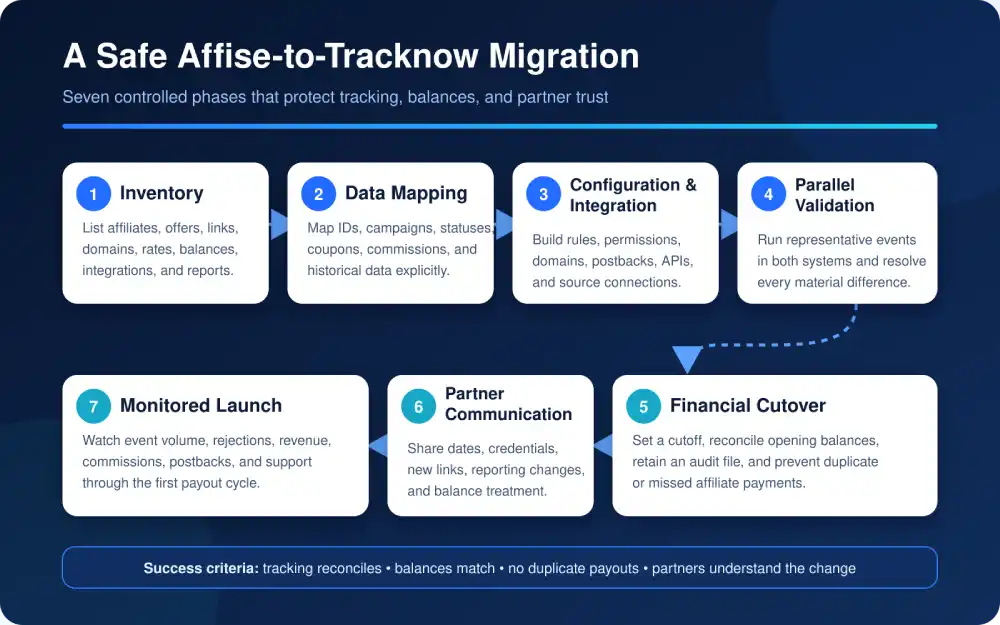
Phase 1: Inventory
List every active offer, affiliate, domain, link structure, postback, integration, commission type, status, currency, report, payment method, custom field, and scheduled process. Identify which data must be migrated and which historical data can remain in a read-only archive.
Phase 2: Mapping
Map Affise identifiers and fields to Tracknow entities. Decide how affiliates, campaigns, conversions, sub-IDs, coupons, balances, and statuses will be represented. Document any transformation rather than silently changing meaning.
Phase 3: Configuration and Integration
Build campaigns, commission rules, domains, partner groups, permissions, notifications, payment workflows, and technical connections. Use test credentials and non-production events where possible.
Phase 4: Parallel Validation
Run representative events through both systems for an agreed period. Reconcile clicks, conversions, commission bases, rates, currencies, statuses, and partner totals. Investigate differences before changing live affiliate links or postbacks.
Phase 5: Financial Cutover
Choose a clear cutoff time. Export final pending, approved, and paid balances from Affise. Import or record agreed opening balances in Tracknow, preserve an audit file, and prevent the same conversion from being paid in both systems.
Phase 6: Partner Communication
Tell affiliates when links, domains, portal access, reporting, or payment processes will change. Provide new credentials and test links early. Explain how historical balances and reports will remain accessible.
Phase 7: Monitored Launch
Monitor event volume, rejection rates, revenue, commission totals, postback responses, and support questions more frequently during the first payout cycle. Keep the former system available in read-only form until reconciliation and financial sign-off are complete.
Tracknow provides onboarding support, affiliate imports, tracking setup assistance, and migration guidance. The exact scope should be defined from the source data and integrations before the project begins.
Frequently Asked Questions
Is Tracknow a good alternative to Affise?
Yes, particularly for businesses that need flexible commission rules, coupon attribution, lifetime tracking, multi-level affiliates, partner engagement tools, or workflows designed for eCommerce, Forex, iGaming, prop trading, affiliate networks, and creators. Review the direct Tracknow and Affise comparison for the detailed feature view.
Is Tracknow cheaper than Affise?
Tracknow currently has a substantially lower published entry price. Tracknow Pro is listed at $116 per month billed annually, while Affise Beginner is listed at $625 monthly with a lower committed price shown at $499. Final cost depends on the required plan, usage, overages, add-ons, integrations, setup, support, and internal operating work.
Can Tracknow support CPA, CPS, CPL, and RevShare?
Yes. Tracknow supports standard models such as CPA, CPS or RevShare, CPL, CPC, and CPM, along with goals including registrations, deposits, FTDs, and installs. It can also support lifetime, tiered, coupon, category, partner-specific, and hybrid commission workflows.
Which platform is better for Forex and introducing brokers?
Tracknow provides dedicated Forex and IB configurations for CRM integration, CPA, FTD, per-lot, pip, spread, rebate, revenue sharing, sub-affiliates, and Master IB structures. Buyers should test the precise trading and qualification rules used by their brokerage.
Which platform is better for iGaming?
Both companies offer iGaming solutions. Tracknow is especially relevant when the operator needs player-based reporting, qualified CPA, NGR RevShare, separate balances, carryover logic, hybrid deals, tiers, contests, and sub-affiliates in one partner-management workflow.
Can an affiliate network use Tracknow?
Yes. Tracknow offers network plans with unlimited campaigns and affiliate partners, advertiser access, network-specific features, multiple tracking domains, API access, reporting, fraud protection, and payment workflows. iGaming network and custom network options are also available.
Can data be migrated from Affise?
Yes, but the scope depends on available exports, APIs, identifiers, and the history the company needs to retain. Affiliate accounts, offers, commission rules, conversions, statuses, balances, payments, domains, and postbacks should be mapped and reconciled separately.
Does Tracknow provide a free trial?
Yes. Tracknow provides a 14-day free trial without requiring a credit card. Use the trial to validate integrations, attribution, commission rules, reports, and payout workflows with representative data.
Final Verdict
Affise is a capable and established performance marketing platform. The reason to choose Tracknow is not that Affise cannot track affiliate activity. It is that Tracknow may fit the commercial and operational shape of your program more closely.
Tracknow is particularly compelling when the company wants an accessible professional starting point, flexible commission rules, coupon and lifetime attribution, sub-affiliate hierarchies, partner engagement tools, vertical-specific workflows, and a team that participates in setup and migration.
The decision should be verified with your own conversions, commission agreements, integrations, support requirements, and 12-month cost model. Use the complete Tracknow vs Affise comparison for the detailed platform view, then run the acceptance tests in this guide.
Book a Tracknow demo to review your existing Affise setup and migration requirements, or start a 14-day free trial to validate the workflow directly.