
iGaming Affiliate Compliance: Licensing Geos, Creative Restrictions, and Responsible Gambling Rules
How casino and sportsbook operators run affiliate compliance — licensed geos, creative restrictions, RG rules, monitoring, and takedowns without killing the channel.

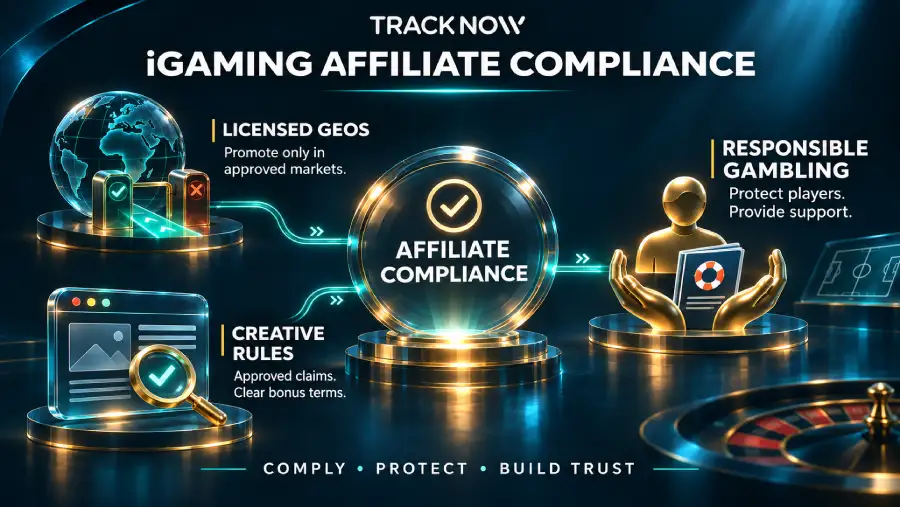
iGaming affiliate programs do not fail only on bad traffic. They fail when a partner promotes the wrong geo, overpromises a bonus, skips age gates, or runs a creative that would never pass your own ads team. By then the screenshot is already in a regulator’s or platform’s queue.
That is why compliance sits inside the same operating system as traffic and commissions in iGaming affiliate marketing — not as a PDF nobody opens after onboarding. Licensing geos, creative restrictions, and responsible gambling (RG) rules decide which partners you can recruit, which claims you can allow, and how fast you must take content down.
This article is an operational guide for operators and affiliate managers. It is not legal advice. Rules differ by jurisdiction, license, product, and channel. Use it to build internal controls; confirm market-specific requirements with qualified counsel.
Quick Summary
- Treat geo, creative, and RG rules as program infrastructure — written, trained, monitored, enforced.
- Partners inherit your advertising risk; “we did not approve that banner” is weak if you never sampled live placements.
- Separate allowed markets from restricted markets in terms, creatives, and tracking where possible.
- Require disclosures, accurate bonus terms, and RG messaging appropriate to each licensed geo.
- Build a weekly sampling + escalation path before you scale recruitment.
- General affiliate compliance still applies — see Affiliate Marketing Compliance in 2026 — then add gambling-specific controls.
What “iGaming Affiliate Compliance” Means in Practice
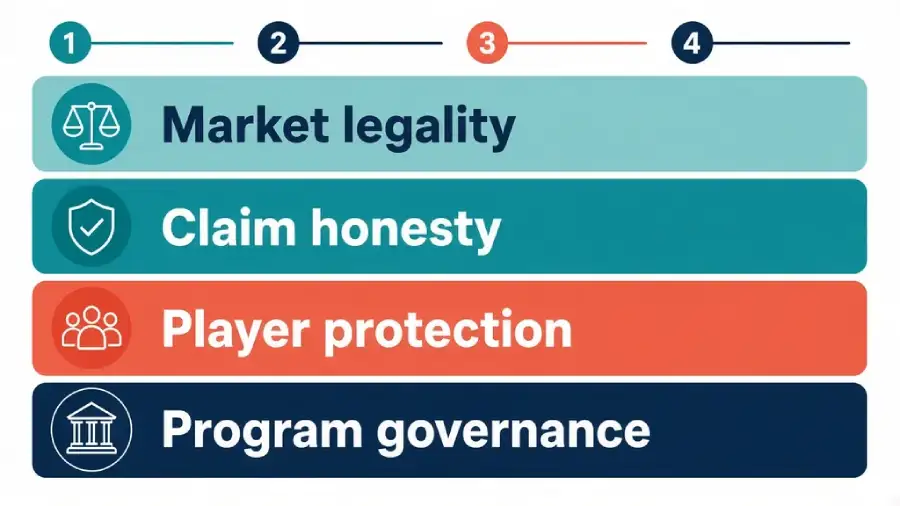
Compliance here means controlling how third parties present your casino or sportsbook to consumers under licensing and advertising rules. Three layers matter:
- Market legality — the product may be offered and promoted in that geo through that channel
- Claim honesty — bonuses, odds, “risk-free,” and winnings language match approved terms
- Player protection — age, RG, and self-exclusion expectations are respected in creative and landing paths
Program governance is the fourth layer: terms, approval workflows, evidence retention, and takedowns. Without it, layers 1–3 are aspirations. Broader disclosure and partner-oversight habits from horizontal compliance programs still apply; iGaming simply raises the cost of getting them wrong.
An affiliate manager who only optimizes EPC without sampling creatives is running an acquisition desk, not a licensed partner channel.
Licensing Geos: The First Filter
Every serious recruitment conversation starts with geography. A strong publisher in a blocked market is not a lead. Publish an allowed-country list (and channel caveats) in partner terms and in the portal. Update it when licenses change — stale geo lists create accidental breaches.
Practical geo controls
- Allowed / restricted / prohibited countries in writing
- Channel limits inside allowed geos (for example: search OK, social restricted)
- Language and domain expectations for local markets
- Tracking and landing defaults that do not invite wrong-geo traffic
- Application questions that force partners to declare geos and methods
Network distribution does not remove your duty. If you list on a network, still define which geos and creatives are permitted for your offer — see Affiliate Networks Explained by an Expert. Model choice (network vs in-house) changes visibility, not responsibility — context in iGaming Affiliate Programs vs In-House Networks.
Mini scenario: Soft geo leak
A sportsbook allowed “Country A” only. An SEO partner ranked for Country B queries and used a shared landing URL. FTDs looked fine until payments and KYC showed mismatched residency. The fix was geo-specific landings, clearer terms, and rejecting traffic that failed residency checks — not a louder CPA.
Creative Restrictions That Actually Need a Process
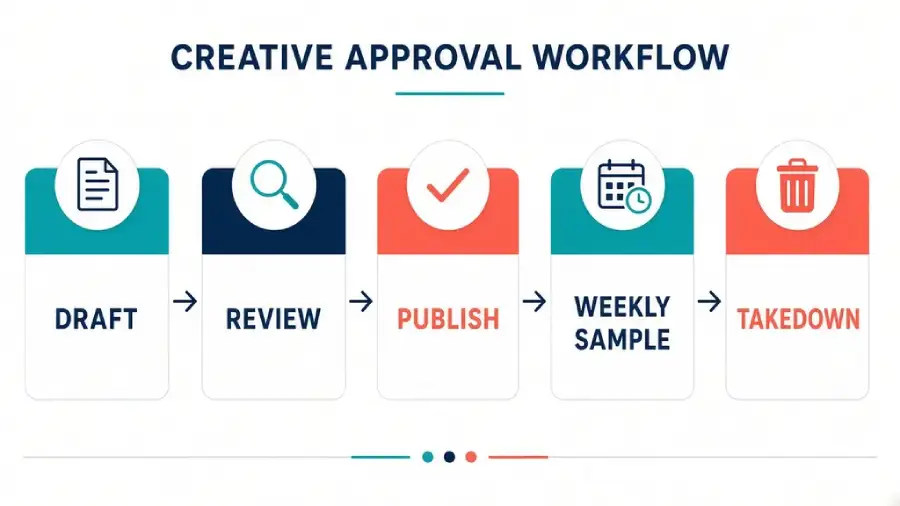
Creative compliance fails when “approved once” means “live forever.” Bonus amounts change, odds change, and regulators care about the claim the player saw — not the claim in your brand folder last quarter.
What to put in the creative policy
- Mandatory license / operator identifiers where required
- Age and RG lines (exact wording may be market-specific — confirm with counsel)
- Banned phrases (guaranteed wins, “risk-free” where not permitted, targeting minors, etc.)
- Bonus presentation rules: eligibility, wagering, expiry, significant conditions
- Brand and trademark use; spoofed “official” domains
- Brand bidding / SEM rules — expand in Brand Bidding Policies for Affiliate Programs
- Versioning: only current asset IDs may run; expired packs must be pulled
Give partners a current pack and a kill list. When terms change, notify active partners with a deadline. Landing accuracy matters as much as banners — CRO habits in Landing Page Optimization for Affiliate Offers should never override approved claims.
Responsible Gambling Rules in Partner Channels
RG is not a footer checkbox for operators alone. Affiliates shape first impressions: urgency tactics, “easy money” framing, and content aimed at vulnerable audiences can conflict with your license expectations even when the click tracks correctly.
Operational RG expectations for partners usually include:
- No marketing that targets underage audiences
- No content that trivializes harm or promises financial rescue through gambling
- Required RG or help-resource references where your markets demand them
- Respect for self-excluded or blocked customers in remarketing where the partner controls lists
- Honest portrayal of risk — not “sure tips” dressed as guarantees
Spell these out in terms and onboarding. Train streamers and tipsters especially: spoken claims travel farther than a banner disclaimer. Recruitment should filter for this maturity — see How to Recruit iGaming Affiliates and the general playbook in How to Recruit Affiliates for a New Program.
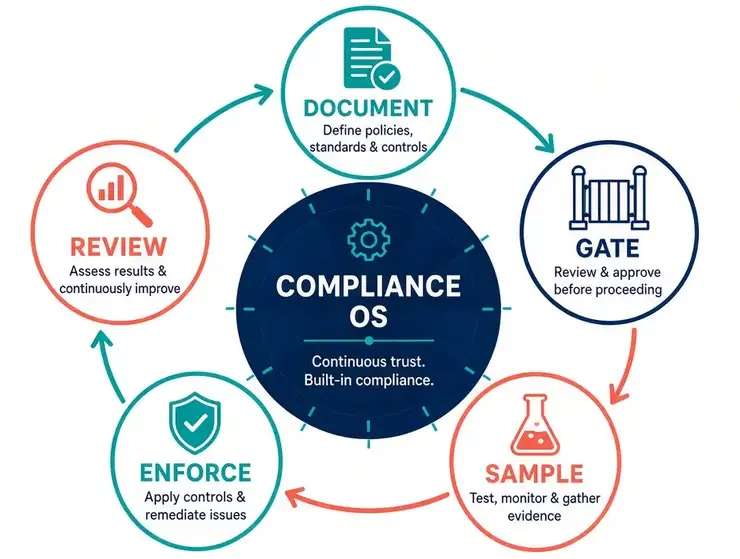
A Practical Compliance Operating System
- Document — geo list, creative rules, RG expectations, brand-bid policy, escalation contacts.
- Gate — application-only until sources and methods are declared; probation for new partners.
- Enable — current creatives, fact sheets, disclosure examples, portal notices.
- Sample — weekly checks of top partners by volume and random long-tail placements.
- Record — screenshots, URLs, dates, partner replies, decisions (warn / suspend / terminate).
- Enforce — written outcomes with deadlines; pause commissions on clear breaches when terms allow.
- Review — monthly theme review (bonus claims, geo leaks, sub-affiliates).
Sub-affiliate layers need extra visibility. If you cannot see the traffic, you cannot sample it — policy territory for Sub-Affiliate Networks in iGaming.
Finish foundational ops before scaling partners: Affiliate Program Launch Checklist. Software that stores creatives, partner statuses, and audit-friendly history helps — evaluate with iGaming affiliate software criteria, not only CPA features.
Monitoring: What to Check Each Week
| Check | Why | Typical signal |
|---|---|---|
| Live bonus claims | Expired or inflated offers | Mismatch vs current terms |
| Geo language / domain | Wrong-market promotion | Currency, TLD, address cues |
| Age / RG presence | License expectations | Missing lines on key pages |
| Brand bidding | Trademark and budget risk | Ads on your brand terms |
| Sub-affiliate URLs | Hidden sources | Undeclared domains |
| Creator scripts / VODs | Spoken overclaims | “Guaranteed” language |
Prioritize by risk × volume. A tiny blog with a banned claim still matters; a top media buyer with clean landings still needs periodic re-checks when offers rotate.
Traffic-quality reviews connect here: incentivized or misleading acquisition is both a fraud and a compliance problem. Keep channel quality standards aligned with How to Drive High-Quality Traffic to Your Affiliate Program.
Casino vs Sportsbook Nuances
Both sit under iGaming, but creative risk differs. Casino partners push bonuses and game variety; sportsbook partners push odds, tips, and event urgency. Event-driven spikes increase the chance of reckless “lock this bet” language. Track and message accordingly — deeper funnel differences belong in Sportsbook vs Casino Affiliate Marketing.
Commission design also interacts with compliance: aggressive unqualified CPA can reward the wrong creative behavior. Keep commercial rules honest in How Casino and Sportsbook Affiliate Commissions Work so partners are not paid to ignore your policy.
Common Mistakes (and How to Avoid Them)
One global creative pack for every license. Localize mandatory lines and claims; confirm with counsel per market.
Approving partners without declared sources. You cannot monitor what you cannot name.
No owner for weekly sampling. Unowned compliance becomes annual panic.
Leaving expired bonuses live on partner sites. Build a change-notification + deadline process.
Treating RG as operator-site-only. Affiliates create the first promise players see.
Ignoring sub-affiliates. Master deals without visibility multiply risk.
Punishing without records. Keep evidence; inconsistent enforcement invites disputes and repeats.
Launching recruitment before terms and packs exist. Fix the foundation first — then scale outreach.
Conclusion
iGaming affiliate compliance is how you keep licensed acquisition alive: clear geos, controlled creatives, RG-aware partner behavior, and a monitoring loop that can take content down. Traffic and commissions without that operating system eventually collide with platforms, payment partners, or regulators.
Write the rules, gate onboarding, sample what is live, and enforce with documentation. Partners who want a long relationship will prefer clarity over silence.
If you need partner portals, creative controls, geo-aware program setup, and audit-friendly tracking for casino and sportsbook affiliate programs, Tracknow is a strong place to start.
FAQ
What is iGaming affiliate compliance?
It is the set of controls that keep partner promotions aligned with licensing, advertising, and responsible gambling expectations — geos, claims, creatives, disclosures, monitoring, and enforcement. It is operational governance, not a single checkbox in the signup form.
Are affiliates responsible for gambling advertising rules?
Partners must follow applicable rules and your program terms; operators remain accountable for how their brands are promoted. Programs should not assume “affiliate mistake” removes risk. Confirm obligations with counsel for each market.
How do we handle multi-geo programs?
Maintain explicit allowed/restricted lists, market-specific creatives where required, and application data that shows where partners traffic. Prefer geo-appropriate landings over one universal URL whenever mismatch risk is high.
What creative claims get affiliates in trouble most often?
Expired or incomplete bonus terms, “risk-free” / guaranteed-win style language where not permitted, missing age or RG lines, and brand impersonation. Spoken overclaims on streams are a frequent blind spot.
How often should we sample affiliate sites?
Weekly for top partners by volume and risk; rotate long-tail partners on a schedule. Increase frequency after offer changes, new geos, or a breach. Sampling without records is incomplete.
What should a takedown process include?
Evidence (URL, screenshot, date), a clear request and deadline, confirmation of removal, and a written outcome (warning, suspension, termination). Pause new creatives until fixed when terms allow.
Do networks remove our compliance burden?
No. Networks can help with distribution and some controls, but your offer still needs geo, creative, and RG rules — and you should reconcile what runs under your brand.
How does responsible gambling apply to tipsters and streamers?
They need approved messaging, age-aware positioning, and limits on guarantee-style language. Promo codes and scripts should include required lines for your markets. Vet creators before scale.
Should compliance block recruitment?
It should shape recruitment: application questions, probation, and partner-type filters. Skipping compliance to grow faster usually creates a larger cleanup later.
Is this legal advice?
No. This is an operational framework for affiliate program teams. Gambling and advertising law vary by jurisdiction. Obtain qualified legal advice for the markets and channels you use.
10-Point Checklist for iGaming Affiliate Compliance
- Allowed / restricted geos published and dated.
- Creative policy covers claims, RG, age, brand use, and versioning.
- Current asset pack and kill list available to active partners.
- Brand-bidding and SEM rules written.
- Application captures sources, geos, and methods.
- Weekly sampling owner and schedule assigned.
- Evidence template ready (URL, screenshot, date, decision).
- Takedown SLA and escalation path documented.
- Sub-affiliate visibility rules defined.
- Counsel review cadence set for market rule changes (operational reminder — not a substitute for advice).