
How Affiliate Marketers Can Use SEO and Link Building to Drive Quality Traffic and More Conversions
Learn how affiliate marketers can use SEO, content, and link building to attract quality traffic, improve conversions, and track what drives revenue.

Affiliate marketing has always been a traffic business, but more traffic does not automatically mean more revenue.
An affiliate can generate thousands of visits to a review, comparison page, or landing page and still see disappointing results if those visitors have little purchase intent. At the same time, another affiliate may attract a much smaller audience and generate significantly more conversions because the traffic is more relevant to the offer.
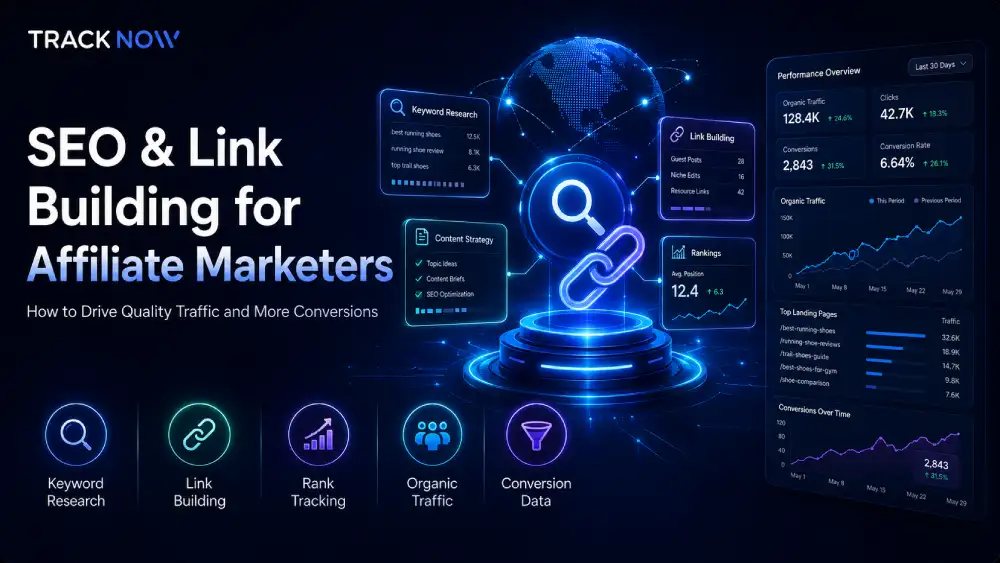
This is where SEO becomes particularly valuable for affiliate marketers.
Instead of paying for every click or depending entirely on short-lived social campaigns, affiliates can build pages that attract people who are already searching for a product, solution, comparison, or recommendation. When those pages rank for the right searches, they can continue generating traffic long after the content has been published.
However, ranking content is only one part of the process.
Affiliate marketers also need to build website authority, earn relevant links, optimize pages for commercial intent, and — most importantly — understand which traffic actually turns into conversions and revenue.
In this guide, we will look at how SEO, content, link building, and affiliate tracking can work together to create a more sustainable acquisition strategy.
Link Building Platforms and Services for Affiliate Marketers: A Quick Comparison
Link building is the part of affiliate SEO that most people end up paying for in some form, either placement by placement or as a managed service. Before we get into strategy, here is how the main options compare.
The right choice depends on whether the priority is self-service link building, a done-for-you service, digital PR, detailed analytics, or international media coverage.
| Platform | Model | Notable Strength | Best Fit for Affiliate Marketers |
|---|---|---|---|
| LinkScope | Self-service link building marketplace | Filter publishers by niche, traffic, authority and price, then pay per placement. Supports guest posts and niche edits. | Affiliates who want to choose their own placements and keep a focused, self-service workflow |
| SEOSkit | Managed link building and SEO agency | Prospecting, outreach, content and publishing handled by the agency and delivered as an ongoing program rather than one-off orders | Affiliates running larger sites who would rather hand link building to a team than order placements themselves |
| Collaborator | Guest post and PR platform | Large catalog and extensive website filtering and analytics options | SEO teams that want very detailed filtering before choosing publishers |
| WhitePress | SEO, content distribution and digital PR platform | Broad ecosystem covering publications, links and international campaigns | Affiliates for whom link building is part of a wider content or digital PR workflow |
| EcomSkit | Ecommerce link building service | Editorial links, product PR and review placements aimed at category and product pages, for stores on Shopify, Magento, WooCommerce and BigCommerce | Affiliates who run their own online store, or ecommerce brands with an affiliate program, that need authority on category and product pages |
| Getfluence | Sponsored content and premium media platform | Strong focus on branded content and established media publishers | Campaigns combining SEO with brand awareness and digital PR |
| PRPosting | Guest post and content placement platform | Detailed filtering using multiple third-party SEO metrics | Marketers who want to evaluate publishers through a large number of technical SEO indicators |
Why SEO Can Be a Powerful Traffic Channel for Affiliate Marketers
Many affiliate traffic channels are temporary by nature.
A paid advertising campaign generates traffic while the budget is active. An email campaign produces most of its clicks shortly after it is sent. A social post can receive a burst of engagement before disappearing from users' feeds.
Search traffic works differently.
A useful page that ranks for a relevant query can potentially attract visitors repeatedly for months or years, provided that it continues to satisfy search intent and remains competitive.
For affiliates, this creates several advantages.
- Organic traffic can compound over time. Each new useful article expands the number of searches through which potential customers can discover the website.
- Search traffic can have strong intent. Someone actively searching for a product review or comparison is much closer to a decision than someone who randomly sees an advertisement.
- Content can promote multiple offers. A single comparison or educational article can introduce several relevant products without requiring a separate campaign for each one.
- SEO reduces dependence on a single acquisition channel. Affiliates relying entirely on paid ads, social platforms, or email lists can become vulnerable to changes in pricing, algorithms, or platform policies.
- Performance is measurable. Organic visitors can still be connected to affiliate clicks, campaigns, SubIDs, conversions, and revenue.
The last point is especially important.
SEO metrics such as impressions, keyword positions, and organic sessions tell an affiliate whether a website is becoming more visible. They do not tell the full commercial story.
An affiliate business ultimately needs to answer questions such as:
- Which articles generate affiliate clicks?
- Which search topics produce the highest conversion rate?
- Which products convert best from organic traffic?
- Which pages generate the highest earnings per click?
- Which traffic sources produce customers rather than visitors?
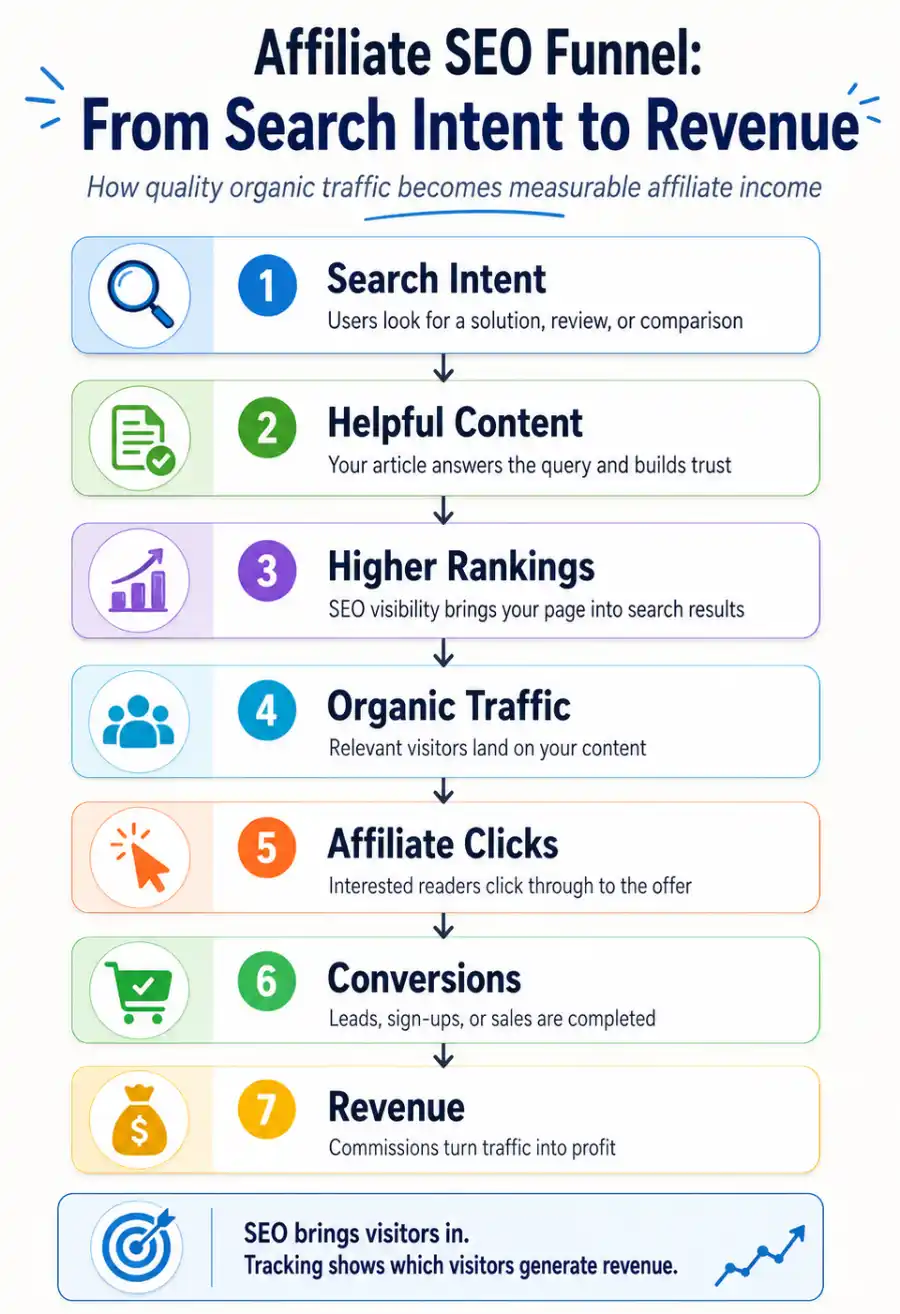
This is why the most effective affiliate SEO strategy connects search visibility with conversion tracking rather than treating them as separate activities.
Start With Search Intent, Not Search Volume
One of the easiest mistakes in affiliate SEO is choosing keywords based primarily on how many searches they receive.
A keyword with 50,000 monthly searches may look much more attractive than one with 1,000 searches. But if the larger keyword is mostly informational while the smaller one is used by people preparing to buy, the smaller keyword can be considerably more valuable.
This is why affiliates should think about search intent before search volume.
Informational Intent
Informational searches happen when users are researching a subject rather than actively choosing a product.
Examples include:
- What is affiliate tracking?
- How does cloud accounting work?
- How to improve website speed?
- What is a prop trading challenge?
These keywords can attract significant traffic and introduce new users to a website. They are particularly useful for building topical authority and reaching potential customers early in their research process.
However, they may not convert immediately.
Commercial Investigation
Commercial searches are often especially valuable for affiliates because the user already knows that a solution exists and is now evaluating different options.
Typical keyword patterns include:
- best [product] for [use case]
- [product A] vs [product B]
- [product] review
- [product] alternatives
- best software for [problem]
A person searching for "best accounting software for freelancers" is considerably closer to choosing a product than someone searching for "what is accounting software."
This is exactly the type of intent that works well with affiliate content.
Transactional Intent
Transactional queries indicate that the user may already be ready to take action.
They can contain phrases such as:
- buy
- sign up
- pricing
- discount
- free trial
- coupon
These searches can convert very well, but they are often more competitive and may also overlap with the advertiser's own branded traffic.
The Best Affiliate SEO Strategy Uses All Three
A healthy affiliate website usually does not target only commercial keywords.
Informational pages can attract backlinks and build authority. Comparison and review pages can capture commercial demand. Transactional pages can convert users who are ready to act.
The goal is therefore not to find one "perfect" keyword type. It is to create a content ecosystem that guides visitors from research to decision.
For example:
- A user searches for information about solving a problem.
- They discover an educational article on an affiliate website.
- The article links to a comparison of several possible solutions.
- The visitor evaluates the products.
- They click an affiliate link.
- The resulting conversion is attributed to the affiliate.
SEO brings the user into the funnel. Affiliate tracking shows whether that funnel actually produces business results.
Create Content That Can Rank and Convert
Keyword research identifies opportunities, but keywords alone do not generate affiliate revenue. The page itself still has to solve the user's problem and make the next step clear.
For affiliates, this usually means balancing two goals: creating content that deserves organic visibility and creating a useful path toward a relevant product.
Product Reviews
Reviews work best when they go beyond repeating information from the product's website.
A useful affiliate review can explain:
- who the product is designed for;
- where it performs well;
- where its limitations are;
- how pricing works;
- which alternatives should also be considered;
- what type of customer is most likely to benefit from it.
Original screenshots, testing, examples, tables, and practical observations can make the content substantially more useful than a rewritten product description.
Comparison Articles
Comparison content is particularly effective because users searching for "A vs B" have usually progressed beyond basic awareness.
A good comparison should help the reader make a decision rather than simply declare a winner.
Compare products by meaningful criteria such as pricing model, features, target audience, ease of use, integrations, limitations, and use case.
If Product A is better for beginners while Product B is better for large businesses, saying so can make the comparison more credible — and often more useful commercially — than recommending the highest-paying affiliate offer in every situation.
Best-Of Lists
Listicles can perform well when users genuinely need to evaluate several options.
However, they become less useful when every company is described as "the best."
A stronger structure assigns each product a specific use case:
- Best for beginners
- Best for small businesses
- Best for automation
- Best for advanced users
- Best value
This helps match individual visitors with the offer most relevant to them.
Tutorials and Problem-Solving Content
Not every affiliate article needs to focus directly on a product.
Tutorials can attract visitors much earlier in the buying journey and create opportunities for contextual recommendations.
For example, a detailed guide about improving email deliverability may naturally recommend an email verification service. A tutorial about managing multiple client websites may introduce suitable hosting or SEO software.
The product becomes part of the solution rather than the entire purpose of the page.
Link Building for Affiliate Websites
Producing useful content is essential, but content does not exist in isolation.
In competitive markets, many websites may publish high-quality reviews, comparisons, and tutorials targeting the same commercial queries. Search engines therefore need additional signals to understand which resources are established and authoritative.
Backlinks — links from other websites pointing to your pages — are one of the signals that can contribute to a site's broader authority and discoverability.
Why Link Building Matters in Competitive Affiliate Niches
For an affiliate marketer, link building can support several objectives.
- Improving the authority of important pages. Commercial affiliate pages often compete against established publishers, brands, marketplaces, and other affiliates. Earning relevant links to useful resources can strengthen the overall backlink profile surrounding those pages and the website as a whole.
- Helping new content get discovered. Links from established websites can create additional paths through which search engines and users discover new content.
- Generating referral traffic. A backlink can also send visitors directly. This is particularly valuable when the linking website serves an audience closely aligned with the affiliate offer. A hundred relevant visitors from an industry publication can sometimes be more commercially useful than thousands of visitors from an unrelated website.
- Building recognition within a niche. Repeatedly appearing on relevant industry websites can expose an affiliate brand to potential customers, publishers, partners, and other businesses within the same ecosystem.
For that reason, good link building should not be reduced to collecting the highest possible domain metrics.
Relevance, real traffic, editorial quality, audience fit, and the context surrounding the link all matter.
How to Evaluate Backlinks Without Chasing Vanity Metrics
Domain Rating, Domain Authority, estimated organic traffic, referring domains, and similar metrics can be useful when evaluating websites. But none of them should be treated as a guarantee that a backlink is valuable.
Affiliate marketers should look at the complete picture.
Before pursuing a placement, ask:
- Is the website relevant to my niche or audience?
- Does it appear to receive genuine organic traffic?
- Is the content written for readers or primarily for publishing links?
- Would the link make sense even if SEO metrics were hidden?
- Is the surrounding article genuinely useful?
- Does the site publish content related to the page I am promoting?
- Could the placement generate relevant referral traffic?
This approach is especially important for affiliates because their most valuable pages often target commercial searches. A backlink from an unrelated website with impressive metrics may look attractive in a spreadsheet but contribute little to the actual audience journey.
Relevance should therefore come before scale.
Finding Relevant Placements Without Manual Outreach
One challenge with link building is not understanding why links matter — it is finding appropriate websites efficiently.
Traditional outreach can require building prospect lists, finding contact information, sending emails, negotiating terms, following up, and managing publication manually. That approach can work, but it becomes increasingly time-consuming when an affiliate operates across several websites, markets, or content categories.
Link building platforms provide another option by bringing publishers and placement opportunities into one searchable environment.
One example is LinkScope, a link-building marketplace designed around browsing publishers using SEO and traffic metrics before choosing a placement.
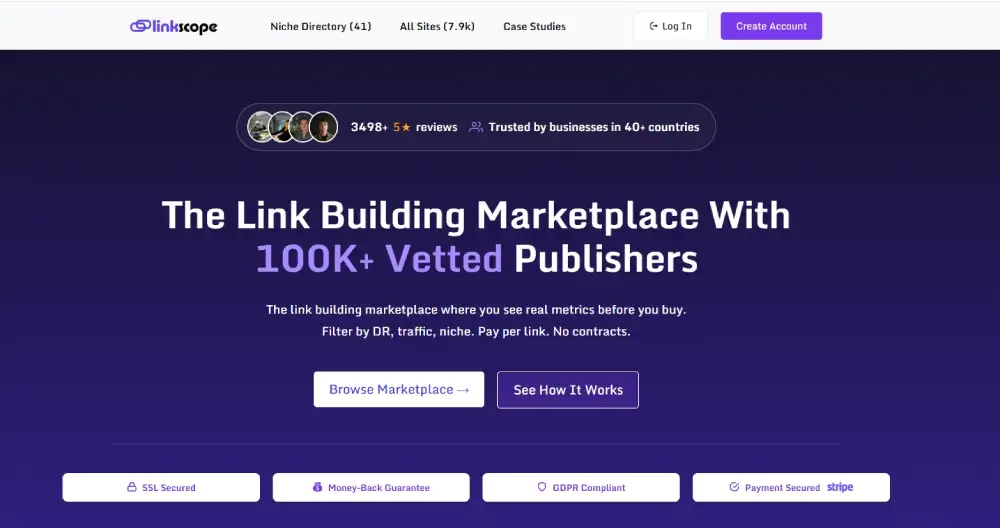
Users can filter opportunities using criteria such as niche, Domain Rating, traffic, and price rather than starting every link prospecting campaign from an empty spreadsheet. The platform also supports different placement types, including guest posts and niche edits.
Affiliate websites often operate in clearly defined commercial niches — SaaS, finance, ecommerce, gaming, technology, travel, health, or other verticals.
That makes filtering particularly useful.
Instead of looking only for websites with a high authority metric, an affiliate can begin with relevance and then narrow the list using traffic, authority, price, and other criteria.
For example, an affiliate promoting business software could first identify websites covering business or technology, remove publishers that do not meet its traffic requirements, compare authority metrics, and then evaluate the remaining sites manually before placing an order.
This does not eliminate the need for due diligence. It simply reduces the amount of manual prospecting required before that evaluation begins.
Self-Service or Managed?
The comparison table near the top of this guide covers the main options. In practice, the decision for most affiliates comes down to how much of the work they want to do themselves.
For an affiliate whose main objective is finding relevant backlink opportunities without turning the process into a full digital PR campaign, a self-service platform such as LinkScope keeps the workflow narrow: identify a niche, compare available publishers, review the metrics, choose an opportunity, and manage the placement directly.
By contrast, managed agencies handle outreach for you to save time, while platforms focused more broadly on sponsored media or digital PR are designed for brand visibility. LinkScope fits right in the middle for affiliates who want full control over their own placements without the manual prospecting hassle.
Whichever route you take, do not choose a provider based purely on the number of websites listed. A smaller group of highly relevant opportunities is often more useful than thousands of unrelated domains.
Traffic Quality Matters More Than Ranking Growth Alone
Link building and SEO are usually evaluated using metrics such as ranking improvements, organic impressions, traffic growth, or referring domains.
Those numbers are important, but affiliates have an additional advantage: they can connect traffic acquisition directly to commercial performance.
Imagine two affiliate articles.
Article A receives 10,000 organic visits per month but sends only 300 visitors to the advertiser and generates three conversions.
Article B receives 2,000 organic visits, sends 400 users to the advertiser, and produces 20 conversions.
If success is measured only by organic traffic, Article A appears to be the stronger asset.
If the affiliate looks at revenue, Article B may be far more valuable.
This is why SEO decisions should eventually be connected to affiliate performance data.
Measure Organic Traffic Beyond Sessions
At minimum, affiliates should monitor:
- Organic sessions: how much search traffic the page receives.
- Affiliate click-through rate: what percentage of visitors continue to the advertiser.
- Conversions: how many referred users complete the desired action.
- Conversion rate: how effectively referred clicks become customers or leads.
- Earnings per click (EPC): how much commission the affiliate generates relative to outgoing clicks.
- Revenue per organic visitor: how effectively the page monetizes its search traffic.
Together, these metrics reveal something SEO tools alone cannot: the commercial value of the audience being acquired.
Connect SEO Traffic to Affiliate Conversions
Once organic traffic begins arriving, the next challenge is attribution.
An affiliate should be able to distinguish traffic and performance across different pages, campaigns, offers, and acquisition strategies.
For example, simply knowing that 250 conversions came from an affiliate account is useful. Knowing that 160 came from comparison content, 55 from product reviews, 25 from tutorials, and 10 from other sources is considerably more actionable.
This is where campaign parameters, tracking links, SubIDs, and conversion tracking become important.
Use SubIDs to Separate SEO Campaigns
SubIDs allow affiliates to attach additional information to affiliate traffic without creating an entirely separate account for every page or campaign.
An affiliate could create a simple naming structure such as:
review-product-acomparison-a-vs-bbest-tools-categorytutorial-topic-a
When conversions arrive, those identifiers help reveal which content produced them.
A more advanced implementation can also separate traffic by page, CTA placement, language, campaign, or website.
Compare Conversion Rate by Page Type
Different SEO content serves different stages of the buying journey, so conversion rates should not always be expected to match.
An informational tutorial may attract significantly more visitors while producing fewer immediate affiliate clicks.
A product comparison may receive less traffic but generate substantially more clicks per visitor.
A branded review can attract an even smaller audience while converting at a high rate because users already know the product.
Looking at these page types separately prevents affiliates from making the wrong optimization decisions.

Use Conversion Data to Improve Your SEO Strategy
Tracking should not be the final step of an affiliate campaign. The data can be used to influence what content gets created and optimized next.
Suppose an affiliate publishes 30 articles.
After several months, the data shows that comparison pages account for only 25% of organic traffic but generate 60% of affiliate revenue.
That insight can influence the next content cycle.
The affiliate might:
- publish more comparison content;
- update older comparisons;
- build internal links toward high-converting pages;
- pursue backlinks to the most commercially valuable sections;
- test different calls to action;
- improve product tables;
- negotiate better commissions for the products that perform well.
Alternatively, the data may reveal that a page ranks very well but converts poorly.
In that case, creating additional backlinks may not be the highest priority. The problem could be poor intent alignment, an ineffective call to action, the wrong offer, outdated information, or a landing page that does not match what visitors expected.
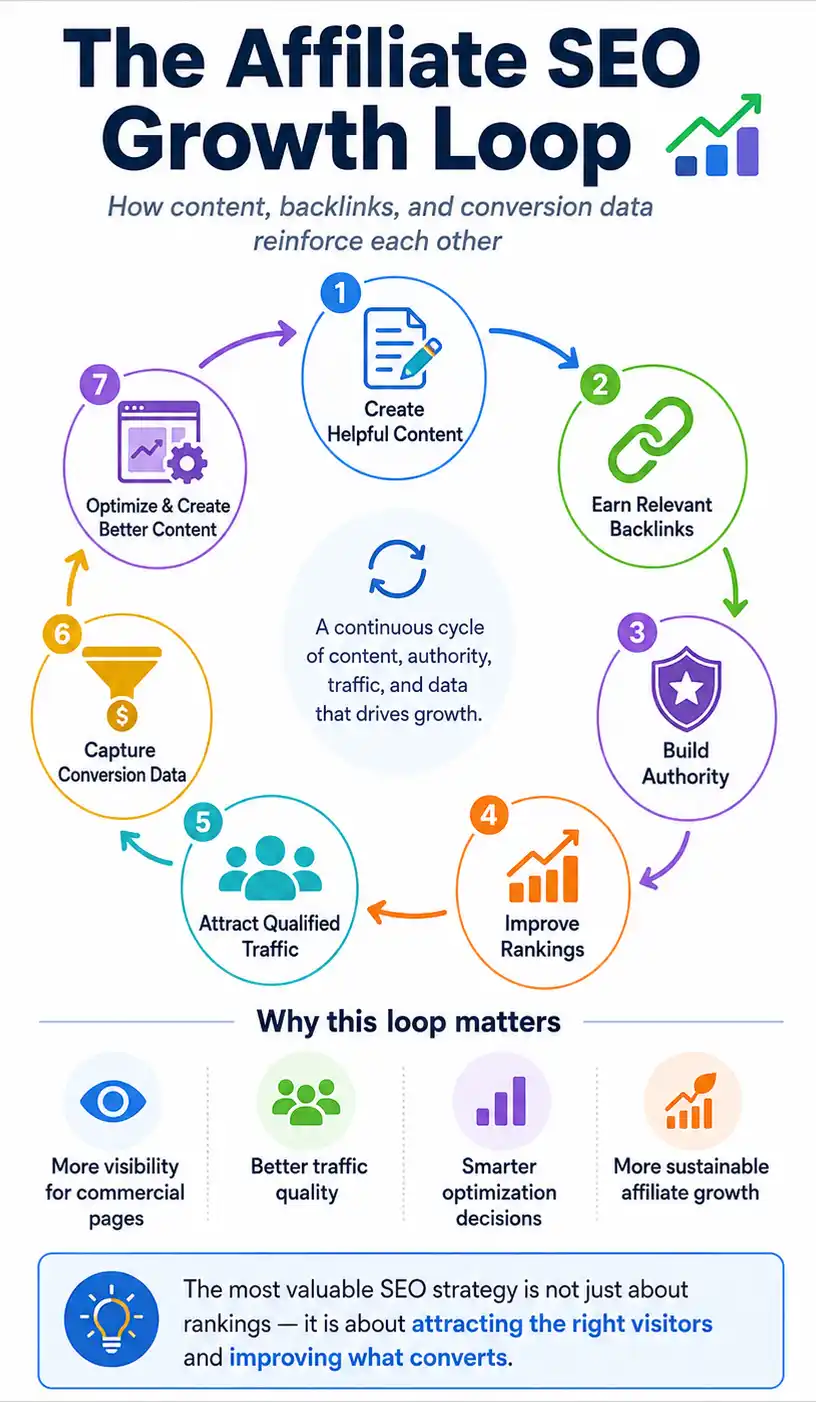
This creates a useful feedback loop:
SEO data tells you where users arrive. Affiliate tracking tells you what those users do next.
A Practical SEO-to-Revenue Workflow for Affiliates
A sustainable affiliate SEO strategy can be organized into a repeatable process.
- Research the market. Identify topics your target audience researches before purchasing a product or service.
- Map search intent. Separate informational, comparison, review, alternative, and transactional keywords.
- Create genuinely useful content. Add analysis, examples, screenshots, comparisons, testing, and information that cannot be found by simply reading the advertiser's landing page.
- Build internal links. Connect educational pages with relevant commercial pages so users can naturally move through the site.
- Develop relevant external authority. Identify websites and publications that overlap with your niche and audience rather than chasing authority metrics alone.
- Track affiliate clicks and conversions. Use tracking links and campaign identifiers to connect individual content assets with performance.
- Calculate commercial performance. Compare traffic with click-through rate, conversions, EPC, and revenue.
- Invest more in what works. Update, expand, internally link, and promote the pages that attract the right traffic and generate measurable business outcomes.
Common SEO and Link-Building Mistakes Affiliate Marketers Should Avoid
1. Optimizing for Traffic Instead of Intent
Large traffic numbers look impressive, but an affiliate website is not a media business unless advertising impressions are its primary monetization model.
If revenue depends on affiliate conversions, commercially relevant visitors matter more than raw pageviews.
2. Publishing Content With No Original Value
Rewriting product descriptions and adding affiliate buttons is rarely enough to create a useful review.
Give readers information that helps them make a decision: examples, comparisons, strengths, weaknesses, screenshots, pricing context, and clear recommendations for different use cases.
3. Choosing Backlinks Only by DR or DA
Third-party authority metrics are useful filters, not guarantees.
Always look at relevance, real traffic, content quality, indexing, the site's publishing patterns, and whether the placement makes sense for a genuine reader.
4. Sending Every Visitor to the Same Offer
Different keywords can reveal different needs.
A visitor looking for an inexpensive beginner solution should not necessarily receive the same recommendation as an enterprise buyer searching for advanced functionality.
5. Measuring Rankings Without Measuring Conversions
A keyword moving from position eight to position three is positive SEO progress. But if the resulting visitors do not click or convert, the commercial impact may still be limited.
Track both visibility and downstream performance.
6. Ignoring Existing High-Converting Content
Affiliates often spend all their time publishing new articles while pages already generating conversions receive little attention.
Updating high-performing pages, improving their internal links, adding new information, and strengthening their authority can sometimes produce better returns than creating another article from zero.
Conclusion
SEO can become one of the most valuable acquisition channels for an affiliate business, but rankings and traffic should never be the final objective.
The real opportunity comes from connecting the entire process.
Research the searches that indicate genuine customer intent. Create content that helps users make decisions. Build authority through relevant websites and useful placements. Then track what happens after visitors arrive.
When affiliates can connect keywords, pages, traffic sources, affiliate clicks, and conversions, SEO stops being simply a traffic strategy.
It becomes a measurable revenue channel.

FAQ: SEO and Link Building for Affiliate Marketers
Is SEO still worth it for affiliate marketers?
Yes, provided that SEO is treated as a way to attract relevant users rather than simply generate pageviews. Search traffic can be particularly valuable for affiliate websites because users frequently search for reviews, comparisons, alternatives, and solutions immediately before making purchase decisions. The key is connecting organic visibility to affiliate clicks and conversions so that content is evaluated by commercial performance as well as rankings.
What type of SEO content converts best for affiliates?
Commercial-intent formats such as product comparisons, reviews, alternatives, and "best for" pages often have strong conversion potential because visitors are already evaluating solutions. However, informational tutorials can play an important role by attracting users earlier in the journey and directing them toward relevant commercial content. The best mix depends on the niche, product, and customer journey.
How important are backlinks for affiliate websites?
Backlinks can contribute to authority, discovery, referral traffic, and competitiveness in organic search. Their value depends heavily on context and relevance. A link from a respected publication within the same or a closely related niche can be more meaningful than a link chosen only because it has a high third-party authority score. Affiliates should therefore evaluate traffic, editorial quality, relevance, and audience fit alongside SEO metrics.
Should affiliates buy backlinks?
Affiliate marketers should be careful with any link-building method designed primarily to manipulate rankings. Search engines have policies covering paid links and link schemes, so marketers should understand those guidelines before running campaigns. From a marketing perspective, placements should still be selected according to relevance, audience, editorial quality, and potential referral value rather than treating backlinks as interchangeable SEO units.
What is a link-building marketplace?
A link-building marketplace is a platform that helps marketers discover websites offering different types of content or link placements. Instead of manually researching every publisher and conducting outreach individually, users can typically browse opportunities and compare factors such as niche, traffic, authority metrics, price, and placement type. Platforms such as LinkScope are designed to make this discovery and ordering process more centralized.
What should affiliates look for when choosing a backlink opportunity?
Start with topical relevance and audience fit. Then examine whether the website receives genuine traffic, publishes useful content, appears to be indexed normally, and has reasonable SEO metrics. Consider where the link will appear and whether it makes sense within the article. The goal should be to find placements that would still have marketing value even if a single SEO metric changed.
How can affiliates track conversions from SEO content?
Use unique affiliate links, SubIDs, campaign parameters, or other tracking identifiers for different pages and content categories. This makes it possible to connect conversions with individual reviews, comparisons, tutorials, or websites. An affiliate tracking platform can then report clicks and conversions so affiliates can compare which content generates traffic and which content actually generates revenue.
Which SEO metrics matter most for affiliate marketing?
Rankings, impressions, organic traffic, backlinks, and referring domains are useful for understanding search visibility. Affiliate marketers should combine them with commercial metrics such as outbound affiliate click-through rate, conversion rate, earnings per click, commissions, and revenue per visitor. The most valuable SEO page is not always the page receiving the most traffic; it is often the one attracting the right users and moving them toward a profitable action.
How long does affiliate SEO take to work?
There is no universal timeline. Results depend on competition, website authority, content quality, technical SEO, backlink profile, and the keywords being targeted. New websites generally require more time to establish visibility than established domains. For that reason, affiliate SEO should usually be treated as a long-term acquisition strategy rather than a source of instant traffic.
Should affiliates focus on SEO or paid traffic?
The two channels solve different problems. Paid traffic can generate visitors quickly and makes testing offers relatively fast, while SEO generally requires more upfront time but can create a durable source of organic traffic. Many affiliate businesses use both: paid campaigns for rapid experimentation and search content for longer-term acquisition. Whatever the channel, conversion tracking is necessary to determine where the strongest economics actually exist.