
Proxy Servers for Affiliate Marketing: Use Cases, Tracking, Ad Verification & Fraud Risks
Learn how affiliates, networks, and advertisers use residential, mobile, ISP, and datacenter proxies for GEO testing, tracking QA, ad verification, offer monitoring, and fraud prevention.

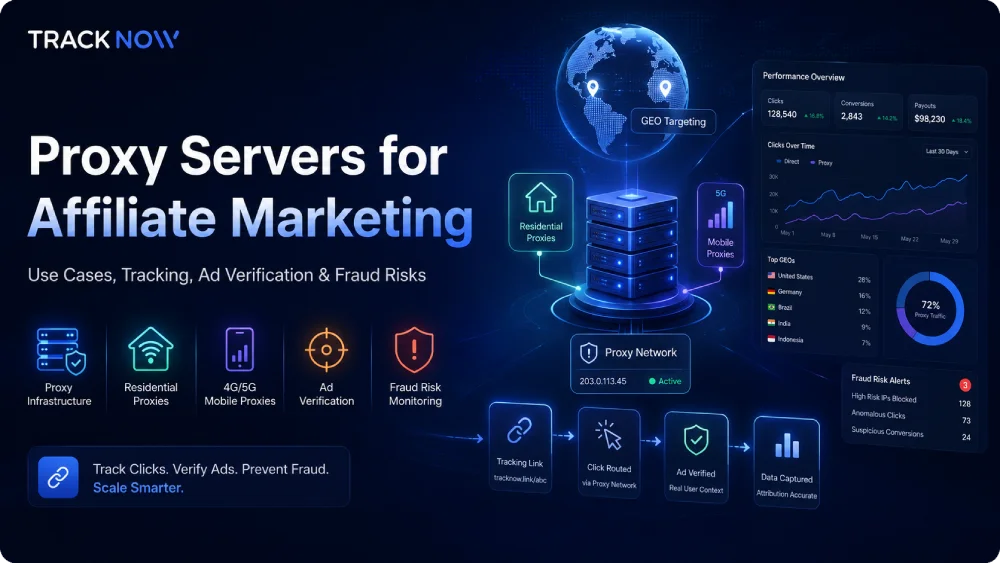
Proxy servers sit behind more affiliate marketing workflows than most people realize. Affiliates use them to check offers from another country, verify localized landing pages, monitor search results, and confirm that a campaign works before sending paid traffic. Advertisers and affiliate networks use them to inspect redirect chains, monitor partner websites, verify advertising placements, detect broken offers, and investigate suspicious activity.
At the same time, proxies can be abused. The same infrastructure that helps an affiliate manager view a landing page from Germany can also be used to hide the real origin of automated clicks, fake leads, duplicate accounts, or manipulated conversions.
That is why proxy traffic should not automatically be classified as either legitimate or fraudulent. A proxy is an infrastructure layer. Whether its use is acceptable depends on the purpose, authorization, data being accessed, traffic behavior, and commercial outcome.
This guide explains how proxy servers intersect with affiliate marketing, how different proxy types work, how affiliates and partner programs use them, how proxy-based ad verification fits alongside affiliate tracking software such as Tracknow, and why residential and mobile proxies make fraud detection more complicated.
Updated: August 2026.
Contents
- What Is a Proxy Server?
- Why Proxy Servers Matter in Affiliate Marketing
- The Main Types of Proxy Servers
- Where Proxies.sx Fits in the Proxy Landscape
- How Affiliates and Webmasters Use Proxies
- How Affiliate Programs and Networks Use Proxies
- How Proxy Verification Fits Into Affiliate Tracking
- Proxy-Based Ad Verification
- Proxy Traffic and Affiliate Fraud Risks
- How to Detect Suspicious Proxy Traffic
- Compliance, Privacy, and Responsible Use
- How to Choose a Proxy Provider
- Implementation Checklist
- Frequently Asked Questions
What Is a Proxy Server?
A proxy server is an intermediary between a user, application, or automated system and a destination website.
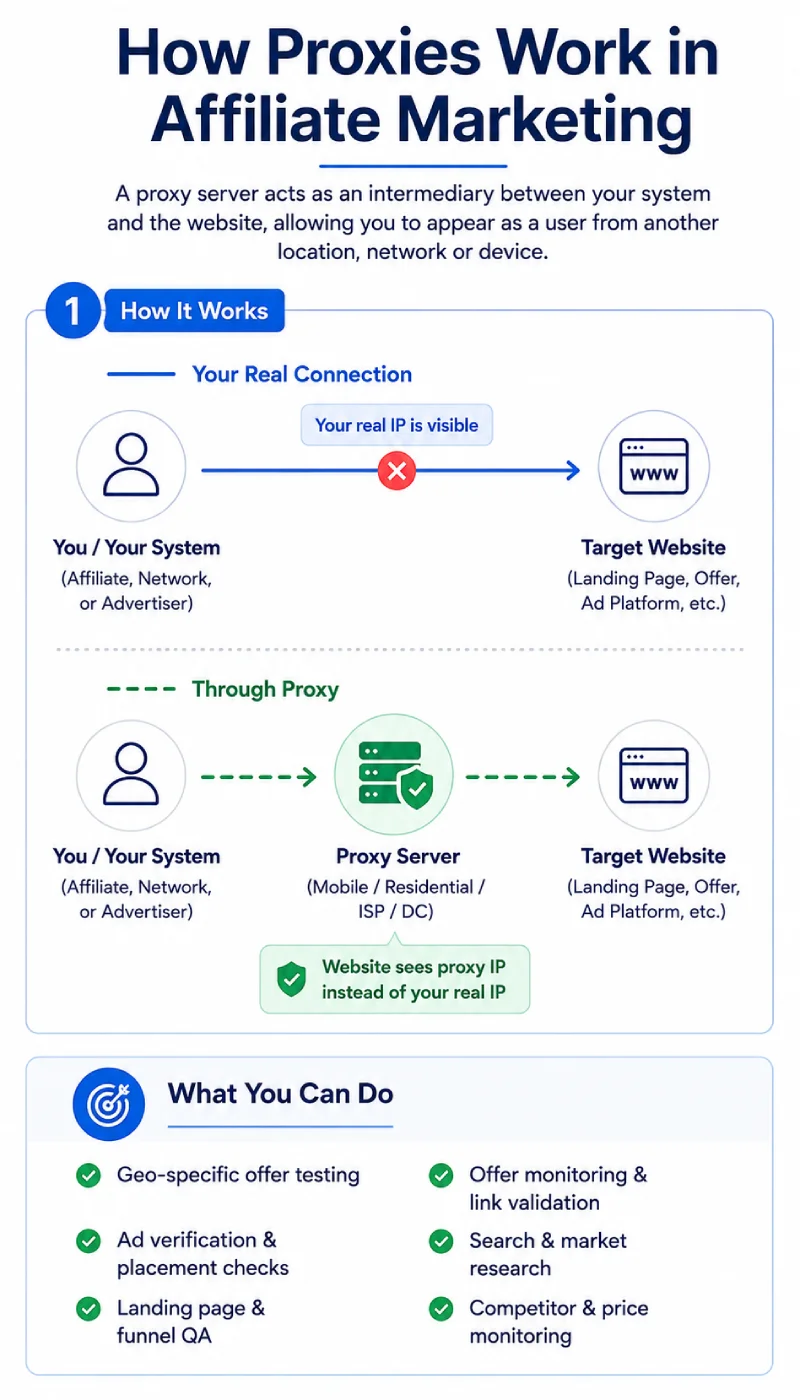
User or application
        ↓
    Proxy server
        ↓
  Destination website
        ↓
    Proxy server
        ↓
User or application
Instead of connecting directly to the website, the request first goes through the proxy. The destination generally sees the proxy’s IP address rather than the original connection’s public IP address.
This can change how the destination interprets the request. Depending on the proxy, the website may see traffic coming from another country, city, internet provider, mobile carrier, or network type.
A proxy can therefore help an authorized user answer questions such as:
- What landing page is displayed to a visitor in another country?
- Does an offer redirect correctly from a mobile connection?
- Is a localized price, bonus, disclosure, or creative visible in the intended market?
- Does an affiliate link preserve its tracking parameters through every redirect?
- Is a campaign available through a particular ISP or carrier?
A proxy does not automatically provide complete anonymity. Websites can also examine cookies, browser configuration, device characteristics, user-agent data, time zone, language, request frequency, authentication history, and behavioral patterns.
Changing the IP address changes one important signal, but it does not automatically make two sessions look like two unrelated people.
Why Proxy Servers Matter in Affiliate Marketing
Affiliate marketing is heavily affected by location and context. An offer may be available in one country and blocked in another. A casino bonus may differ by licence jurisdiction. An eCommerce site may display different products, prices, currencies, or delivery options. A finance advertiser may accept leads from one GEO while rejecting another.
That creates a visibility problem.
An affiliate manager located in Cyprus may need to inspect what a user in Canada sees. A webmaster in Poland may be promoting an offer in Australia. An affiliate network may have thousands of campaigns operating across dozens of markets.
Without a local connection, the person reviewing the campaign may see the wrong version of the page or may be unable to access it at all.
Proxy infrastructure helps create a controlled view from the target market. It can be used to test:
- Affiliate tracking links and redirect chains.
- Offer availability by country, region, city, ISP, or mobile carrier.
- Localized landing-page language and currency.
- Mobile and desktop variations.
- Advertising placements and creative compliance.
- Affiliate disclosure and brand-usage requirements.
- Public search results and competitor positioning.
The key distinction is that proxy infrastructure observes or accesses the external web experience, while affiliate tracking software records the commercial relationship behind the traffic.
A proxy can show what happened to a test visit. An affiliate platform can show which affiliate, campaign, click ID, conversion, commission, and payout were connected to the visit.
The Main Types of Proxy Servers
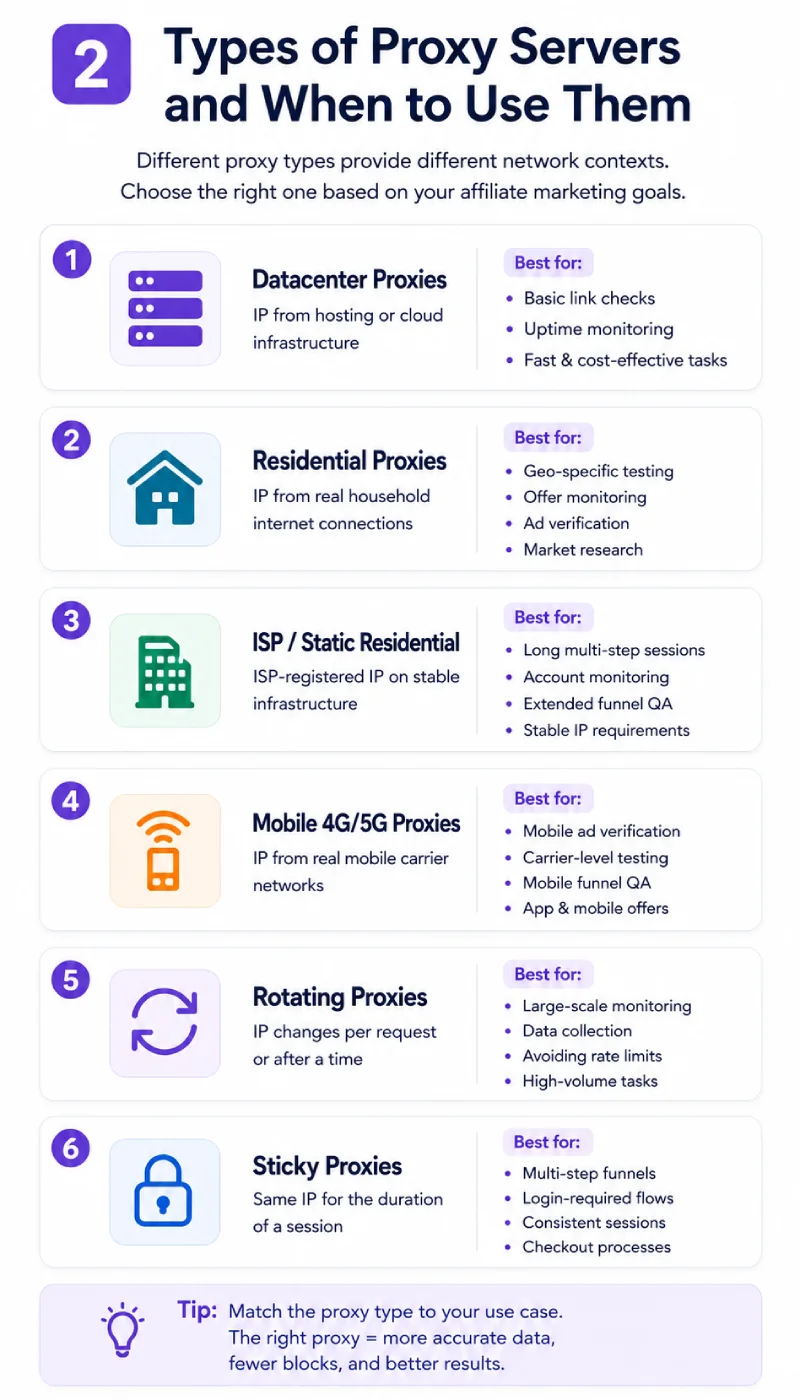
Proxy terminology is often confusing because several classification systems are mixed together. A provider may describe a product as a “rotating dedicated residential SOCKS5 proxy,” where every word refers to a different characteristic.
The clearest approach is to separate four dimensions:
- IP origin: datacenter, residential, ISP, or mobile.
- Session behavior: rotating or sticky.
- Access model: shared or dedicated.
- Protocol: HTTP, HTTPS, or SOCKS5.
1. Datacenter Proxies
Datacenter proxies use IP addresses associated with cloud providers, hosting companies, or physical datacenters. They are not normally assigned to household broadband customers or mobile devices.
They are usually fast, stable, and relatively inexpensive. This makes them useful for high-volume tasks against websites that do not apply aggressive IP-based restrictions.
In affiliate marketing, datacenter proxies can be sufficient for:
- Basic link-health checks.
- HTTP status monitoring.
- Testing open landing pages.
- Checking redirects that are not heavily GEO-restricted.
- Collecting public data from less protected websites.
The main limitation is recognizability. IP intelligence services can often identify an address as belonging to a hosting provider. Sensitive websites may block it, challenge it, or serve a different response.
2. Residential Proxies
Residential proxies route traffic through IP addresses associated with consumer internet providers and real residential connections or devices.
To the destination, the request may resemble traffic coming from a normal household internet connection. This often makes residential proxies more useful for location-sensitive testing, ad verification, public market research, and access to websites that restrict datacenter traffic.
Residential proxy networks are commonly built using peer devices. Because the traffic exits through someone else’s connection, sourcing is important. A responsible provider should be able to explain how participants joined the network, what they agreed to, and whether they are compensated.
Residential proxies are commonly used for:
- Country, city, ZIP-code, ISP, or ASN targeting.
- Localized landing-page testing.
- Offer monitoring across many markets.
- Ad verification and brand protection.
- Public price and product monitoring.
- Search-engine and content localization research.
Residential pools are often rotating because peer devices are not guaranteed to remain online permanently.
3. ISP Proxies or Static Residential Proxies
ISP proxies are often marketed as static residential proxies. They combine characteristics of datacenter and residential infrastructure.
The IP range is registered to an internet service provider, but the proxy endpoint may be hosted on stable server infrastructure rather than an ordinary consumer device.
This usually provides:
- A relatively trusted ISP-class IP address.
- Higher uptime than a peer-based residential connection.
- Longer and more predictable sessions.
- A stable IP that does not rotate unless requested.
ISP proxies can be suitable when a workflow needs both consistency and a non-datacenter network identity. Examples include extended QA sessions, monitoring a localized account owned by the business, or testing a multi-step user journey that may trigger security checks if the IP changes midway.
4. Mobile 4G/5G Proxies
Mobile proxies route traffic through carrier networks used by smartphones, SIM cards, cellular routers, and other mobile devices.
The exit IP is associated with a mobile carrier rather than a conventional residential ISP or hosting company. Mobile networks frequently use Carrier-Grade Network Address Translation, or CGNAT, where many legitimate subscribers may share a public IP address.
That shared structure has two important consequences.
First, mobile traffic can be valuable for testing how websites and advertising platforms behave for real carrier-network users.
Second, IP uniqueness becomes a weaker identity signal. Many real people may share one mobile IP, while one person can receive several different IPs over time.
Mobile proxies are especially relevant for:
- Mobile ad verification.
- Carrier-specific offer testing.
- Mobile landing-page and app-flow QA.
- Country or carrier localization.
- Testing websites that treat mobile and fixed-line traffic differently.
- Authorized data collection from strongly protected public websites.
Mobile proxies are often more expensive than datacenter proxies because the underlying infrastructure requires SIM cards, mobile plans, devices, modem racks, or participating mobile peers.
| Proxy Type | IP Origin | Typical Strength | Typical Limitation | Affiliate Marketing Fit |
|---|---|---|---|---|
| Datacenter | Hosting or cloud network | Speed, stability, low cost | Easy to identify as server traffic | Basic link checks and open-site monitoring |
| Residential | Household ISP or real peer device | Broad GEO coverage and local-user appearance | Higher cost and variable peer availability | Localized offer checks and ad verification |
| ISP / Static Residential | ISP-registered IP on stable infrastructure | Long, consistent sessions | Smaller pools and fewer locations | Extended QA and authorized account testing |
| Mobile 4G/5G | Cellular carrier network | Mobile-specific access and carrier targeting | Cost, latency, and limited capacity | Mobile ad verification and carrier-specific testing |
Rotating vs. Sticky Proxies
Rotation describes what happens to the exit IP between requests.
Rotating proxies may assign a new IP for each request or after a defined interval. They are useful for large-scale monitoring where many independent pages must be checked.
Sticky sessions attempt to keep the same exit IP for a group of requests. They are useful when the test involves several steps, such as opening a landing page, choosing a country, viewing an offer, and reaching a registration form.
Rotation and IP origin are separate concepts. A residential proxy can rotate or remain sticky. A mobile proxy can also rotate or use a longer session.
Shared vs. Dedicated Proxies
A shared proxy pool is used by multiple customers. It is normally more scalable and affordable, but another customer’s activity may influence IP reputation.
A dedicated proxy or dedicated pool is reserved for one customer or one defined target. It can provide greater control, but it does not automatically make the IP trustworthy or compliant.
HTTP, HTTPS, and SOCKS5
HTTP and HTTPS proxies are designed primarily for web traffic. SOCKS5 operates at a lower level and can handle a wider range of TCP-based applications.
For most affiliate landing-page checks, ad verification, and browser-based QA, HTTP or HTTPS support is sufficient. SOCKS5 may be useful when the testing tool, browser environment, or application specifically requires it.
Why AI-Native 4G/5G Mobile & Residential Proxy Networks Matter for Affiliate Marketing
For many affiliate marketing tasks, simply changing an IP address is not enough. The quality of the network behind that IP can directly affect whether a landing page loads correctly, whether a campaign is visible in the target GEO, whether an ad can be verified, and whether automated monitoring works consistently at scale.
This is where 4G/5G mobile and residential proxy networks become particularly useful. Instead of routing traffic through conventional hosting infrastructure, these networks use IP addresses associated with real mobile carriers and residential internet connections.
For affiliate teams, the main advantage is not anonymity. It is the ability to reproduce a more realistic user environment in different countries, networks, and device contexts.
What Is an AI-Native Mobile & Residential Proxy Network?
An AI-native mobile and residential proxy network combines two layers:
- Real-world proxy infrastructure based on mobile carrier and residential IP addresses.
- Automation-friendly access that allows software, monitoring systems, scripts, and AI agents to select locations, rotate sessions, run checks, and process results programmatically.
The term AI-native does not describe a new type of IP address. The underlying connection is still mobile or residential. Instead, it describes infrastructure designed to be controlled through APIs and automated workflows rather than used only through a manually configured browser.
This becomes valuable when an affiliate business needs to perform hundreds or thousands of checks instead of manually opening a campaign once.
Affiliate Campaign
        ↓
Automated Verification System
        ↓
Mobile / Residential Proxy Network
        ↓
Target GEO or Carrier
        ↓
Affiliate Link
        ↓
Redirect Chain
        ↓
Landing Page
        ↓
Verification Result
Why Mobile 4G/5G Proxies Are Useful for Affiliate Marketing
Mobile proxies route traffic through IP addresses associated with mobile carriers. In practice, they can help reproduce the network environment of users connecting through 4G or 5G services.
That can be particularly useful when an affiliate campaign depends on mobile traffic.
Common use cases include:
- Mobile ad verification: checking whether an advertisement is actually displayed to users on a particular mobile network or in a specific country.
- Carrier-specific offer testing: verifying offers that behave differently depending on the mobile operator or connection type.
- Mobile landing-page QA: checking whether redirects, registration pages, app links, and mobile funnels work correctly.
- GEO verification: confirming that a campaign intended for one country does not unexpectedly redirect users elsewhere.
- Affiliate offer monitoring: periodically checking whether active offers are still accessible to the intended audience.
- Public web monitoring: reviewing localized content, advertising, prices, promotions, or search results from the perspective of a mobile user.
Mobile carrier networks also frequently use shared IP infrastructure such as CGNAT. This means that many legitimate users may appear under the same public IP range, making mobile network behavior different from traditional datacenter traffic.
For verification and QA, this can provide a more realistic view of what an actual mobile customer may experience.
Why Residential Proxies Complement Mobile Networks
Residential proxies use IP addresses associated with consumer internet providers and residential connections.
They are particularly useful when an affiliate team needs broad geographic coverage rather than a specific mobile carrier.
Residential proxies can help with:
- Country-specific affiliate offer checks.
- Localized landing-page testing.
- Price and product monitoring.
- Search-result monitoring.
- Affiliate website compliance checks.
- Brand and trademark monitoring.
- Large-scale redirect validation.
- Public competitor and market research.
For example, an affiliate network could use residential IPs from Germany, Brazil, Canada, and Australia to check whether the same campaign correctly sends users to the appropriate localized landing page in each market.
Mobile + Residential Is Often More Useful Than Either Network Alone
Mobile and residential proxies solve overlapping but slightly different problems.
| Task | Mobile 4G/5G | Residential |
|---|---|---|
| Mobile ad verification | Excellent fit | Useful for broader GEO checks |
| Carrier-specific testing | Excellent fit | Usually limited |
| Country-level landing-page QA | Very useful | Very useful |
| Large-scale offer monitoring | Useful when mobile context matters | Often more scalable for broad GEO coverage |
| Mobile funnel QA | Excellent fit | Useful but less carrier-specific |
| Public market research | Useful | Excellent fit |
A combined mobile and residential network therefore gives an affiliate business more flexibility. Mobile IPs can be used where carrier-level realism matters, while residential IPs can handle broader location-based monitoring and research.
Where AI-Native Proxy Infrastructure Becomes Especially Valuable
The real advantage appears when proxy access becomes part of an automated affiliate workflow.
Instead of asking an affiliate manager to manually check campaigns one by one, software can periodically test them from multiple locations.
For example:
5,000 Active Affiliate Offers
            ↓
Automated Proxy Checks
            ↓
US / UK / DE / BR / AU / CA
            ↓
Validate:
- HTTP status
- Redirect chain
- Final URL
- GEO availability
- Tracking parameters
- Landing-page content
            ↓
Flag Problems Automatically
This type of workflow can identify problems before affiliates begin reporting them manually.
An operator or network could receive alerts when:
- An affiliate link starts returning an error.
- An offer unexpectedly redirects to another domain.
- A campaign becomes unavailable in an approved GEO.
- A tracking parameter disappears from the redirect chain.
- A mobile user sees a different offer than expected.
- A landing page changes significantly.
- A restricted campaign becomes visible in a prohibited market.
For larger affiliate programs, automation can make proxy infrastructure much more valuable than using proxies only for occasional manual browsing.
What to Look for in a Mobile or Residential Proxy Provider
Not all proxy networks provide the same quality. For affiliate marketing, network stability and predictable behavior often matter more than the advertised number of IP addresses.
Before choosing a provider, evaluate the following areas.
1. Network Stability
A proxy connection that disappears in the middle of a multi-step test can produce incorrect results.
For affiliate offer monitoring, the provider should deliver consistent connections, predictable rotation behavior, and reliable session handling.
Test:
- Connection success rate.
- Median response time.
- Session survival.
- Timeout frequency.
- Error rate.
- Performance during peak periods.
A large proxy pool is not particularly useful if a significant percentage of requests fail.
2. Real IP Origin and Network Quality
Ask where the IP addresses actually come from.
For mobile networks, determine whether traffic comes from real carrier connections, SIM-based devices, physical modems, or another infrastructure model.
For residential networks, understand how participating devices enter the pool and whether participation is transparent and consent-based.
The origin of the network affects reliability, reputation, compliance, and how realistically the connection represents a normal user.
3. GEO and Carrier Targeting
Depending on the affiliate use case, country targeting may not be enough.
You may need:
- Country.
- Region.
- City.
- ASN.
- ISP.
- Mobile carrier.
For mobile affiliate campaigns, carrier selection can be particularly valuable when offers, ads, or billing flows differ between telecom providers.
4. Rotation and Sticky Sessions
Offer monitoring and scraping often benefit from rotating IPs, while multi-step funnel testing usually requires a stable session.
A good provider should make it possible to control how long an IP remains active.
For example:
- Rotate for independent page checks.
- Keep the same IP while testing a registration funnel.
- Rotate after a defined period.
- Request a new session through an API.
5. API and Automation Support
This is particularly important for an AI-native proxy network.
Affiliate teams should be able to automate:
- Proxy selection.
- GEO selection.
- Session creation.
- IP rotation.
- Health checks.
- Usage monitoring.
- Integration with internal QA or compliance tools.
An API-first design makes it easier to connect proxy infrastructure with affiliate tracking, BI, alerting, compliance, and AI-agent workflows.
6. Reputation and Challenge Rate
The term “clean IP” is frequently used in proxy marketing, but it should be evaluated through actual performance rather than treated as an absolute label.
Measure:
- How often target websites reject the connection.
- How frequently additional verification is triggered.
- Whether the IP is correctly classified as mobile or residential.
- Whether the GEO and ASN are accurate.
- Whether the IP appears in major reputation databases.
The only meaningful definition of a good proxy is whether it reliably performs the required workflow.
7. Transparent IP Sourcing
Residential proxy sourcing deserves particular attention.
A provider should be able to explain:
- How residential participants join the network.
- Whether participation requires explicit consent.
- Whether users are compensated.
- Whether they can stop participating.
- How abuse complaints are handled.
Transparent sourcing reduces both ethical and operational risk.
8. Pricing Based on the Real Workflow
Proxy providers may charge by bandwidth, IP, port, request, session, or subscription.
Estimate costs using your real task rather than only comparing advertised prices.
For example, checking the HTTP status and final URL of 10,000 affiliate offers requires far less bandwidth than rendering 10,000 complete browser sessions with screenshots.
Proxies.sx as an Example of Mobile + Residential Infrastructure
One example of this combined model is Proxies.sx, which positions its service as an AI-native 4G/5G mobile and residential proxy network.
Its mobile network is designed around real carrier-network connections, while the platform also provides residential proxy capacity. This type of architecture is relevant to affiliate businesses that need both mobile-network testing and wider residential GEO coverage.
Potential affiliate use cases include:
- Checking casino, sportsbook, finance, eCommerce, or app offers from target markets.
- Testing mobile affiliate funnels through 4G/5G connections.
- Verifying advertisements and localized campaign experiences.
- Monitoring active affiliate offers automatically.
- Checking redirect chains and tracking parameters.
- Running public market and competitor monitoring.
- Providing proxy infrastructure to automated QA tools or AI agents.
Proxies.sx states that part of its mobile infrastructure is built on physical 4G/5G modems that it operates directly. For affiliate teams, this illustrates an important procurement principle: understanding how the underlying network is built matters.
Physical infrastructure, transparent IP sourcing, predictable session behavior, and stable connections can be more important than an extremely large advertised IP count.
Why Stability Matters More Than a Huge Proxy Pool
Proxy providers frequently compete on the size of their IP pools. Pool size can matter, particularly for large-scale residential monitoring, but it should not be the only buying criterion.
For affiliate operations, instability can create false alerts and incorrect conclusions.
Consider an automated offer checker:
Affiliate Offer
      ↓
Proxy Connection
      ↓
Request Fails
      ↓
System Marks Offer as Broken
The offer may actually be working perfectly. The problem was the proxy.
If this happens repeatedly across thousands of campaigns, an unreliable proxy layer can create more operational work than it removes.
A better evaluation focuses on:
- Successful connection percentage.
- Correct GEO percentage.
- Stable session percentage.
- Target-site success rate.
- Latency consistency.
- Rotation predictability.
- API uptime.
- Quality of support when problems occur.
For affiliate marketing, a smaller but predictable network can be more valuable than a huge pool with inconsistent results.
The Practical Takeaway
Mobile and residential proxy networks are most useful when they solve a specific operational problem.
Use 4G/5G mobile proxies when carrier context, mobile advertising, or mobile user behavior matters.
Use residential proxies when broad GEO coverage, localized web access, offer monitoring, or market research matters.
Use an AI-native or API-driven proxy platform when those checks need to become part of an automated workflow rather than an occasional manual task.
And when comparing providers such as Proxies.sx or other mobile and residential networks, prioritize network provenance, targeting accuracy, session control, API capabilities, and operational stability over marketing metrics alone.
In affiliate marketing, the best proxy network is not simply the one with the most IP addresses. It is the one that can repeatedly reproduce the user environment you need to test without introducing unreliable data into your tracking, compliance, and monitoring processes.
How Affiliates and Webmasters Use Proxies
1. GEO-Specific Offer Testing
An affiliate may promote offers in markets where the affiliate does not physically live. A proxy can help confirm whether the destination is available in the target country and whether the correct version of the offer is displayed.
A complete check should review more than the first page. The tester should verify:
- The initial affiliate URL.
- Every redirect in the chain.
- The final domain and page.
- HTTP status codes.
- Tracking parameters and sub IDs.
- Language, currency, and country selection.
- Offer terms, eligibility, and restricted-market messages.
This can prevent an affiliate from paying for traffic that reaches an expired offer, an incorrect brand, or a generic homepage that no longer preserves attribution.
2. Landing-Page and Funnel QA
Landing pages frequently change according to location, device type, language, and previous session data.
A residential or mobile proxy allows the webmaster to inspect the experience from a more relevant network context. The affiliate can compare desktop and mobile versions, confirm that the call to action is visible, and check whether registration or checkout begins correctly.
Testing should stop before creating unauthorized accounts, submitting false personal data, or completing billable actions. Where a full conversion test is required, the advertiser should provide a sandbox, test campaign, coupon, or clearly marked non-production process.
3. Redirect and Tracking-Link Validation
Affiliate links often pass through several systems:
Affiliate placement
        ↓
Affiliate tracking domain
        ↓
Network or sub-network
        ↓
Advertiser tracking system
        ↓
Landing page
Every redirect creates another opportunity for a parameter to be removed, overwritten, or incorrectly encoded.
A proxy-based checker can validate that the redirect chain works in the intended GEO and that important identifiers survive until the advertiser receives the visit.
4. Ad Verification
Affiliates who buy media may need to confirm that their advertisement appears in the intended location, format, and environment.
A proxy can help identify:
- Whether the advertisement is visible in the target country.
- Whether a mobile user sees the expected creative.
- Whether the landing page matches the advertisement.
- Whether a publisher has replaced or modified the placement.
- Whether a campaign is being shown outside its permitted GEO.
Verification should avoid unnecessary paid clicks. Ad-platform preview tools, placement reports, and non-billable verification methods should be used whenever available.
5. Search and Content Research
Search results differ by location, language, device, and user context. Affiliates can use localized connections to research:
- Market-specific keywords.
- Competitor rankings.
- Local comparison websites.
- Country-specific promotions.
- Localized review content.
- Brand bidding and trademark usage.
The purpose should be research and verification, not manipulation of rankings, clicks, reviews, or advertising metrics.
6. Public Market and Price Monitoring
Webmasters in travel, eCommerce, finance, software, and comparison niches may monitor public prices, availability, fees, product descriptions, and regional differences.
Proxy infrastructure helps separate the researcher’s physical location from the market being studied. However, access to public pages does not remove contractual, copyright, privacy, or rate-limit obligations.
How Affiliate Programs and Networks Use Proxies
1. Automated Offer Checking
An affiliate network may manage thousands of URLs. Manual verification does not scale.
An automated offer checker can periodically open each campaign through an IP in the target GEO and record:
- Response status.
- Redirect path.
- Final destination.
- Page title.
- Offer availability.
- Load time.
- Screenshot or content hash.
- Unexpected domain changes.
An Oxylabs case study about Affise describes how residential proxies were used to support an Offers Checker performing millions of campaign checks per month. The purpose was to identify broken links and traffic that did not reach the intended destination.
This is one of the clearest examples of legitimate proxy use in affiliate marketing.
2. Affiliate Website and Placement Monitoring
An advertiser may authorize an affiliate to promote a brand only in specific markets or through approved content.
Proxy-based monitoring can help determine whether the affiliate:
- Displays the brand in a restricted GEO.
- Uses an expired bonus or price.
- Makes an unapproved claim.
- Omits a required disclosure.
- Uses a prohibited creative.
- Redirects traffic through an unexpected intermediary.
This is especially relevant in regulated industries such as gambling, financial services, credit, healthcare, and trading.
3. Brand-Bidding and Trademark Monitoring
Programs can review localized search results to detect affiliates or competitors bidding on protected brand terms.
Because search and advertising results differ by country and device, monitoring from a single corporate IP may provide an incomplete picture.
The evidence collected should include a timestamp, search query, GEO, device context, screenshot, final URL, and the affiliate identifier where available.
4. Campaign Availability Monitoring
An advertiser may unintentionally continue accepting traffic after an offer has been paused, capped, or restricted.
Regular external checks can identify:
- Campaigns that return an error.
- Offers that are active in the tracker but unavailable on the advertiser site.
- Incorrect GEO routing.
- Changed domains.
- Missing tracking parameters.
- Landing pages that no longer match the campaign description.
5. Fraud Investigations
Proxy infrastructure can also be used defensively during an investigation.
A fraud or compliance team may reproduce a suspicious user journey from the reported GEO, inspect the affiliate placement, compare redirect behavior, and determine whether different visitors are shown different content.
This can help identify cloaking, misleading pre-landers, hidden redirects, or GEO-specific violations.
How Proxy Verification Fits Into Affiliate Tracking
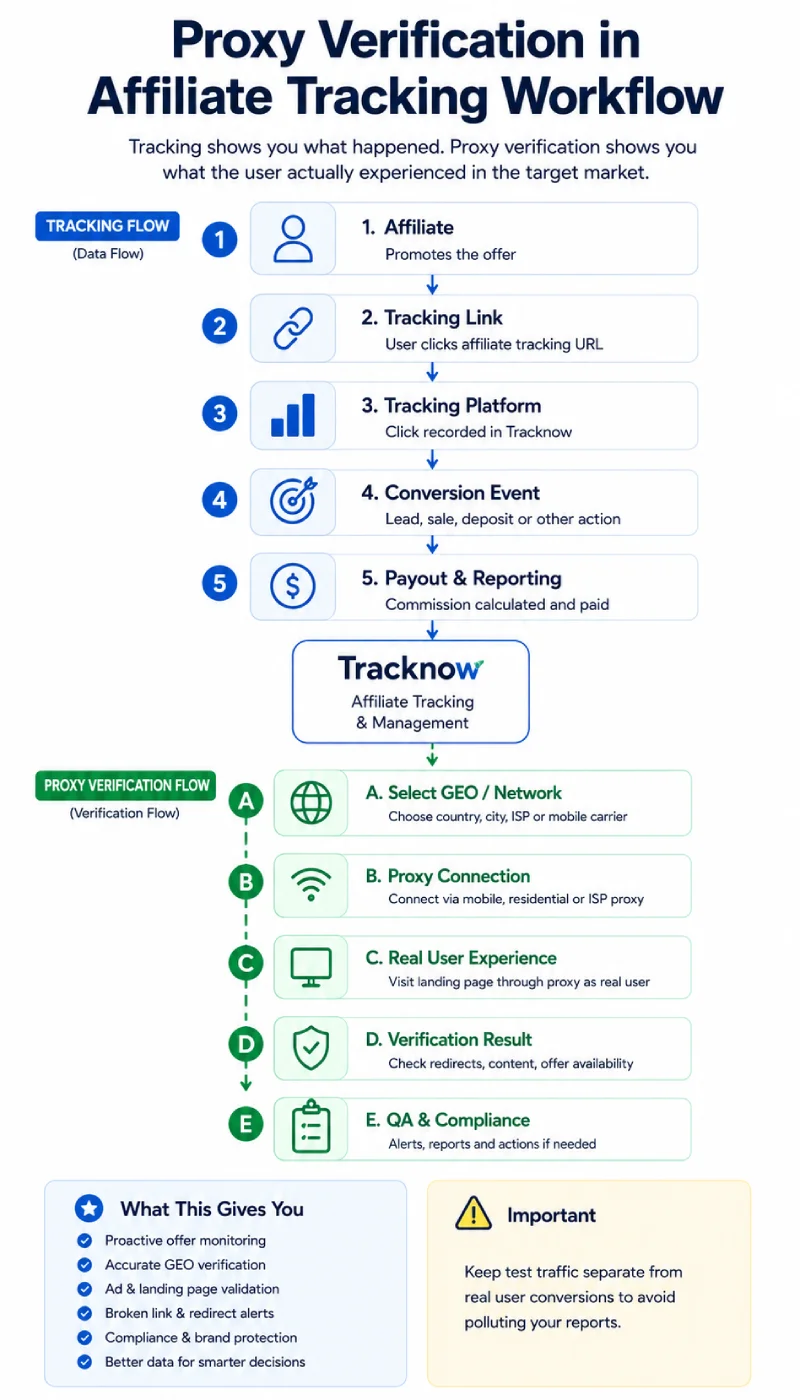
Proxy verification and affiliate tracking solve different problems.
Affiliate tracking software records:
- The affiliate and campaign.
- The tracking link and click ID.
- The visitor’s GEO and device information.
- The conversion event.
- The transaction amount.
- The commission rule.
- The conversion status.
- The payout.
A proxy verification layer observes:
- What a visitor in a selected location can access.
- Which redirects occur.
- Which landing page is displayed.
- Whether the campaign is available.
- Whether the page contains required or prohibited content.
- Whether the destination changes over time.
The two layers can complement each other:
Affiliate or campaign URL
            ↓
      Tracking platform
            ↓
Proxy visit from target GEO
            ↓
Redirect and landing-page check
            ↓
Verification result and evidence
            ↓
Alert, report, or compliance review
Using Proxies Alongside Tracknow
Tracknow can act as the system of record for affiliates, clicks, conversions, commission models, fraud indicators, and payouts.
A separate proxy service can be used as the external verification layer. A custom workflow could periodically test a Tracknow campaign link from the intended GEO and record whether the visitor reaches the correct destination.
The result could then be stored in a monitoring database, BI system, ticketing workflow, or custom integration. Depending on the implementation, Tracknow’s API or server-to-server capabilities may be used to associate the result with the corresponding campaign or tracking entity.
This should not be described as a native Tracknow proxy feature unless such an integration has actually been configured. The proxy provider and tracking platform remain separate systems.
Keep Synthetic Verification Traffic Separate
Proxy-based checks can contaminate analytics if they look like genuine affiliate traffic.
A responsible setup should separate test visits from production activity by using one or more of the following:
- A dedicated QA affiliate account.
- A separate campaign or tracking link.
- A custom test parameter.
- A non-commissionable goal.
- A test conversion status.
- Known verification user agents or IP ranges.
- Separate reporting filters.
Tracknow supports several conversion statuses, including a test status, as well as pending, revision, hold, approved, and denied workflows. This makes it possible to prevent a test event from becoming an affiliate payout.
For conversion attribution, Tracknow also supports server-to-server postbacks and click-ID-based workflows. S2S tracking is important because a proxy visit by itself does not prove that a real conversion occurred.
A proxy can validate the external journey. The advertiser’s server or trusted backend should validate the commercial event.
What Proxies Cannot Replace
Proxy infrastructure does not replace:
- Click IDs and attribution rules.
- First-party conversion data.
- Server-to-server postbacks.
- CRM validation.
- Payment verification.
- Affiliate commission logic.
- Fraud review and approval workflows.
It is an observation and access tool, not a source of revenue truth.
Proxy-Based Ad Verification
Ad verification is the process of checking whether an advertisement appears where, when, and how it was intended to appear.
The IAB guidelines for ad verification describe verification as a way to confirm that advertisements appear on intended sites and reach the targeted audience.
In affiliate marketing, ad verification can focus on both paid advertisements and affiliate-controlled placements.
A verification record may include:
- Advertiser and campaign.
- Affiliate or publisher.
- Country, region, city, ASN, or carrier.
- Device and browser context.
- Date and time.
- Creative or advertisement text.
- Placement URL.
- Redirect chain.
- Final landing page.
- Screenshot or archived evidence.
Residential and mobile proxies are often selected because they provide a more realistic local network context than a datacenter address. Oxylabs, for example, positions residential proxies for verifying ads across different environments and locations.
Proxies.sx positions its 4G/5G network for mobile ad verification, carrier targeting, landing-page checks, and affiliate offer monitoring.
These are provider claims, and the actual result should be tested against the specific advertising platform and market.
Avoid Creating Invalid Traffic During Verification
A verification process should not unnecessarily generate paid clicks, impressions, leads, or conversions.
Where possible:
- Use official ad preview and diagnostic tools.
- Coordinate test windows with the advertiser.
- Use non-billable campaign environments.
- Identify verification bots or agents.
- Exclude synthetic activity from commercial reports.
- Never submit fake customer or payment information.
The objective is to observe and document the campaign, not to increase its performance metrics.
Proxy Traffic and Affiliate Fraud Risks
Proxies are used legitimately, but they can also make abusive activity more difficult to attribute.
Examples of prohibited or suspicious uses include:
- Generating fake advertisement clicks.
- Creating fake leads or registrations.
- Submitting duplicate accounts.
- Hiding traffic from prohibited countries.
- Manipulating CPA qualification events.
- Simulating deposits or purchases.
- Evading campaign caps or account limits.
- Concealing automated traffic.
- Misrepresenting the real traffic source.
- Inflating publisher or affiliate performance.
Google defines invalid traffic as clicks or impressions that do not result from genuine user interest, including fraudulent activity, accidental or duplicate clicks, and automated tools. That definition is useful beyond Google Ads because it captures the underlying commercial issue: the event does not represent a legitimate opportunity or customer action.
| Legitimate Proxy Use | Abusive Proxy Use |
|---|---|
| Checking whether a landing page works in Canada | Pretending Canadian traffic came from real customers |
| Verifying an approved advertisement | Clicking advertisements to increase cost or revenue |
| Testing a registration flow in a sandbox | Creating fake accounts or leads |
| Monitoring public offer availability | Evading access controls protecting private data |
| Reviewing affiliate compliance by GEO | Hiding promotion in a prohibited GEO |
Why Residential and Mobile Proxies Complicate Detection
A simple fraud rule may classify datacenter IPs as suspicious. That approach becomes less effective when the traffic exits through residential or carrier networks.
Residential IPs can belong to ordinary ISP ranges. Mobile IPs may be shared by many legitimate subscribers through CGNAT.
As a result:
- One IP does not always mean one user.
- Several IPs do not always mean several users.
- A residential or mobile ASN does not prove human activity.
- A clean IP reputation does not prove a clean conversion.
- A proxy-detection result should be treated as a signal, not a verdict.
Fraud detection must therefore examine the complete event context.
How to Detect Suspicious Proxy Traffic
1. Combine IP Intelligence With Behavioral Data
IP data can identify country, region, ASN, ISP, carrier, hosting type, known VPNs, and known proxy networks. It should be combined with behavioral and commercial signals.
Useful signals include:
- Time between click and conversion.
- Time between repeated conversions.
- Device and browser consistency.
- Language, time zone, and GEO consistency.
- Cookie and click-ID reuse.
- Repeated deposit or order amounts.
- Identical conversion sequences.
- Traffic concentration by sub ID or placement.
- Chargeback and refund rates.
- Customer retention and downstream value.
2. Examine Event Sequences
A real customer journey usually contains a plausible sequence of events. The exact sequence differs by vertical, but abnormal patterns may reveal automation.
For example:
Click
  ↓ 3 seconds
Registration
  ↓ 2 seconds
Deposit
  ↓
Identical pattern repeated 40 times
Different residential IPs do not make this sequence normal.
3. Compare Network and Device Context
Examples of inconsistencies include:
- A French IP with a different time zone and unrelated browser locale.
- A mobile carrier IP paired with a desktop-only device pattern.
- Frequent IP changes during a session that should remain stable.
- Dozens of supposedly unrelated users sharing the same device characteristics.
- Country changes that do not match normal travel or session behavior.
None of these signals proves fraud by itself. Together they can justify review.
4. Protect Server-to-Server Conversion Inputs
Affiliate fraud does not always require a fake browser session. An attacker may attempt to inject unauthorized postbacks directly into a tracking platform.
Tracknow provides IP restrictions for postbacks, allowing conversion data to be accepted only from approved server addresses. This helps separate trusted advertiser events from requests submitted by an unauthorized source.
Postback protection should also include:
- Authentication or signed requests.
- Unique event IDs.
- Deduplication.
- Timestamp validation.
- Amount and currency validation.
- Replay protection.
- Logging and alerting.
5. Use Review and Delayed Approval Workflows
High-risk conversions should not automatically become payable commissions.
Tracknow’s fraud documentation describes a fraud score based on factors that include conversion timing and indicators such as VPN or proxy use. Campaigns can be configured to move higher-risk conversions into revision or denied statuses.
This is a better approach than rejecting every proxy-associated conversion. A legitimate customer may use a corporate VPN, privacy service, carrier network, or shared residential connection.
6. Measure Downstream Quality
Fraud often becomes clearer after the first conversion.
Programs should compare affiliates by:
- Qualified conversion rate.
- Refund and chargeback rate.
- Customer activation.
- Repeat activity.
- Retention.
- Revenue or NGR.
- Compliance incidents.
- Manual-review rate.
An affiliate with a high registration rate but no meaningful downstream activity may be generating traffic that looks successful only at the first event.
Compliance, Privacy, and Responsible Use
Proxy servers are legitimate infrastructure, but a legitimate tool can still be used in an unauthorized way.
Before deploying proxy-based monitoring or data collection, a business should evaluate:
- The target website’s terms and technical rules.
- Whether the content is public or access-controlled.
- Whether personal data is being collected.
- The legal basis and purpose for processing that data.
- Copyright and database rights.
- Advertising-platform rules.
- Industry-specific obligations.
- Data retention and access controls.
Public accessibility does not automatically mean unrestricted reuse.
Affiliate programs should also ensure that monitoring does not create invalid traffic or distort partner statistics.
Affiliate Disclosures Still Apply
Proxies can help check whether disclosures are visible in different markets, but the proxy itself does not solve disclosure compliance.
The US Federal Trade Commission advises that material connections between an advertiser and an endorser should be disclosed clearly when the relationship could affect how the audience evaluates the recommendation.
Programs should define where affiliate disclosures must appear and use monitoring as one part of a broader compliance process.
Evaluate Proxy Sourcing
Residential and mobile providers should be able to explain how their exit devices enter the network.
Questions should include:
- Is participation explicit and informed?
- Can the device owner stop sharing?
- Is the participant compensated?
- Are free applications silently monetizing bandwidth?
- Does the provider buy traffic from unknown brokers?
- Can the provider identify the source class for a specific request?
- What abuse monitoring and KYC controls exist?
Sourcing is not only an ethical issue. It is also a reliability and business-continuity issue.
How to Choose a Proxy Provider for Affiliate Operations
1. Match the Proxy Type to the Use Case
Do not pay for mobile traffic when a datacenter IP can perform the task. Do not use datacenter IPs when the test specifically requires a mobile carrier.
| Use Case | Likely Starting Point | Reason |
|---|---|---|
| Simple link uptime checks | Datacenter | Fast and cost-efficient |
| Country-specific landing-page QA | Residential | Local ISP context and broad coverage |
| Long multi-step test session | ISP or sticky residential | Stable IP throughout the workflow |
| Mobile advertisement verification | 4G/5G mobile | Real carrier-network context |
| Large multi-GEO offer monitoring | Rotating residential | Broad location coverage and scalable rotation |
2. Verify Geographic Accuracy
Check whether the provider supports the targeting level you need:
- Country.
- Region or state.
- City.
- ZIP code.
- ASN.
- ISP.
- Mobile carrier.
Test the result against several independent IP databases because location databases can disagree.
3. Test Rotation and Session Stability
Determine whether you need a new IP for each request or the same IP for several minutes.
Ask what happens if a peer disappears during a sticky session. Does the request fail, or does the provider silently assign another address?
4. Understand Pricing
Proxy pricing may be based on:
- Bandwidth.
- Number of IPs.
- Ports or endpoints.
- Concurrent connections.
- Requests.
- Successful responses.
- Target sites.
- Geographic targeting.
Model total cost using the actual number and size of pages that will be checked. Screenshot-heavy browser sessions consume more bandwidth than simple HTTP status checks.
5. Review Network Provenance and Acceptable Use
A serious provider should publish or explain:
- How residential and mobile IPs are sourced.
- Whether users consent and receive compensation.
- Its KYC process.
- Prohibited activities.
- Complaint and abuse handling.
- Security controls.
- Logging and retention policies.
6. Measure the Right Performance Metrics
Do not rely only on the provider’s advertised pool size.
Test:
- Success rate on your target websites.
- Median and high-percentile latency.
- Correct-GEO rate.
- Session survival.
- Rotation speed.
- CAPTCHA or challenge frequency.
- Bandwidth consumption.
- Error handling and retry behavior.
A smaller pool that works reliably for the target workflow may be more valuable than a larger pool that performs inconsistently.
Implementation Checklist
- Define the exact business purpose for proxy use.
- Choose the correct network type: datacenter, residential, ISP, or mobile.
- Determine whether sessions should rotate or remain sticky.
- Confirm country, city, ASN, ISP, or carrier targeting.
- Create a dedicated QA affiliate, campaign, or tracking link.
- Prevent test activity from generating payable commissions.
- Record the final URL, redirect chain, status, timestamp, GEO, and screenshot.
- Store verification data separately from production conversion data.
- Use trusted backend events for real conversion attribution.
- Apply postback authentication, IP restrictions, event IDs, and deduplication.
- Review the provider’s IP sourcing and acceptable-use policy.
- Confirm that collection and monitoring comply with applicable contracts and laws.
- Test current volume and projected scale before signing a long-term contract.
- Document how alerts, manual review, and evidence retention will work.
Frequently Asked Questions
What is a proxy server in affiliate marketing?
A proxy server routes a request through another IP address before it reaches a website. In affiliate marketing, proxies are commonly used for GEO-specific offer testing, landing-page QA, redirect validation, ad verification, public market research, and affiliate compliance monitoring.
What is the best proxy type for affiliate marketing?
There is no universal best type. Datacenter proxies are often sufficient for basic link checks. Residential proxies are useful for localized offer monitoring. ISP proxies work well for stable sessions. Mobile 4G/5G proxies are most relevant when the test requires a real carrier-network context.
What type of proxy network is Proxies.sx?
Proxies.sx primarily positions itself as a 4G/5G mobile proxy network with an expanding residential peer pool. The company says its mobile core uses physical modems it owns, while broader residential coverage comes from an opt-in, compensated peer network. Its “AI-native” description refers to the platform and orchestration layer rather than a separate IP type.
What is the difference between residential and mobile proxies?
Residential proxies usually use IPs associated with household internet providers and residential devices. Mobile proxies use IPs associated with cellular carriers. Mobile connections may use CGNAT, where many legitimate subscribers share one public IP. Mobile proxies are especially useful for mobile advertising and carrier-specific testing.
What is the difference between rotating and sticky proxies?
A rotating proxy changes the exit IP between requests or after a defined interval. A sticky proxy attempts to keep the same IP for a session. Rotation is useful for large independent checks, while sticky sessions are useful for multi-step landing-page or funnel testing.
Can affiliates use proxies to check offers in another country?
Yes, provided the testing is authorized and does not create fake commercial activity. A proxy can help an affiliate confirm whether an offer is available, whether the correct localized page appears, and whether tracking parameters remain intact.
Can affiliate programs use proxies with Tracknow?
Yes, as separate but complementary layers. Tracknow can manage affiliates, clicks, conversions, commissions, fraud indicators, and payouts. A proxy provider can perform external GEO and landing-page verification. A custom workflow can associate verification results with Tracknow campaigns without treating synthetic checks as genuine conversions.
Does using a proxy improve affiliate attribution?
Not by itself. Attribution depends on click IDs, tracking parameters, cookies or first-party identifiers, S2S postbacks, and advertiser data. A proxy can help verify that the journey works, but it does not prove that a real customer conversion occurred.
Are proxy visits considered invalid traffic?
Automated verification traffic should not be counted as genuine advertising engagement or billable affiliate traffic. It should be identified, separated, and excluded from commercial reporting. A legitimate proxy-based QA visit is not the same as fraudulent traffic, but it can distort metrics if it is not handled correctly.
How can affiliate programs detect proxy fraud?
Programs should combine proxy and VPN detection with click timing, device data, GEO consistency, event sequences, duplicate identifiers, postback security, conversion quality, refunds, chargebacks, and downstream customer value. A proxy signal should trigger context-aware analysis rather than automatic rejection.
Are residential proxies legal?
Proxy services are legitimate tools, but legality depends on the activity, authorization, data collected, target terms, privacy rules, and jurisdiction. Accessing a public page for authorized QA is different from accessing private information, submitting false data, or evading technical controls. Legal advice may be necessary for large-scale collection or regulated use cases.
Can proxies be used to bypass CAPTCHAs?
A suitable network type may reduce the number of automated challenges triggered during legitimate testing, but proxies should not be used to defeat access controls protecting unauthorized or private resources. Businesses should prefer official APIs, approved access methods, and documented testing environments whenever available.
What is the difference between a proxy and a VPN?
A proxy commonly routes traffic for a specific browser, application, or request. A VPN normally creates an encrypted tunnel for most or all device traffic. Proxy platforms also tend to offer larger pools, GEO selection, session rotation, and automation controls designed for testing and data workflows.
Should an affiliate program reject all proxy traffic?
No. Legitimate customers may use corporate VPNs, privacy tools, mobile carrier networks, or shared connections. Blanket rejection can create false positives. Proxy use should be evaluated alongside behavior, event integrity, conversion quality, and the affiliate’s overall traffic pattern.
Conclusion
Proxy servers have a legitimate and increasingly important role in affiliate marketing. They help affiliates, networks, and advertisers see localized web experiences, verify advertisements, monitor campaign availability, inspect redirects, and enforce partner requirements across markets.
They also introduce risk. Residential and mobile proxies can make automated or fraudulent traffic appear more similar to ordinary consumer traffic. That is why fraud prevention cannot depend on IP reputation alone.
Affiliate tracking software and proxy infrastructure should be treated as complementary systems. Tracknow can record the commercial journey from click to conversion, commission, and payout. A residential or mobile proxy network can help verify what an external visitor actually sees in a particular location.
The strongest setup combines reliable S2S attribution, secure postbacks, controlled proxy-based verification, separate test traffic, multi-signal fraud analysis, and clear compliance procedures.
Proxy infrastructure should make an affiliate program more transparent—not make artificial activity look real.
Need a more reliable way to track affiliates, conversions, fraud signals, commission rules, and payouts? Explore Tracknow affiliate tracking software or book a demo.